‘DV Connect’ is “non-judgemental” (but men calling their helpline are sneaky perpetrators)

I read an article yesterday entitled ‘A connection to hope in a world of violence‘, concerning the operation of a charity active in the sphere of domestic violence and sexual assault called ‘DV Connect‘. It featured the usual feminist spin that comes with the territory, but the part that turned my stomach was the following:

“Every now and then a perpetrator calls, desperate to find where his spouse is. Often these men present themselves as victims, hoping to unearth the addresses where their partners might be seeking safety from the storm.

Now, just a quick reminder to readers that at least one third of the victims of domestic violence are men. Staff at DV Connect are apparently so astute that they can confidently differentiate between those men (actual victims) and that very small minority of men who are actually abusers. A remarkable feat by any standards.

In their web site DV Connect describe themselves as follows:

“DVConnect is the only state wide telephone service offering anyone affected by domestic or family violence a free ‘crisis hotline’ 24 hours a day 7 days a week

We offer free, professional and non-judgemental telephone support, wherever you live in Queensland.

DVConnect Womensline takes over 4000 calls every month from Queensland women who are in fear of or in immediate threat of danger from Domestic or Family Violence, and on average we assist over 350 of them and often more than 400 children to be moved to safety every month.

We can arrange practical assistance such as counselling, intervention, transport and emergency accommodation for Queensland women and children who are in danger from a violent partner or family member”.

Yes, you read that correctly, their telephone support is “non-judgemental”. I guess they just mean the service provided for female callers, because they seem perfectly willing to judge the men who call … as mainly comprising perpetrators.

And notice how, within the space of a few lines, they morph from an organisation providing services to “anyone affected by domestic or family violence“, to one that’s here to help “Queensland women“.

DV Connect provides both a Mensline and Womensline service. The Mensline page in their web site has been re-written since I originally wrote this post, and now makes mention of men seeking help as both perpetrators and victims of domestic violence. The Womensline page assumes that women can only be victims of domestic violence despite this being obviously untrue.

Details regarding how the Mensline services operates in a discriminatory manner can be found in this reddit discussion thread.

I was unable to locate DV Connect within the Australian Charities and Not-for-Profits Commission’s register, but their 2013/14 annual report can be downloaded here. A few extracts illustrating the gynocentric bias within this organisation are shown below:

(p9) “We not only work with almost every specialist and community service throughout Queensland around the safety needs of women and children but we also have the unique position of having a ‘helicopter view’ of the sector as a whole … The physical and psychological safety of women and children living with domestic violence is the overriding focus of our work both on Womensline and Mensline.”

(p14) “An even smaller number of men call Mensline because of violence from a female partner or family member. Often this violence is on a very different level to that experienced where the male is the perpetrator of violence. Most of these situations do not have the element of fear in these relationships …”

(p17/18) “Sadly, hundreds of women, children and their beloved pets across Queensland are constrained in violent and fearful relationships because the fear and practical challenges of leaving are just too overwhelming.”

“Every month in Australia six women die at the hands of their intimate partner, at least one of them is from Queensland” and “Sadly in the year ended June 2014 we held 10 rallies for 18 women who died at the hands of their male partners“.

Minimal mention is made of male victims, apparently less important than pets. And when they are acknowledged (as above) their experience is discounted/diminished. And no mention anywhere, in the entire report, of female perpetrators.

I wish I could say that this type of unfair gender-stereotyping was rare or unusual, but I can’t. The fact is that most organisations working in the field, both government and non-government, are just as biased. Their web pages, their helplines, and their brochures and PR material, all relentlessly drive home a message of men as perpetrators and women as their victims. I provide a few examples of this in other posts within my blog, such as this one.

One of the outcomes of this situation is that only a small number of men call seeking assistance and/or to report what is happening in their homes. I would further suggest that another outcome is the large number of suicides by men involved in situations of actual or alleged domestic violence.

Perversely, DV advocacy groups then use this fact (very small number of male callers versus female callers) to to ‘prove’ their claims that very few men are victims of domestic violence. They also use it as a basis for, for example, reducing the level of services provided for men whilst ramping up the services for women.

Men know full well that they won’t be taken seriously if they call these organisations, and that they may be accused of being perpetrators in denial. Many also know that even if they are given a sympathetic hearing then there are no actual support services available to them (e.g. beds in shelters). In fact, by and large, the only services provided for men are anger management classes (yet, ironically, no such classes are available for the women abusing them).

And invariably (and ridiculously) when anyone dares to question the status quo they are attacked on the basis that they are either ignorant, wilfully denying that women are victims of DV and/or uncaring about the plight of female victims.

But back now to DV Connect’s annual report. The financial statement included within the report informs us that the organisation’s total revenue in 2014 was $3,231,446. The statement does not provide a breakdown of their revenue sources, which is somewhat unusual. I have, however, subsequently been advised by the relevant agency that:

“DVConnect Ltd received $2,853,133 in 2013-2014 and $2,666,064 in 2012-2013 from the Department of Communities, Child Safety and Disability Services to provide domestic and family violence and sexual assault support services.”

As is typical for the sector, the overwhelming bulk of DV Connect’s expenditure goes towards salaries and employee-related expenses:

“DVConnect now employs 54 staff including a small management and administration team and almost 50 counselling staff all of whom work varying shifts to cover our 7 day 24 hour telephone service.”

In May 2015 it was announced that “DV Connect will receive an extra $750,000 per year for two years, on top of existing funding ($3.17m in 2014/15) for services including counsellors to expand its Womensline telephone support service.”

This reddit.com discussion thread discusses the discriminatory nature of the Mensline service, and calls on people to write letters in an attempt to resolve this situation.

Further information about DV Connect is available from their web site and Facebook page

And elsewhere in Queensland?
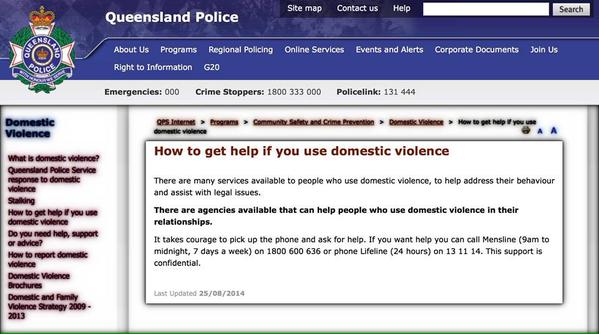
nooptionstoreport

Here are two screenshots from the web site of a Queensland Government agency. The wording assumes that any men seeking help in relation to domestic violence are perpetrators, and that any women seeking help are victims.

Unfortunately this bias is replicated in the web sites of other similar Australian government and non-government agencies. One example, involving a Western Australian government agency, is addressed in another post in my blog.bias

Postscript 27 March 2015: In order to provide further insight into the mindset within DV Connect, let me relay what just occurred. I contributed a comment to the Facebook page of DV Connect, in relation to an item about the release of the QLD Task Force report on family violence. I simply noted that I had prepared some comments on the report and included a link to the relevant page (refer screensave below). By the next morning the comment that I posted had been removed from public view. It seems that DV Connect wants to prevent their supporters accessing alternative perspectives. That looks a lot like ‘controlling behaviour’ to me.

dvconnectdvconnect2

To the left is what I see when I visit DV Connect’s page whilst logged-in to my Facebook account. The screen-save below shows what is visible to members of the public, i.e. no comments

Postscript 14 April 2015: Further censorship with the removal of my comment in response to an inaccurate statement in the DV Connect web site. I simply cited the relevant ABS statistic, but I guess the reality that men face more violence than women was just too triggering.

DVconnect_zap

On 11 September 2015 Di Mangan was quoted as saying that they couldn’t justify running the Mens Helpline on a 24 hour basis as so few calls were being received. Gee, I wonder why?

Fast forwarding now to January 2016 and along comes another advertorial for DV Connect, naturally with male victims & female perps air-brushed out of the picture.

This January 2016 article includes the following quote from the CEO of DV Connect:

“Mangan said abusive men were “emboldened” by the public murders that shook Queensland in 2015, noting that many of the calls received by DV Connect were from men warning that they wanted to harm their partners. Some of the men wanted help while others were calling to make a threat.”

In November 2017, the Courier-Mail published ‘DV Connect chief executive Diane Mangan axed from role amid dispute‘. I’d like to think this move was about improving efficiency & accountability, rather than just personalities, but have little faith in either of the parties involved.

The sort of gender discrimination practiced by DV Connect has been discontinued in one part of the United Kingdom as described in this November 2017 article by HEquel.

Postscript 3 May 2020:Inside the Men’s Referral Service, a call centre dealing with Australia’s abusive men and domestic violence‘. Gender-biased fruit off the same tree?

Postscript 6 May 2020: This video concerns a UK example of gender-biased caller-screening

Postscript 6 March 2022: This form of anti-male gender-bigotry is now VIC government policy

“I’m proud to announce the Palaszczuk Government is providing additional funding of $2 million to DVConnect to keep up with the high demand” said Shannon Fentiman (3 August 2022).

Postscript 18 January 2023: Family violence perpetrator focused screening and risk assessment: identifying current practice and future opportunities. A Monash Uni study. According to this Tweet, the issue of screening women was also addressed, but I am yet to find any reference to this issue in the papers I’ve read (?)

DV Connect left more than 10,000 calls unanswered in three-month period, investigation finds (8 August 2025)

Elsewhere in this blog you might also be interested in these posts:

On recognising and supporting male victims of domestic violence

So what exactly is the ‘Domestic Violence Industry’?

Australian taxpayer-funded organisations that do little/nothing for men (other than demonising them)

My submission to the Premier’s Special Taskforce on Domestic and Family Violence in Queensland

My response to the report of the Queensland Task Force on Family Violence

My response to the report of the Queensland Task Force on Family Violence

Ms. Annastacia Palaszczuk MP
Premier of Queensland and Minister for the Arts

Dear Premier

As you are aware, the Special Taskforce on Domestic and Family Violence released its report entitled ‘Not Now Not Ever’ on 28 February 2015. I am one of many people who earlier contributed a submission for consideration by the Task Force. I have now reviewed the Task Force’s report and wish to provide you with my thoughts on it.

Firstly some general observations

  • My first impression of the report was favourable in that its tone was generally inclusive and gender neutral in comparison to the more overt anti-male bias of many other reports regarding domestic violence (DV), such as The National Plan to Reduce Violence against Women and their Children, 2010-2022. The weakness of the Bryce report though was that the words were not followed-up with conclusions and recommendations when it came to the issue of female perpetration and male victimisation. In addition, there were many things left unsaid in relation to these aspects of DV that should have been addressed.
  • No mention was made in the report of the extent of anti-male bias in the pre-existing debate concerning DV, nor for example of the corresponding lack of resources devoted to male victims. Likewise no mention was made of the puzzling lack of family violence perpetrator intervention initiatives provided for violent or abusive women.
  • The report continues the trend of earlier reports in that it features an inflated emphasis and reliance on communication/education/awareness programs, without properly justifying what had been achieved to date – nor what gains might be predicted in the future. This is confusing as the problem does not seem to be that people are unaware of domestic violence, as was confirmed in the focus groups. How and why will more “awareness” result in lower rates of perpetration? Has this been achieved in Australia? In any other countries? Indeed no effort was made to detail the full extent of previous expenditure in this area, either absolutely or relative to total government expenditure related to DV.
  • The fact that a document word search of the Task Force’s report, using the terms ‘male survivor’ ‘male victim’ or ‘female perpetrator’, returned no results is indicative of the extent of gender bias present therein.
  • I am curious as to why copies of public submissions were not made available online (except of course those people who sought anonymity). Publishing submissions, as for example occurred with the federal Senate Inquiry, would have been consistent with the desire for awareness raising advanced in the report. I have no doubt that there would have been many submissions lodged that, like my own, challenged the dominant feminist narrative regarding DV. It is of concern that no extracts/quotes from such submissions featured within the body of the report, and that all of the references cited were written by those adopting and promoting a pro-feminist perspective. It appears, for all intents and purposes, that all such submissions were simply swept aside.
  • There is a major anomaly in that no ’round table’ was held with members of mens/fathers groups, yet special meetings were held with (for example) members of the Indian and African communities? This despite the fact that the need to involve men was stressed within the body of the report, and that men comprise a substantial number of the victims of DV.
  • It was pleasing to see that the LGBTI community was included in the discussion, as was the issue of elder abuse. Given the latter however I am unclear why (non-sexual) child abuse that occurred in the home was not also discussed in the report. Was this decision made because the pattern of perpetration was at odds with the dominant feminist narrative?

Comments in relation to specific matters raised in the report

Foreword: “Today there are more than 300 women’s refuges around Australia and there have been many advances in the past 40 years in how we deal with domestic abuse”

Why was there no mention of how many beds in refuges are currently available for men?

“It is through listening, sharing and understanding the experiences of those subjected to abuse and violence that we can start to understand how we can put an end to violence, and the action that must be taken.”

And yet no serious effort was made in the report to listen to and understand the circumstances of male victims, and men generally.

Executive Summary:On average, across Australia, one woman is killed by her partner every week.” (p6)

Why was no mention made of the corresponding number of male victims?

“Initiatives such as White Ribbon (a male-led campaign) and Australia’s CEO Challenge (a workplace domestic violence prevention program) are driving campaigns to break the silence surrounding domestic and family violence.”

Yet no attempt was made to quantify the extent to which rates of perpetration have been affected. Does simply “breaking the silence” actually help survivors? Especially when the ‘awareness’ campaign relentlessly drive home a gender-biased and blame-ridden message of ‘men are violent/women are their victims’?

“The majority of people who experience domestic and family violence in Queensland are women. This is not to say that women cannot be the perpetrators of fear and violence upon male victims.”

On a positive note it was pleasing to see that the Task Force did not follow suit and use the misleading phrase “overwhelming majority” as has featured in many other similar reports.

“Men can be and are victims of violence and coercive control, and are victims of domestic and family violence homicides. Any domestic and family violence, regardless of who the victim and perpetrator are, is unacceptable.”

It transpired that this is/was essentially the report’s sole concession to specifically recognising the existence of male victims and their right to be heard and to receive support.

“The Taskforce recommends that Government commission specific reviews into the impacts of domestic and family violence for two targeted vulnerable groups – people with a disability and the elderly. There is a distinct lack of sound and helpful evidence on the impact of domestic and family violence for these two groups, and the Taskforce strongly believes that more is needed to understand the needs and dynamics of elderly and disabled victims”.

The inclusion of these two groups is to be applauded, but men should also have been included and discussed as an at-risk minority for the same reasons as given for including the other minority victim groups.

“The attitudes, knowledge and beliefs of individuals and communities can and do create a culture that justifies, excuses, perhaps trivialises or even condones or encourages domestic violence.”

I disagree with this assessment. Later in the report the Task Force offers, as its sole supporting evidence, the findings of a national survey that did not even bother to ask questions about the community’s views about violence towards men. Thus its findings were compromised by the lack of statistical context or any valid point of comparison.

(p8) “Culture and attitudes affect the ability of victims to report violence and seek help, and influence the willingness of the community to hold perpetrators to account. It affects the behaviour of the professionals within our police, justice, welfare and service-provider systems when called on to deal with and respond to domestic and family violence. Importantly, culture and attitudes inform and influence the decisions of bystanders to either intervene or ignore incidents of domestic and family violence.”

This is highly applicable to the situation of male victims yet no mention was made of them in this regard – a further reason why men should have been included as an at risk minority and consulted with via a separate round-table meeting.

(p12) “Leaving a violent partner or home situation is a difficult step for a victim. If a victim does not know where to go, or does not feel understood or supported by a service, or worse, if there is no service for the particular need, the victim may return to the violence and not try to leave again. Compassionate, coordinated responses provide much needed support to victims trying to leave and will ensure greater success than disjointed and disengaged services can.”

It would have been highly relevant to note here the fact that many helplines and related web pages pointedly assume that male callers are perpetrators and female callers are victims. All such information, and such services, should be made non-judgemental and gender neutral. 

(p13) “Much of the focus in this report and elsewhere is placed on victims, but cultural change needs to happen to stop perpetrators from using violence and coercive control in their relationships. Any integrated service response must include programs to address perpetrator behaviour and hold perpetrators to account”.

Why was no mention made of the need for perpetrator programs for violent women? There is a cultural problem with the community ‘looking the other way’ in relation to abusive women and the Task Force report only perpetuates that situation. 

No male perspectives were provided in section 3, and Section 3.3 made no mention of the mens/fathers rights perspective put forward in any of the submissions. This section of the report was given over to advancing one ideology, and one alone, that being gender feminism.

(p105) “Training and games provide opportunities to engage boys and men in conversations and actions around understanding domestic and family violence, without the involvement of women and in a traditional or stereotyped ‘masculine’ environment. Just starting the conversations will make significant steps toward changing attitudes and behaviours.”

This implies that men/boys are the problem and/or that girls don’t play sport, and/or that sporting venues constitute a “a traditional or stereotyped ‘masculine’ environment”. This is inaccurate, unhelpful, and simply conforming to dated stereotypes. Why not have the same program for girls/women? Why could this not have been written as: 

‘Training and games provide opportunities to engage adults and children in conversations and actions around understanding domestic and family violence, without the involvement of members of the opposite gender’

(p142) “Further, in the National Crime Prevention Survey, one in four young Australians admitted having witnessed physical domestic violence against their mother and/or step-mother”.

It would have been more appropriate to report that ‘23% of young people between the ages of 12 and 20 years had witnessed an incident of physical violence against their mother/stepmother and 22% against their father/stepfather’ (Source)

(p151) “Alarmingly, the most recent national survey about community attitudes towards violence against women revealed that significant numbers of Australians believe there are circumstances in which violence can be excused. More than 1 in 5 agreed that partner violence can be excused if the person is genuinely regretful afterward (21%) or if they temporarily lost control (22%). These statistics are disturbing and indicate attitudes that trivialise violence by suggesting that violence against a partner can be excused. There is no excuse for domestic and family violence”.

It should have been noted that this survey did not ask about community attitudes towards violence towards men, thus there is no context in which the results may be interpreted. If the surveyors had bothered to ask about men, they might well have found that the community was even more complacent about violence towards men than women. This is not to suggest that any such complacency is good/better, but rather that the issue is one of social attitudes towards violence generally rather than sexism towards women.

(p152) Both Our Watch and White Ribbon ignore female perpetration of violence. There are other groups working in the field that hold a different perspective. Why was no mention made, for example, of the One in Three organisation?

(p154) “We will only achieve long-term and lasting change if we address the causes of domestic violence. International evidence shows the causes are complex – unequal distribution of power and resources between men and women, rigid or narrow gender roles and stereotypes, and a culture and attitudes that support violence” 

The two references cited to support this assertion were written by a hardline feminist researcher and a feminist advocacy group. Feminists rely heavily on a theory known as the ‘Duluth Model’ in their approach to DV. Whether or not the factors they mention are, in fact, the primary “contributing factors” is highly debatable. Alternative perspectives should have been provided in this section of the report, in order to provide a more thorough and more balanced coverage of the topic. An example of an alternative perspective worthy of consideration is presented in this article.  

(p155) “The most recent data released from the Australian Bureau of Statistics in August 2014 shows a widening of the wages gap between men and women in Australia with women currently earning 18.2% less than men.”

This is an average figure for all men and all women and cannot and should not be extrapolated as an indicator of gender bias or discrimination. The so-called gender gap is a complex issue and one that is routinely misrepresented by feminist advocacy groups

(p156 and again at p162-167) “There appears to be a significant gap between an individual’s belief that the violence is wrong, and the willingness to talk about the violence or take action to do something about it.”

It would have been relevant to note that this gap is greater in the case of people witnessing a man being assaulted than in the case of a woman

(p159-160) Mention should have been made of the fact that the media focuses overwhelmingly on male-perpetrated domestic violence, and on promoting a view that only men are responsible for such behaviour. This mirrors the message disseminated in most existing education/awareness campaigns such as those mentioned in the Task Force’s report.

(p171) “It is crucial for men to show leadership in the community in their actions to prevent domestic violence and to address the social and cultural causes of domestic violence. It is also important for them to demonstrate the value of healthy and respectful relationships.” Surely the same could, and in fact should, be said about women? Why wasn’t it?

(p173) The White Ribbon ‘breaking the silence’ campaign has been criticized for only focussing on the responsibilities of boys to treat members of the other gender with respect. It basically shames boys for being male and let’s girls ‘off the hook’ entirely in terms of how they act towards boys. This is not gender equality, it is gender bias or sexism.

(p176-179) This section is unbalanced and excessively influenced by feminist ideology. It absolves women of any responsibility whilst pushing all responsibility onto men (despite the fact that it admits that few men commit violence against their partners)

Domestic violence is a men’s issue because their wives, mothers, sisters, daughters and friends are being harmed. We know that most men do not commit violent acts in the home, however their attitudes are pivotal to accountability and responsibility for that violence because the majority of violence against women is perpetrated by men.”

Instead of that wording, why not this version instead?

Domestic violence is a women’s issue because their husbands, fathers, brothers, sons and friends are being harmed. We know that most women do not commit violent acts in the home, however their attitudes are pivotal to accountability and responsibility for that violence because a substantial proportion of violence against men is perpetrated by women.

Women must also challenge violence committed by other women!

Some further revised wording for the Government’s consideration:

‘There are three key forms of action that people can take in helping to reduce and prevent intimate partner violence:

  • Avoiding the personal use of violence against their partner
  • Intervening in the violence of other people
  • Addressing the social and cultural causes of violence’

(p235) Currently, there are 14 services funded by the Queensland Government to provide perpetrator intervention initiatives for the following regions: Townsville; Mount Isa; Gold Coast; Murgon; Toowoomba; Rockhampton; Brisbane; Cairns; Roma; Maroochydore; Ipswich; and Logan. In addition, there are two services funded by the Commonwealth”.

How many of these cater for violent women? Any of them? Surely this is relevant to the discussion?

Comments in relation to the Task Force’s recommendations

17. It was most pleasing to note that the monitoring and evaluation of programs was identified as a priority area

18-23. These recommendations demonstrate an excessive emphasis/reliance on communications. How will this help? Apart from just sounding good? No clear nexus between spending money here and actually fixing the problem

24-29. It should have been made clear that such programs should be aimed at both boys and girls (re: respecting the other gender) and not simply a platform for anti-male messaging.

Why was there no suggestion of using female role models? This goes against the general thrust of the report, and implies that it is only male behaviour that is the problem, and that no effort/adjustment is needed on the part of women/girls

31-37. The recommendations in relation to domestic violence leave should have clearly identified that both men and women would be eligible for such leave

67-70. The names of alleged perpetrators and victims should be protected to the same extent. If the victim’s name is withheld until such time as a conviction is recorded, then so to should the alleged perpetrators name be protected from publication

“… reviews and updates the Professional Practice Standards: Working with men who perpetrate domestic and family violence”.

To be consistent with the general thrust of the report it would have been desirable to have this document reviewed and re-launched as Professional Practice Standards: Working with PEOPLE who perpetrate domestic and family violence OR have a separate document written for female perpetrators. To do otherwise is simply to unquestioningly accept an unacceptable and gender-biased status quo.

84-88. Why was no mention made of the existing supply of and demand for shelter beds for male victims?

96-98. Why was no mention made of the fact that this type of specialist court has just been de-funded by the WA Government as they were found to be counter-productive? (Source)

Conclusion

The continued focus on the feminist perspective towards domestic violence, and the exclusion of other perspectives that are equally or perhaps even more valid, is deeply troubling.

Mens violence towards women is a very important issue, but at the same time we must remain mindful of the fact that it is but one component part of a bigger issue. Everyone is important and we need to focus on achieving a reduction in violence to adults and children whether they be male, female or transgender.

I believe that real gains will elude us until such time that we adopt a holistic, practical and non-ideological approach to this most pressing and complex social problem.

My submission to the Premier’s Special Taskforce on Domestic and Family Violence in Queensland

A submission to the Premier’s Special Taskforce on Domestic and Family Violence in Queensland

Introduction

Thank you for according me the opportunity to contribute my ideas in relation to this pressing social concern. My submission touches on all six elements of the Task Force’s Terms of Reference, but with perhaps a slightly stronger emphasis on:

  • Educating and engaging Queenslanders to create a community that supports respectful relationships, practices positive attitudes and behaviours and promotes a culture of nonviolence
  • Defining the scope of violence, assault and abuse to be addressed in a domestic and family violence strategy and whether it would be appropriate for such a strategy to focus on particular or defined sections of the community in order to have the most impact.

The true nature of domestic violence

Domestic violence (DV) comprises man-on-man, woman-on-woman, man-on-women, and woman-on-man violence. There is also a very substantial incidence of bi-directional violence, whereby both partners perpetrate violent and/or abusive acts against one another.

IPV-TruthwgrayThe US organization ‘Stop Abusive and Violent Environments’ (SAVE) examined DV research results from around the world and noted that “These studies show that rates of female perpetration are very similar to male perpetration rates.

The authors concluded that the results of this review suggest that partner abuse can no longer be conceived as merely a gender problem, but also (and perhaps primarily) as a human and relational problem, and should be framed as such by everyone involved.

These conclusions mirror findings in the United States, where research shows men and women initiate most forms of abuse at equal rates, for similar reasons, and rarely in self-defense.” [1]

I applaud the fact that the Task Force’s Terms of Reference do not demonstrate the gender bias that is otherwise widespread within the debate regarding domestic violence, and amongst many of the staff of relevant agencies and advocacy groups. Such bias promotes a view of ‘domestic violence’ that is overly simplistic and which misrepresents DV as ‘men’s violence towards women’.

This focus on violent men and their female victims is more indicative of the pervasive influence of feminist ideology within the DV sector, rather than being an accurate reflection of patterns of DV perpetration.[2] Further, this systemic gender bias against men constitutes a significant barrier to effectively addressing domestic violence and better supporting the welfare of all victims of DV.

It is my firm belief that a solution to the problem of domestic violence will continue to elude us as long as agencies continue to only acknowledge and address one piece of the puzzle.

Others who have advanced a similar perspective have been accused of seeking to ameliorate the behavior of male perpetrators and/or to downplay the suffering experienced by female victims. I wish to assure members of the task Force that this is most certainly not my intention.

How has the misleading view of domestic violence as being synonymous with male violence towards women become so worryingly widespread?

DV advocacy groups, social commentators, and even senior members of the public service, have repeatedly stated that “the overwhelming majority of domestic violence in Australia is perpetrated by men against women”.[3] This is quite simply untrue. Numerous respected and non-ideologically biased researchers have found that between one and two-thirds of the victims of domestic violence are male.[4] The variation in findings was dependent upon variables that included the country surveyed, sampling techniques and the definition of ‘domestic violence’ employed. Other research has also highlighted the fact that large numbers of men commit suicide as a result of either being subjected to domestic violence, or after having been falsely accused of perpetrating domestic violence.[5]

Indeed I can assure members of the Task Force that much of the data about patterns of domestic violence that appears in the media, and in the web sites of DV agencies, is woefully misleading. This is unfortunate as suitable data, albeit sometimes imperfect or incomplete in some regards, is available for those who genuinely seek it. From this one might conclude that misleading statistics are at times being deliberately advanced in order to support a particular ideological perspective that, as previously noted, is held by many working in the field of DV. And in fact there is clear evidence that this occurs relatively frequently and with complete impunity.[6]

One red flag for astute observers is the absence of comparative statistics for male victimisation within much of the literature about domestic violence. In some cases this is because men were not surveyed, or failed to ask the appropriate questions regarding female perpetration and male victims. In other cases the relevant comparisons were available but were not reported, presumably as doing so might undermine a predetermined narrative and/or preferred conclusion.

The view that is put forward by most within the DV sector is that their preoccupation with male violence is justified because the number of female perpetrators is minimal – that female abusers are virtually an insignificant aberration.

When provided with irrefutable statistics showing near gender symmetry in rates of perpetration, the fall-back position is typically that a focus on male offenders remains valid because females only perpetrate violence in self-defence, that the physical violence they perpetrate is less severe, and/or that the impact of DV is greater for women than men.

The first statement is demonstrably false[7] and the subsequent statements demand careful qualification to be of any value in framing an appropriate policy response.

Focusing wholly on male perpetration of violence masks the extent of female perpetration of domestic violence, as well as a trend of increasing violence by women and girls generally

The Rape, Abuse and Incest National Network (RAINN) prepared a submission to the White House Task Force to Protect Students from Sexual Assault. RAINN is the USA’s largest anti-sexual violence organization. In that submission they wrote:

“… an inclination to focus on particular segments of the student population (e.g.,athletes), particular aspects of campus culture (e.g., the Greek system), or traits that are common in many millions of law-abiding Americans (e.g., “masculinity”), rather than on the subpopulation at fault: those who choose to commit rape. This trend has the paradoxical effect of making it harder to stop sexual violence, since it removes the focus from the individual at fault, and seemingly mitigates personal responsibility for his or her own actions.”[8]

Now if we change ‘sexual violence’ to ‘domestic violence’ you might see where I am heading with this. As stated earlier, many within the DV sector are loudly asserting that ‘domestic violence is men’s violence towards women’, and devoting their resources to educating/shaming men as a collective group. But by doing so they are inadvertently sending a message to violent women that ‘whatever you are doing must be something other than domestic violence’, and ‘given the violent nature of men your actions might well be justified’.

It also follows that violent women would be less concerned about being prosecuted in the knowledge that they will probably be believed more readily than their male partner should the authorities become involved.

The claim that women are rarely responsible for domestic violence becomes all the more implausible when one considers recent trends showing substantial increases in violent crime by women and girls.[9] Such increases also exceed the trend in similar crimes by males.

What other problems are created by failing to acknowledge violent women and male victims of DV?

The ‘DV=Mens violence towards women’ focus is reflected in language and in statements that paint a picture of all men as abusers or potential abusers. Web site content, even to promote help-lines, is written in such a way as to pre-judge visitors based on their gender. I will provide a link to one such site in a footnote, but the agency in question is by no means unusual in this regard.[10] The material posted online in most Australian federal, state, and NGO web sites dealing with DV is assiduously judgmental and anti-male in its nature.

Take for example the document the ‘National Plan to Reduce Violence against Women and their Children’ which sets the scene for addressing domestic violence at both federal and state level. That document, as do many others like it, waves away the welfare of battered men within the first few paragraphs. The Plan states “While a small proportion of men are victims of domestic violence and sexual assault, the majority of people who experience this kind of violence are women in a home, at the hands of men they know.  Men are more likely to be the victims of violence from strangers and in public, so different strategies are required to address these different types of violence.”

As a consequence of both the message being communicated by DV agencies, and broader social forces at work (i.e. anti-male bias and sex-role stereotyping), many male victims are discouraged from coming forward to report crimes and/or seek assistance. By the same token it is also entirely likely that the overt profiling undertaken by DV agencies results in fewer women coming forward to seek help for their own aggressive tendencies.

Under-reporting by male victims then has a flow-on effect of reinforcing the misconception that there are few female aggressors, that facilities for male victims are unnecessary, that survey question on male victims/female aggressors are redundant, etc.

There are many reports of male victims who do come forward being treated with suspicion, if not downright hostility. They claim to not have been believed, and that they were considered as abusers who were denial. Even when they are treated sympathetically, the next problem they encounter is that there are either nil or minimal services (e.g. beds in shelters) or assistance available to men, and particularly men accompanied by children.

When this mantra of ‘DV=men’s violence towards women’ is disseminated through the community via the media it encourages the view that men are inherently violent, and that should you see a man involved in a violent incident with a woman then the man is immediately assumed to be the instigator and perpetrator of violence.

This is clearly demonstrated in the videos available at http://www.fighting4fair.com/promulgating-inequality/differing-public-response-to-partner-violence-depending-on-gender-of-victim/

Be assured that men suffer deeply from the affects of domestic violence. Another largely unreported outcome of the current situation is a very high rate of male suicide linked to involvement in domestic violence – which is often exacerbated by subsequent isolation from children.[11]

A man’s separation from children can and does occur regardless of whether the father is the perpetrator, the alleged perpetrator, and/or the victim of domestic violence (as for e.g. in the case where no emergency accommodation is available for fathers with children).

Queenslanders deserve good governance, transparency and accountability with regards to public funds directed towards the fight against domestic violence

It is a sad fact that when society places a particular group of people on a pedestal then the result is often a scandal, as normal common-sense oversight is relaxed, criticism quashed, people abused or taken advantage of, and public funds misspent or otherwise wasted. Unfortunately I believe that we are now beginning to see this happening within organizations driven by feminist ideology, and particularly in the field of domestic violence.

Millions of dollars of taxpayer funds and donations are already being poured into the fight against domestic violence, and this is rapidly increasing. A large proportion of this money is subsequently finding its way to feminist advocacy groups like ‘Our Watch’ and ‘White Ribbon Australia’.

We want to think that throwing money at a problem will make it go away, and that high-profile and politically-savvy advocacy groups should be well-positioned to use funds to good effect. There is a time to make decisions with the head and not the heart (or with an eye on short-term PR value), and the fight against domestic violence is such an example. The Government should consider whether more might be achieved by greater funding of government agencies providing direct assistance to those in need, rather than for example directing funds to a non-government organization who may direct funds towards salaries, rent, conferences and securing the services of marketing/PR firms.[12]

This topic was recently addressed by well-known Canadian activist Karen Straughan:

“Violence against women in any form has been a HUGE cash cow for feminism. The more they inflate their claims regarding its pervasiveness in society, the more money pours in, and the more power they have to tinker with legislation and policy. Because it is such an emotionally charged subject, any rational scepticism of these claims (as to whether they are true in the first place, or whether feminists are accurate in their estimates of pervasiveness), is easily deflected by attacking the sceptic.”

You can demonstrate until the cows come home just how much certain feminists are profiting from generating an inflated fear of violence against women among the public (the average [almost always feminist] director of a battered women’s shelter here in Alberta rakes in over $100k/year, and in the US, that number can be significantly higher), and people won’t care, because ending violence against women is THAT important. They won’t see the people who claim to be working to end it as the exploitative con-artists or ideologically driven religious inquisitors that they are.

If you point out that a very lucrative industry has formed around these issues, and that like any organic entity, this industry will work to sustain and grow itself rather than the other way around, you get called a conspiracy theorist. Even though none of these claims require a conspiracy to be valid–all they require is human nature.” [13] 

An appropriate focus for education and for remedial action

I believe that there is a role for educational messages but that these should be gender-neutral. The community should be truthfully informed that there are both male and female perpetrators, that there are male and female victims, and that in many cases both partners engage in violence and abuse. The community should be told that any/all violence or abuse in the home is inappropriate and harmful for everyone involved, and particularly for those children who witness that abuse.

I believe that there is no legitimate objective basis for addressing in isolation, let alone focusing resources on, any one particular group of victims or abusers. In particular I object to the current gender-based approaches to addressing domestic violence. I say deal with the whole problem. Fix the whole problem.

I believe that agencies or organizations active in the DV field should provide services, counseling and support to both male and female perpetrators and male and female victims. I believe that government funds should be allocated where they will be most effective, and that this may mean that most funds are directed towards government agencies who provide practical assistance, rather than to advocacy groups paying PR/marketing firms to develop and implement costly ‘shame and blame’  campaigns of dubious value.

My recommendations to the Task Force

  1. First and foremost, I would implore members of the Task Force to consider this submission, and the linked references it provides, with an open mind and in an objective manner.

Please be open to the possibility that the limited success achieved to date in addressing DV may be due in part to shortcomings in both the philosophical approach that is driving current efforts, and the fixed attitudes and preconceived notions of many of those tasked with addressing the issue.

Indeed I am very much aware of the ‘elephant in the room’ that is feminist doctrine, and of the combative ‘us and them’ approach often adopted by adherents to that movement. But as is usually the case, we can and must find a middle path that will lead us to a fair and workable solution to the scourge of domestic violence.

2. Please evaluate and modify all documents and web content produced by relevant agencies in order to identify and remove any bias that might be present in relation to gender or sexual orientation. None of this material should pre-judge who is or might be the perpetrator or the victim in the relationship, or their motivation for coming forward to seek help.

3. Ensure that possible bias in relation to gender or sexual orientation is removed from survey instruments and that research methodology is carefully vetted in order to ensure accurate, unbiased and truly representative findings.

4. Evaluate and adjust the composition of relevant sections within agencies, committees, and panels dealing with DV issues so that, as far as practicable, they are representative of the broader community, particularly in relation to gender and sexual orientation.

At the moment it is my impression that many such groups are currently overwhelmingly comprised of people in a very narrow demographic , typically tertiary-educated women aged 25-45 who identify as feminists. It is highly probable that this is introducing a degree of bias which could limit the scope of approaches being considered or undertaken to address the problem of DV.

5. Do everything possible to ensure good governance and the cost-effective use of public monies. Grants should stipulate the need for key performance indicators, gender neutrality and natural justice, together with requirements for performance reviews and auditing. It is also important that any budget committee, steering committees or similar should contain representatives who are completely independent, in a financial sense, from any of the matters being considered. It would be naïve to assume, given the huge amounts of money directed towards domestic violence at the state and federal level, that there was no potential for financial considerations or self-interest to influence decisions regarding expenditure priorities.

6. Evaluate and adjust the allocation of funding and resources so that it is in accordance with the reality of the domestic violence problem in its entirety. In the first instance this would almost certainly necessitate additional resources being directed towards male victims of domestic violence and counseling for female perpetrators of violence.

7. Although it may be beyond the scope of the Committee’s consideration the manner in which the welfare of men has been largely ignored in the case of DV is indicative of the lack of any real advocacy for the interests of men and boys within the spheres of both federal and state government.

This contrasts strongly with the situation for women where there are generously-funded agencies, or at least sections within agencies, to address and advance the interests of women and girls. This may not be the time or place to consider this issue, but if we as a community sincerely aspire to gender equality, then this it is a disparity which should not continue to go unquestioned.

[1] http://www.saveservices.org/dvlp/policy-briefings/partner-abuse-worldwide/

[2] https://www.youtube.com/watch?v=–Pk25vBeHg (Donald Dutton video)

[3] http://www.fighting4fair.com/misrepresenting-reality/this-is-what-a-lie-looks-like-domestic-violence/

[4] http://www.fighting4fair.com/misrepresenting-reality/domestic-violence-one-sided-media-coverage-and-bogus-statistics/

[5] http://www.emeraldinsight.com/doi/abs/10.5042/jacpr.2010.0141

[6] http://www.fighting4fair.com/misrepresenting-reality/fudging-the-figures-to-support-the-feminist-narrative-domestic-violence/

[7] See for example http://www.mediaradar.org/docs/Dutton_GenderParadigmInDV-Pt1.pdf, See  p687

[8] https://rainn.org/images/03-2014/WH-Task-Force-RAINN-Recommendations.pdf

[9] http://www.fighting4fair.com/women-behaving-badly/on-the-recent-increase-in-violent-crime-carried-out-by-women-and-girls/

[10] http://www.fighting4fair.com/misrepresenting-reality/addressing-anti-male-bias-by-an-australian-state-government-department/

[11] http://mediaradar.org/docs/Davis-DomesticViolenceRelatedDeaths.pdf See Conclusion

[12] White Ribbon Australia is simply provided here as an example of a NGO active in the DV field, and for which financial records are publicly available http://www.whiteribbon.org.au/publications/previous-annual-reports and http://www.acnc.gov.au/RN52B75Q?ID=D19DFBA4-B116-4C8A-B1CF-9509317B0877&noleft=1

[13] http://owningyourshit.blogspot.com.au/2014/11/false-allegations-are-rare.html

Postscript:

The report of the Taskforce was released on 28 February 2015, and I have prepared a response to it that can be read here.

Initial media coverage included:

QLD domestic violence report unveiled (28 February 2015)

Call for specialist courts to deal with ‘scourge’ of domestic violence (28 February 2015)

Domestic violence rising in Queensland according to new report (1 March 2015)

In August 2015 the Queensland Government announced that it would implement all 140 recommendations of the Bryce report

In September 2015 the Queensland Government announced that Quentin Bryce would head a Task Force in relation to domestic violence

Domestic and Family Violence Implementation Council