How one union got drunk on feminist ‘kool-aid’ (CFMEU)

“The Construction, Forestry, Mining and Energy Union (CFMEU) is Australia’s main trade union in construction, forestry, furnishing products, mining and energy production. The CFMEU has offices in all capital cities in Australia and in many major regional centres with the national office of the union in Melbourne. The union has an estimated 120,000 members and employs around 400 full-time staff and officials.” (Source)

That Wiki entry also tells us that “in August 2010, the CFMEU donated over $1.2 million to political activist group GetUp! to pay for TV airtime for a women’s rights ad-spot condemning Tony Abbott and the Liberal Party.” Exactly what benefit its members extracted from that expenditure is unclear. 

This union represents sectors of Australian industry whose employees are predominantly male, and I would assume that more than 90% of its members are men. I could not locate this information in the CFMEU web site.

I later learnt that the CFMEU failed to provide a response for the 2010 ACTU Women in Unions survey. They did provide information to the ACTU at a later date, but details of female rank and file membership are not provided in subsequent ACTU reports.

I then unsuccessfully sought clarification about the number of female members from both the CFMEU and the ACTU. Why so coy, guys?

The industry sectors from which the CFMEU draws its members are also notable for the level of workplace death and injury that occurs in each. Those deaths and injuries also affect women, but mostly as dependants of male victims. With regards to fatalities, there were 191 workplace deaths in Australia in 2015, of which approx 95% were men.

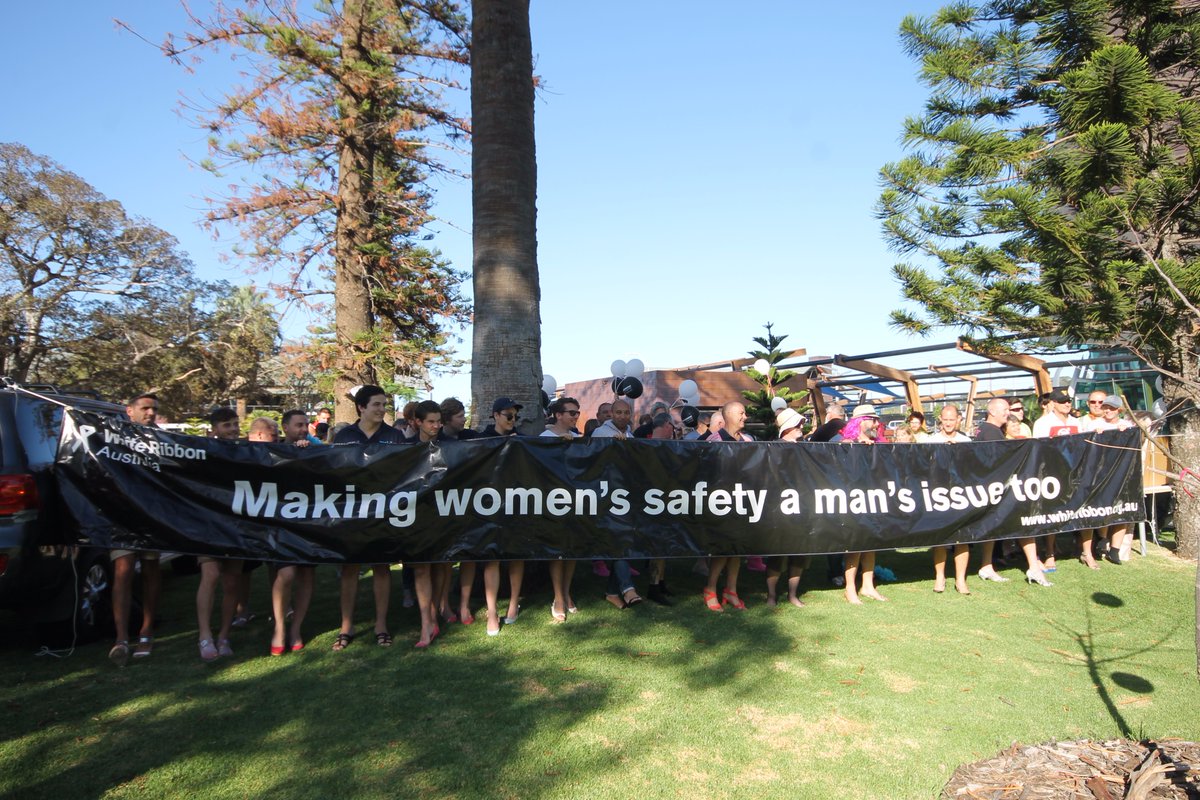
If there was a case for an organisation to encourage the support of women in enhancing the welfare of men, then this might well be one. I was therefore surprised to see, on 12 July 2016, the union issue a tweet in support of feminist activist Van Badham featuring the photograph shown below. And here is Van Badham returning the love. Nice.

CFMEU

Granted this is a White Ribbon banner, but presumably its message is supported and promoted by the union. This correspondent’s initial impression is that ‘brown-nosing’ the feminist lobby is accorded a higher priority by the union than is pursuing their core responsibility, the welfare of its own members. Who could wonder why union membership has slumped at the rate that it has?

In the case of domestic violence, the issue about which Van Badham was pontificating on Q&A, at least one third of the victims are men. If we again consider fatalities alone, there were 158 domestic violence-related deaths in 2015, and again 1/3 of these were men.

So although there are more workplace deaths than DV-related deaths, strangely I don’t recall ever seeing feminists carrying banners demanding action on workplace safety.

Worse yet, male victims of domestic violence are routinely ignored, denied or even mocked by feminists and pro-feminist organisations like White Ribbon.

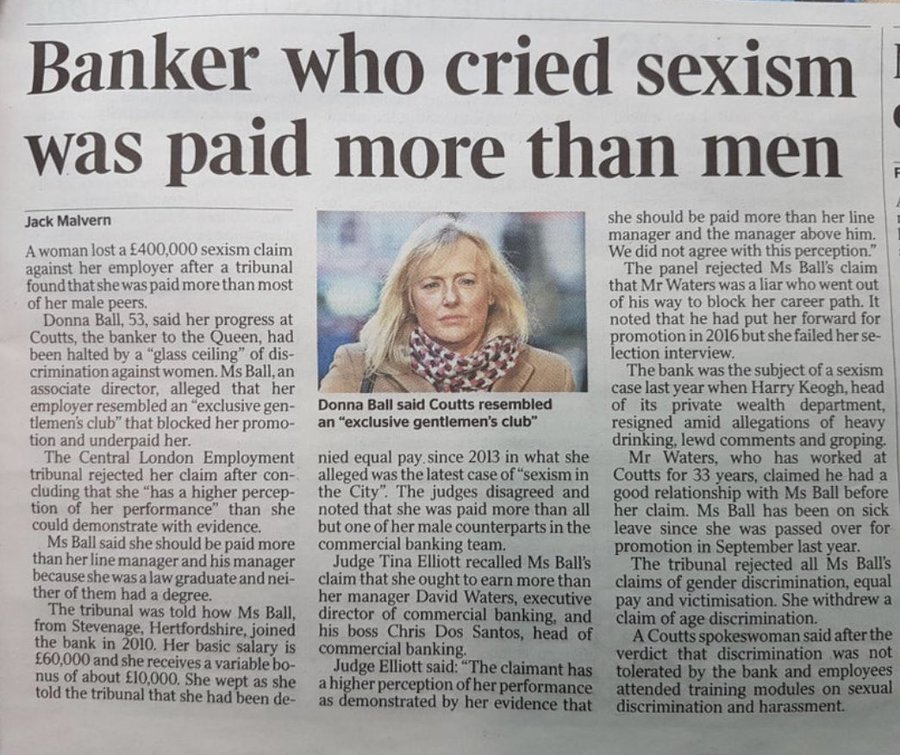
Bear in mind that there would surely be many victimised men within the rank and file membership of the CMFEU. How much support do they receive from their union? SFA, I would suspect. And according to this article it doesn’t look like women get much respect from the union either. Funny thing that.

As I have already said in another post in this blog, it’s high time that there was some quid pro quo with regards to seeking support from women and women’s groups for some of the many issues that have a negative impact on men.

Unfortunately however that’s not how it works at present. The feminist narrative, and all component parts thereof, must be publicly recognised and given the highest priority. Men are expected to drop everything and rush to assist strong, independant women tackle whatever real or imagined obstacles are encountered by them.

Women on the other hand are not to be held responsible for anything, least of all to help construct or support remedies that benefit men.  At least that’s how it is with feminists – and theirs are the female voices getting all the airtime in the media.

What a state we now find ourselves in.

Am I saying that unions should be denied a voice in relation in relation to matters affecting the broader community? Of course not. I simply saying that in this case, their priority should be their members, the broader community, and the feminist lobby. In that order, rather than the reverse.

I would say to the CFMEU, ‘wake up to yourselves!’, but I’d most likely be wasting my time doing so. And considering the mood in the reader’s comments sections with respect to articles addressing gender bias, I know that I’d not be alone in recognising the need for a better and fairer approach to these issues.

Regrettably the ideological rot of the regressive left has well and truly set in, and the sort of common sense and decency that was once integral to the Australian character is rapidly becoming just a memory.

Unfortunately the same trend is apparent elsewhere, and in the U.K for example the Trades Union Congress joined forces with hardline feminist group ‘Everyday Sexism’ to produce a survey and report on harassment in the workplace. In addition to other methodological flaws they only surveyed women. Male victims of harassment? None to be found = harassment only affects women. Wrong.

harassed


A useful portrayal of victims of domestic violence … from an unlikely source

The focus of this post is an article entitled ‘There is nowhere for us to go’: Domestic violence happens to men too, by feminist journo Ginger Gorman. I have seen Ginger’s work before and was somewhat taken aback to see what appeared to be an item sympathetic to men.

Ginger’s article began with a detailed personal account by Nick of the abuse that he had suffered at the hands of his wife. Nick also recounted the extreme difficulty he had accessing professional support.

The author noted that this was a common theme amongst the men who volunteered to tell their story, but failed to provide statistics on the number of services catering to male versus female victims of domestic violence.

But then Ginger wheeled in outspoken male feminist and misandrist Dr Michael Flood who pushed the predictable feminist line on domestic violence:

(Another myth put about by some feminists is that most domestic violence against men involves male partners, whereas in fact 94% of domestic violence against men was perpetrated by female partners)

Ginger then told the story of Mereana who had experienced relationships involving two-way verbal and physical abuse. Mereana had suffered extensive abuse as a child as a result of which she suffered possible brain damage as well as emotional problems. Mereana did a stint in jail, and since then had sought help for her issues (although still exhibited violent tendencies).

The next part was interesting:

““I had to go looking and digging to find someone to help me confront and dismantle my issues and work out my triggers. There’s no support for female perpetrators,” she says.

In part, she blames white middle class feminists for this, who she says have “protected the conversation” about domestic violence to the exclusion of “all those other voices.” Finally, Mareana convinced a violent offenders’ counsellor at a local men’s support service to take her on as a client.”

If only Ginger had seized on this point, and done some digging, for e.g. how many states/regions actually do offer programs for violent women? As far as I know, almost none. Why is this issue not raised in the many costly inquiries that have taken place in recent times?

Michael Flood then re-appears to disparage the ‘One in Three‘ group, which advocates for the welfare of male victims of domestic violence. This is a task with which Michael already has considerable experience. This particular comment was unfair, inaccurate and more than a little ironic:

“[One in Three] has spent “at least as much effort trying to undermine campaigns to address violence against women.””

Actually Michael, ‘One in Three‘ take pains to point out (in their submissions to government, for example) that they are NOT seeking to undermine support for female victims. I think what Michael is referring to are instances where ‘One in Three‘ provide alternative data sources that debunk misrepresentations put forward by feminist groups (often in the form of attacks on One in Three).

I would suggest that One in Three believes there to be a strong case to support all victims of domestic violence, and that this does not require or benefit from the gender bias and misrepresentation that pervades the Domestic Violence Industry.

On the other hand, Michael and other feminists seem to consider it their sacred duty to undermine efforts to raise awareness of female perpetrators and their victims. And with even more examples of such behaviour here, here and here.

The article concludes with the suggestion that any blokes out there who need help with this issue, can call Mensline. Sadly that’s all there is, but the feedback about that service is anything but complimentary, with many male callers reportedly being treated as abusers in denial only to then be signed up for anger management classes and/or passed on to groups offering crisis accommodation for the homeless.

See also:

ABC Life Matters story on male victims of domestic violence (10 August 2016) Australia


Women attack first responders yet omitted from ‘awareness’ campaign

“The government is spending more than $1.3 million on an education campaign to remind the public not to treat health workers as punching bags, after 3300 assaults in the past year alone.” (31 March 2016)

Click here and scroll down the page to watch two of the ads subsequently aired on Australian TV.

Strange thing though … no violent and abusive women are featured in the ads, despite the fact that such people most certainly do exist in real life. I very much doubt that was an accidental omission. Think about why such a decision might that have been made.

There might well be fewer incidents involving women, though I would be interested in seeing the stats in relation to the sex ratio of males v females treated/transported and then the percentage of each that were abusive.

Personally, I suspect that the decision to only show violent men is less about patient ratios and more about social conditioning with respect to how society perceives men and women, and the threat they pose.

Here are three incidents in the first half of 2016 involving female perpetrators assaulting paramedics:

“A WOMAN has stabbed a paramedic on Fraser Island after trying to force him to hand over drugs.” (Source)

“A 21-year-old woman has been charged over the alleged assault of a paramedic sent to a Brisbane pub to help her. The 41-year-old female ambulance officer suffered cuts her arms and swelling and bruising to her face in the alleged drunken assault at Toowong’s Regatta Hotel.” (Source) (Postscript: This case went to court in August 2017 and the perpetrator was found ‘not guilty’)

“As the ambulance passed through the Legacy Way tunnel en route to the Royal Brisbane and Women’s Hospital she allegedly attacked the 51-year-old ambulance officer, kicking him in the groin and punching him in the head.” (Source)

Anger after two Cairns paramedics allegedly come under attack while on the job (31 October 2016)

ambos

Melbourne mothers beg magistrate to spare them jail after attacking paramedic (8 September 2017)

“Experienced ambulance worker Paul Judd has not been able to return to work since the violent attack in April 2016 and has required multiple surgeries on his foot.

Amanda Warren, 31, and Caris Underwood, 20, have admitted punching and kicking Mr Judd as he and another paramedic tried to treat a patient in Reservoir.

They have both pleaded guilty to intentionally causing injury, while Warren has also admitted criminally damaging the ambulance by ramming it with a car.”

See also:

Police bodycam shows married teacher being arrested for allegedly raping boy, 15 (2 April 2025) And another feminist journalist, Rebekah Scanlan, applies the ‘glamorous’ label to another female misfit.

Paramedic allegedly assaulted after man found dead in home (4 October 2024)

Women arrested after police officer allegedly bitten in CBD (30 May 2022)

Expecting young mum spits on ‘gronk’ paramedic, abuses ‘incompetent’ nurses (8 December 2021)

‘Distressed’ woman attacked paramedic with blade after flagging down ambulance – Mirror Online (2 August 2021)

Police officer, 36, paralysed for life after drunk woman kicked him on duty (25 April 2020) UK

999: What’s your emergency? (22 February 2020) An episode of a UK TV series

Paramedic cuts diamond ring from dead woman’s finger and pawns it, cops say (14 November 2019) Whoops, looks like even female paramedics can be bad too.

Glamorous teen assaults paramedic she calls ‘a white dog’ (1 June 2018). And Leilani Clarke is back in the paper in May 2019 and still being referred to, by the same female journalist, as “glamorous“. Not in my book! And back in court again in July 2019, and again in April 2020. I don’t believe it, Candace Sutton refers to her as ‘glamorous‘ again in May 2020. #FacePalm

(Psst. And here’s reference to another glamorous female mis-fit. As labelled by another female journalist, Ms Alexa Cimino)

Pensioner, 68, grabs crotch of paramedic treating her for a fall and asks, ‘How big is it?’ | Daily Mail Online (11 July 2019)

Furious paramedics protest decision not to jail women who beat ambulance worker (16 May 2018) Gee, female judge too – fancy that.

Nurses and patient at Sydney’s Royal Prince Alfred Hospital stabbed in face by woman with scissors (5 May 2019)

Mums’ ‘vicious’ assault on paramedic lands them in prison (12 December 2017)

Other posts in this blog relevant to this post include:

On violence carried out by women and girls

How men are portrayed … Haw Haw Haw! The jokes on us

Differing public response to partner violence depending on gender of victim

On the punishment of women and the notion of a ‘pussy-pass’

On chivalry

Australian 2016 Federal Election: No party willing to step up to the mark for men & boys

The last Australian federal election was held on 2 July 2016, and was ultimately (narrowly) won by the Liberal Party/National Party Coalition.

This post concerns those gender-related policy positions adopted by the three main players during the campaign: the Australian Labor Party (ALP), the Liberal Party/National Party Coalition (LNP), and The Greens.

In another blog post I provide details regarding the relevant positions adopted by some of the minor parties.

Gender issues did not feature amongst the key issues debated during the election campaign. The one specific gender-related issue which was aired was domestic violence. With that in mind, let’s look at what the major parties had to say on that topic:

The Domestic Violence statement provided in the ALP web site can be found here. The number of times the terms ‘men’ or ‘male’ (e.g. male victims) feature in this document = 0

The Domestic Violence statement within the Liberal Party web site is accessible here. The number of times the terms ‘men’ or ‘male’ (e.g. male victims) feature in this document = 1. That sole mention refers to the contentious ‘Mensline’ counselling service – read more about Mensline here.

The Domestic Violence statement in the National Party web site is here. The number of times the terms ‘men’ or ‘male’ (e.g. male victims) feature in this document = 0

The Greens Domestic Violence Policy is here. The number of times the terms ‘men’ or ‘male’ (e.g. male victims) feature in this document = 0. By way of contrast, the word ‘women’ features 31 times.

None of the major parties have shown any interest in addressing issues that detrimentally affect men and boys. None of them have issued significant statements in support of male victims of domestic violence, nor have they made reference to female perpetration of violence.

The major parties are essentially all in lockstep with the feminist movement, the only area of divergence being the amount of money that each is willing to relegate to/waste on feminist causes.

Amongst the major parties, the Greens offer the most ardently pro-feminist perspective, with the ALP running a close second. It was the Greens, for example, who were the driving force behind the current federal Inquiry into Domestic Violence and Gender Inequality.

The federal budget released by the Government in May 2016 represented the first salvo in the election campaign:

“In this Budget the Government has allocated $100.0 million over three years for Domestic and Family Violence: New Initiatives To Break the Cycle of Violence. This builds on the $101.2 million provided for a Women’s Safety Package announced by the Government in September 2015 (detailed in the Mid-Year Economic and Fiscal Year Outlook 2015–16). This measure will draw on the recommendations of the Third Action Plan (part of the National Plan to Reduce Violence against Women and their Children 2010–22), due for release in mid-2016. [Footnote]” (Source)

Further details of what were proposed and some related background information are provided at:

Domestic and family violence budget review 2016-17
The number of times the terms ‘men’ or ‘male’ (e.g. male victims) feature in this document = 0. Again, by way of contrast, the word ‘women’ features 28 times.

Budget Paper No. 2. Part 2 Expense measures. Social Services (See Domestic and Family Violence — new initiatives to break the cycle of violence)

With respect to media coverage, the first relevant item I noticed discussed one particular funding measure announced by the Government … see ‘Family violence legal aid boost of $30 million won’t solve crisis: Lawyers‘ (12 May 2016). As is essentially ‘par for the course’ , the article implies that all victims of domestic violence are female.

The next cab off the rank was the ALP in ‘Federal Election 2016 Campaign: Bill Shorten promises $65 million funding boost to family violence services‘ (14 May 2016)

“Labor will provide funding certainty to frontline family violence organisations if it wins government, Bill Shorten has promised. The Opposition Leader has committed $65 million over six years to ensure 1800 RESPECT, Our Watch and Australia’s National Research Organisation for Women’s Safety (ANROWS) can continue their work in tackling family violence.”

Again, each of the major Australian political parties is unambiguously pro-feminist, regardless of how overtly they choose to express it. At this point none of these parties have chosen to raise awareness of, or to provide practical support for, male victims of domestic violence.

During an otherwise tedious and predictable campaign at least Mark Latham entertained via poking pins into feminist/white knight thought bubbles.

Further coverage of gender issues during the campaign:

Feminist group ‘Fair Agenda‘ compiled their own scorecard on how the parties stack up in relation to domestic violence. You can probably guess that their criteria differ from my own.

Here is the election wish-list of another feminist group, the ‘Australian Women Against Violence Alliance‘. They sent me a tweet stating “All victims should have access to support” yet there is no mention of male victims here.

Suicide prevention funding not reaching men says Labor senator (16 June 2016)

Bill Shorten speech launching Labor’s gender equality policy (11 June 2016) Bill uses the word ‘men’ five times versus 55 times in the case of ‘women’. Whilst Australian women get reassurance, support and encouragement, the men get this:

“men who have harmed them and their children”
“men rely on women for childcare”
“childcare remains a responsibility that Australian men too often unfairly leave to Australian women”
“25 per cent of women nominate a lack of childcare as their reason for leaving the workforce. In the case of men, it is 3 per cent.”
“It is primitive and wrong that women are paying the mortgage on houses occupied by men who have harmed them and their children”

The ALP sees providing a myriad of policies to support women whilst providing none to address men’s issues as “gender equality”. But wait, there’s more.

Bill goes on to state that “Australia cannot afford six Liberal years of ‘budgets for blokes’.” Seriously Bill? You mean all that money lavished on the Ministry of Men’s Affairs? Oh wait, there isn’t one is there? In fact all I can see is hundreds of millions poured into organisations like these.

**I challenge Bill or any other ALP politician to add a comment to this post providing examples of current federal budgetary allocations which they feel only benefit “blokes”**

Bill has also promised a hand-out for women’s health. Real men don’t get sick right, mate? {insert gratuitous joke about ‘man-flu’ here}

What might political parties include in their electoral platforms if, you know, they gave a damn about men and boys? In this paper a fellow put forward some ideas in relation to the  2015 UK election.

Female journalists expose barrage of federal election sexist abuse (1 July 2016) With just one example of alleged abuse provided in this and the linked article, and no details provided regarding online abuse of male reporters, it’s hardly convincing case of a campaign of gendered trolling.

Despite the rhetoric, this election fails the feminist test (28 June 2016) The word ‘women’ appears 17 times in this piece by rusted-on feminist Eva Cox (‘men’ = 0 btw). But it’s ok, as we are reassured that “feminist issues are about a better society for all, not just advancing women in a male defined world”. And while feminists want more, they are being offered a veritable buffet compared to the situation for men/boys.

“While both the Liberal Party and the Labor Party have issued women’s policy documents, these are strong on equality rhetoric but short on the continuing gender inequities, instead offering some funding to fix service problems.” What a shame that the dog chewed the corresponding men’s policy documents.

Election 2016: Labor commits $88 million to provide safe houses for domestic violence victims (11 June 2016)

The f-word enters the campaign and trips up both major parties (8 June 2016)

Malcolm Turnbull declares himself a feminist and chokes up over his family history, Turnbull finds it easy to declare himself a feminist, and Grandfather PM talks up the power of girls (6 June 2016)

Australian Brotherhood of Fathers election campaign round-up (2 June 2016)

Gender differences in voting intentions in the current campaign as of 16 May 2016

Gender differences in voting patterns in previous Australian elections

Powerful coalition of women call for both parties to stop their war on women‘ (17 May 2016) The election campaign demands of one feminist organisation (WEL)

Why neither party should ignore gender in this election (13 May 2016)

Domestic violence: Rosie Batty launches Australian election campaign push (5 May 2016)

Finally, a quick glimpse of what’s happening in the U.S Presidential campaign: here and here. This UK article is entitled ‘Why are men’s issues consistently ignored in electoral manifestos?‘  (29 May 2017)

Here is Bill Shorten’s take on domestic violence – notice how much attention he offers re: male victims. (July 2017)

It looks like the 2019 federal campaign may see gender issues given a higher profile, though I suspect purely employing the feminist perspective. Here was the first shot fired … (more details here)

Shorten promises $400 million to boost women’s superannuation (19 September 2018)

Elsewhere in this blog you might also be interested in the following posts:

Partners in alms: A primer on the ‘Domestic Violence Industry’

Australian taxpayer-funded organisations that do little/nothing for men (other than demonising them)

Dealing with mens issues – The current situation in Australia

Sadly, Australian politicians only find the courage to criticise the feminist lobby after they retire

A couple of queries concerning ‘Balancing the future: The Australian Public Service gender equality strategy 2016-19’

The Australian Government recently launched ‘Balancing the Future: Australian Public Service Gender Equality Strategy 2016–19‘.

The Strategy “sets out actions for driving high performance and boosting productivity in the Australian Public Service (APS). It is a strategy for harnessing the best talent, changing cultures, and challenging assumptions that hold us back.”

On Wednesday 11 May 2016 I sent the following email to diversity@apsc.gov.au:

“The statement below extracted from your report only provides one supporting reference, a dead hyperlink to a WGEA paper. The WGEA is notable as an organisation that employs almost no men (despite espousing the need for gender balance), and for its strong feminist bias.

“A growing body of research shows that:

  1. organisations with the most gender equality outperform those with the least,
  2. increasing the proportion of women in leadership roles is associated with better financial performance, and
  3. gender equality in teams promotes an environment where innovation can flourish.”

Are you able to provide any concrete examples of this “growing body of research” you speak of? I am not aware of any studies that show anything more than some correlation between, for example, business performance and the presence of senior female managers. Refer http://www.fighting4fair.com/uncategorized/companies-with-women-at-the-helm-perform-better-afeministsaidso/

The other factor that I would appreciate some feedback about is the practical meaning of “gender equality” in the report. It seems that the meaning used only considers the female side of the equation, that is gender equality exists at any point beyond 50% female participation.

Therefore, for example, an organisation comprising 75% female staff is portrayed as gender equal, despite the fact that from a male perspective the situation is not equal at all. Moreover it would seem that even when more than 50% staff overall are female, unless the most well-remunerated ranks of the organisation are also 50%+ female, then there is still not gender equality. This certainly does give the impression that the report itself suffers from a significant degree of gender bias.

I look forward to receiving your response at your earliest convenience. Thank you”

Now, dear readers, let’s sit back with a cup of tea and see what (if anything) they come back with.

Check back later as I’ll post any response here.

On 17 May 2016 I received the following response:

“Thank you for your email and interest in the APS Gender Equality Strategy. The link you referred to has been updated and further links added.

In relation to your other query, the Strategy seeks to address gender imbalance across the APS, at all classifications and in all agencies—no matter the direction of any current imbalance. Agencies are expected to set stretch targets for gender equality across all leadership levels and business areas in the context of their existing gender distribution. The Strategy also emphasises increased access to flexible work arrangements for all employees, regardless of gender.

I hope this information is useful to you.

Diversity Policy – Employment policy Group
Australian Public Service Commission”

A number of the additional references cited are already listed in my blog post referred to earlier, and are not considered as providing conclusive evidence that female management was the *cause* of improved organisational performance. I look forward to reviewing the additional references provided, of which I was previously unaware.

Van Badham’s eye roll: Just hysterical

My post today begins with a panel discussion entitled ‘Have men become second-class citizens’ that featured on the ‘Sunrise’ TV program in Australia.

“Miranda Devine, Mark Latham, Van Badham and Rory Gibson join Sunrise to discuss if women are receiving preferential treatment in today’s society, and if feminism is responsible for men feeling displaced.”

Eyeroll

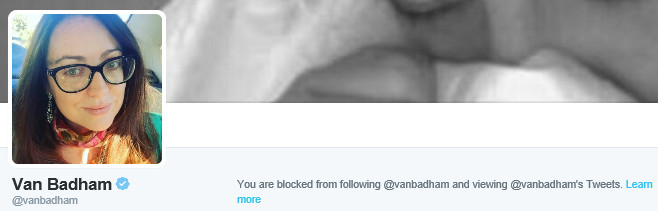
Mark Latham spoke out strongly in the affirmative sparking the usual immediate backlash. Guardian Australia columnist and feminist activist Vanessa ‘Van’ Badham also upset a few people with her anti-male comments, and subsequently received a slew of feedback via social media. You can review her Twitter account to get a sense of the nature of that feedback. I didn’t notice anything of a particularly hurtful or threatening nature. Indeed, the comments she received were considerably tamer than the noisome effluence that is Van’s contribution to social media.

vanbadham6

Nevertheless, Van Badham issued the following tweet:

vanbadham5


Just as with Clementine Ford, it seems to a case of those who launch the most mud and the sharpest barbs, squealing the loudest when someone dares return fire.

Anyway, shortly thereafter I issued a few tweets in relation to the Sunrise program, one of which is shown below. These were not in response to tweets posted by Van Badham (with whom I have never previously communicated), nor were they specifically directed at her. No matter, because I had revealed myself as being one of ‘them’ rather than one of ‘us’.

vanbadham4

Van Badham chose to respond by alerting an Australian law firm who apparently use a marketing slogan “We fight for fair“. She did so in the vain hope of involving me in some sort of legal wrangle.  And in so doing she earnt a ‘like’ from her feminist colleague, journalist Wendy Tuohy, who features elsewhere in this blog.

So this is how strong independent women behave? No, but it’s how feminists behave.

This illustrates, yet again, that the default position of most feminists is to do whatever it takes to divert attention away from key issues and discourage public discussion thereof. And this means shutting-down and/or isolating dissenters as quickly possible, one example of this are ongoing coordinated campaigns to shut down anti-feminist Facebook pages.

Why? Because they know that their best hope of retaining credibility/power is to keep as many people as possible from recognising the expansive chasm between the ‘dictionary definition’ of feminism, and what is actually being said and done by real-world feminists. Discussion can lead to enlightenment, whilst shunning and censorship is more likely to preserve the status quo.

But of course feminists won’t come out and admit that. They attempt to rationalise their unwillingness to respond to opposing viewpoints in other ways. In this article concerning the same TV program, Clementine Ford states:

“We need to stop wading into these debates and understand that we lose nothing by refusing to participate. We are under no obligation to defend our feminist ideals from anybody, and we certainly have no responsibility to try to ‘prove’ the necessity of them to those who feel threatened by them.”

Those who have taken the time to read other posts in this blog would have noted that the theme of feminist-imposed censorship emerges again and again in the context of many gender-related issues. This is, in itself, a blazing ‘red flag’ with respect to the true nature of contemporary feminism.

Van Badham then joined that rather pathetic group of feminists/SJW who have blocked me from their social media accounts simply for questioning aspects of the misguided ideology to which they still desperately cling …

Shun this person who doesn’t support feminism! Unclean! Unclean!

vanbadham2

And predictably Van then demands the opportunity to share, what will no doubt be, a long drawn-out procession of ‘last words’ on the issue:

I have sympathy for Mark Latham. He’s barking at a cloud that’s passed him by (4 May 2016)

Van Badham and Steve Price went head-to-head on Q&A (12 July 2016) See also this article in The Age. Response from  Steve Price here.

Van Badham reveals ugly response to Steve Price’s comments about her (14 July 2016) And of course, her own words and behaviour played no role whatsoever with regards to the subsequent public reaction. Yup, sure. Let’s make it all about Steve … and misogyny. And to suggest that Steve’s solitary off-the-cuff comment constitutes “demonisation” is absurd posturing on Van’s part.

Look what I found in a Reddit discussion thread about Van Badham’s stouch with Steve Price … apparently Van wanted to put Tony Abbott underwater. Wait, where have a heard a comment like that before? Oh yes, Eddie McGuire.

From The Spectator, ‘Van Badham and the ugly facts of an ugly matter‘ (15 July 2016)

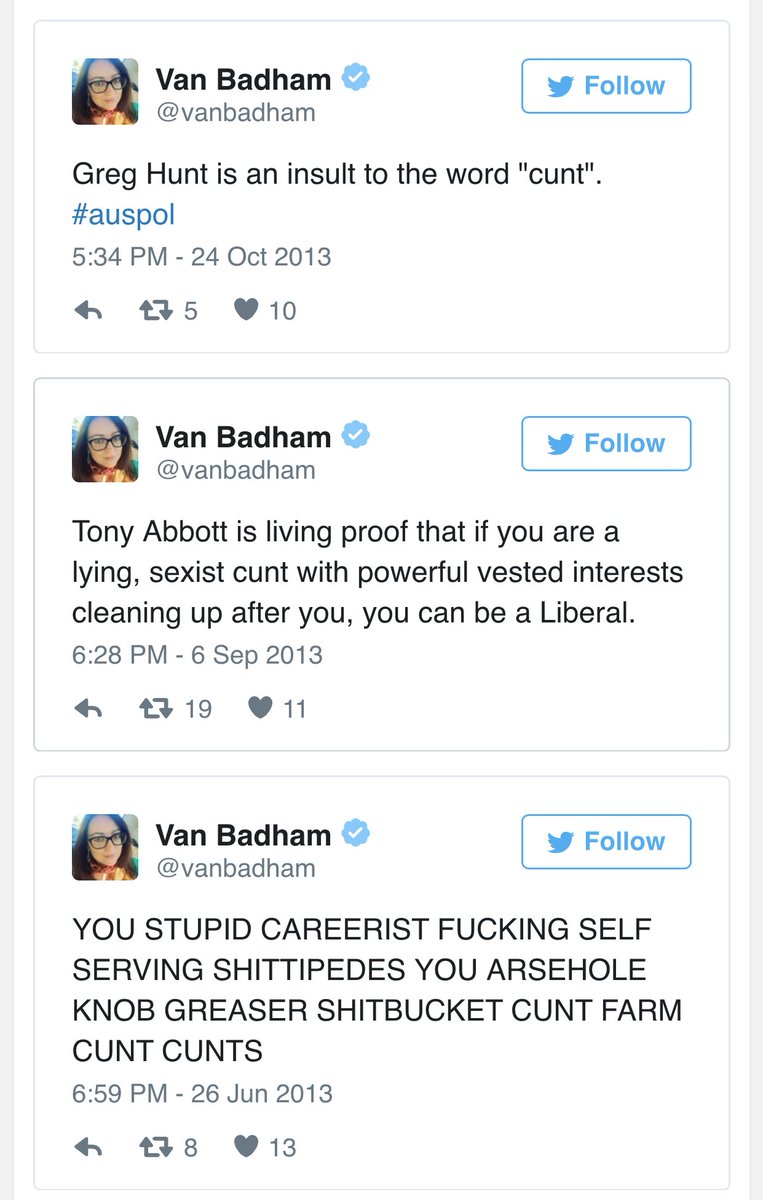
Readers might care to seek out a tweet by @RitaPanahi on 12 July 2016 for further examples of what Ms Badham considers appropriate to dish out (but not receive). Gems such as:

badham

And on a parting note, an item by Andrew Bolt entitled ‘How Van Badham attacks even children‘ (2 March 2017).

Release of the Final Report of the COAG Advisory Panel on Reducing Violence against Women and their Children

The final report of the Council of Australian Governments (COAG) Advisory Panel on Reducing Violence against Women and their Children was provided to COAG on Friday, 1 April 2016. See this page for a link to download the report, and this page for background information concerning the work of the panel.

Yes, add this to the already long list of Australian government inquiries into domestic violence. The mind boggles at the combined costs of these reports. It would surely be enough to pay for – oh, let’s see – behaviour management programs for female offenders in each state plus a network of refuges for men and *their* children.

It would be one thing if these inquiries were reaching out to different groups and generating new and different ideas – but in the case of gender issues like DV the reverse is true. It’s always the same faces on the panels, consulting the same groups, bringing forward the same ideas based on the same ideology. And all the while with no concrete progress being made save for a succession of costly PR-value-only campaigns farmed out to the same ‘old girls club’ consultancies.

The Panel delivered its preliminary advice to COAG in July 2015. The Australian Government adopted all of the Panel’s recommendations through the $100 million Women’s Safety Package.

The Panel delivered its second report in December 2015 and recommended priority actions which were all endorsed by COAG. This included a national domestic violence order scheme, the development of national outcome standards for perpetrator interventions, and a national approach to dealing with technology-facilitated abuse.

The members of the Advisory Panel are Ken Lay (Chairman), Rosie Batty (Deputy Chair), Heather Nancarrow (Deputy Chair), Maria Hagias, Darren Hine, Dr Victoria Hovane, Ms Tracy Howe, Mr Edward Mosby, Ms Julie Oberin, The Hon Bess Price MLA, and Ms Sue Salthouse.

“The Panel recommends that a new approach be adopted by all governments to achieve generational and lasting change:

  • Men must be held to account for their actions and supported to change
  • Responses must focus on empowering women and their children to make informed choices
  • Political leaders, businesses, industry and the broader community all need to commit to collective, long-term action to improve gender equality and change violence supportive attitudes
  • Children and young people must be recognised as victims of violence against women
  • Aboriginal and Torres Strait Islander communities need trauma informed responses, and
  • Integrated responses are required to keep women and their children safe.

The Panel’s Final Report includes 28 recommendations for COAG’s consideration, with innovative, practical and deliverable options for further joint Commonwealth, state and territory work to reduce violence against women and their children.”

This is the first I had heard of this report, and even then I only became aware of it via reading the Twitter stream of a feminist politician. So much for publicising the exercise beyond the feminist encampment.

“In developing its advice, Panel members undertook over 120 separate consultations with stakeholders and experts in primary prevention, victim support services, perpetrator treatment, technology, law enforcement, research and education, and the business community.

Targeted consultations were also undertaken to discuss specific issues in relation to children, women with disabilities, women from culturally and linguistically diverse communities and Aboriginal and Torres Strait Islander women and their children.”

How many such consultations were with father’s or mens rights groups or advocates? I have scrolled through the list in the report, and I can’t recognise any. Of those groups and individuals who were approached for input, were there many that did not subscribe to the dominant feminist view of domestic violence? Was there even one?

Based on my first glance at the report it appears to ignore male victims entirely. In fact I just word-searched the report using the term ‘male victims’ and got not one hit. Not an encouraging sign, yet not unexpected. The report also clearly implies that all perpetrators of domestic violence are male. And irony of ironies, there is a section on gender bias amongst people working with DV victims which only acknowledges gender bias against women.

Just to remind readers, if it were even necessary, that at least one in three victims of domestic violence are male.

I honestly cannot fathom how the panel members, all of whom would probably have fathers/brothers/sons, can sleep at night knowing they were complicit in an exercise wherein the basic human rights of so many were so cruelly disregarded.

Elsewhere in this blog you might also be interested in reading:

So what exactly is the ‘Domestic Violence Industry’?

Two awareness campaigns. Only one can be criticised. Cowed by feminism?

Australian taxpayer-funded organisations that do little/nothing for men (other than demonising them)

When banks divert from banking to social engineering

Mid-way through 2015 the ANZ bank in Australia opted to join the chorus of ‘enlightened’ corporate entities banging the feminist drum at their customers expense.

The bank’s first step was to release the ANZ Women’s Report: ‘Barriers to Achieving Financial Gender Equity’. And no, in case you wondered, there is no corresponding ANZ Men’s Report. There never is. This despite the fact that, in this instance, many men also “fall behind and retire in poverty“.

“For many years people have been trying to tackle issues around gender equality by asking men and women to change. This approach will not work.

What we need to do is to look at the systems that are holding women back from achieving their full potential. And when we’re talking about systems we’re referring to structures and practices in our schools, workplaces, businesses and community that reinforce biases. These systems need to be redesigned so they are fairer for women, recognise the unique strengths and talents of both genders, and equally support the success of both genders.”

So apparently we can’t ask women to change what they’re doing, even if it directly contributes to their predicament. Nope, we have to change the “systems“.

Since then various related ‘initiatives’ have emerged such as ideologically correct videos (below), and a decision to contribute an additional $500 into the superannuation accounts of female staff based on the feminist misinterpretation of the gender pay gap.

Being unhappy about witnessing this regressive move I contacted the bank, firstly via Twitter and then email, to express my concern and dissatisfaction. Our subsequent email exchange is shown below:

“Thanks for getting in touch with us to provide feedback relating to ANZ Women’s Initiative that was launched on the 29 July 2015. This kind of feedback is valuable to us because it helps us better understand what’s important to our customers. 

ANZ is committed to being a socially responsible bank, and we believe that from time to time we have a responsibility to take action on important social issues. We understand that some of our customers and employees hold different views on our decision to make additional superannuation contributions for our female employees, and we respect your right to hold this view.

Research shows that in Australia, women retire with 47% less superannuation than men – and 1 in 5 women yet to retire has no superannuation at all. This is driven by a range of complex factors.  However, on average women retire earlier and live longer than men, so the importance of having enough superannuation is even greater for women.

ANZ has weighed up all of these factors and is comfortable that the payment to female staff is a positive step that will help women to overcome the gap.

ANZ takes the issue of discrimination very seriously and in developing these new measures considered the relevant Sex Discrimination and Anti-Discrimination Laws. The payment is permitted under Australia’s anti-discrimination laws because it is a “special measure” designed to address this super gap that our research clearly demonstrates between men and women.

Our action has the full support of the Sex Discrimination Commissioner at the Australian Human Rights Commission. The Sex Discrimination Commissioner advised ANZ that, in her view, ANZ’s initiative is consistent with the objects of the Federal Sex Discrimination Act. ANZ has also been given a 10 year exemption from the NSW Anti-Discrimination Commission (because NSW is the only State where the anti-discrimination legislation does not contain a “special measures” exception).

 ANZ views this initiative as a positive step to support women and help close this gap in superannuation savings so they have greater security in retirement. While you may disagree, we do appreciate you taking the time to provide us with this feedback.”

I wrote back to the bank:

“Thank you for your prompt response. I disagree with your rationale for promoting feminist policies at the expense of your customers and shareholders. My original position on this matter remains unchanged and unresolved.

1. Whether women retire with less or nil Super is a reflection of their personal choice. Choice about what type of training they undertook, choice about what field of work in which they seek employment, choice about how much overtime they do, choice about whether they take time out during their careers.

2. Those women who choose to get married often then have the choice to be stay at home mum’s (and be supported by their partner) or not. Most women enter marriage with less assets then their partners, or in debt. Most divorces are initiated by women, who then tend to walk away often with in excess of 50% of their partners assets, even when those assets were accumulated prior to the marriage.

3. The wage gap is a much debunked misrepresentation of the true situation in relation to income received by men and women and cannot be validly used to ‘prove’ gender discrimination. That issue is discussed in this article – http://www.fighting4fair.com/uncategorized/the-myth-of-wage-disparity/

4. Women live longer in large part because disproportionately more is spent on research into women’s health and on the treatment of women’s health issues, and because men are more likely employed in relatively more stressful and higher risk occupations (one reason why they are, on average, in receipt of higher incomes)

In summary for every disadvantage suffered by women there are benefits or advantages, as is the case for men. Therefore it is inappropriate and discriminatory to single out women for incentives/rewards for real or imagined discrimination faced by them, but at the same time to ignore issues that negatively impact on men.

The fact that the additional payment to women by ANZ was ratified by the former AHRC sex-discrimination commissioner is more a reflection of her partiality and gender bias rather than vindication that ANZ’s policy was truly a fair and appropriate one. That issue is discussed in this article – http://www.fighting4fair.com/uncategorized/gender-bias-at-the-australian-human-rights-commission/

And the bank duly wrote back:

“Thank you for your email and further feedback which has been noted. As your concern is regarding a policy decision made by ANZ, the Customer Advocate will not become involved. It is not the role of the Customer Advocate to review or change a matter that relates to ANZ’s setting of staff benefits. If you wish to escalate your concern you may contact the Financial Ombudsman Service.”

Whereupon I said:

“Thank you for your prompt response but my concerns with ANZ’s decision to re-orientate itself in lockstep with feminism philosophy runs deeper than simply the $500 payment to female staff. In the absence of other options I will now investigate/consider the appropriateness of lodging a submission with the Financial Ombudsman Service”

It’s not just banks doing this … it’s not just about financial benefits … and the implications extend beyond staff of the relevant company

Since forever many companies have wanted to do good in their local communities, or at least be seen to do good. Until recently they were content to do things like sponsor a local football team or make a donation to a charity. Although the worthy causes were usually unrelated to the business of the company, these were small benign gestures that troubled no-one. How quickly that has changed in the space of just a few years.

Now were are seeing companies expend large amounts of money and time on causes that can be polarising and contentious. The implications of adopting (often judgmental) public positions on these issues or causes can flow through to staff, customers, shareholders and then out into the broader community.

With the superannuation issue there was a tangible benefit for staff, well, for some staff. As this trends builds, and with these other issues, there are both carrots and sticks being employed. The sticks can include shunning/shaming or even dismissal for staff who don’t embrace the company line and engage in wrong-think.

Workplace intimidation silences lawyers critical of same-sex marriage (30 August 2017)

“Solicitors have complained of being intimidated at their workplaces if they publicly criticise the endorsement of same-sex marriage by their professional association and law firms … He said it was wrong for the Law Society and the Bar Association to express any view on same-sex marriage because it was peripheral to the central concerns of both organisations.”

The market for virtue: why companies like Qantas are campaigning for marriage equality (28 August 2017)

How James Damore went from Google employee to right-wing Internet hero (12 August 2017)

See also:

Experts on why women should be asking for super during divorce (14 April 2025)

Huge reaction as Toyota shifts away from DEI and pro-LGBTQ events (8 October 2024) Ooh, and a company grows out of the woke thing

Jetstar boss Steph Tully’s plan to change entire Aussie industry (18 September 2024) And now airline management feel the need to bang the feminist drum.

Women and wealth, by Bettina Arndt (19 August 2024)

Does virtue signaling in advertising impress you or depress you? It’s time to take a look at ESG (6 September 2023)

‘Significant concerns’ in Downing Street as NatWest boss quits over Farage leak (26 July 2023)

Weaponising banks against men, by Bettina Arndt (6 July 2023)

NAB takes on financial abuse (26 June 2023)

NAB cracking down on financial abuse (26 June 2023)

Redesign banking products to protect women from financial abuse: Report (22 November 2022)

Bankwest Curtin Research Centre – take a look at their publications and media releases. See if you can find any gender-related topic that isn’t covered in a manner consistent with feminist ideology.

Inconvenient truths about impoverished women and privileged men, by Bettina Arndt (11 April 2021)

Commonwealth Bank launches anti-domestic violence and financial abuse initiative (20 July 2020) Such initiatives can be positive – should be positive – if not for what seems to be a compulsion to ‘white-out’ all trace of abusive women and male victims of abuse.

Young women drain their super accounts (18 June 2020) Australia

Raise women’s super to 15%: Victorian Labor (12 February 2020) The gynocracy warmly welcomes the assistance of fem-compliant governments. Yet another case of #GenderEqualityWhenItSuits

NAB promotes #EndToViolence (November 2017) with further details in their web site

Did Westpac just mansplain gender diversity to its competitors? (26 October 2017) Westpac learns, as have countless male feminists, that no matter how much you pander to feminist nonsense, you will still be subjected to harsh criticism.

Westpac under fire over same sex marriage email (5 October 2017)

“Westpac has been forced to defend an email from a staff networking group telling fellow employees to vote Yes in the same-sex marriage survey, erroneously claiming that doing so would prevent 3000 suicides a year”

What? No, Women Shouldn’t Be Paid More Super Than Men, by Corrine Barraclough (26 May 2017)

Why we’re backing women, by Lorraine Murphy, National Australia Bank (6 March 2017)

Young women can budget in the short term but struggle with long-term investments: survey (14 February 2017) A very gynocentric article, but which does support the value of addressing financial literacy/skill to enhance post-retirement financial status.

Banks preaching about gender wage gap myth, by Rita Panahi (28 October 2016)

Female tech leadership to get $1m boost (4 October 2016)

Shareholders slam CBA’s ‘diversity’ bonus (27 September 2016) Australia

It would seem that National Australia Bank has now jumped on the bandwagon (August/September 2016) See below and here. Perhaps trying to regain their feminist cachet after an earlier #fail

nab

I see that both ANZ and NAB have directors on the board of Diversity Council Australia. DCA are, amongst other things, the organisers of this feminist talk-fest planned for November 2016.

CEOs say women will be promoted and men should get used to it or leave (24 August 2016)

Radical proposal to force bosses to fork out extra super for women (3 June 2016)

Angus Aitken out at Bell Potter after ANZ Michelle Jablko email (26 May 2016) with further background to this episode in this interview with Kate Jenkins

Tweet from Paul Edwards, Group GM Corporate Communications at ANZ. So now it’s forbidden to criticise women in the finance sector (misogyny!). In the words of Miranda Devine: “Where is the sexism? You know what damages women? Cheap virtue signalling PC BS like this”

The Superannuation Gender Gap (21 April 2016) Australia. Related reddit discussion thread here

Australian bank buys into the gender pay gap rubbish (9 April 2016) with related Reddit discussion thread here. Note the observation about the Bank disabling comments on their Facebook page and cleansing earlier comments – as feminists are wont to do.

Australian bank ANZs new ad. Pushing the wage gap myth on children (March 2016) Reddit mensrights discussion thread

‘Blatant sexism’: ANZ’s #equalfuture campaign cleared of discriminating against men (4 September 2015)

ANZ pays women extra super (31 August 2015) A very long-running discussion in the Whirlpool online forum

ANZ bank giving female employees an extra $500 to correct gender pay gap (August 2015) Reddit mensrights discussion thread

ANZ Bank launches a super deal for female employees (29 July 2015)

ANZ pushes its new gender diversity measures in national campaign (29 July 2015)

This article suggests that women might be better off considering the impact of financial literacy on their retirement savings, rather than complaining about the wage gap.

Postscript (19 September 2018) Today Bill Shorten, Australian federal leader of the Opposition, announced a $400 million scheme to support women in relation to their retirement Super balances

Image

My submission to the 2016 Federal Government Inquiry into Domestic Violence and Gender Inequality

Introduction

Thank you for permitting me the opportunity to contribute my thoughts in relation to the work of the Inquiry, and concerning the pressing issue of domestic violence generally.

I believe the Inquiry’s Terms of Reference to be ill-considered, inappropriate, and strongly indicative of ideological bias. In what appears to be akin to a ‘dorothy-dixer’[1] on the floor of parliament, the Terms of Reference appear to have been formulated with the intention of producing a report that simply justifies a continuation of the existing failed gender-biased approach to combatting domestic violence. In so doing it seems that remaining in lockstep with the feminist movement has been accorded a higher priority than actually addressing the problem via constructive debate about the full range of potential causes and solutions of/for DV.

I fully anticipate that the only new development to arise from the Inquiry will be leveraging the Committee’s ‘findings’ in order to be institute progressively higher levels of government funding for the Domestic Violence Industry[2]. Funding for which there will likely continue to be few, if any, controls or oversight in relation to performance monitoring and accountability.

The Committee has opted to pursue a biased, parochial and blinkered approach to a complex social issue about which there are many views but few certainties. It is an approach which, based on nothing more than the cherished belief of one particular lobby group, pre-empts consideration of other, quite likely more relevant, factors.

A strong consensus exists – beyond the confines of the feminist encampment – that several factors jointly bring about patterns of domestic violence. Gender inequality is but one of these. Parental abuse and neglect of children who subsequently grow up to become perpetrators being another. I would join others in suggesting that gender inequality is, in itself, generally a relatively minor factor. Indeed, I believe that in many cases it bears little or no influence at all.

In what has become an established tactic, however, anyone proposing that gender equality is not a pivotal factor underpinning domestic violence is shamed and threatened.[3] [4] [5] [6] The Terms of Reference of this Committee will clearly only strengthen the resolve of those who encourage and pursue such totalitarian and counter-productive behaviour.

Committee members, this is not the type of approach to adopt if you genuinely wish to identify and then win support for truly effective strategies to remedy complex social problems.

Might I suggest that the reference to ‘education’ (in the Terms of Reference) was intended to generate expressions of profuse support from the feminist faithful for further ‘public awareness campaigns’[7] and school programs[8]. This despite the fact that I am yet to learn of any conclusive proof with regard to the value of either of these strategies. Excepting of course their value to those pro-feminist advocacy groups and consultancies who will find themselves in receipt of generous allocations of public funds[9]. Additionally, in both cases I would suggest that a case could be made that such programs also have the potential to bring about certain negative outcomes.

As to diverting the discussion to examine the likely impact of toys and entertainment on the incidence of domestic violence? I feel that would likely constitute a poor investment of time and resources … these being inconsequential yet over-stated minutia in the overall scheme of things.

I reject the following positions in relation to gender equality and domestic violence:

That gender inequality is the primary contributing factor with respect to the incidence of domestic violence in Australia

That the overall picture of gender inequality in Australia is one that strongly favours men/boys

That in the overwhelming majority of cases, domestic violence manifests itself in the form of men abusing women

In contrast, individuals and organisations who ascribe to feminist ideology would count amongst the core supporters of those statements noted above. Bearing that in mind I would suggest that the Committee be mindful of the following:

  • The term ‘feminist’ is not inter-changeable with ‘woman’ or ‘women’ given that only a small minority of women identify as feminists [10]
  • Feminists do not hold any form of mandate to speak on behalf of Australian women
  • Feminists have a strongly vested interest in painting domestic violence as a gendered issue involving male violence towards women, including a substantial and growing pecuniary interest [11]
  • Feminists have a well-established ‘track record’ of engaging in biased and academically flawed research, and in misrepresenting research undertaken by others in order to support their position and/or to undermine the position of those holding alternate views.[12] [13]

These last two dot points imply a need to subject the statements and conduct of feminists and feminist organisations to some reasonable standard of scrutiny, rather than simply accepting them at face value.

Gender inequality as the primary contributing factor with respect to the incidence of domestic violence in Australia

The theoretical cornerstone of the feminist approach is the ‘Duluth Model’ which is discussed in this rather illuminating email exchange[14]this academic paper[15], and in various posts in my blog[16]. In a nutshell, applying this framework to most (let alone all) incidents of DV is highly misleading and inappropriate.

Further, if gender inequality is the single greatest determinant of domestic violence then:

Why is the incidence of domestic violence greater in lesbian couple than in heterosexual couples?[17]

How might one explain the already high and growing levels of female-perpetrated violence generally?[18]

How might one explain the significant geographical variations in the incidence of domestic violence? (refer chart which follows)

Why does there exist a very considerable number of male victims of domestic violence? [19] [20]

How might one explain the relatively high levels of child abuse and neglect involving single mothers? [21]

Why is the level of domestic violence so high in countries like Sweden that, even feminists would agree, have a higher than average level of gender equality?

These categories or situations of domestic violence are not the inconsequential anomalies that many propose them to be. On the contrary, they constitute very large and substantial pieces of the domestic violence jigsaw.

highrateDVareas

In an intimate partnership between two people of different genders, an unequal balance of power can be a factor contributing to DV. But what feminists refuse to concede is that the partner asserting most power need not be male, and often isn’t.

The Inquiry’s Terms of Reference are based on the premise that it is an established and undeniable fact that gender inequality is the predominant factor behind domestic violence. This is absolutely not the case. On the other hand, there are many others in the community who hold differing views – views similar to my own. In this submission I will introduce you to sources of information that very much counter the feminist position of domestic violence.

On the suggestion that the overall picture of gender inequality in Australia is one that strongly favours men/boys

Let’s assume for a moment that gender inequality is in fact the predominant trigger for the initiation of domestic violence. So just how much gender equality is present in Australian society? The feminist position is that there is a great deal of gender equality, and that it is strongly biased in favour of men/boys. I do not believe this to be the case. Feminists have a pronounced tendency to overstate or imagine disadvantages faced by women, whilst conveniently overlooking the many disadvantages faced by men/boys.

The indicator most commonly advanced by feminists to ‘prove’ the existence of gender equality is the gender wage gap. This use of the wage gap statistics for this purpose is misleading has been thoroughly debunked.[22] [23]

The next most commonly cited statistics are those concerning the number of male vs female politicians and CEO’s. Yes there is obviously an imbalance but again this need not be indicative of gender discrimination nor inequality.[24] Indeed if this were the case then surely there would be a Minister for Men’s Affairs, or at least men’s/boys divisions within government agencies – of which there are none.  Not only is there no advocacy for men/boys whatsoever, there exists active discrimination against them in many agencies including for example the Australian Human Rights Commission.[25] [26]

In terms of various other indicators of equality I would draw the Committee’s attention to the material contained in these two overseas sources:

http://philosophyofmensissues.blogspot.ca/2014/10/evidence-re-gender-equality-and-feminism.html

http://www.avoiceformen.com/the-facts-about-men-and-boys/

On the suggestion that, in the overwhelming majority of cases, domestic violence manifests itself in the form of men abusing women

IF gender inequality was the primary cause of domestic violence, and IF there was rampant gender inequality in Australian, and IF that inequality favoured men/boys, then one would expect that almost all cases of domestic violence involved men abusing women. But is this the case? No, it is certainly not the case.

I would draw the Committee’s attention to the sources listed below, with many further sources available online[27]. These all demonstrate that at least one third of the victims of domestic violence are males.

References examining assaults by women on their spouses or male partners: An Annotated Bibliography by Martin S. Fiebert.[28] This bibliography examines 286 scholarly investigations: 221 empirical studies and 65 reviews and/or analyses, which demonstrate that women are as physically aggressive, or more aggressive, than men in their relationships with their spouses or male partners. Here is a link to an updated June 2013 version of Fiebert’s bibliography.[29]

Partner Abuse, Volume 1, No. 1, 2010 The new journal was created to showcase academic research into domestic violence without gender bias[30]

Partner Abuse State of Knowledge Project – Facts and Statistics on Domestic Violence at-a-Glance.[31] Sponsored by the Journal Partner Abuse, November, 2012. This study is also discussed in this article:

Male Victims of Intimate Partner Violence in the United States: An Examination of the Review of Literature through the Critical Theoretical Perspective, by Caroletta A. Shuler (2010)[32] and related reddit discussion thread[33]

Boys Victims of Dating Violence, Too[34] (29 January 2016) USA

Extensive listing of mainly North American research findings related to domestic violence[35] (29 April 2015)

Family violence in Canada: A statistical profile[36] (27 January 2011) This study found an almost equal numbers of male and female victims of DV

Partner Violence as Female-specific in Aetiology[37]

Intimate partner violence: Facts and statistics[38] (1 September 2014) This paper includes some discussion of ‘Patriarchal Dominance’ theory

Domestic violence rates are higher for homosexual couples than for heterosexual couples[39] (18 November 2013)

Differences in Frequency of Violence and Reported Injury between Relationships with Reciprocal and Nonreciprocal Intimate Partner Violence[40] (2006), which includes this statement:

“Almost 24% of all relationships had some violence, and half (49.7%) of those were reciprocally violent. In non-reciprocally violent relationships, women were the perpetrators in more than 70% of the cases.”

The graphic that follows, for example, was sourced from a Canadian organisation (www.saveservices.org). Interestingly, broadly similar patterns of perpetration have been observed in the UK, USA, Australia and Canada (although Australian lags somewhat in terms of the information available on male victimisation/female perpetration).

women_as_abusers


In closing I would invite members of the Committee to take a few moments to also read my submission to the recently-released Victorian Royal Commission on Family Violence[41], given that that document provides further relevant background information concerning certain matters that will also likely be addressed in this current Inquiry.

I wish the members of the Committee well in their endeavours, and I sincerely hope that the concerns I have expressed in this submission prove to be unfounded.

[1] https://en.wikipedia.org/wiki/Dorothy_Dixer

[2] http://www.fighting4fair.com/uncategorized/so-what-exactly-is-the-domestic-violence-industry/

[3] http://www.fighting4fair.com/uncategorized/a-message-to-supporters-of-the-white-ribbon-campaign-feminist-version/

[4] http://www.fighting4fair.com/uncategorized/sallee-mclaren-must-write-on-the-blackboard-i-must-not-challenge-the-feminist-narrative-domestic-violence/

[5] http://www.mamamia.com.au/miranda-devine-unsuitable-women-article/

[6] http://www.fighting4fair.com/uncategorized/beware-the-ire-of-an-angry-feminist/

[7] http://www.fighting4fair.com/uncategorized/two-awareness-campaigns-only-one-can-be-criticised-cowed-by-feminism/

[8] http://www.fighting4fair.com/uncategorized/no-place-for-feminist-propaganda-in-our-schools/

[9] http://www.fighting4fair.com/uncategorized/so-what-exactly-is-the-domestic-violence-industry/

[10] http://www.fighting4fair.com/uncategorized/some-indicators-that-feminism-is-no-longer-worthy-of-trust-or-support/

[11] http://www.fighting4fair.com/uncategorized/so-what-exactly-is-the-domestic-violence-industry/

[12] http://www.fighting4fair.com/uncategorized/fudging-the-figures-to-support-the-feminist-narrative-domestic-violence/

[13] http://www.fighting4fair.com/uncategorized/on-blocking-out-non-feminist-perspectives-and-opinions/

[14] http://www.naasca.org/2015-Articles/032915-TheDuluthModel-JasonDale.htm

[15] http://ncfm.org/libraryfiles/Children/DV/Gender%20Paradigm%20In%20Domestic%20Violence.pdf

[16] http://www.fighting4fair.com/#Domestic Violence

[17] http://www.breitbart.com/london/2015/05/07/attack-of-the-killer-dykes/

[18] http://www.fighting4fair.com/uncategorized/on-the-recent-increase-in-violent-crime-carried-out-by-women-and-girls/

[19] http://www.fighting4fair.com/uncategorized/domestic-violence-one-sided-media-coverage-and-bogus-statistics/

[20] http://www.fighting4fair.com/uncategorized/on-the-experience-of-male-victims-of-domestic-violence/

[21] http://www.fighting4fair.com/uncategorized/mostly-female-perpetrators-so-child-abuse-is-a-gendered-crime-then/

[22] http://www.fighting4fair.com/uncategorized/the-myth-of-wage-disparity/

[23] http://www.fighting4fair.com/uncategorized/that-tired-old-feminist-chestnut-that-is-the-gender-wage-gap-resurrected-in-australia/

[24] http://www.fighting4fair.com/uncategorized/less-than-5050-representation-does-not-automatically-imply-gender-bias/

[25] http://www.fighting4fair.com/uncategorized/gender-bias-at-the-australian-human-rights-commission/

[26] http://www.fighting4fair.com/uncategorized/australian-taxpayer-funded-organisations-that-do-littlenothing-for-men/

[27] http://www.fighting4fair.com/uncategorized/domestic-violence-one-sided-media-coverage-and-bogus-statistics/

[28] http://www.csulb.edu/~mfiebert/assault.htm

[29] https://j4mb.files.wordpress.com/2014/03/140901-martin-s-fiebert-bibliography.pdf

[30] http://www.responsiblerecovery.org/PDF/PartnerAbuse.pdf

[31] http://www.domesticviolenceresearch.org/pages/12_page_findings.htm

[32] http://fathersunionaustralia.com/wp/partner-abuse-state-of-knowledge-project-the-gold-standard-of-domestic-violence-information/

[33] http://np.reddit.com/r/todayilearned/comments/37t7cp/til_that_47_of_male_victims_of_domestic_abuse_are/

[34] http://www.medicinenet.com/script/main/art.asp?articlekey=193363

[35] http://www.mrarchivist.com/frm_display/explore/?item=&topic=Intimate%20Partner%20Violence&nation=United%20States

[36] http://www.statcan.gc.ca/daily-quotidien/110127/dq110127a-eng.htm

[37] http://www.newmalestudies.com/OJS/index.php/nms/article/view/149

[38] http://www.sciencevsfeminism.com/resources/intimate-partner-violence-facts-and-statistics/

[39] https://winteryknight.wordpress.com/2013/11/18/domestic-violence-rates-are-higher-for-homosexual-couples-than-for-heterosexual-couples/

[40] http://ajph.aphapublications.org/doi/abs/10.2105/AJPH.2005.079020

[41] http://www.fighting4fair.com/uncategorized/submission-to-the-victorian-royal-commission-on-family-violence-may-2015/
Regarding the report of the Victorian Royal Commission on Family Violence

My initial blog post on this issue, which includes a copy of my submission, can be accessed here. The final report of the Royal Commission can be accessed here. (Oh, and here’s the latest Victorian DV ‘initiative’ as of February 2024)

Men constitute a demographic group the same size as do women. The Commissioners admitted that one in four victims of DV are male (although that’s understating the correct figure). And yet here we see the discussion of male victims tucked away in a section of the report dealing with the needs of various minority groups. I recently observed the same approach being taken in the recent Queensland DV Inquiry.

Still it could have been worse, for male victims didn’t even rate a mention as constituting even a minority group in the Issues Paper produced by the Commission in March 2015 (refer clause 35).

And so in the final Royal Commission report a sub-section entitled ‘Male Victims’ can be found in Volume 5, which includes discussion of each of the following affected groups in the community:

Aboriginal and Torres Strait Islander peoples (60 pages)
Older people (32 pages)
Culturally and linguistically diverse communities (32 pages)
Faith communities (10 pages)
Lesbian, gay, bisexual, transgender and intersex communities (26 pages)
People with disabilities (38 pages)
Male victims (10 pages)
Rural, regional and remote communities (22 pages)
Women in prison (14 pages)
Women working in the sex industry (8 pages)

(Men in prison and men working in the sex industry are apparently exempted from involvement in family violence).

At ten pages in length the ‘Male Victims’ sub-section constitutes 0.48% of the bulk of this mammoth 2,082 page report, and features only two of the report’s 227 recommendations. The Commission’s report, by the way, cost $13.5 million.

Recommendation 180. The Victorian Government publicise and promote the Victims Support Agency in any information campaign relating to family violence as the primary source of assistance for male victims. The agency should also provide appropriate online resources for male victims [within 12 months].

Recommendation 181. The Victims Support Agency continue to receive all police referrals (L17 forms) relating to male victims, including after the establishment of the Support and Safety Hubs. The agency and all other relevant support services should develop joint arrangements to ensure that male victims of family violence are supported in obtaining the help they need [within two years].

Forgive me, but after reading these, the earth isn’t exactly moving for me. You’d think that if the Commissioners were only going to allocate two recommendations specifically in relation to the needs of male victims, then they might have come up with something a little more incisive and substantial than these.

One only has to read as far as the second paragraph of the ‘Male Victims’ section to see male victimisation being minimised. Do you recognise the following gem of many earlier pro-feminist reports/papers on domestic violence?

“Violence by women towards male partners is generally less severe than that of men towards their female partners.” (No citation provided)

On p209 I note the statement “A lack of data makes it difficult to determine the extent of the service gap for male victims of family violence.” And yet no subsequent recommendation that suitable research be undertaken.

Then on p210 “A number of men expressed a particular sense of injustice in connection with family violence intervention orders. In particular, some said the justice system was unable to differentiate between ‘true perpetrators’ of family violence and those men who were ‘set up’ by a female partner.

Conversely, the Commission heard that it was common for male perpetrators of family violence to blame their situation on unfair legal processes, rather than accepting responsibility for their own behaviour.” (The latter attributed to community legal service with no evidence provided of statistical validity)

My initial impression of the report prior to undertaking a more thorough reading?

I’m disgusted. By no means surprised. But most definitely disgusted.

With regards to its treatment of male victims, the Commission’s report represents nothing more than a token effort at providing a semblance of the level of support and compassion provided for female victims of domestic violence.

We really do still have a very long way to go to achieve gender equality and justice in this regard.

The most positive aspects of the report I can see thus far are that:

    • Some attention was given to the need for greater oversight, review and performance measures in the provision of domestic violence services. This is an issue that I addressed in both my submission, and in my blog post in relation to the Domestic Violence Industry.
  • Some attention was given to the significance of the impact of domestic violence (and presumably child abuse and neglect) on children with regards to its effect in creating a generational cycle of abuse. This is, I believe, a causal factor which is far more significant that gender inequality. (Postscript: Unfortunately however it seems that the rapporteurs have even managed to apply gender bias to this issue – see comments below from Greg Andresen of the One in Three organisation)

Update as of 24 Sept 2023: Family violence roles axed in public service purge

Update as of 6 March 2022: Anti-male gender bigotry is now VIC Gov’t policy

Update as of 29 May 2024: Victorian Premier Jacinta Allan creates social media backlash by creating new new role of Parliamentary Secretary for Men’s Behaviour Change

See also:

Victorian budget 2017: record spending to break family violence (2 May 2017)

Video and discussion thread concerning a gender-biased advertising campaign (17 January 2017)

Victoria Is Spending More Money On Domestic Violence Than The Federal Government (15 July 2016)

Urgent Family Violence Investment Will Help Keep Women And Children Safe (13 April 2016) Only one mention of the word “men” here, and that is in relation to behaviour change programs fos abusive men. Male victims and/or female perpetrators? Erased

‘Silent victims’: royal commission recommends better protections for child victims of family violence (1 April 2016)

Minister for Prevention of Family Violence needs to think about her own family history (1 April 2016)

Family Violence royal commission proposes policing, social services, courts overhaul (31 March 2016)

neave

Royal Commission into Family Violence: fixing the culture starts now (31 March 2016)

Royal commission calls for complete overhaul of Victoria’s family violence services and responses (30 March 2016)

Family violence: Portrait of an abuser (30 March 2016)

Royal Commission into Family Violence: what you need to know (30 March 2016)