Blog posts

Australian minor political parties and their views on feminism & men’s rights

In another post in this blog I mention the fact that there are scarcely any individual politicians in Australia, let alone political parties, that are prepared to move out of lockstep with the feminist lobby.

Also in another blog post I briefly discuss the position of the major parties on feminism and men’s rights, in the context of the 2016 Australian federal election.

In this current blog post I thought it might be interesting to put this question to some of the smaller parties. First up we hear from Senator Bob Day of the Family First Party:

“Subject: Your party’s position on feminism vs mens issues

Good morning. I would be interested to learn about the position of family first concerning the influence of feminist ideology in Australia, and
particularly in the political sphere and public service. I would also be interested to learn if FF has a position in relation to one or more of the men’s issues as nominated and discussed in my blog at www.fighting4fair.com.

Thank you, and I look forward to hearing from you in due course”

Response received on 10 June 2015:

“Thank you for your email to Senator Day regarding Family First’s position on feminism.  Feminism has brought about social change, improved treatment & representation of women and improved productivity.  These gains are now considered commonplace factors in everyday Australian life.  Our focus as a modern political party is on the question of family and how that basic foundational institution in society can be encouraged, supported and protected from harm and government excesses of power.

Family First supports the role of the family as the foundation for Australian society, and acknowledges that male and female are complimentary, each able to make valuable contributions to the community. We encourage you to visit Senator Day’s website: www.senatorbobday.com.au  or Family First’s website www.familyfirst.org.au for further information.

Your blog www.fighting4fair.com discusses many different issues with a common theme being the role of male and female within the family sphere (domestic violence, legal custody battles, or matters pertaining to parenting in general). Regarding this matter, Family First supports the traditional family and whatever can be done to ensure that families with children stay together.  The sad reality today is that many relationships fail, and then there are public policy questions about dealing with the breakdown.  Thankfully, throughout the Australian community there are in the majority of cases accepted norms about how child access and support is resolved after separation.

A great many families resolve their post-breakdown arrangements without resort to lawyers, violence or alienation of a parent from their child or children.  Often they do so to put the children first, and the parents’ disputes second.  Regrettably, in some cases the breakdown is so acrimonious that violence and/or alienation of a parent occurs.  Moves in recent times to exclude lawyers and prefer mediation at the first opportunity have been welcome shifts away from adversarial resolution of post-breakdown child support and access questions, towards an approach that focusses on what is agreed between the parents.

Family First supports a child having the involvement of a father and mother in their life.  Studies show this is vital to their healthy development.  However, it must be stressed that there are exemptions to this position.  Modern society now has a myriad of social problems, from drug, alcohol and other substance abuse; to domestic violence; to child physical and/or sexual abuse.  Mental health of children and/or parents is also a major factor in family breakdown.  Children must be protected from situations that might expose them to harm.  The court system is so overwhelmed with allegations of this behaviour that it is rare that it gets to the bottom of those allegations.

The handling of family breakdown is further complicated by yet another example of state and federal jurisdictional ambiguity.  States and territories are responsible for laws concerning child protection and domestic violence, whereas federal law regulates child support and family law concerning post-breakdown child access and distribution of property.  At times the two areas do not connect properly with one another, at times – for instance – seeing at-risk children ordered by a federal court to go to a parent who may place those children at risk of harm.

Senator Day appreciates that you have written to him about a current issue that concerns you.  The Senator has been elected as a Family First Senator for South Australia on a platform of “Every family, a job and a house”.  This is a massive task which promotes independence and self-reliance, reducing the need for government intervention. This leads to smaller government, lower taxes and therefore more money in the pockets of families. Senator Day therefore has a limited capacity to advocate for (a) issues outside of his State or (b) policy priorities beyond that focus.  Having said that, Senator Day has indicated above what he has to say about the issues that you have raised.”

Next I sought to profile the Liberal Democratic Party, but they did not reply to my emailed invitation to put forward their views on the issues discussed in this blog. I did however note this reddit discussion thread regarding their platform, and this article in which Bill Shorten attacks Senator David Leyonhjelm regarding his views in relation to broadasting women’s sport.

It is encouraging that Senator Leyonhjelm has since written some articles in support of a gender-neutral approach to domestic violence, such as this one. He has also done some good work in committees – see this video in particular. In this video he discusses domestic violence and diversity.

In May 2017, Mark Latham announced that he intends to join the LDP.

I then approached Australian Liberty Alliance regarding their position, and they responded:

“We don’t have a policy on every issue, for this our first campaign we are concentrating on our 20 core policies. Please see Q4 from our FAQ.
http://www.australianlibertyalliance.org.au/news-media/blog/faq-frequently-asked-questions

I approached Nick Xenophon Team and await their response. Their policy position on family violence appears gender-neutral, which is a positive sign.

Another federal parliamentarian, Bob Katter (Katter’s Australian Party) has  previously expressed concern regarding anti-male bias within the family court system.

I also approached the Glenn Lazarus Team for comment (also nil response). The Team appears to have just one gender-related policy, which relates to removing the GST on women’s sanitary products:

“The Glenn Lazarus Team believes women should not be penalised financially for the need to purchase essential items such as tampons and sanitary napkins, and all women should have access to these basic sanitary items during times of difficulty and hardship. Sanitary items are essential products for women and must be GST free.” (Source)

Independent Senator Jacqui Lambie was discussed in this blog post. More recently she had the claws out for Pauline Hanson. Hardly promising.

On that note, perhaps the most positive thing to emerge from the 2016 election campaign was the success of Pauline Hanson’s One Nation. This article appeared during the campaign: ‘Pauline Hanson claims women make frivolous DV complaints‘, with the party’s actual policy available here.

Immediately following the election we were treated to two click-bait article attacking both Pauline and advocates for men’s issues generally. In both cases the majority of readers comments were at odds with the biased views of the writers.

The first was entitled ‘How ‘angry man’ vote resurrected Pauline Hanson‘ (news.com.au). Apparently from this journalist’s perspective, when the major parties focus exclusively on women’s issues, that’s gender equality. In contrast, when One Nation proposes to address men’s issues, that’s indicative of a “blokes’ show“. Psst, Malcolm Farr, your white-knightery is showing.

A subsequent article, ‘Even for Pauline Hanson, doing the bidding of mean men is risky’, was from feminist journalist Wendy Tuohy. This very negative and scare-mongering offering paints Pauline as a foolish ingénue toying with drooling sociopaths (otherwise known as people seeking to have men’s issues properly acknowledged and addressed).

I had to laugh when I read this article in The Conversation where the academic author states – presumably not tongue-in-cheek – that for Pauline Hanson and the “paranoid right“, “the normal rules of political engagement – coherence, consistency, fact, logic, proportion – do not apply“. That which is “normal” for feminists and the regressive left? I’m thinking D-e-l-u-s-i-o-n-a-l

In February 2017 Pauline Hanson proposed mandatory pre-nuptial agreements as a means to reducing backlogs in the Family Court system. She has also pushed strongly for family law reform.

In October 2017 One Nation announced details of their policy direction in relation to domestic violencethis video shows the disappointing response from the Queensland Government (also addressed in this article, and again here).

Derryn Hinch and his Justice Party are discussed in this Facebook post by Leith Erikson from the Australian Brotherhood of Fathers

Cory Bernardi (Australian Conservatives) is making waves with this call for greater scrutiny of the pro-feminist White Ribbon Campaign.

(Footnote – April 2019: I just noticed this mostly negative review of the policies of the ‘Australian Better Families Party’)

Overseas examples

An interesting development across the water in New Zealand, where David Seymour of the ACT Party is ruffling a few feminist feathers with his proposal to introduce a Minister for Men, discussed in more detail here.

In this paper a fellow put forward some ideas for consideration by political parties in relation to the 2015 UK election … these are also useful thought-starters for Australian political parties.

Submission to the Victorian Royal Commission on Family Violence (May 2015)

Thank you for according me the opportunity to contribute my thoughts in relation to the pressing social concern that is family violence.

I am not a representative of any particular organization, and I have no pecuniary interest in the provision of services related to family violence. My motivation for preparing this submission is simply that of a concerned citizen who believes that every Australian man, woman and child should be able to live their lives free from violence and abuse.

In this submission I shall:

  • provide a few brief comments in relation to certain specific matters raised in the Commission’s Issue Paper
  • address several myths regarding family violence and explore the linkages between the origins of those myths, and the implications of their widespread dissemination in terms of the prevailing policy response
  • put forward a number of recommendations for consideration by the Commission

Within the context of the public debate and media coverage of the matter, family violence is usually portrayed as consisting of violent and controlling behavior by adult males directed at their adult female partners. Such behavior, however, constitutes only one piece of a large and complex jigsaw.

Academic researchers, on the other hand, generally consider family/domestic violence as comprising violence involving intimate partners that takes the form of man-on-man, woman-on-woman, man-on-women, or woman-on-man violence.

Such research has also identified a substantial incidence of bi-directional violence, whereby both intimate partners perpetrate violent and/or abusive acts against one another.

Others consider family violence to be even broader again including, for example, elder abuse, child abuse and neglect, and violence perpetrated by children/youth against other family members.

For the purpose of this submission I shall use the terms ‘family violence’ ‘domestic violence’ (‘DV’) and ‘intimate partner violence’ as being largely interchangeable.

Where-ever I use the terms ‘victim’ and ‘perpetrator’ I do so in a gender-neutral manner unless otherwise specified, bearing in mind that substantial numbers of people in both categories are male, female or transgender (and indeed many could be placed in both categories).

Some observations in relation to certain matters raised in the Commission’s Issue Paper 

I applaud the fact that the Commission’s Terms of Reference and Issues Paper largely avoid the gender bias that is otherwise rampant within the social debate concerning domestic violence, as well as amongst many of the staff of relevant agencies and advocacy groups. 

I wanted to address a few of the specific points mentioned in the Issue Paper now, but will do some only very briefly as I plan to address several key points later in my submission.

Point 14: “Research shows that it is overwhelmingly women and children who are affected by family violence, and men who are violent towards them. For this reason, family violence is described as being ‘gendered’. Although family violence is gendered, men may also be affected by it”

No, in fact only some research shows women and children as being victims in the “overwhelming” majority of cases. Most credible research shows the rate of male victimisation as falling in a range between 35% and 70%.

Similarly the claim that domestic violence is “gendered” is by no means universally accepted, with many researchers suggesting that categorising family violence as being gendered only deflects attention from its primary causes.

Further, the statement that “men may also be affected by it” is inaccurate, inappropriate and suggestive of gender bias. Men are affected by it. Every single day.

Point 21: “Against this backdrop, community attitudes towards family violence are of interest, and concern. For example, in a 2013 VicHealth survey …”

The unfortunate aspect of this survey was that it was designed with an ideological agenda and particular findings in mind. It did not, but should have, adopted a gender neutral approach. There should have been equal numbers of both male and female respondents, and they should have been asked identical questions about each genders. Instead, this survey only asked about attitudes towards violence/abuse of women and not towards men.

This robbed the findings of the context that was necessary in order to use them to craft appropriate public policy. In others words, for example, we don’t know whether the public is equally or even more complacent about violence against men. Thus we don’t know if we are truly observing an ‘attitude towards violence against women’ problem, or simply an ‘attitude towards violence’ problem.

Point 23: “The Royal Commission acknowledges the sustained and ground-breaking efforts of those who work in this field.” And yet the only indicator of these “ground-breaking efforts” seems to be that more violence is being reported. There is no indication provided of the costs of these initiatives and their measurable outcomes. There needs to be, and this should start now

Point 25: But have not all violent crime rates decreased during this period? Is there any evidence at all that this was due to the strategies described at point 24, or is that simply wishful thinking? I note there is no mention of the homicide rate for men – why? Men are a part of most families.

Point 27: (As for point 21). The results of such surveys must be interpreted with caution as all too often they were designed to explore only one dimension of the family violence debate. Unless equal number of males and females were surveyed, and identical questions asked about violence towards men and toward women, then the findings cannot and will not provide sufficient context and coverage to provide the information needed to formulate an unbiased and effective policy response.

Point 32: This concerns the risks and challenges faced by people in particular groups and communities (see ‘Family violence and particular groups and communities’). On the one hand we are told that the focus of anti-DV efforts must be on abused women because that is where the bulk of the problem is seen to be. We are also told that men’s needs and issues are both lesser and different. And consequently abused men are not acknowledged, their experiences minimised, and their needs mostly ignored.

On the other hand men are not accorded minority status (here or elsewhere) as are various other defined social groups. And so yet again abused men fall through the net and are ignored. This is hardly fair or in the spirit of gender equality.

Question 8: Tell us about any gaps or deficiencies in current responses to family violence, including legal responses. Tell us about what improvements you would make to overcome these gaps and deficiencies, or otherwise improve current responses.

There needs to be greater recognition of the needs of abused men, particular those with children under their care and protection. There needs to be DV refuges that accommodate men, just as there are for women. There needs to be behaviour modification programs made available for violent women, as well as men. There needs to be gender-neutral and non-judgemental help-lines and avenues of support that do not assume that every man that approaches them is either an abuser, potential abuser or abuser in denial. Some are just victims.

Question 14: To what extent do current processes encourage and support people to be accountable and change their behaviour?

If you objectively evaluate the current systems of support and intervention, it will be observed that to a large extent, violent women are let ‘off the hook’ due to the almost exclusive focus of attention on violent men. There appears to be very little accountability imposed on women when the prevailing mindset is that women are only ever victims, women are not aggressive (except in self-defence), women’s actions do not contribute to the incidence of DV, and so on.

Questions 18/19/20: What barriers prevent people in particular groups and communities in Victoria from engaging with or benefiting from family violence services?

How can the family violence system be improved to reflect the diversity of people’s experiences? How can responses to family violence in these groups and communities be improved?

The biggest barriers are the endemic bias against recognising and supporting male victims, against recognising and intervening in the case of abusive women, and against ensuring transparency and accountability on the part of those allocating and spending public funds associated with the battle against family violence.

On an even broader level the shouting-down of anyone proposing theories or methodologies that are not closely aligned to the dominant feminist/Duluth model approach, is the single major constraint on moving towards a truly effective solution to family violence. Consider, for example, just these two recent instances of this aggressive ostracism by the feminist lobby:

Tanveer Ahmed: http://www.fighting4fair.com/uncategorized/a-message-to-supporters-of-the-white-ribbon-campaign-feminist-version/

Sallee McLaren: http://www.fighting4fair.com/uncategorized/sallee-mclaren-must-write-on-the-blackboard-i-must-not-challenge-the-feminist-narrative-domestic-violence/

So instead we continue to fund the same groups, providing the same services and campaigns, despite the fact that even they admit that DV rates appear to be moving up rather than down.  

Myth #1 That family violence consists primarily of uni-directional violence perpetrated by men against women
Myth #2 That male victims of domestic violence are relatively rare and unusual

The US organization ‘Stop Abusive and Violent Environments’ (SAVE) examined DV research results from around the world and noted that “These studies show that rates of female perpetration are very similar to male perpetration rates.

The authors concluded that “the results of this review suggest that partner abuse can no longer be conceived as merely a gender problem, but also (and perhaps primarily) as a human and relational problem, and should be framed as such by everyone involved.”  

These conclusions mirror other findings in the United States, where research tells us that men and women initiate most forms of abuse at equal rates, for similar reasons, and rarely in self-defense.” [1]  

The focus of the public debate on DV, violent men and their female victims, is more indicative of the pervasive influence of feminist ideology than being an accurate reflection of actual patterns of DV perpetration.[2]

The effect of this has been to minimize and discredit discussion of female perpetration and male victimization.

It is my position that this systemic gender bias constitutes a significant barrier to effectively addressing domestic violence and better supporting the welfare of all victims of DV.

It is my firm belief that a solution to the problem of domestic violence will continue to elude us as long as agencies continue to only acknowledge and address one piece of the puzzle.

Others who have advanced a similar perspective have been accused of seeking to ameliorate the behavior of male perpetrators and/or to downplay the suffering experienced by female victims. I wish to assure you, the Commissioners, that this is most certainly not my intention.

DV advocacy groups, social commentators, and even senior members of the public service, have repeatedly stated that “the overwhelming majority of domestic violence in Australia is perpetrated by men against women”.[3] This is quite simply untrue.

Numerous respected and non-ideologically biased researchers have found that between one and two-thirds of the victims of domestic violence are male.[4] [5] The variation in findings was dependent upon variables that included the country surveyed, sampling techniques and the definition of ‘domestic violence’ employed.

Other research has also highlighted the fact that large numbers of men commit suicide as a result of either being subjected to domestic violence, or after having been falsely accused of perpetrating domestic violence.[6] [7] It should be remembered that a man’s separation from his children can and does occur regardless of whether the father is the perpetrator, the alleged perpetrator, and/or the victim of domestic violence (as for e.g. in the case where no emergency accommodation is available for fathers with children).

Indeed I can assure the Commission that much of the data about patterns of domestic violence that appears in the media, and in the web sites of DV agencies, is woefully misleading. This is unfortunate as suitable data, albeit sometimes imperfect or incomplete in some regards, is available for those who genuinely seek it. From this one might conclude that misleading statistics are at times being deliberately advanced in order to support a particular ideological perspective that, as previously noted, is held by many working in the field of DV. And in fact there is clear evidence that this is occurs relatively frequently and with complete impunity.[8]

One red flag for astute observers is the absence of comparative statistics for male victimisation within much of the literature about domestic violence. In some cases this is because men were not surveyed, or surveyors failed to ask the appropriate questions regarding female perpetration and male victims. In other cases the relevant comparisons were available but were not reported, presumably as doing so might undermine a predetermined narrative and/or preferred conclusion.

The view that is put forward by most within the DV sector is that their preoccupation with male violence is justified because the number of female perpetrators is minimal – that female abusers are virtually an insignificant aberration.

When provided with alternative research showing more similar rates of perpetration, the fall-back position is typically that a focus on male offenders remains valid because females only perpetrate violence in self-defence, that the physical violence they perpetrate is less severe, and/or that the impact of DV is greater for women than men.

The first statement is demonstrably false[9] and the subsequent statements demand careful qualification to have any significance in framing an appropriate policy response.

Myth #3 That women rarely perpetrate violent and controlling behaviour  

The Rape, Abuse and Incest National Network (RAINN) prepared a submission to the White House Task Force to Protect Students from Sexual Assault. RAINN is the USA’s largest anti-sexual violence organization. In that submission they wrote:

“… an inclination to focus on particular segments of the student population (e.g. athletes), particular aspects of campus culture (e.g., the Greek system), or traits that are common in many millions of law-abiding Americans (e.g., “masculinity”), rather than on the subpopulation at fault: those who choose to commit rape. This trend has the paradoxical effect of making it harder to stop sexual violence, since it removes the focus from the individual at fault, and seemingly mitigates personal responsibility for his or her own actions.”[10]

Now change ‘sexual violence’ to ‘domestic violence’ and consider the implications for the DV debate. As stated earlier, many within the DV sector are loudly asserting that ‘domestic violence is men’s violence towards women’, and devoting their resources to educating/shaming men as a collective group. But by doing so they are inadvertently sending a message to violent women that ‘whatever you are doing must be something other than domestic violence’, and ‘given the inherently violent nature of men your actions might well be justified’.

It also follows that violent women would be less concerned about being prosecuted in the knowledge that they will probably be believed more readily than their male partner should the authorities become involved.

The claim that women are rarely responsible for domestic violence becomes all the more implausible when one considers recent trends showing substantial increases in violent crime by women and girls.[11] Such increases are now, in some jurisdictions, exceeding the trend in similar crimes by males.

On the implications of failing to properly acknowledge/support/counsel violent women and male victims of DV  

The ‘DV=Men’s violence towards women’ focus is reflected in language and in statements that paint a picture of all men as abusers or potential abusers. Web site content, even to promote help-lines, is written in such a way as to pre-judge visitors based on their gender. I will provide a link to one such site in a footnote, but the agency in question is by no means unusual in this regard.[12] The material posted online in most Australian federal, state, and NGO web sites dealing with DV is assiduously judgmental and anti-male in its nature.

Take for example the document the ‘National Plan to Reduce Violence against Women and their Children’ which sets the scene for addressing domestic violence at both federal and state level. That document, as do many others like it, waves away the welfare of battered men within the first few paragraphs. The Plan states “While a small proportion of men are victims of domestic violence and sexual assault, the majority of people who experience this kind of violence are women in a home, at the hands of men they know.  Men are more likely to be the victims of violence from strangers and in public, so different strategies are required to address these different types of violence.”

As a consequence of both the message being communicated by DV agencies, and broader social forces at work (i.e. anti-male bias and sex-role stereotyping), many male victims are discouraged from coming forward to report crimes and/or seek assistance. By the same token it is also entirely likely that the overt profiling undertaken by DV agencies results in fewer women coming forward to seek help for their own aggressive tendencies.

Under-reporting by male victims then has a flow-on effect of reinforcing the misconception that there are few female aggressors, that facilities for male victims are unnecessary, that survey question on male victims/female aggressors are redundant, etc.

There are many reports of male victims who do come forward being treated with suspicion, if not downright hostility. They claim to not have been believed, and that they were considered as abusers who were denial. Even when they are treated sympathetically, the next problem they encounter is that there are either nil or minimal services (e.g. beds in shelters) or assistance available to men, and particularly men accompanied by children.

When this mantra of ‘DV=men’s violence towards women’ is disseminated through the community via the media it encourages the view that men are inherently violent, and that should you see a man involved in a violent incident with a woman then the man is immediately assumed to be the instigator and perpetrator of violence.

This is clearly demonstrated in the videos available at http://www.fighting4fair.com/promulgating-inequality/differing-public-response-to-partner-violence-depending-on-gender-of-victim/

We need to mandate rigorous evaluation for existing programs as well as trialling new approaches

I believe that there is a role for educational messages but that these should be gender-neutral.[13] The community should be truthfully informed that there are both male and female perpetrators, that there are male and female victims, and that in many cases both partners engage in violence and abuse. The community should be told that any/all violence or abuse in the home is inappropriate and harmful for everyone involved, and particularly for those children who witness that abuse.

I believe that there is no legitimate objective basis for addressing in isolation, let alone focusing resources on, any one particular group of victims or abusers. In particular I object to the current gender-based approaches to addressing domestic violence. I say deal with the whole problem. Fix the whole problem.

I believe that agencies or organizations active in the DV field should provide services, counselling and support to both male and female perpetrators and male and female victims. I believe that government funds should be allocated where they will be most effective, and that this may mean that most funds are directed towards government agencies who provide practical assistance, rather than to advocacy groups paying PR/marketing firms to develop and implement costly ‘shame and blame’ campaigns of dubious value.

The need for good governance and accountability amongst DV service providers  

Victorians deserve good governance, transparency and accountability with regards to public funds directed towards the fight against domestic violence.

It is a sad fact that when society places a particular group of people on a pedestal then the result is often a scandal, as normal common-sense oversight is relaxed, criticism quashed, people abused or taken advantage of, and public funds misspent or otherwise wasted. Unfortunately I believe that we are now beginning to see this happening within organizations driven by feminist ideology, and particularly in the field of domestic violence.

Millions of dollars of taxpayer funds and donations are already being poured into the fight against domestic violence, and this is rapidly increasing. A large proportion of this money is subsequently finding its way to feminist advocacy groups like ‘Our Watch’ and ‘White Ribbon Australia’. [14]

We want to think that throwing money at a problem will make it go away, and that high-profile and politically-savvy advocacy groups should be well-positioned to use funds to good effect. There is a time to make decisions with the head and not the heart (or with an eye on short-term PR value), and the fight against domestic violence is such an example.

The Government should consider whether more might be achieved by greater funding of government agencies providing direct assistance to those in need, rather than for example directing funds to a non-government organization who may direct funds towards salaries, rent, conferences and securing the services of marketing/PR firms.[15]

This topic was recently addressed by well-known Canadian activist Karen Straughan:

“Violence against women in any form has been a HUGE cash cow for feminism. The more they inflate their claims regarding its pervasiveness in society, the more money pours in, and the more power they have to tinker with legislation and policy. Because it is such an emotionally charged subject, any rational scepticism of these claims (as to whether they are true in the first place, or whether feminists are accurate in their estimates of pervasiveness), is easily deflected by attacking the sceptic.”

You can demonstrate until the cows come home just how much certain feminists are profiting from generating an inflated fear of violence against women among the public (the average [almost always feminist] director of a battered women’s shelter here in Alberta rakes in over $100k/year, and in the US, that number can be significantly higher), and people won’t care, because ending violence against women is THAT important. They won’t see the people who claim to be working to end it as the exploitative con-artists or ideologically driven religious inquisitors that they are. If you point out that a very lucrative industry has formed around these issues, and that like any organic entity, this industry will work to sustain and grow itself rather than the other way around, you get called a conspiracy theorist. Even though none of these claims require a conspiracy to be valid–all they require is human nature.” [16]  

My recommendations to the Royal Commission

1. First and foremost, I would implore the Commissioners to consider this submission, and the linked references contained within it, with an open mind and in an objective manner. Indeed I am very much aware of the ‘elephant in the room’ that is feminist doctrine, and of the combative ‘us and them’ approach often adopted by adherents to that movement. But as is usually the case, we can and must find a middle path that will lead us to a fair and workable solution to the scourge of family violence.

Please be open to the possibility that the limited success achieved to date in addressing DV may be due in part to shortcomings in both the philosophical approach that is driving current efforts, and the fixed attitudes and preconceived notions of many of those tasked with addressing the issue.

2. Please evaluate and modify all documents and web content produced by relevant agencies in order to identify and remove any bias that might be present in relation to gender or sexual orientation. None of this material should pre-judge who is or might be the perpetrator or the victim in the relationship, or their motivation for coming forward to seek help.

3. Ensure that possible bias in relation to gender or sexual orientation is removed from survey instruments and that research methodology is carefully vetted in order to ensure accurate, unbiased and truly representative findings.

4. Evaluate and adjust the composition of relevant sections within agencies, committees, and panels dealing with DV issues so that, as far as practicable, they are representative of the broader community, particularly in relation to gender and sexual orientation.

At the moment it is my impression that many such groups are currently overwhelmingly comprised of people in a very narrow demographic, typically tertiary-educated women aged 25-45 who identify as feminists. It is highly probable that this is introducing a degree of bias which could limit the scope of approaches being considered or undertaken to address the problem of family violence.

5. Initiate policies and procedures to ensure good governance and the cost-effective use of public monies related to combating DV. Grants should stipulate the need for key performance indicators, gender neutrality and natural justice, together with requirements for performance reviews and auditing. It is also important that any budget committee, steering committees or similar should contain representatives who are completely independent, in a financial sense, from any of the matters being considered. It would be naïve to assume, given the huge amounts of money directed towards domestic violence at the state and federal level, that there was no potential for financial considerations or self-interest to influence decisions regarding expenditure priorities.

6. Evaluate and adjust the allocation of funding and resources so that it is in accordance with the reality of the domestic violence problem in its entirety. In the first instance this would almost certainly necessitate additional resources being directed towards male victims of domestic violence and counseling for female perpetrators of violence.

7. The manner in which the welfare of abused men has been largely ignored in the case of family violence is indicative, in part, of the lack of effective (or in fact, any) advocacy for the interests of men and boys within the spheres of both federal and state government.

This contrasts strongly with the situation for women where there are generously-funded agencies, or at least sections within agencies, to address and advance the interests of women and girls. This may not be the time or place to consider this issue, but if we as a community sincerely aspire to gender equality, then this it is a disparity which should not continue to go unquestioned.

Footnotes

[1] http://www.saveservices.org/dvlp/policy-briefings/partner-abuse-worldwide/

[2] https://www.youtube.com/watch?v=–Pk25vBeHg (Donald Dutton video)

[3] http://www.fighting4fair.com/misrepresenting-reality/this-is-what-a-lie-looks-like-domestic-violence/

[4] http://www.fighting4fair.com/misrepresenting-reality/domestic-violence-one-sided-media-coverage-and-bogus-statistics/

[5] http://www.fighting4fair.com/uncategorized/on-the-experience-of-male-victims-of-domestic-violence/

[6] http://www.emeraldinsight.com/doi/abs/10.5042/jacpr.2010.0141

[7] http://mediaradar.org/docs/Davis-DomesticViolenceRelatedDeaths.pdf See Conclusion

[8] http://www.fighting4fair.com/misrepresenting-reality/fudging-the-figures-to-support-the-feminist-narrative-domestic-violence/

[9] See for example http://www.mediaradar.org/docs/Dutton_GenderParadigmInDV-Pt1.pdf, See p687

[10] https://rainn.org/images/03-2014/WH-Task-Force-RAINN-Recommendations.pdf

[11] http://www.fighting4fair.com/uncategorized/on-the-recent-increase-in-violent-crime-carried-out-by-women-and-girls/

[12] http://www.fighting4fair.com/misrepresenting-reality/addressing-anti-male-bias-by-an-australian-state-government-department/

[13] http://www.fighting4fair.com/uncategorized/two-awareness-campaigns-only-one-can-be-criticised-cowed-by-feminism/

[14] http://www.fighting4fair.com/uncategorized/so-what-exactly-is-the-domestic-violence-industry/

[15] White Ribbon Australia is simply provided here as an example of a NGO active in the DV field, and for which financial records are publicly available http://www.whiteribbon.org.au/publications/previous-annual-reports and http://www.acnc.gov.au/RN52B75Q?ID=D19DFBA4-B116-4C8A-B1CF-9509317B0877&noleft=1

[16] http://owningyourshit.blogspot.com.au/2014/11/false-allegations-are-rare.html

Some of the media coverage that followed the closing date for public submissions:

Submissions to family violence royal commission reveal a fragmented system (14 July 2015)

The family violence royal commission must tackle these four issues to succeed (13 July 2015) Surprisingly balanced article … for The Guardian

Day one of royal commission into family violence to focus on victims and causes (13 July 2015)

Andrews Government plans tough new laws to fight family violence (1 June 2015)

Family violence royal commission: New domestic violence offence suggested in Victoria ahead of inquiry (1 June 2015)

See also:

Royal commission report into family violence “will change everything” (30 March 2016) Provides some details of the report released today. A link to final report provided on this page.

So who misled the Victorian Royal Commission? (16 December 2015) Reddit mensrights discussion thread

Here is a link to the submission to the Inquiry that was prepared by the One in Three organisation

Here is a link to my submission within the Commission’s web site

The report’s not released yet but funds made ready for pouring into the coffers of the Domestic Violence Industry (23 March 2016)

On being booted off Facebook

My Facebook account was locked last Friday. I think it happened because someone reported me to Facebook HQ as being guilty of promulgating hate speech and/or perpetrating other vile lapses of the Facebook Terms of Use.

I’d say it was no coincidence that it occurred the day after I had an encounter with a couple of aggressive/threatening women whilst I was commenting on an article in the Facebook page of The Guardian Australia. (Hi, Louise and Rebecca).

It’s not the first time this has happened to me, and I doubt it will be the last. But for the time being at least, I couldn’t be bothered persisting with Facebook.

I didn’t actually say or do anything hateful on that day, or on any other day. I didn’t upload porno. Or threaten anyone. Or even use profanity (unlike the two women in question). But those that reported me didn’t care about Facebook rules per se. They just wanted to stop me, and people like me, expressing our views online. And they sought to have all trace of that which had already been posted, removed.

You see, all of my posts using that Facebook account concerned gender-related issues. More specifically, my stance generally contrasts with the feminist position, and feminists don’t take kindly to dissenting views.

I could try to contact Facebook HQ (as I have attempted in the past) to discover what was alleged, and to rebut those allegations. But that would be difficult/impossible because whilst Facebook has streamlined the reporting process, they clearly don’t want to get involved in time-consuming dispute resolution. Read about another person’s experience with Facebook here.

Given previous feminist campaigns against Facebook, I suspect that Facebook is as wary of feminists as our politicians appear to be. And of course, those who made the allegations against me know this.

People reading this who have crossed swords with feminists online would be rolling their eyes at this point in time. They would be thinking “well what does this person expect? Everyone knows that feminists do that stuff all the time”.

The thing is though, I don’t think people in the broader community are fully awake to this. Not even those people sympathetic to what they understand to be feminist ideals.

So to those who don’t realise how real-world feminists behave, consider this post your very own ‘heads-up’. For I can assure you that many in the feminist movement make it their mission to consistently and persistently block the dissemination of messages that run contrary to the feminist narrative.

Feminists even discuss ways and means of getting people off-line – refer examples here and here. It’s always phrased in noble terms such as stopping “trolling” “online bullying”, etc. But the truth is that in the hard-done-by & perpetual-victim mindset of the fervent gender feminist, ANY dissent constitutes trolling, no matter how tactfully expressed.

And indeed I have seen this scenario played out more times than I care to remember. This blog post talks more about this issue, and indeed the theme is revisited in several other posts.

The various tactics that feminists utilise to try to deny their perceived enemies a voice, include:

  • Blocking specific people from posting on pro-feminist Facebook pages
  • Removing posts from pro-feminist Facebook pages when they disagree with the views being expressed
  • Blocking specific people from accessing/posting to pro-feminist Twitter accounts
  • Lodging exaggerated or false reports with Facebook or Twitter in order to have certain peoples’ accounts suspended/closed
  • Not uploading readers comments to blogs or web sites when they are seen as unsupportive of the feminist position on the matter
  • Removing readers comments from blogs or web sites (ditto)
  • Reporting posts to moderators when they are seen as negative towards the feminist position on the matter
  • Not allowing any readers comments to be posted

What does it say about the credibility of a social movement when its adherents devote so much time and energy to blocking debate and suppressing information, rather that doing the opposite?

The truth is that feminists of this ilk don’t want to engage in debate, and they don’t want to provide a ‘right of reply’ (even after they have attacked a specific organisation or individual). And they certainly don’t want information circulated that provides the contextual background the public needs to properly consider feminist claims/grievances, particularly when it serves as evidence of feminist double-standards or hypocrisy.

Why not? Well in part it’s because this unchecked element of the feminist movement carry such intense feelings of contempt and anger towards those who question their cause. And in part it’s because they realise that their position on many issues simply cannot be supported with facts and logic. Thus they far more to lose from enabling informed debate, than they have to gain.

So they stifle debate, censor, deflect and misrepresent. Because they can. Any way they can. And feel completely justified and exonerated in doing so. Like so many cockroaches scuttling about in dark places.

This is what feminist entitlement looks like.

censorship

See also:

Facebook Bans Clementine Ford From Own Account For 30 Days (21 June 2015) Finally some small consolation … a rare treat indeed … a misandrist ratbag has HER account (briefly) suspended

Guess What, Girls? You Don’t Deserve **** (4 May 2014)

Elsewhere in this blog you will find these posts most relevant to this topic:

On the censorship and erasure of non-feminist perspectives and opinions
Beware the ire of an angry feminist
The Unbearable Lameness of Being
Domestic Violence NSW censors dissenting views (before lapsing into paranoid delusion)

Two awareness campaigns. Only one can be criticised. Cowed by feminism?

Many among the media, and the political and bureaucratic elite seem to get quite a hard-on about awareness campaigns. Indeed, some have suggested that such campaigns are a favoured device of the prevailing leftist/feminist hegemony. This despite the fact that the effectiveness of such campaigns is often difficult to assess. Or perhaps it’s because of that.

The American political philosopher Thomas Sowell observed “We should not be surprised to find the left concentrated in institutions where ideas do not have to work in order to survive.” (Source)

Ah, but not all awareness campaigns are the same. Campaigns concerning issues that are pivotal to the feminist cause are beyond reproach. Mild criticism is however tolerated in the case of campaigns on less ideologically revered topics.

A very different reaction to two public awareness campaigns

It’s May 2015 and the Australian federal government has released its annual budget. It proposes substantial allocations to two separate public awareness campaigns. One relates to drug use, specifically crystal methamphetamine – or ‘ice’ ($9 million). The other relates to domestic violence ($7 million).

Plenty of people have lined up to criticise the first campaign on the basis, for example, that it’s unoriginal, focuses too much on scare mongering, is unlikely to be cost-effective, and might even be counter-productive.

On that last point, one article included the statement that “When an ad is on television for a particular illicit drug, we know afterwards young people think it must be really, really common and so therefore it can increase their perception of how normal it is.”

In contrast the only public criticism that the domestic violence campaign has been subject to, is that not enough money has been provided. It is probably no coincidence that the feminist lobby is heavily invested in the DV campaign, but not the other.

So just how many parallels, if any, are there between the two campaigns?

The drug campaign was also discussed in an article entitled ‘Awareness campaigns need to target the real victims of ice” (13 May 2015), which noted that:

“International evidence suggests such “awareness” campaigns are not the most appropriate way to address harmful methamphetamine use. In fact, fear-based approaches can increase stigma which possibly drives people away from, rather than towards, treatment.”

The article proceeds:

“Australian media outlets and politicians claim we’re facing a nationwide “ice epidemic” …  the most up-to-date research estimates that the proportion of Australians who have used any type of methamphetamine (ice, “speed” powder) in the previous year has remained relatively stable for at least the last decade.

Nevertheless, the government and media’s continued use of hyperbolic language – in addition to a tendency to ignore and sometimes dismiss public health experts’ advice on ice – has the potential to incite unnecessary fear and misinform the public about this supposed “menace”.”

So there’s our first parallels, for neither campaign will be targeted and in both cases Australian media outlets and politicians are making exaggerated claims about an emerging epidemic.

The article then goes on to question whether the personal and public threat posed by drug use (as compared to the extent of drug use) has also been exaggerated.

The article states: “We need to accurately define the issue, including the nature and extent of methamphetamine use and related harms in rural and regional areas, to allow the development and implementation of cost-effective, evidence-based and timely responses.”

A further parallel is that the debate about domestic violence likewise does not accurately define the issue, focussing as it does wholly on uni-directional violence by men against women. I would also argue that the policy response is not evidence-based but rather driven by the ideology of those most heavily invested in the issue.

The article then goes on to talk about the success of health-related public awareness campaigns, noting that some “are costly, ineffective and possibly even counterproductive”.

In one example cited “The findings of one study suggest that the Montana Meth Project might actually increase acceptability and decrease perceptions of risk relating to using methamphetamine.” Elsewhere it noted that “fear-based approaches can lead to stigma and poor health outcomes, such as from reduced treatment-seeking.”

The article concludes with a discussion of the value of an alternative or supplementary strategy, that of “harm minimisation”. It notes:

“Because people will choose to engage in drug use (both licit and illicit) regardless of the policies and programs in place, we need to encourage them to do so as safely as possible. We also must continue to inform the public about options for managing drug-related consequences and appropriate and available means for professional support, such as telephone and internet counselling”.

The concept of ‘harm minimisation’ also applies to domestic violence when we consider the prevalence of bi-directional violence, as shown in the diagram below, and the fact that domestic violence may persist from one generation to the next. Perhaps we need to resign ourselves, that in some situations it may be more effective to focus more on the provision of short-term shelter accommodation, the removal of children into care, etc.

IPV-Truthwgray

Assuming there are parallels between awareness campaigns for drug use and domestic violence, then why have the same criticisms not been raised in relation to the latter?

Indeed, why has no criticism at all been directed at those spending large amounts of taxpayer funds on domestic violence awareness campaigns? Doubly so, given that there have been many previous awareness campaigns undertaken, and that these all appear to have achieved little in terms of effecting a remedy for the problem.

Is this lack of criticism because those in positions of influence truly believe in the value of such campaigns, or is it simply a reflection of wishful thinking and/or the very real fear of feminist backlash against dissenting voices?

Do public awareness campaigns even work?

Many public organisations love awareness campaigns because for minimal work they provide maximum profile (i.e. ‘hey, look at us doing something about the problem!’). Just engage a marketing consultant, agree on a logo, and begin advertising.

The jury is out, however, on their effectiveness – in part because many public awareness campaigns are not subject to proper evaluation. This is probably, in part, because of the factor noted above – they are often created at short notice for reasons of political expediency.

It is known however that some types of awareness campaigns are more likely to be successful than others:

“Some police agencies participate in domestic violence awareness campaigns and school programming, such as classroom instruction to teens about dating violence and ways to handle conflict. Domestic violence prevention messages may target the general population or specific populations. For example, campaigns may be designed to encourage victim reporting, deter potential offenders, or raise the consciousness of potential witnesses of abuse (neighbours, friends, relatives). However, the effect of these prevention strategies is unknown.

For instance, few of the programs developed to reduce teen dating violence have been evaluated, and of those that have, there have been mixed results. Although some report an increase in knowledge in the targeted population and greater familiarity with available resources to help victims, this does not necessarily translate into a reduction in the incidence level of dating violence.

† The Lancashire (United Kingdom) Police Constabulary placed messages about domestic violence on police vehicles, beer glass coasters in bars, utility bills, and lampposts, and used radio advertising to increase awareness of domestic violence.

As a rule, prevention is more likely to work if highly targeted. General campaigns are not typically effective. Highly targeted campaigns that focus on a specific target group or geographic area can have some impact. Offender-oriented campaigns, which are designed to raise potential offenders’ perceptions that there will be meaningful consequences to battering, are more likely to be effective than campaigns that appeal to potential offenders’ morals.” (Source)

See also:

What’s the point of sexual harassment training? Often, to protect employers (17 November 2017) This research found that sexual harassment training could actually produce the opposite result to what was intended.

Marriage vote: how advocacy ads exploit our emotions in divisive debates (13 September 2017) Now transpose the views expressed here across to domestic violence awareness campaigns, with the ‘yes’ lobby being those challenging the status quo by seeking a non-gendered approach to the issue. Again, “the ‘no’ campaign has many unfair advantages”. Though I suspect, most likely, not in the eyes of the typical reader of ‘The Conversation‘.

Feminist academics take issue with a women’s fitness awareness campaign (13 August 2017) Don’t exercise as men will look at you. A Mark Latham video

How Australia’s discrimination laws and public health campaigns perpetuate fat stigma (11 July 2017) “Fat-shaming” awareness campaigns don’t work and are reprehensible (… but male-shaming campaigns do/aren’t?) Of course this has nothing to do with where the issue of focus falls on the leftist/PC acceptability spectrum. #sarcasm

What if Mandatory “Sexual Respect” Classes are Counterproductive? (21 September 2016)

What good is ‘Raising Awareness’? (21 April 2015) USA

Are social marketing campaigns effective in preventing child abuse and neglect? (October 2010) Australia

And what if the campaign message is inaccurate and/or biased?

Another reason why a campaign might be counter-productive is when the information it disseminates is inaccurate and/or biased. This is a real danger with a topic like domestic violence, the debate concerning which is tightly-controlled by one group who maintain a very particular and inflexible ideological stance on the  matter.

It is highly likely that the campaign that eventually emerges will focus solely, or almost solely, on men’s violence towards women. Issues like bi-directional violence, domestic violence in same-sex couples (especially women), and female on male violence will be ignored or minimised. The focus on gender and control will mean that other factors like social disadvantage and substance abuse will be played down. Political correctness will also rule out consideration of race, ethnicity or religion as potentially relevant factors.

What messages will this send? What biases and stereotyping will this reinforce?

Three examples:

Feminism, Domestic Violence & Spiderman Screenings (12 July 2017)

Video and discussion thread concerning a gender-biased awareness campaign in Victoria, Australia (17 January 2017)

The UK Home Office ‘Disrespect Nobody’ campaign included this TV advert which failed to acknowledge female perpetration of abusive behaviours.

Other sources that may be of interest:

‘Ice Wars’ message is overblown and unhelpful (14 February 2017)

Our Watch charity invited to assess its own schools gender equity program (4 February 2017) Just have one feminist organisation (a recipient of substantial public funds) evaluate the effectiveness of a program of similar allied organisation. What could go wrong with that?

Miranda Devine: Stop telling boys to act like girls, by Miranda Devine (24 April 2016) Australia

Some early reaction, on mensrights reddit, to the new Australian DV ‘awareness’ campaign (24 April 2016)

Get ready for some good old male-bashing (22 April 2016)

What about the mean girls? by Jasmin Newman (21 April 2016) Australia

Australia’s costly new national ‘violence against women’ awareness campaign and some articles that followed its launch:

Prevention of violence against women – finally, an idea whose time has come, by Mary Barry (20 April 2016)
Domestic violence ad campaign to focus on ‘influencers’ in bid to change attitudes (20 April 2016)
Where the new $30 million domestic violence campaign is missing the mark‘. This campaign ignores male victims and female perpetrators, and is based on the flawed assumption that the main cause of DV is attitudes towards women.

Branded for life? Sending the wrong message to young perpetrators of family violence (24 February 2016) Australia. Campaign devised by feminist group ‘Our Watch’ and article published in pro-feminist site The Conversation. Campaign only features male perpetrators, this issue ignored in article.

Fear-based health information makes new mothers anxious (23 July 2015) Australia. Now consider DV campaigns that demonise all men despite them having no control over the small minority of men who abuse. The community seemingly sees no problem with making men feel “anxious” in that situation, even despite the fact that four times as many men commit suicide as do women.

Not just a slick TV ad: what makes a good domestic violence awareness campaign? (23 July 2015)

National $30 million campaign to tackle domestic violence (5 March 2015)

Mark Latham on why Labor can’t get it right on domestic violence (16 May 2015)

$16m for dom violence but $1.2b for terrorism (14 May 2015)

Social Marketing for Preventing Violence Against Women: Making every action matter (June 2013) This paper is written from a pro-feminist pro-awareness campaign perspective, but provides a useful list of many previous awareness campaigns. It fails to provide serious/objective evaluations of individual campaigns or of awareness campaigns generally. Indeed, it’s telling that the only campaign against which it directs criticism is the ‘One in Three‘ campaign that draws attention to male victims of domestic violence. One in Three‘ is an ongoing target for feminist criticism.

Sallee McLaren must write on the blackboard “I must not challenge the feminist narrative” (domestic violence)

Imagine a major social problem. Hundreds of millions of dollars of public funds have been thrown at it over the past few years in the hope of effecting a solution. Millions more have been allocated. The same types of solutions based on the same philosophical approach have been funded time and time again. And yet instead of the problem getting smaller, the people responsible for both allocating and for spending the money, are saying it is getting worse and worse.

In most other situations people would be saying “hey, it’s time we looked at the problem from other angles and tried different solutions“. But not in the case of domestic violence. Because here sensible pragmatism is well and truly trumped by the imperative of remaining safely within the confines of feminist dogma.

The other day The Age newspaper published an article entitled ‘The part women play in domestic violence‘ It was written by Sallee McLaren, a Melbourne-based clinical psychologist. With a title like that I thought it was going to be about female perpetrators, but that was not the case.

In fact, there was not ONE WORD about violence perpetrated by women. Yet despite that, feminists still reacted with fury. That’s a testament to the reality of just how distorted and one-sided the debate about domestic violence has become.

You see Sallee had the audacity to suggest that women in abusive relationships had some limited measure of control over the situation. That their behaviour sometimes exerted some influence over the circumstances that they now find themselves in. That they are something other than completely helpless victims. Yes, in the eyes of feminists, she was a VICTIM-BLAMER.

If this sounds like a familiar story, it is. You might recall the case of Tanveer Ahmed.

Miki Perkins, who also writes for The Age, was first cab off the rank for Team Feminism with an article entitled ‘Don’t play the victim blame game with family violence‘ (with 100 reader comments at last count).

Further examples of the feminist backlash against Sallee’s article can be found herehere and here. Naturally, social media is also awash with harsh comments about both Ms McLaren and The Age (for publishing such heretical and insensitive material).

And now I see that both Sallee and Tanveer Ahmed rate a mention in this article regarding the feminist infiltration of the Australian trade union movement.

To be continued.

Minister Fentiman’s response to my concerns regarding the ‘Not Now, Not Ever: Putting an end to domestic and family violence in Queensland’ report

My submission to the Queensland Premier’s Taskforce inquiry can be found here, and my response to the Taskforce’s subsequent report can be found here.

There was no formal public review process for considering feedback in relation to the final report and the Task Force Secretariat has been disbanded. As far I am aware the report’s recommendations were simply handed on to the Premier and the relevant committee for further consideration and subsequent implementation (in full or part).

That being the case I pressed both the Premier, and the Minister for Communities, Women and Youth, Minister for Child Safety, for a response to my response to the report. I also passed on a copy of my feedback to each member of the Committee, and the Committee Secretariat.

I have today (7 May 2015) just received the first response to my enquiries:

“Thank you for your email regarding the ‘Not Now, Not Ever: Putting an end to domestic and family violence in Queensland’ report, produced by the Special Taskforce on Domestic and Family Violence. The Honourable Shannon Fentiman MP, Minister for Communities, Women and Youth, Minister for Child Safety and Minister for Multicultural Affairs, has asked me to respond to you on her behalf.

I appreciate your concern for men who have experienced domestic and family violence. No-one deserves to live in fear of their partner or ex-partner. There can however, be no doubt that the overwhelming majority of domestic violence is perpetrated by men against women. I acknowledge your point about the importance of reducing the levels of violence in the wider community, and addressing domestic and family violence is a significant part of that effort. The Queensland Government takes the issue of domestic and family violence very seriously, and is giving careful consideration to the recommendations in the Taskforce Report, and to the evidence supporting the findings. Delivering responses that are evidence-based is important, and there is a growing body of knowledge around how we can improve responses to this critical issue that claims so many lives across the country.

Sustainable responses to domestic and family violence require government agencies to work together with the broader community to create change, support communities to speak out against violence in the home, and to assist those affected, whether male or female.

The department funds a range of services for women, men and children affected by domestic and family violence. These services include Mensline, a statewide telephone counselling ad referral service offering specialist support for men on a range of issues, including domestic and family violence.

Thank you again for sharing your perspective on this issue. If you require any further information or assistance in relation to this matter, please contact Ms Sue Coxon, Manager, Violence Prevention Team, Department of Communities, Child Safety and Disability Services on 3006 8832.

Yours sincerely

Cynthia Kennedy, Chief of Staff
Office of the Minister for Communities, Women and Youth”

I plan to now prepare a response to this email.

Australian feminist attacks integrity of advocacy group for male victims of domestic violence

gilmore1

In her article entitled The ‘One in Three’ claim about male domestic violence victims is a myth, Jane Gilmore launched a full-frontal attack on the integrity of Australia’s key advocacy group for male victims of domestic violence, and of the men’s rights movement (MRM) generally.

But more than that, Jane did exactly what feminists have long accused the MRM of doing, she sought to discredit the reality of substantial numbers of victims of domestic abuse on the basis of their gender. She sought to elevate the importance of the feminist-driven domestic violence industry by climbing on the backs of male victims.

Jane claimed that her action was necessary because “there’s a serious risk it [acknowledging significant numbers of male victims of DV] will alter the way governments approach the issue“. This is certainly one of the more absurd claims I have heard emerge from Australian feminists in recent times. And that’s saying something.

And the evidence in support of Jane’s fear is what exactly? None of the recent inquiries into domestic violence stepped outside the strict parameters of the DV debate as determined by the feminist lobby. Male victims of domestic violence are scarcely a faint blip on the political radar screen either federally, or in any of the state or territories. In fact, sadly, I see little evidence of politicians paying any attention to the ‘One in Three‘ organisation, or to the data it disseminates, or indeed to the MRM generally.

The relevant post in the Facebook page of publisher ‘Daily Life attracted a substantial number of responses from readers, fairly evenly balanced between supporters and critics of Ms Gilmore’s article. This surprised me given that Daily Life is generally avoided by those who aren’t ardent feminists, thanks to a combination of biased content and hostile moderation. Many of those writing in support of Jane’s article came across as extremely ill-informed and sexist, but don’t take my word for it – click on the link above and see for yourself.

Ms. Gilmore herself added a comment on 1 May 2015 stating:

“I’m not going to get into any pointless arguments here, but I’d like to remind everyone that I said more than once in the article that anyone who needs help should get it, and quoted Karen Willis on the topic as well. This is not about denying services for men or the fact that male victims exist, it’s about understanding the facts and directing services where they are genuinely needed. And most importantly, gender is relevant in prevention and must be considered if primary prevention programs are going to be effective in keeping both men and women safer.”

bigotbigot2

But of course Jane’s article does, and can only, undermine efforts to address the ongoing denial of recognition and support for male victims of domestic violence. Such efforts are underway not only in Australia but also, for example, in Canada, the U.K and the United States.

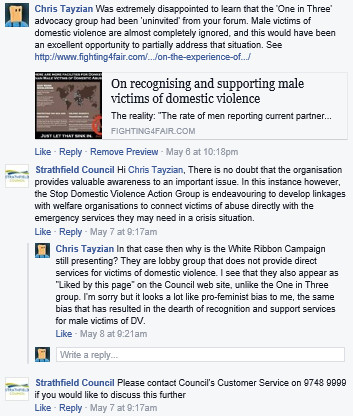
bigot3And indeed, within days of Jane’s article being published, the One in Three organisation was uninvited from presenting at a Forum on Family Violence hosted by Strathfield Council, and there will now be no voice for male victims of domestic violence. Although they do not provide front-line services to victims, the reason given for excluding One in Three, the pro-feminist White Ribbon Campaign will still be presenting. This course of events can only be seen as a further sad indictment of the misguided priorities of the feminist lobby.

gilmore

The degree of impartiality of Strathfield Council was further called into question when they removed a comment I made on 8 May from the timeline of their Facebook page (before and after screen-saves provided below)

strathfieldstrathfield2

One in Three published a rebuttal to Jane Gilmore’s article here, and which I recommend that you read. Jim Muldoon, an Australian MRA, also published a critique of the Daily Life article here. (Jim also wrote an earlier article about Gilmore’s biased position on domestic violence, entitled ‘Jane Gilmore should stop with the rubbish domestic violence games, in December 2014)

One in Three subsequently published a disturbing account of the bias and antagonism that they encountered whilst contributing to the Senate Inquiry into Domestic Violence.

Later, on 29 November 2015, the misandrists at ‘Daily Lifelaunched another disgraceful attack on the ‘One in Three’ organisation and male victims of domestic violence. Not yet sated, on 3 December 2015 they went and took another swipe.

In closing, here are a couple of more recent examples of feminists seeking to undermine ‘One in Three’ and/or male victims generally:

  1. Poorly-regarded male feminist, Michael Flood, felt the need to lash out at ‘One in Three’ in his submission to the Victorian Royal Commission on Family Violence (refer top page 8)
  2. Director of the Gold Coast Domestic Violence Prevention Centre Amy Compton-Keen, victim-blames and advances the myth that women are only ever violent in self-defence/after sustained abuse. See the reader reaction to that article.

clementine_DV

This August 2016 article describes how Clementine Ford attacked Erin Pizzey, the founder of the Women’s Shelter movement (but now campaigns for better recognition/support for male victims of DV. See related Reddit discussion thread here.

And yet another example of feminist hypocrisy – Jane Gilmore derides mens rights activists for devoting too much energy to addressing issues raised by feminists rather than rendering practical assistance to men. Maybe if she could resist the urge to attack/undermine then more help could be provided to those in need. With another cookie-cutter version of earlier articles here.

This Australian feminist group has lobbied to have trans-women excluded from DV shelters, so clearly CIS men have zero chance of being offered support. Discussion thread and linked article here.

This MRA exposes a feminist pretending to be a male victim of domestic violence (1 December 2016) Video with related Reddit discussion thread here

Groups pressure BMO Vancouver Marathon to remove men’s charity from annual run (6 April 2017)

Feminists against men’s domestic violence shelters (24 May 2017) Video

Beware the dubious claims of this men’s rights group, by Sherele Moody (24 June 2017)

To end on a bright note, one hopes this Irish feminist group learnt a lesson.

Postscript January 2018: The organisation helping the male victims of domestic violence

Mildred Daley Pagelow is a feminist who claims that male victims of domestic violence violence are essentially an overstated farce that erodes finding available for female victims of domestic violence (Source 1) (Source 2) (Source 3)

Update 31 May 2024: Twitter thread regarding feminists protesting about billboards in Italy regarding male victims of domestic violence and Reddit discussion thread here.

Image

Elsewhere in this blog you might also be interested in:

On recognising and supporting male victims of domestic violence

Fudging the figures to support the feminist narrative

Australian government announces intention to reprogram boys to reduce domestic violence

“BOYS as young as nine will be targeted in the new fight against domestic violence.

Social media will also become the new way to deliver the Federal Government’s $30 million education campaign.

The Assistant Minister for Women, Michaelia Cash, has revealed boys aged between nine and 12, non-English-speaking women and Aboriginal and Torres Strait Islanders are among the groups chosen for special focus …

We want them to understand the girl standing next to you is the same as the boy standing next to you,” she said.” (Source)

With respect Minister, but that is a nonsense. If you really believed that to be true then both boys and girls would be given the same instruction. In other words there would be a corresponding expectation that girls/women treat men/boys with respect. But no, that is not what is being proposed.

So congratulations Minister for swallowing the feminist narrative hook, line and sinker. In so doing you are complicit in the ongoing process of downplaying female perpetration of violence (increasing), and ignoring the many male victims of DV.

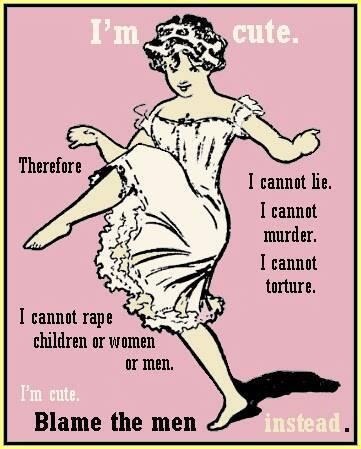
cuteAnd this incredibly sexist and biased policy move seemingly based on a survey that didn’t even bother to ask about public attitudes to violence towards men, thus robbing it of proper context in which we might interpret its findings.

See also:

Editorial in the Courier Mail

Courier Mail Facebook post See readers comments, most of whom call for the inclusion of girls in the proposed program

A November 2015 article by Australian feminist journalist, Wendy Tuohy, put forward as an example of just how one-sided (i.e. gynocentric) the discussion about respectful relationships has become

Elsewhere in this blog you might be interested in reading:

No place for feminist propaganda in our schools or universities
Two awareness campaigns. Only one can be criticised. Cowed by feminism?
On violence carried out by women and girls
On recognising and supporting male victims of domestic violence
The trouble with boys and learning
My response to the report of the Queensland Task Force on Family Violence

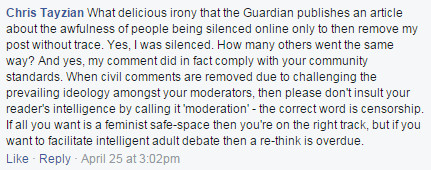
The Guardian publishes article about the awfulness of people being silenced online, and then silences me

TL:DR version: I posted perfectly civil comments in relation to pro-feminist article in The Guardian that weren’t fully supportive of the author’s position. The article was about the horribleness of women’s voices being silenced online. TG then:

  • deleted my comments from their web site
  • deleted my comments from their Facebook timeline (in relation to post on same article)
  • placed me on their pre-moderation grey-list (where I remain to this day)

And now in more detail

I recently read and commented upon the following article in the web site of the Australian version of The GuardianWomen are silenced online, just as in real life. It will take more than Twitter to change that (23 April 2015)

I would suggest that you read the article now and then come back for a brief discussion.

I submitted a comment on the article which briefly appeared online only to then be removed without trace. It didn’t even get the usual place-marker of “This comment was removed by a moderator because it didn’t abide by our community standards. Well, I have read the “standards” and (hand on heart) my comment did not contravene them.

So just how hypocritical is that? Publish an article bemoaning how people are silenced online only to then silence others. Not that The Guardian is any stranger to employing heavy-handed pro-feminist censorship.

Let’s look at a couple of the readers comments that made it through the wringer:

“I dunno. Speaking as a female here, I’ve never had a problem being bullied by the boys online. If we disagree, I can usually deliver a sufficiently ferocious tongue-lashing to make them cringe back in respect. More often, though, we end up flirting through our discussions.

I’ve also had more than one off-putting experience in heavily-moderated forums. While I’m all for civility and respect for fellow-commenters, emotions will rise, taboo words will be used for emphasis, and respecting diversity needs to include accepting that many people don’t share the Official Civilized View on any given issue. There are otherwise intelligent and moral people who have genuine reasons for supporting racist, sexist, and homophobic viewpoints, often backed by science which is at least as solid as that backing the Politically Correct Ideology. And it’s these off-center, alternative, maverick views which offer the most interesting diversity in the marketplace of ideas. Moderating them out of existence because someone will be offended is the worst way to prevent intelligent conversation.

I know I’m not a typical female. But frankly, “typical females” bore me, and I’m afraid that when internet forums are made safe and secure enough for the lame and timorous, it’s the intellectual equivalent of pulling half the water out of a swimming pool so that it’s safe for the little kids. I’m not a little kid anymore, and I don’t swim in the wading pool.” (Cynndara)

Another reader stated:

“Whilst you may have a some of data, on “who” is posting, your analysis is deeply flawed. Let’s start with the click-bait: “Women are silenced online, just as in real life”

The first analysis of your article shows that women are quiet (vs silenced) online and this probably matches offline behaviour. (Yes, in ANY gender balanced group, the loudest are often males… oh goodness… online news matches)

Sadly, this hyperbole characterises much of the rest of your article. Limited data – eg. a paucity of obviously female pseudonyms on some news commenting sites – are extrapolated to such breath taking gender stereotypes as:

Many women are still doing the primary family management and caring roles, so don’t have time.

Yeah, that’s implied by the data isn’t it? Me (a male name) must be hacking out comments whilst my female-type partner (if I have one) would be cleaning the kitchen and caring for the kiddies! Jeez men are slobs.

Of course, matching the template for a standard gender-based argument, the next sentence completely contradicts this:

On the other hand, women are bigger users than men of Facebook, Instagram and Pinterest, platforms that offer a public voice in a personally controlled social environment.

Whut!? No time to write, but time for FaceBook… yes, of course… no problem, keep that mud slinging…

And so we move on to “hey, but women don’t post because THEY’RE FRIGHTENED!!” (ie. women are abused)

Yes, people – and probably more women – are abused online. although seriously, the “article” that you use to support this – 100,000 tweets mentioning rape – hardly merits mention on scientific grounds, let alone relevance for news-based blogs.

Then we go beyond mere hyperbolic extrapolation of limited data, to explaining the whole news-blog world should be reformed in the image of a single web site, because

moderators silently delete, block and ban rather than facilitate conversation, and journalists don’t take part.

Wrong! Sorry, but even here, on the Guardian, where you’re making this claim article authors DO sometimes contribute. In fact (in my anecdotal experience) the most common authors who respond are those with female-like names! And the Guardian already gives the ability to “up vote” (but not good enough, because they don’t throw in a buzz word like respect…)

Moreover, it is best practice to remove (without trace) reported comments. It does not improve the conversation to tolerate/facilitate trolls.

Here’s a thought: stick to what you can argue from the data, and don’t use a sample to help drive your own barrow. For future research you might consider:
1/ IS there ANY relation to female/male roles on the posting of news items — eg. why is it that most Guardian posts are NOT during evening times and other “males do nothing in the home” time periods, but rather, during normal office hours?

2/ MAYBE (just maybe) women AREN’T INTERESTED on commenting on the news and opinions of random strangers. I’m taking a sample size of one here, in that I actually asked an actual female, rather than impying gender from anonymous poster names, but I say that’s one more than you’ve done.

It could be shocking to internet-gender researchers, but a LOT of people could not care less about commenting into the void, and many females (at least that I talk to) find it quite funny that so many men do so: no-one is hiding 19th century style, they just have whole lives to lead.

3/ TOP posters are irrelevant. They are just loud. Look for meaningful attributions, such as “who becomes a Guardian featured poster” OR “who gets lots of replies”

4/ Keep your abuse tags to where they are relevant. Yes, on Twitter there is a surfeit of abusive idiots. Here, less so. As a male-pseudonym, I get ‘abused’ 2 posts out of 5 or so. Of the most critical, I’d say 50% are female pseudonyms. Why not actually look at (on this site)
(i) the type of articles that attract abusers (I can give you some guesses)
(ii) the type of post that attracts abusers
(iii) the “gender” of abusers.

5/ How many female authors have posted, but then stopped. Preferably with correlation against abusive responses.

At that point, please, feel free to extrapolate.” (Stephen Weaven)

I also subsequently posted a comment on the Facebook entry for this story, which can be found here. That entry is no longer visible in the Guardian’s Facebook timeline, having been removed soon after I posted my comment (shown below). Was this a coincidence? Perhaps, but probably unlikely given that other stories uploaded the same day are still visible.

tayzian

Below again you can see another person’s comment taken from the Facebook entry for the article. This is one that perfectly typifies the entitled feminist mentality that anyone not fully supportive of the feminist position is a “male troll” whose views are unworthy of publication. On the other hand, feminists who “challenge too directly” are victimised when their posts are deleted.

geason

On feminists, white feathers and Anzac Day

For the benefit of overseas readers, Anzac Day commemorates “all Australians and New Zealanders who served and died in all wars, conflicts, and peacekeeping operations” and “the contribution and suffering of all those who have served.”

This year (2015) is of special significance in that it marks the 100th anniversary of the landing at Gallipoli (Turkey) in April 1915. As a consequence we are currently being bombarded with all things Anzac – documentaries, mini-series, promotional products, and so on. But this is understandable as the Anzac phenomenon is recognised by most Australians as a pivotal element in our ‘nation building’ narrative.

Whilst the focus has always been on our fallen soldiers, an increasing amount of attention is now being given to the role played by women in the First World War, particularly with regards to nurses working close to the front line.

Nevertheless the feminist lobby have long associated Anzac Day with ‘toxic masculinity’ and men’s innate desire to initiate wars and engage in wholesale violence (for example).

The wikipedia entry cited in my opening paragraph, for example, mentions that in 1978, “a women’s group laid a wreath dedicated to all the women raped and killed during war, and movements for feminism, gay rights, and peace used the occasion to draw attention to their respective causes at various times during the 1980s. In the 1980s, Australian feminists used the annual Anzac Day march to protest against rape and violence in war and were banned from marching.”

In condemning Anzac Day as a celebration of men’s propensity for violence, feminists appear to be either be blissfully unaware of, or to conveniently overlook, the existence of a movement known as the Order of the White Feather.

“The organization aimed to shame men into enlisting in the British Army by persuading women to present them with a white feather if they were not wearing a uniform.

This was joined by prominent feminists and suffragettes of the time, such as Emmeline Pankhurst and her daughter Christabel. They, in addition to handing out the feathers, also lobbied to institute an involuntary universal draft, which included those who lacked votes due to being too young or not owning property.

The White Feather movement facilitated the war deaths of untold numbers of young men, as well as the shaming and suicide of many other men who either chose not to join the army or who were denied active service (which could occur for a variety of reasons).

On a final note, some have compared the White Feather movement to the present-day White Ribbon campaign, given the level of feminist influence surrounding both and their shared emphasis on male shaming.

See also:

Never A Fight of Woman Against Man: What Textbooks Don’t Say about Women’s Suffrage (May 2015)

Karen Straughan speaks on the male obligation to perform national service and the role of the suffragettes (2014) Video

15 articles about men and war that will make you think again (1 July 2016)

Lest We Forget, by Mark Dent (20 April 2016)

A reminder that suffragettes did not get women the vote but instead commit terrorism (27 December 2015)

The White Feather campaign in the Second World War (29 October 2012)

Pankhurst: The white feather betrayal of history (15 November 2012)

White Feathers during World War II Caused the Suicides of Two Teenage Boys (30 November 2013)

15 articles about men and war that will make you think again (9 November 2014)

Christabel Pankhurst – The White Feather betrayal of history (12 December 2014)

A couple of related reddit mens rights discussion threads:

TIL that early feminists would attempt to humiliate men who were not soldiers during WWI

The order of the White Feather

Other posts in this blog that may be of interest:

Do feminists have any male heroes?

On masculinity and ‘real men’