How tragic that feminists ignore their role in demonising men

What follows is just one example of feminist hypocrisy. Not the worst example by any means. But just one that happened to come across my desk the other day. The author is a feminist journalist working for an Australian pro-feminist media group, an organisation that has been mentioned in one or two of my other blog posts due to it’s routine anti-male bias.

The title of the article is ‘How tragic that men are afraid to help kids‘ (29 October 2014), and it begins:

“THIS story finding more than two thirds of Australian men would be afraid to go to the aid of a child in need for fear of being thought a potential “pervert” is so sad for men and kids.”

Well that’s reasonable isn’t it? Of course it is sad that men are all too aware that they are viewed as potential predators. Very sad. But let’s think about how this situation came about.

Firstly, and undeniably, it is partly due to actual perpetration of sex crimes by a very small number of men, against a small minority of children. The actions of these people are obviously inexcusable, and clearly such offenders need to be dealt with to the full extent of the law.

But then the media, advocacy groups and public agencies take over, building that kernel of evil wrong-doing into a mountain of fear and foreboding. They do this not only in relation to their handling  of the specific issue of child sexual abuse by men, but also with regards to how they address the topics of (for example) domestic violence, sexual violence/‘rape culture‘, and workplace discrimination and harassment.

I need to digress here for a moment because feminists are wont to respond to what they imagine men are saying, rather than to what is actually said:

Men are not saying:

  • That the issues mentioned above are not real and/or do not warrant remedial action being taken
  • That all men are innocent of wrongdoing in relation to these issues
  • That the misrepresentation of men’s culpability is indicative of a global conspiracy against men (as is the case for example with feminists and their belief in the existence of a patriarchy)

Men are saying:

  • That media coverage of the issues listed above generally asserts (or at least implies) that men are almost always the perpetrators and that women are victims, when this is often not the case
  • That even in those situations where rates of male perpetration are substantially greater than female perpetration, this is not a valid justification for failing to acknowledge and address female perpetrators and male victims
  • That this biased misrepresentation of the actual situation appears to be a deliberate attempt of the part of many writers to damage the credibility of men and/or support and further the cause of feminist ideology
  • That this ongoing misrepresentation is unfair and unhelpful in addressing the issues under consideration

Let’s think about the broader picture of how men are presented in the media generally, and that is anything but a positive portrayal. It is no coincidence that the Australian media is overwhelmingly influenced and shaped by feminists and their white-knight cohorts. Should you doubt this fact then start reading almost any of the posts in this blog.

Let’s think about why women are not similarly viewed as potential predators despite the fact that they are responsible for most (non-sexual) child abuse and neglect, much elder abuse, and given that there are now almost daily incidents involve adult women preying on underage boys and girls.

A major factor here is, yet again, pro-feminist and anti-male bias in the media. This pervasive sexist bigotry sees men’s transgressions amplified, whilst women’s are minimised or ignored entirely. The general public then comes away with the idea that men’s perpetration is commonplace, deliberate, and severe, whilst women’s crimes are rare aberrations for which there are usually extenuating circumstances.

Let’s think about what feminists in general, and feminist journalists in particular, are doing to address this issue of men being portrayed as evil.  I mean apart from shedding crocodile tears by way of superficial space-filler articles like the one introduced earlier.

Are feminists, for example, lobbying for airlines to stop their discriminatory policy of not allowing men to sit next to unaccompanied minors? Are they lobbying for the imposition of gender quotas for male primary school teachers? Are they doing anything at all to help? Please prove me wrong, but I think you will find that the answer is no. No, they are much too busy pushing in the opposite direction.

PS: By the way, I did try to share my views about the article in the Herald-Sun web site via submitting a readers comment, but alas it was not posted. I’m hardly surprised … such censorship moderation is  absolutely par for the course when it comes to feminists seeking to avoid having their precious ideology critiqued derailed. Oh, and then the author of the article blocked me from her Twitter page – presumably in retaliation – rather than providing a mature and lucid rebuttal. This is what a feminist looks like.

See also:

Can we discuss gender issues rationally? Yes, if we can stop gamma bias (4 December 2018)

Male teachers fear student contact for false abuse claims: experts (4 August 2017)

Men won’t volunteer to help the Scouts for one depressing reason: they’ll be labelled paedophiles (13 April 2017) Reddit discussion thread and linked article

Wendy Tuohy: Too right, women do more work. And we’re so tired (17 March 2017)

Feminism: The demonization of males, by Stacy McCain (2 March 2017)

An open letter to men, who can help female runners feel safe (6 December 2016)

Rachel Stewart: No predator more dangerous than the human male (12 October 2016) New Zealand

‘Hysterical’ feminism isn’t helping our fight against domestic violence, by Corrine Barraclough (22 July 2016) Australia

The damage being done when people insist ‘boys will be boys’, by Clementine Ford (3 June 2016)

Congratulations creeps: You’ve scared women off the streets, by Wendy Tuohy (13 May 2016) Australia

Australian teacher warns young men not to become teachers as a result of the experience he has had (7 May 2016) The investigation into an accusation of inappropriate touching last two years – then found to be unsubstantiated.

Men won’t volunteer to help the Scouts for one depressing reason: they’ll be labelled paedophiles (3 May 2016) UK

Demonising men creates a culture of fear that is bad for everyone, by Karen Brooks (18 April 2016) Australia

Men are way creepier than women, according to science (14 April 2016)

Introducing the most derided ethnic group in Britain: young white men (14 December 2015) UK

When a women-only community is the answer to male violence, by Clementine Ford (18 August 2015)

A similar article from another feminist journalist at the same newspaper. This one is entitled ‘Why is being a male a crime these days?‘ (12 May 2015)

Women’s studies prof calls for ‘men control’ (23 June 2015) More on that here

Funding for Sydney Men’s Health Service axed

Many readers would be aware that the level of Australian government support (both federal and state) provided to men’s groups/men’s issues is miniscule in relation to that provided to groups advocating for and/or providing services to women. I am currently in the process of trying to quantify this differential but it is developing into a mammoth undertaking.

I recently came across a readers comment about men’s health in a blog post about an unrelated matter. Reader ‘Michael’ stated:

“Hope you can maintain some momentum, as there is no funding for grass-roots groups that are concerned about men and boys. The Mens’ Health Information & Resource Centre at the University of Western Sydney has had its paltry funding withdrawn, so there is no longer any formally based Australian organisation concerned with issues of male experience and equity.”

I then googled searched seeking confirmation of this news, which I had previously heard nothing about. I couldn’t find anything nor could I see anything in the Centre’s own web site. Anyway I eventually did get a response from a former staff member of the Centre, who advised as follows:

“Thank you for your email. I and responding to your enquiry on behalf of MHIRC … 

Our long-standing funding arrangements that have been renewed since 1999 from the NSW State Government were ceased in 2013. This represented our major source of funding for the operations of the Men’s Health and Information Resource Centre at UWS. The Centre also operates The Shed at Mt Druitt for which funding has been provided for one more year and this originates from the Federal Government’s Department of Health.

The funding sources are not transferable so one source cannot subsidise another. For MHIRC, this means that our key projects of Men’s Health Week and MENGAGE the NSW Male Health Clearinghouse are able to continue only in a very limited format. We are currently exploring funding for 2015’s Men’s Health Week through other sources such as donations.

MHIRC was recently visited by the Governor-General, at his own initiation, and this may open up discussions about future funding.

Essentially, what we would like to say to the community and people concerned about approaches to male health that are not just medical or disease-focused, is that we need your support. If you would like to contribute to keeping important community-driven events like Men’s Health Week going, donations can be made to the Men’s Health Research Fund at the University of Western Sydney.

On a personal note, I will continue to donate time and energy to keep Men’s Health Week and MENGAGE going as I did when it was my job as I now work in a different part of UWS. I believe strongly that we need community-driven support for social wellbeing programs for men in Australia beyond the ‘problem-driven’ answers that governments focus on.

Thank you for your interest in the future of a social approach for men’s health in Australia.”


The men’s shed movement: A little bit ‘rad’ and a little bit sad

I noticed that reddit discussion threads were created at /mensrights (pre-existing thread here) and at /australia, after the ABC ran a special on the ‘men’s shed’ movement. The thread at /australia included discussion of a recent decision to block the formation of a men’s club at the University of Sydney, as detailed in this article.

You’ll probably ask, ‘What is the men’s shed’ movement?’ So, from Wikipedia:

Men’s Sheds are non-profit organisations that originated in Australia, to advise and improve the overall health of all males. However they have expanded their remit to anyone regardless of age. In many ways they parallel the growing Hackerspace movement which has similar aims and mechanisms, albeit Hack/Maker spaces are more explicit about their inclusion of all ages and genders. They normally operate on a local level in the community, promoting social interaction and aim to increase the quality of life. There are over 900 located across Australia, with thousands of active members. Men’s Sheds can also be found in Scotland, England, Wales, Ireland, Finland and Greece.

Further explanation of the nature of the men’s shed movement is provided here.

Let me make a couple of observations about the movement, and my opinion of it, at the outset of this discussion:

  • Most men’s sheds permit, if not actively encourage, female participation.
  • Irrespective of the concerns that I express in this post, I feel that men (both individually and collectively) are most certainly better off with the shed movement in place, than without it.

I’ve had some peripheral involvement with the men’s shed movement, which I see as a combination of ‘rad’ (radical) and sad. It is ‘rad’ in that it is an organisation/service specifically for men, in a society where now anything for men is seen as inherently bad and to be feared/opposed. It is ‘rad’ also in that it receives funding (albeit very limited funding) in a political environment whereby the provision of government funds for men’s organisations and interests amounts to a tiny fraction of that provided for women’s organisations and interests.

It is sad in that it survives on the basis of a short leash gripped by White Knight politicians and femocrats. The tick of approval that they have reluctantly conferred remains in place only so long as the movement continues to operate with a diversional therapy/mental health focus, and poses no challenge to the feminist narrative. It is sad also when one compares the far greater range of outlets, programs and safe-spaces that are available to women – more often than not subsidized by the public purse (see examples). Further, female participation in such opportunities is applauded in contrast to the condescending and resentful attitude of some feminists towards men’s involvement in the shed movement. See examples of feminist perspectives of the men’s shed movement here and here.

I get the distinct feeling that with this, as with other Australian men’s health-related initiatives, those people running them fully realise just how tenuous the level of government support is and are desperately frightened not to offend anyone. This is reflected in the vanilla tone of the online forum associated with the men’s shed movement, administered by ‘Beyond Blue‘ and the ‘Australian Men’s Shed Association‘. I have started or participated in a couple of discussion threads there – see for example http://www.theshedonline.org.au/discussions/general/australian-human-rights-commission-appears-to-have-little-interest-in-men.

The level of site traffic is quite low, so in that regard they appear to have failed to capture the interest of their target audience. The movement is seen, by some at least, as fusty/musty and a forum for rather forlorn/resigned expressions about the life in the good old days, awkward blokey chit-chat, etc. The site administrators have on occasion asked for suggestions for improvement, primarily to try to increase traffic. I suggested having a section for men’s rights-type issues like portrayal of men in the media, etc, but that was met with stony silence.

I am sure that the site administrators would respond by saying that the  men’s shed movement is not intended to be a men’s rights organisations. I get that. And I’m sure that most of the guys in the sheds movement enjoy their involvement and are unconcerned regarding how that movement fits into the bigger picture of the gender debate. This is partly reflective of the fact that a large slab of the male population still don’t give much consideration to men’s rights issues.

At the same time, though, no-one can tell me that the social backdrop re: attitudes to men, imposition of stereotypes, demonisation by feminist organisations, etc, is not a contributing factor to anxiety and the development of depression and other men’s mental health issues. By getting men to recognise, discuss and maybe mobilise against these factors … well maybe that would achieve more for their mental welfare than just giving them a venue from which they can temporarily escape from their wives/lives.

I guess there are a several of ways to look at the role of the men’s shed movement, marked by end points that might be:

  • seeing the men’s shed movement as a beachhead on which to empower men to do things and/or participate as part of a movement, that will enhance their own sense of worth and create a better social environment for those that come after them, or
  • seeing the men’s shed movement as occupying men harmlessly within a sheltered workshop environment granting them some temporary solace from the #@%# that awaits outside

Long may the movement prosper, but I confess that my position lies closer to the former than the latter.

See also:

On male-only and women-only spaces and On chivalry (elsewhere in this blog)

The boy’s club is under siege, by Bettina Arndt (25 November 2022)

Women’s sheds are providing a place for older Australians to meet up and learn new skills (11 April 2022) The Boys Scout movement re-visited?

South Australian Men’s Sheds: Who, What and Why? (undated)

Bettina Arndt has a go a virtue-signaling men allowing women into Men’s Sheds (25 March 2018) Video

‘I’d be dead without it’: Life-saving men’s shed under threat (24 July 2016)

The Men’s Shed Movement: The Company of Men (2015) A book by Prof. Barry Golding

A fight for male space: the Australian Men’s Shed movement (31 January 2015)

University of Sydney Board blocks formation of men’s group (26 September 2014) Also addressed here, here and here, and with an even more patronising article about the proposal here

More men face lonely old age, says study (12 October 2014) and one feminist’s scornful response

Men’s sheds: Because blokes have feelings too (30 August 2011) See comments

Australia – Fears of Pedophilia Shut down “Men’s Shed” (25 August 2011)

It’s time the boys got back to their sheds (4 June 2010)

Image

Readers at ‘The Conversation’ call for an end to feminist bias and censorship (domestic violence)

I made mention of an Australian web site called The Conversation in an earlier post. The Conversation features articles that range from politics and general current affairs to more esoteric matters, with a marked predisposition towards the tastes and values of left-leaning progressive liberals.

Most readers comments seem to be penned by sycophantic members of the ‘chardonnay set’ and career academics, although it’s hard to say if they are truly representative of the overall readership given that many other comments are moderated into oblivion.

Feminism and feminist topics are heavily covered (example), whilst mens issues are all but ignored. As a consequence, The Conversation often runs articles concerning domestic violence, sexual assault, and the ‘wage gap’ with only minor variations around the standard feminist theme on those subjects.

On 1 October 2014 they ran an article entitled ‘Why don’t we speak up when we see signs of domestic violence?‘ by Sarah Wendt. There was nothing exceptional about the article – it claimed that domestic violence was a gendered issue, made no mention of male victims or female perpetrators, and slipped in a promo for the author’s book. Absolutely typical of its genre really.

No, the exceptional part was the fact that almost all of the readers comments were critical of the biased treatment of the subject.  Later, many also raised the issue of the relatively large number of comments being removed. Some readers also queried why the author of the article had chosen not to contribute her thoughts regarding the unfolding discussion.

I launched into the fray quite early on, commenting thus:

“So “Domestic violence is about gender power relations”? What then of recent research that tells us that lesbian couples are the most predisposed towards partner violence?

So another article about domestic violence that assumes from the get-go that DV consists purely of men’s violence towards women and that any other form of DV is a rare aberration that is unworthy of serious consideration. These stats seem to tell a different story: http://www.oneinthree.com.au/storage/pdfs/1IN3_Fact_Sheets_Sept_2014.pdf with many more at http://www.fighting4fair.com/misrepresenting-reality/domestic-violence-one-sided-media-coverage-and-bogus-statistics/

This ongoing feminist monopolisation of the DV debate is tired and its wrong. If we want to tackle the scourge of DV, rather than just lob grenades in a war against a mythical patriarchy, then we need to acknowledge, discuss and address the entire problem not just the bits that fit into the feminist narrative.”

Based on my earlier experience with The Conversation I was surprised by the lack of punitive action by the site’s moderator. All that changed the next afternoon, however, when the thought police suddenly appeared on the scene and removed sixteen of the comments. By the time the site stopped accepting readers comments at lunchtime the following day, a total of twenty-seven comments had been removed.

In a final hurrah before the editorial team took their bat and ball and ran home, Helen Westerman, Deputy Managing Editor at The Conversation, posted a comment stating that:

“Nowhere does this piece suggest that domestic violence does not affect men. We have run many pieces making the point that men are also subject to partner violence (by women or other men) and I thank the men here who have shared their experiences. They are moving and valid.

And I would ask that this understanding is also extended to the viewpoint of women around this topic and that women be allowed to speak about this issue. And I also thank the women who have left their experiences here. They are moving and valid.

Sadly, this debate so often this devolves into a zero sum game: if women’s perspectives on violence are written about, then somehow it means that men’s are being “ignored”. Simply not true.

The hard truth is whichever way you cut the cake, women are affected disproportionately more than men by domestic violence. However, men are more affected by violence in general.

Neither fact should make us feel particularly proud – and should make us want to change this situation. The common ground here is that it shouldn’t happen to anybody, not matter who is meting it out.

It makes for very uncomfortable reading and elicit strong emotions. But we’ve got to talk about it.” 

To this I replied:

“Helen, thank you for contributing your thoughts but please, your opening sentence is an embarrassingly poor defence in response to the legitimate concerns that have been raised about both the bias of the article and in the subsequent moderation of comments.

Seriously, if the shoe was on the other foot, and you were reading an article about (only) male victims of domestic abuse … would you accept the excuse that “the article never said women were not victims”?

None of those commenting here have suggested that women not “be allowed to speak about this issue”, and that includes those comments that were binned. I think everyone, like myself, appreciates the opportunity to hear all perspectives on the subject. But this forum is for grown-ups and some questioning and rebuttal is an expected feature of adult ‘conversation’

Yes I agree, “we’ve got to talk about it”. Now about those moderated comments”

Highlights of the comments section included several insightful and incisive comments from psychologist Adam Blanch, including:

“Domestic violence is about people who are angry, jealous, distressed and mentally ill acting out their frustration. The motive for ‘control’ and ‘power’ is only present in a very small percentage of DV, and both sexes do it to the same extent.

The partner abuse state of knowledge Project, the largest and most comprehensive meta study of DV ever conducted, makes this information freely available at http://domesticviolenceresearch.org/pdf/FindingsAt-a-Glance.Nov.23.pdf

The entire Duluth model, which assets that domestic violence is about ‘Gender power relations’, has been so extensively disproven by legitimate researchers that no fair minded person without a ‘gender agenda’ could possibly subscribe to it.

PS. the ABS personal safety survey has some serious methodological issues that appear to have been built in, twice, to bias the outcome in favour of a ‘Gendered’ view of DV.”

There was also this classic comment from a guy called Andy George:

“Definition of irony:

A website called ‘THE CONVERSATION’, publishes an article titled “Why don’t we speak up when we see signs of domestic violence” calling on people to talk about the issue, then censors comments that are from male victims of domestic violence but leaves the equivalent posts by women who were victims of domestic violence.”

Negative aspects of the comments section included examples of those tiresome, incorrect yet oft-repeated assertions of feminists that:

  • men should just listen to discussions about domestic violence but not contribute their thoughts (unless to offer unqualified agreement) because to do so only “derails” the discussion
  • men only raise the subject of male victims and/or female perpetrators in order to excuse/minimise the behaviour of male batterers and/or deny/minimise the experiences of battered women
  • by raising concerns about the appropriateness of feminists continually asserting that ‘domestic violence = men’s violence towards women’ men are attacking and denigrating female victims, and women generally

Anyway, well done to all the men and women who made the effort to bring the author’s sexist bias to account. Hopefully this will be a harbinger of the reaction to the inevitable future displays of sexism and gender bias at The Conversation, and in the media generally. Enough is enough.

See also:

Reddit discussion thread concerning moderation in relation to another article at The Conversation

A little less Conversation, by Institute of Public Affairs (undated)

“As the site’s charter admits, it hopes to ‘give experts a greater voice in shaping scientific, cultural and intellectual agendas’, and aims to work for the advancement of the ‘public good.’ It also promises to be ‘editorially independent’, provide ‘diverse’ content and be ‘free of commercial or political bias.’ Whether it achieves this is open to question.

Professor Judith Sloan, another academic who can boast a tangible impact on policy and public debate, is unconvinced:

‘this site strikes me as emblematic of all that is wrong with Australian universities. Crammed with puerile, naïve, left-wing tosh, the contributing academics…really have no idea when it comes to serious public policy contributions.'”

A rather one-sided ‘conversation’, by Tony Thomas (14 February 2014) Another group – not MRA-related – express their concern about the level of bias evident at The Conversation

Postscript 25 January 2015: There are a few occasions when the moderator remains in his/her kennel, and then it’s refreshing to see that adults can indeed engage in vigorous debate without chaos ensuing. Look at this article for example.

Postscript 23 March 2015: A moderator removed a comment I added to this article about domestic violence. My comment was as follows:

“Rob, I haven’t read your report yet (but will do so shortly), so the following comment is based on what I’ve read in the media. It appears that your report talks about the need for more & better intervention and behaviour modification programs for perpetrators, but that your recommendations in this regard are limited to male perpetrators.

Can I ask why you would not adopt a gender-neutral approach in this regard and have programs that catered for both male and female perpetrators. I mean, it’s not as though there are so few violent women that we can afford to just wave them away.

Indeed I understand that the rate of increase in violent crime by women is exceeding that of men in many jurisdictions. See http://www.fighting4fair.com/uncategorized/on-the-recent-increase-in-violent-crime-carried-out-by-women-and-girls/

Postscript 1 April 2015: A moderator removed a comment I added to this article about sexual assault. My comment was as follows:

“It’s deeply ironic that the title of your article is “let’s turn the spotlight on known perpetrators”, but within the first sentence you exclude acknowledgement or consideration of all female perpetrators of sexual assault. On what basis? There’s less reported crimes involving female perps, so it’s OK to just airbrush them out?

I’m also troubled by you referencing the 2013 National Community Attitudes Towards Violence Against Women survey, which didn’t bother to ask respondents about their attitudes towards violence to men. Thus the questions about violence towards women were robbed of context and so we don’t know the extent to which the issue is men’s attitudes towards women, or Australians attitudes towards violence generally.”

Postscript 22 June 2015: A moderator removed many comments that readers contributed to this article about online harassment. This matter is discussed further in this post.

Reader Craig asked: Why was a dissenting comment regarding information contained in this article, with links to support its claims, removed by the moderator? There was no abuse or apparent breaching of the Community Standards (unless it was a Twitter technicality?)

Moderator Cory replies: We also require research that’s credible:

“Back up your ideas with evidence and fact where possible. If you’re claiming something as scientific fact, try to provide credible references.”

While some of the links were fine, many of them – upon reading them – were less than credible. They were closer to a smear campaign than anything resembling research. This is also prohibited in our community standards:

“We’ll distinguish between constructive comments and smear campaigns. We’ll remove any deliberate attempts to misinform, distort facts or misrepresent the opinions of others.”

Smear campaign? WTF? “a strategy to discredit a person, esp. a public figure, through disparaging remarks or false accusations“. We are talking about ideas, Cory. Can anyone point me towards any of the linked papers on this page that attacked a person. Aren’t the readers of The Conversation mature enough to, you know, exercise their own judgement about others’ opinions?

Postscript 30 April 2018: One in Three Campaign – News Articles About Family Violence – Response to The Conversation Fact Check from 1IN3 An example of how ‘The Conversation’ responds to offers to provide correct information to their fact-checking process

A busy few weeks for gender matters (Aug/Sept 2014)

I thought I would create this post to mention several significant developments related to the gender debate that occurred in Australia during the period late August to late September 2014. As usual the feminist lobby monopolised the newspapers and airwaves, and consequently the news was mostly negative from a men’s rights perspective. The silver lining, however, was the level of discussion that occurred, and within it the large number of people who openly questioned the feminist narrative and/or spoke up for the male perspective … even in Tim Watts’ own Facebook page.

22 August 2014: Leader of the federal opposition, Bill Shorten, cleared of rape allegation  – But of course false rape allegations are just a misogynist myth … apart from perhaps just this one exception

25 August 2014: Launch of the Australian ‘Polished Man’ campaign.  The campaign web site originally stated that “Men perpetrate approximately 90% of violence against children and by wearing nail polish, YGAP asks men to raise awareness, generate conversation and become positive role models in the fight against violence towards children“. I say “originally stated” because they quickly changed the wording of the relevant page, presumably after too many people called them out on their lie. Their site now states that men cause 90% of sexual violence against children. Many web sites who received the original media release still, however, have the original wording online. (As an aside, this initiative inspired me to launch my own campaign to help prevent child abuse and neglect.)

4 September 2014: The re-badging of the ‘Foundation to Prevent Violence against women and their children‘ to ‘Our Watch‘ – I assume this bit of window-dressing was to make the Foundation appear more inclusive, and less the bigoted feminist echo-chamber that it actually is.

7 September 2014: Tim Watts MP tells feminists about men’s violence towards women

9 September 2014: Article in The Australian newspaper by Gary Johns entitled ‘Violence knows no gender divide’

Gary Johns made two main points in his article. Firstly he queried whether the government should provide substantial ongoing funding to an advocacy group (Our Watch) with relatively little oversight/accountability, in lieu of providing the same funding to the relevant Government Dept to provide direct services to victims and their families.

Secondly Gary queried why virtually all the funding for domestic violence was directed towards female victims when there are also substantial number of male victims. We don’t need to get hung up on the exact percentages, the point is that the current situation is highly inequitable and unhelpful in addressing the needs of all affected families. Again, hardly a heretical position to adopt.

Nevertheless the knives were out in a flash and Twitter and online feminist hang-outs were full of exaggeration and invective about this nasty misogynist man who dared question the feminist ‘DV= Men’s violence towards women’ construct.

10 September 2014: Article in The Australian newspaper by Tim Watts MP entitled ‘Violence against women is about gender’.  See also comments made in Tim Watts Facebook page. This and the article that followed were a veritable tsunami of shrill ill-informed white-knightery.

10 September 2014: ABC item by Tim Watts MP entitled ‘Labor MP tells men who criticise campaign to prevent violence against women to ‘Grow up!’.  See Reddit mens rights discussion thread and Reddit Australia discussion thread

17 September 2014: Release of findings from the 2013 National Community Attitudes towards Violence against Women Survey (NCAS). See Reddit Australia discussion thread. No questions asked about violence towards men, guess it’s not that important really. Oh, and of course because survey respondents weren’t asked the same questions concerning violence against men, there is no context provided nor point of comparison for the questions about women. This omission hugely compromises the value of the results with regards to forming an appropriate policy response.

17 September 2014: Trivialising and excusing violence against women plus 240+ readers comments, discussing the results of the NCAS.

17 September 2014: Woman who bashed elderly bus passenger escapes jail

See the video of the original incident at the top of this page. If two young men had beaten and spat upon an elderly woman, would they have walked from court with a slap on the wrist. Ermm. No way. Still that’s equality, feminist style.

21 September 2014: David Penberthy launches a further attack on Gary Johns and anyone else who thinks male victims of domestic violence should be acknowledged entitled Puerile Trash Avoids Facts on Violence, with a rebuttal by Mark Dent. (If anyone needed convincing of David’s status as one of this country’s foremost manginas, then fast forward to June 2016 to first read this article, and then this rebuttal by Mark Dent).

That tired old feminist chestnut that is the ‘gender wage gap’ lives on in the Australian media

It’s hard to believe, but white knight politicians, feminists and media commentators alike are still banging this drum. How many times does the existence of a ‘pay gap’ arising from gender discrimination, need to be debunked before it is finally put to rest?

It’s notable that the relevant Australian Wikipedia entry simply compares the average male and female rates of pay, which is clearly not ‘comparing apples with apples’. By that I mean that we need to compare pay rates for men and women doing the same job (incl. same hours worked), and with the same qualification and experience in order to tease out any meaningful gender-based differences.

While there are certainly differences in the average salary earned by men and women, such differences reflect personal career choices, rather than being an indicator of gender bias in the workplace as is routinely asserted or implied by the feminist lobby. Further, once you drill down into the data it becomes clear that the nature of the gap is  no means uniform ‘across the board’ – which you might expect if it was in fact a meaningful indication of ingrained gender bias across Australian society. (Refer statistical sources provided in this other blog post)

One of the things that feminists don’t mention is that, even when using the average pay rates they base their argument on, the gender gap actually favours women in certain age groups or in certain types of jobs. I would suggest, however, that we don’t all hold our breath waiting for Elizabeth Broderick to take “bold measures” to address those particular areas of ‘inequity’.

Back in March 2014  this article appeared, asserting the existence of gender-based wage disparity. I emailed Westpac bank requesting supporting information and got a reply from their PR section wanting to know why I wanted the info. I was eventually pointed towards the media release section of their web site where I found this. As you can see no mention of male/female salary data at all, so I’m left wondering where Westpac CEO, Gail Kelly (who also features in this Youtube video), sourced those stats.

This week the ‘gender pay gap’ was mentioned here in an article on news.com.auherehere and here in segments on the Australian morning TV show ‘Sunrise’, and here in comments by Tracey Spicer. Tracey was quoted as saying:

“To be a working woman in Australia is to know that you are valued less than your male counterparts. Our (rising) double digit gender wage gap means you’re earning less than guys doing the same job, you have a reduced chance of making your way to a senior leadership position (particularly if you’re angling to be on the board) and no matter where you are in the business hierarchy you stand a 17 percent chance of sexual harassment on the job and a one in five chance of being discriminated against if you become pregnant.”

Why is it that when I see articles that purport to discuss gender differences, but only provide the relevant statistics for women, I immediately think *feminist author*? I wonder if this technique, i.e. don’t provide any context or basis for comparison, is something they are now teaching everyone in ‘gender studies 101’ because it really is so prevalent now.

The wage gap statistics that Tracey refers to were sourced from a government agency, the ‘Workplace Gender Equality Agency‘ (WGEA) which defines the gender pay gap as “the difference between women’s and men’s average weekly full-time equivalent earnings, expressed as a percentage of men’s earnings.”

As is explained in my previous blog post about the ‘pay gap’, comparing average male/female earnings is utterly unhelpful and inappropriate given the large number of variables involved (of which gender discrimination by employers is only one, and only a minor one at that).

I see in this article that the WGEA has previously been subject to criticism for their interpretation of source statistics.

You might be interested to know that only two out of twenty-nine staff in the WGEA are men. And how many of them would identify as feminists? I’m guessing, almost all. Just putting this thought out there, but could it be that perhaps this situation is introducing some teensy, weensy measure of bias into the Agency’s priorities and findings?

In terms of addressing the agency’s staffing imbalance, dare I suggest that they could probably speed things along via the introduction of an enforced gender quota? I mean to say, feminists are proposing gender quotas right left and centre, and what’s ‘good for the goose is good for the gander’ as they say.

But in the meantime the suits at the big end of town clearly think that pandering to feminists makes business sense, as many are falling all over themselves to support the WGEA’s latest ‘pay gap’ initiative.

Postscript … and on and on it goes:

The FIFA World Cup pay gap exists because of one simple factor (31 July 2023)

Gen Z want to work ‘lazy girl jobs’. Who can blame them? (9 July 2023)

Shocking pay gap between men and women (11 February 2022) Another offering from our very own WGEA. Yes, you know the ones

Closing gender pay gap about privilege, not equality (30 November 2021)

Closing the gender pay gap‘ by the Chifley Research Centre (August 2019). The Centre is the official think-tank of the Australian Labor Party, and its official mission is to champion a Labor culture of ideas. It is an Australian public company supported by the Commonwealth Government through a grant in aid administered by the Department of Finance and Deregulation (source).

I have asked the Centre for details regarding the size and source of the budget for this project. The only response thus far has been for a member of the (all-female) project working group to block me on Twitter. Yes an avowed feminist and gender studies academic … surprised? Stay tuned.

Ending Australia’s gender pay gap: ‘Managers can make or break DEI’ (28 October 2021) A recent spray from the pro-feminist sector – to be reviewed

Female futures traders on $315,000 a year among 72 occupations where women earn more than men (29 March 2019) Ooh, see the angry feminist fuming over this article, media poison, no more promotions for this journalist.

Google finds it’s underpaying many men as it addresses wage equity (4 March 2019) USA

In December 2018 Australia’s SBS ran a program called “Is Australia sexist?”. The linked video was a critique of that program. Interesting

Workplace gender equality score reveals massive blind spot letting Australian businesses down (17 November 2017)

Andrew Bolt: Let’s ask Waleed Aly the truth about a pay gap (18 October 2017)

Cafe of Confusion (7 August 2017) Video

What we miss when we focus on the gender wage gap (10 July 2017) Why is it so very difficult for pro-feminist researchers to provide like-for-like statistics and an objective unbiased presentation of the facts of the matter. This articles excludes consideration, for example, of the reality that men are more likely to support others and women more likely to be supported. Therefore now, and in the absence of wide-ranging structural reform, unemployment or underemployment of men has a far more serious impact on welfare of affected persons.

Instead of tweeting his ‘support’ for Natalie Portman, Ashton Kutcher should have coughed up the cash, by Clementine Ford (31 January 2017)

She’s Price(d)less: The economics of the gender pay gap (October 2016) KPMG study for Diversity Council Australia. Exaggerates the significance of gender discrimination – hardly surprising given the agenda of the commissioning organisation. KPMG in turn clearly have their eye on the ball with regards to winning further lucrative ‘women as victims’ consultancies from pro-feminist agencies.

8 September 2016 was ‘Equal Pay Day’. This triggered a flurry of pay gap articles, only one of which challenged the feminist narrative. And oddly that was an article published in news.com.au, entitled ‘How common sense shows gender pay gap is a myth‘.

The others were ‘Closing the gender pay gap won’t just help women. It’ll help men too‘, ‘Will the real gender pay gap please stand up?‘ & ‘It’s time to dispel the myth that women’s choices cause the gender pay gap’ (8 September 2016) None of the pro-feminist articles found it relevant to note that the pay gap favours women in many instances – and in an increasing number of instances – depending on sector, seniority, etc. From the readers comments, many people are far from convinced by the feminist position. This comment from ‘mythbuster’ was a classic:

“Men earn an average total of $27,000 a year more than women”. Yes, EARN, not, “are paid”. That calculation is based on averaging the incomes of all male and all female full time workers. It doesn’t take into account overtime, differences in jobs, female choices. In lower paid, similar jobs they earn more because they do more overtime. There are 12.2 million workers here, split 55/45 men to women. To get equality, you need to conscript 600,000 women out of their homes and into work. You also need to sack 600,000 and put them in front of the afternoon soaps, and then have women support them. There are 1.2 million workers in construction, forestry and mining, 85% male. This pays higher than the 1.1 in health services, 80% women. So lets take about 360,000 women out of counselling or aroma therapy and get them down the mines or out building us houses. That’s where the pay is better, in back breaking, dangerous work. We should also swap some teachers with long distance truckies and oil rig workers, since that will help close the pay gap and the death gap since 93% of workplace deaths happen to men. More dead female workers will be a sign of equality. Its illegal to pay a man or woman a different wage based on gender, if you know of an example of this, please give us the EBA or Award name, otherwise, if you want to be paid like a man, work the jobs women tend not to want to and do the hours men do at it. That’s equality.”

Women catching up to men on wages: ABS (23 August 2016)

“Women’s wages have grown at almost three times the rate of men’s over the past year”

Young men blamed for not believing the feminist misrepresentation of the gender pay gap (Australian Financial Review, 17 July 2016)

Radical proposal to force bosses to fork out extra super for women (3 June 2016)

Opinion: Gap in logic over gender pay discrepancies (8 May 2016)

University of Queensland to host Bake Sale that charges based on gender (3 April 2016) and then ‘The feminist cupcake sale that led to death and rape threats‘ (6 April 2016)

Just thinking out loud now, but I’d love the opportunity to look at these threat messages. Of those that actually exist IRL, I’d like to see how many were sent from newly created accounts with IP addresses that matched those of the recipients.

Higher proportion of gender pay gap ‘unexplained’ in Australia than in US, UK, research shows (24 March 2016) Laughably inane. Headline should be ‘Wage gap found to be insignificant’ … 39% of 3.9% (= 1.5%), only some of which actually results from discrimination

How the work gap affects women, by Jasmin Newman (14 March 2016)

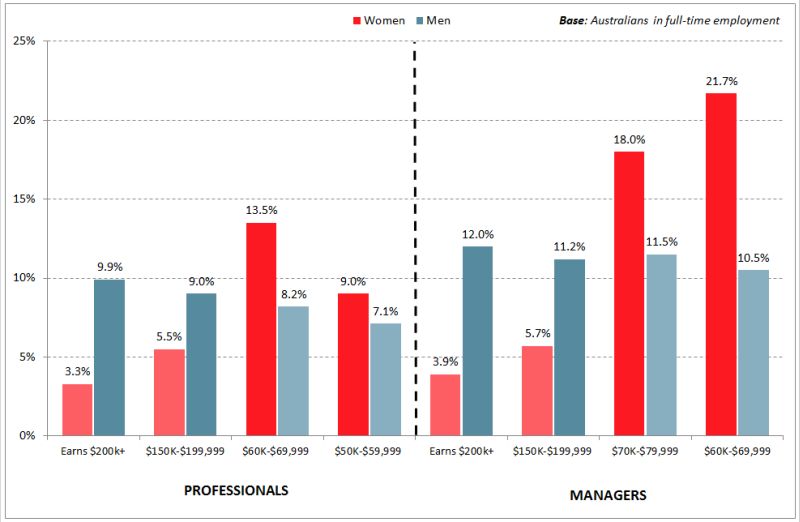
Gender parity still lacking in Australia’s workforce, by Roy Morgan Research (8 March 2016) See chart below – would be interesting to see these results cross-referenced by years of experience in role.

annual_incomes

Gender equality in the workplace can prevent violence against women (1 March 2016) In this article the feminist authors vainly attempt to create a causal link between the pay gap and domestic violence against women. Talk about a reach. And needless to say there is zero acknowledgment of workplace harassment or discrimination against men.

Why women graduates don’t get paid as much as men (14 February 2016) OK, so women freely choose to take courses that lead to lower paying job. It’s not men’s fault, and the only problem seems to be in the minds of feminists. WTF?

Workplace gender equality scorecard puts Australia to shame (26 November 2015)

ANZ bank launches a Super deal for female employees (29 July 2015) And now dodgy interpretation of statistics is used to justify gender discrimination

The Only 2(3) Cents I’m Giving Up Because of the Pay Gap (16 April 2015)

Gender pay gap misinterpreted again (16 October 2014)

Get Fact: do men make much more than women for the same job? (7 March 2014)

Pay gap due to women’s choices, not gender bias (9 March 2015) International Women’s Day 2015 saw a flood of pro-feminist articles about the gender pay gap. I won’t even bother including links here as none of them contributed anything new or useful to the discussion – just the same old debunked nonsense. This article (linked above) was the only one I saw that said anything sensible on the matter.

‘Our Watch’: Just how heartless (or deeply in denial) can people be?

I spent some time the other day voicing my views in relation to an article that appeared in an Australian web site called ‘The Conversation‘. Their motto is ‘academic rigour, journalistic flair’. Their track-record, in my experience, is based upon pandering to progressive liberals – especially feminists. Naturally that has a big bearing on their failure to satisfy the “academic rigour” part of the equation. They include nothing from a men’s rights or egalitarian perspective and heavily moderate readers comments to make sure as little as possible of that nasty triggering sort of stuff makes it online.

Anyway the article was entitled ‘Out of the shadows: The rise of domestic violence in Australia‘ (4 August 2014). I’m going to let you read that article, which is fairly typical of its genre, i.e. domestic violence IS men’s violence towards women and their children, no mention of female perpetrators or male victims, etc. Last time I looked there were more than 50 readers comments tagged on the end, including those of yours truly.

A day or two later I stumbled upon the facebook page of the ‘Foundation to prevent violence against women and their children‘, an organisation tasked with lobbying for and on behalf of female victims of DV. The Foundation receives several million dollars each year from the federal government plus further funding from the Victorian, South Australian and Northern Territory governments.

The Foundation’s Chairperson is Natasha Stott Despoja, who was brought to task by Greg Canning in late 2013 for the use of biased and misleading statistics regarding domestic violence. [See Footnote 1]

Anyway, scrolling down the Foundation’s page I quickly came upon posts by people complaining about some of the comments contributed to the article mentioned above. The comments in question identified substantial omissions and misrepresentations in the way that the issue of domestic violence had been portrayed.

White knight ‘Mike’ bemoaned the fact that men were “nit-picking” the stats about the victimisation of men. Hmm, alerting the public to the fact that a large slab of the victims and perpetrators of DV are being ignored … yes, how petty of us. A spokesperson for the Foundation subsequently commented: “Yes it’s pretty upsetting but let’s hope this kind of resistance is a sign a raw nerve has been struck and that once these men get over the shock they will reach some kind of realisation.” facebook_DV

And then a few days later (6 August 2014) the following exchange took place:

    • Denise H – What about domestic violence against men. It happens, it’s very real.
    • Kirstina B – ‘Denise’ is a guy, obviously.
    • Kirstina B – Oh, and ‘Denise’, I’m sure gay men suffer violence from men, too. That will be addressed when DV is addressed for women.
  • Kris C – I wonder why some people are quick to hijack any publicity of DV with trying to talk about male victims. Yes, they are real, but it’s rather rude to butt in with that when that’s not the specific focus at hand. Imagine hijacking any publicity on the victims of the airline crash with “what about burns victims? they are real”.  [See Footnote 2]

These and other material contained within the Foundation’s page go beyond simply being callous and offhand, to being either breathtakingly deluded or just plain sick. In fact the Foundation’s Facebook page appears to be a veritable goldmine of misandry and gloating indifference to the plight of men.

Men are being battered at the same rate as women but this is rarely acknowledged by the media. Men dare to draw attention to this disparity and instead of empathy and support, the Foundation treats them as if they were ignorant, selfish or stupid.

Let’s hope” the men “reach some kind of realisation”, huh? Oh you bet we will. The realisation that the Foundation, and the feminist ideology with which it is so richly imbued, is content to angrily wave away the welfare of half of the community.

I’d like to invite members of the Foundation to peruse the following comments attributed to men who approached shelters for emergency accommodation: (Source)

“One abused man said:

They laughed at me and told me I must have done something to deserve it if it happened at all.

Another said:

They asked how much I weighed and how much she weighed and then hung
up on me…I was told by this agency that I was full of BS.

Twelve percent of the hotlines accused the man of being the batterer or responsible for the abuse. One abused man said:

They told me women don’t commit domestic violence — it must have been my fault.

Another said:

They accused me of trying to hide my “abuse” of her by claiming to 
be a victim, and they said that I was nothing more than a wimp.

Of the men who sought help by contacting local domestic violence programs, only 10% found them to be “very helpful,” whereas 65% found them to be “not at all helpful.”

One abused man said:
They just laughed and hung up the phone.

Another said:
They didn’t really listen to what I said. They assumed that all abusers are men and said that I must accept that I was the abuser. They ridiculed me for not leaving my wife, ignoring the issues about what I would need to do to protect my six children and care for them.

https://nationalparentsorganization.org/blog/3977-researcher-what-hap-3977

I call on the men and women of the ‘Foundation to prevent violence against women and their children‘ to park their sexist bigotry for 30 minutes and scan the dozens of studies that I either list or link to on my post about domestic violence that show that as many women are violent as are men. Then take a look at my blog post about male victims of domestic violence and the shameful lack of support that they receive.

Ask yourselves, are all of the studies faked? Are they all wrong? Fraudulent components of a global patriarchal conspiracy? Consider those findings in relation to the message you broadcast in your web site and facebook page. Do you feel smugly self-satisfied about the twisted version of reality you are painting, or is there some small sliver of guilt?

Do you not see that acknowledging the true reality of male victimhood, of female perpetration, and of bi-directional violence, does not undermine the validity of advocating for women? Do you understand that this is not some sort of ‘winner take all’ blame game? [see Footnote 3] And that it’s not necessary to step on the backs of men, and certainly not the backs of male victims, to help female victims?

It hardly even matters what the ratio of male/female abusers is, what is important is to address the whole problem and to discuss potential solutions in a free, open, constructive and non-judgemental manner. This is not what the main players in the DV advocacy sector are doing at the moment. This is what they should be doing. What they could be doing if they stopped wasting time deleting posts from others equally invested in finding a solution, but whose ideas and perspectives happen to differ from their own.

Please submit your response to this post and I will be sure to put it online. Oh, and be sure to include your postal address so I can send you your very own commemorative singlet (pictured). i-bathe-in-male-tears

Moving right along, Australian feminists were really on a roll this week (perhaps stung into action by #womenagainstfeminism) because the very next day (5 August 2014) brought us ‘Behind media silence on domestic violence are blokey newsrooms‘, and then ‘Why doesn’t she just leave? The realities of escaping domestic violence‘ on 7 August 2014.

The first of these two staunchly gynocentric articles contained gems of feminist wisdom like:

“Until recently, the media weren’t interested in reporting domestic violence. Journalists didn’t see “domestics” as a story. The reason for this seems to be that the media hold the same negative attitudes to women that have been globally recognised as contributing to violence against them in the first place.

This is of concern, since media play a key role in forming societal attitudes to gender and gender roles.”

Well if you look at my primary post in this blog dealing with domestic violence you will see that the media has published quite a bit about domestic violence. You only need to get busy with google to confirm that. And not only that, but most of the coverage has pushed the feminist line 100%. That being the case I find myself agreeing with the feminists that it really  IS a worry that the media forms societal attitudes … which will now be saturated with feminist dogma and strongly biased against men and boys.

“Australian media have a balance of power tipped overwhelmingly towards men, according to the most recent study of who owns, runs, influences, reports, presents and creates the news.” 

Isn’t it just amazing that seeing how the media is run by men for men, that it takes such a strongly pro-feminist view towards the issue of domestic violence. Quite remarkable really. That little old patriarchy sure can move in mysterious ways.

Footnote 1: Flagrant misrepresentations by feminist DV spokespeople are by no means uncommon. Mike Buchanan in the U.K has also written letters seeking the retraction of biased and misleading information, and as with Ms Stott Despoja, no responses were forthcoming:

Polly Neate CEO, Women’s Aid
Sandra Horley Chief Executive, Refuge
Eleri Butler Chief Executive, Welsh Women’s Aid

Footnote 2: As an aside, I joined this discussion thread to express support for ‘Denise’, only to have my posts disappear and be blocked from further commenting

Footnote 3: Unless of course the primary focus was on securing government funding for a gender-specific advocacy group

when_men_seek_help

The chart above shows what happens when male victims of abuse seek help

Postscript (25 October 2015): The following article provides context to the attitude of the feminist DV advocacy groups towards male victims of domestic  violence

Why I’m backing QLD Labor Premier on male victims | Talk About Men

My submission to the Australian Government Inquiry into Domestic Violence

 A submission to the Senate Inquiry into Domestic Violence in Australia

“I think the sad part is the way husband abuse is treated at the moment is exactly the way wife abuse was treated thirty years ago” Dr Sotirios Sarantakos[1]

 The Inquiry’s Terms of Reference

My submission addresses the nature and adequacy of policy and community responses to domestic violence. I also wish to submit the following comments in relation to the Inquiry’s terms of reference:

Points six and seven of the terms of reference limit consideration of certain matters to their impact on women only:

  • the effects of policy decisions regarding housing, legal services, and women‘s economic independence on the ability of women to escape domestic violence;
  • how the Federal Government can best support, contribute to and drive the social, cultural and behavioural shifts required to eliminate violence against women and their children

I disagree with this limitation given the substantial number of men who are also victims of domestic violence, and who face the same or similar issues as do female victims. That this restriction was considered appropriate reflects the existence of gender bias and outdated notions of gender stereotyping, viz. there are now for example substantial numbers of house-husbands who may be financially reliant on a working partner.

I also object to the use of the phrase “violence against women and their children”.

Firstly, it should be recognized that children generally have two parents and they are not the property of one or the other. Neither should it be assumed that one particular parent is more competent to look after the children than the other, based purely on their gender.

Secondly, when men are victims of domestic violence, it is often the case that the female partner is also abusing or may potentially also abuse children in the household. In such cases the male partner may be forced to leave the home and take the children with him for their safety.

Clarification and disclaimer

Domestic violence (DV) is comprised of man-on-man, woman-on-woman, man-on-women, and woman-on-man violence. The current debate about DV, and the community’s response to it, focuses almost entirely on man-on-woman violence.

I believe that such a focus more closely reflects the prevailing ideology within the DV sector, rather than actual patterns of perpetration. The continued existence of this disparity constitutes a significant barrier to effectively dealing with domestic violence and related issues of concern.

I believe that a solution to the problem of domestic violence will continue to elude us as long as we continue to only recognise and address one piece of the puzzle. Further, the current narrow focus on male-on-female violence generates or accentuates additional problems that I will touch on in this submission.

Those who have previously advanced this perspective have been accused of seeking to ameliorate the behavior of male perpetrators and/or to downplay the suffering experienced by female victims. Be advised that this is most certainly not my intention.

From my research regarding the subject of DV, I am well aware of the highly defensive and oftentimes aggressive response directed towards those who question the ‘DV=men’s violence towards women’ model. This pattern of threatening behavior, shaming and abuse is nothing new, and dates back to the experience of Erin Pizzey in Britain in the 1970’s.[2] It is for this reason, and out of concern for the welfare of my family, that I have chosen to put forward this submission on a confidential basis.

Much of the data about patterns of domestic violence that appears in the media and in the web sites of DV agencies is misleading

The starting point of any discussion about domestic violence must be accurate assessment of the nature and extent of the problem. In my view many of the statistics being circulated in discussions about DV are inaccurate or at the very least, highly misleading. This is unfortunate as suitable data, albeit imperfect or incomplete in some regards, is available for those who genuinely seek it.

From this one might well conclude that misleading statistics are at times being deliberately advanced in order to support a particular ideological perspective that is held by many, if not most, working in the field of DV.

A red flag for astute observers is the absence of comparative statistics for men and boys within much of the literature about domestic violence.[3] In some cases this is because men were not surveyed, or in other cases survey instruments were biased and/or did not ask appropriate questions about female perpetration and male victims. In other cases the relevant comparisons were available but were not reported, presumably as doing so would undermine the predetermined narrative.

For me to provide details concerning the debunking of these widely cited yet misleading ‘findings’, and to provide accurate statistics in their place, would substantially increase the length and complexity of this submission. What I will do instead is provide a series of links to relevant online sources within the body of this submission where the Committee may readily access the relevant information.

The view that is put forward by most within the DV sector is that this preoccupation with male violence is justified because the number of female perpetrators is almost insignificant – that female perpetrators are almost an aberration.

When provided with irrefutable statistics showing gender symmetry (or near symmetry) in rates of perpetration, the fall-back position is typically that females only perpetrate violence in self-defence, that the physical violence they perpetrate is less severe, and/or that the impact of DV is greater for women than men.

The first statement is demonstrably false[4] and the subsequent statements demand careful qualification and interpretation.

The US organization ‘Stop Abusive and Violent Environments’ (SAVE) examined DV research results from around the world and noted that “These studies show that rates of female perpetration are very similar to male perpetration rates. The authors conclude, Results of this review suggest that partner abuse can no longer be conceived as merely a gender problem, but also (and perhaps primarily) as a human and relational problem, and should be framed as such by everyone involved.

These conclusions mirror findings in the United States, where research shows men and women initiate most forms of abuse at equal rates, for similar reasons, and rarely in self-defense.” [5]

I would invite members of the Committee to review the following references:

https://www.youtube.com/watch?v=CsgeDrlRQWc (Donald Dutton)

https://www.youtube.com/watch?v=-KgBVedec_0

http://www.reddit.com/r/mensrightslinks/comments/y0mnx/dvipc_summary/

Intimate partner abuse of men (Edith Cowan University, 2010) at http://www.ecu.edu.au/__data/assets/pdf_file/0007/178297/10_Tilbrook_Final-Report.pdf

http://pubpages.unh.edu/~mas2/V71-Straus_Thirty-Years-Denying-Evidence-PV_10.pdf

http://www.fact.on.ca/Info/dom/heady99.pdf ‘Domestic Violence in Australia – Are men and women equally violent?’

http://pubpages.unh.edu/~mas2/V74-gender-symmetry-with-gramham-Kevan-Method%208-.pdf

http://newscastmedia.com/domestic-violence.htm

http://www.onlineopinion.com.au/view.asp?article=12153&page=0

http://reason.com/archives/2014/02/22/are-domestic-violence-statistics-bogus

http://www.familylawexpress.com.au/family-law-news/research/family-violence-research/domestic-violence-study-suspended-by-unsw-for-breach-of-ethics/2165/

http://time.com/#2921491/hope-solo-women-violence/

http://www.avoiceformen.com/women/working-with-violent-women/ (Erin Pizzey)

These and further references can be found at http://www.fighting4fair.com/misrepresenting-reality/domestic-violence-one-sided-media-coverage-and-bogus-statistics/

Consider also the trend of increasing violence by women and girls generally

The claim that women are rarely responsible for domestic violence becomes all the more implausible when one considers recent trends showing substantial increases in violent crime by women and girls. Such increases also exceed the trend in similar crimes by males.

http://www.dailytelegraph.com.au/violent-crimes-committed-by-teenage-girls-have-surged-in-nsw/story-e6freuy9-1226239405809?nk=5f0a5e0064e7e26d5416acaf028e02d8

http://www.independent.co.uk/news/uk/girls-get-violent-1345290.html

http://www.theage.com.au/national/girls-at-war-the-new-face-of-violence-20090815-elsm.html

http://www.news.com.au/national/arrests-of-women-in-nsw-are-rising-and-now-at-a-faster-rate-than-men/story-fncynjr2-1226937589292

http://www.aic.gov.au/media_library/conferences/evaluation/gelb.pdf

These and further references can be found at http://www.fighting4fair.com/women-behaving-badly/on-the-recent-increase-in-violent-crime-carried-out-by-women-and-girls/

How and why is the current focus on men’s violence towards women a problem?

Firstly it is a problem because this focus is reflected in language and in statements that paint a picture of all men as abusers or potential abusers. Web site content, even to promote help-lines, is written in such a way as to pre-judge visitors based on their gender. I will provide a link to one such site in a footnote, but the agency in question is by no means unusual in this regard.[6] The material posted online in most Australian federal, state, and NGO web sites dealing with DV is assiduously judgmental and anti-male in its nature.

Take for example the document the ‘National Plan to Reduce Violence against Women and their Children’ which sets the scene for addressing domestic violence at both federal and state level. That document, as do many others like it, waves away the welfare of battered men within the first few paragraphs. The Plan states “While a small proportion of men are victims of domestic violence and sexual assault, the majority of people who experience this kind of violence are women in a home, at the hands of men they know.  Men are more likely to be the victims of violence from strangers and in public, so different strategies are required to address these different types of violence.”

As a consequence of both the message being communicated by DV agencies, and broader social forces at work (i.e. anti-male bias and sex-role stereotyping), many male victims are discouraged from coming forward to report crimes and/or seek assistance. By the same token it is also entirely likely that the overt profiling undertaken by DV agencies results in fewer women coming forward to seek help for their own aggressive tendencies.

Under-reporting by male victims then has a flow-on effect of reinforcing the misconception that there are few female aggressors, that facilities for male victims are unnecessary, that survey question on male victims/female aggressors are redundant, etc.

There are many reports of male victims who do come forward being treated with suspicion, if not downright hostility. They claim to not have been believed, and that they were considered as abusers who were denial. Even when they are treated sympathetically, the next problem they encounter is that there are either nil or minimal services (e.g. beds in shelters) or assistance available to men, and even more so for men accompanied by children.

When this mantra of ‘DV=men’s violence towards women’ is disseminated through the community via the media it encourages the view that men are inherently violent, and that should you see a man involved in a violent incident with a woman then the man is the perpetrator.

This is demonstrated in the videos at http://www.fighting4fair.com/promulgating-inequality/differing-public-response-to-partner-violence-depending-on-gender-of-victim/

Be assured that men suffer deeply from the affects of domestic violence. Another largely unreported outcome of the current situation is a very high rate of male suicide linked to involvement in domestic violence – which is often exacerbated by subsequent isolation from children.[7]

The man’s separation from children can and does occur regardless of whether the father is the perpetrator, the alleged perpetrator, and/or the victim of domestic violence (as for e.g. in the case where no emergency accommodation is available for fathers with children).

Focusing wholly on male perpetrators is akin to handing violent women a free-pass

The Rape, Abuse and Incest National Network (RAINN) prepared a submission to the White House Task Force to Protect Students from Sexual Assault. RAINN is the USA’s largest anti-sexual violence organization. In that submission they wrote:

“… an inclination to focus on particular segments of the student population (e.g.,
athletes), particular aspects of campus culture (e.g., the Greek system), or traits that are
common in many millions of law-abiding Americans (e.g., “masculinity”), rather than on the
subpopulation at fault: those who choose to commit rape. This trend has the paradoxical
effect of making it harder to stop sexual violence, since it removes the focus from the
individual at fault, and seemingly mitigates personal responsibility for his or her own actions.”[8]

Now if we change ‘sexual violence’ to ‘domestic violence’ you might see where I am heading with this. As stated earlier, many within the DV sector are loudly asserting that ‘domestic violence is men’s violence towards women’, and devoting their resources to educating/shaming men as a collective group. But by doing so they are inadvertently sending a message to violent women that ‘whatever you are doing must be something other than domestic violence’, and ‘given the violent nature of men your actions might well be justified’.

It also follows that violent women would be less concerned about being prosecuted in the knowledge that they will probably be believed more readily than their male partner should the authorities become involved.

Recommendations

  1. First and foremost, I would implore members of the Committee to consider this submission, and the linked references it provides, with an open mind and in an objective manner. You may or may not share my view that the results of the approach now taken towards domestic violence are somewhat less than stellar. Truly, domestic violence is a difficult and multi-faceted problem with which to wrestle.

Please be open to the possibility that the limited success achieved to date may also be partly due to shortcomings in both the philosophical approach that is driving current efforts, and the fixed attitudes and preconceived notions of many of those tasked with addressing the issue.

Indeed I am very much aware of the ‘elephant in the room’ that is feminist doctrine, and of the combative ‘us and them’ approach often adopted by adherents to that movement. But as is usually the case, we can and must find a middle path that will lead us to a fair and equitable solution to the scourge of domestic violence.

2. Evaluate and modify all documents and web content produced by government agencies in order to identify and remove any bias that might be present in relation to gender or sexual orientation. None of this material should pre-judge who is or might be the perpetrator or the victim in the relationship, or their motivation for coming forward.

3. Ensure that gender bias is removed from survey instruments and in research methodology in order to ensure accurate, unbiased and truly representative findings.

4. Evaluate and adjust the composition of relevant sections within agencies, committees, and panels dealing with DV issues so that, as far as practicable, they are representative of the broader community, particularly in relation to gender and sexual orientation.

At the moment it is my impression that many such groups are currently comprised entirely of women, and it is quite possible that this is introducing a degree of bias which could limit the scope of approaches being considered or undertaken to address the problem of DV.

It is also important that any budget committee, steering committees or similar should contain representatives who are completely independent, in a financial sense, from any of the matters being considered. It would be naïve to assume, given the huge amounts of money directed towards domestic violence at the state and federal level, that there was no potential for financial considerations or self-interest to influence decisions regarding the approaches undertaken.

5. Evaluate and adjust the allocation of funding and resources so that it is in accordance with the reality of the domestic violence problem in its entirety. In the first instance this would almost certainly necessitate additional resources being directed towards male victims of domestic violence and counseling for female perpetrators of violence.

6. Although it may be beyond the scope of the Committee’s consideration the manner in which the welfare of men has been largely ignored in the case of DV is partly indicative of the lack of any advocacy for the interests of men and boys within the federal sphere. This of course contrasts strongly with the situation for women where there are generously-funded agencies or sections within agencies to advance the interests of women and girls. This may not be the time or the place to consider this issue, but it is a disparity which should not continue to go unquestioned.

[1] http://mensrights.com.au/domestic-family-violence/violent-women/

[2]http://en.wikipedia.org/wiki/Erin_Pizzey

[3] http://www.fighting4fair.com/misrepresenting-reality/gender-bias-at-the-australian-department-of-social-services/

[4]See for example http://www.mediaradar.org/docs/Dutton_GenderParadigmInDV-Pt1.pdf, See  p687

[5]http://www.saveservices.org/dvlp/policy-briefings/partner-abuse-worldwide/

[6]http://www.fighting4fair.com/misrepresenting-reality/addressing-anti-male-bias-by-an-australian-state-government-department/

[7]http://mediaradar.org/docs/Davis-DomesticViolenceRelatedDeaths.pdf See Conclusion

[8]https://rainn.org/images/03-2014/WH-Task-Force-RAINN-Recommendations.pdf

*****************************************************************************

Further information concerning the Inquiry can be accessed at http://www.aph.gov.au/Parliamentary_Business/Committees/Senate/Finance_and_Public_Administration/Domestic_Violence.

PS: The tabling of the Inquiry’s report has been postponed from 27 October 2014 to 2 March 2015, and then extended again to 18 June 2015. On 15 June 2015, the Senate granted a further extension of time for reporting until 20 August 2015. I was extremely disappointed with this delay – it was really quite a pathetic effort.

Here is a link to the final report which I have yet to review (that review may well form the basis for a separate post).

An interim report was released on 19 March 2015. Regretfully there is nothing in that document to suggest that any consideration whatsoever has been given submissions from those offering a non-feminist perspective on the matter. As a consequence the report continues the tradition of turning the other way with respect to the existence of male victims and female perpetrators. To give an example, clauses 1.11 and 1.38 only refer to behavioural modification programs in relation to male perpetrators.

The One in Three organisation has had a significant degree of involvement with the Senate Inquiry. In this paper they recount the bias and antagonism that they have witnessed and experienced because of their efforts to seek a fairer outcome for men who have been subjected to family violence.
Gender bias at the Australian Department of Social Services

On the 24 July 2014, I wrote to Mr Finn Pratt, Secretary, Department of Social Services as follows:

“Dear Finn

I came across the following report whilst searching your web site:

http://www.dss.gov.au/sites/default/files/documents/09_2013/literature_review_on_domestic_violence_perpetrators.pdf

On page two of that report it states that:
“Male perpetrators of domestic violence or sexual assault against men and female perpetrators of either offence against men have not been considered in this literature review. It is acknowledged that in practice the great majority of programs will be targeted towards men who commit domestic violence or sexual assault against women.”

Now I am aware that recognised studies of domestic violence tell us that between 1/3 and 1/2 of the victims of physical domestic violence are male. (I can provide links to these studies should you wish).

I find it quite extraordinary therefore that a decision was made to exclude all male victims and most female perpetrators from the report. The stated reason for doing so was disingenuous … I would respectfully suggest that existing programs target only male perpetrators due to the same gender bias that saw male victims excluded from this study … and the same bias that discourages male victims of domestic violence from coming forward.

Are you able to provide me with the following details please?

1. Which section within your Department commissioned the report, and who was responsible for the decision to exclude male victims of domestic violence?

2. Other than the reason mentioned in the report (quoted above), was there any further justification/rationale for making this decision?

3. What was the cost of commissioning this report?

Thank you kindly for your anticipated assistance with this matter”

Addendum: I received some interesting feedback concerning the Dept Social Services consultancy report referred to above from another researcher who made the following observations:

“… their [Urbis’s] definition of domestic violence is (emphasis mine):

For the purposes of this review, and the broader study concerning intervention programs, domestic violence is understood to be an abuse of power perpetrated primarily, but not only, by men against women, both in the context of a relationship, as well as after the relationship may have ended. It occurs when one partner – and in some cases, both partners – attempt physical, psychological, emotional, financial or social control over the other. Whilst domestic violence takes several forms, the most commonly recognised, and officially recorded, forms include physical and sexual violence, threats of violence and intimidation, emotional and social abuse, and economic deprivation. [page 1]

What is curious though is that there is no prevalence data for male victims of domestic violence (apart from sexual assault which includes all assaults, not only those occurring in relationships) [pages 4-7]. Why is the prevalence data for male victims entirely missing from a literature review that purportedly includes them in it’s definitions? …

A good source for prevalence data is the GENACIS, Gender, Alcohol and Culture: An International Study. The results from GENACIS have been used to inform the WHO Global and regional estimates of violence against women: prevalence and health effects of intimate partner violence and non-partner sexual violence, and if is good enough to inform the WHO estimates then it should be inform ours.

The Australian component of GENACIS is reported on in The Range and Magnitude of Alcohol’s Harm to Others published by the AER Centre for Alcohol Policy Research. And unsurprisingly the results appear to show gender symmetry.

Eight percent (n=158) of the population reported being a victim of physical partner aggression, while six percent (n=117) reported being a perpetrator of physical partner aggression. Similar proportions of men and women reported being a victim of this type of aggression (Table 7.5). While the prevalence was lower for being a perpetrator of physical aggression, there were no significant gender differences, and the proportion reporting being a perpetrator appeared higher among women. The severity of acts when a male was the perpetrator was slightly higher than when a female was, but the difference is not significant (Table 7.6).

Fewer than four percent of the population reported being both a victim and perpetrator of physical partner aggression, and no gender difference was evident. This equates to 34% of those who reported any partner physical aggression. [page 85]

So 34% of intimate partner violence is bidirectional (common couple violence), the rest is unidirectional with no significant differences in aggression by either gender.”

On 2 September 2014 I received the following response to my letter to Finn Pratt from Jill Farrelly, Branch Manager, Family Safety:

Thank you for your email of 24 July 2014 to Mr Finn Pratt, Secretary of the Department of Social Services, concerning the Literature Review on Domestic Violence Perpetrators (the literature review) on the Department’s website.  The Secretary has referred your email to me for reply.

I would like to assure you that the Australian Government is committed to ensuring the safety of all Australians. Domestic and family violence and sexual assault cannot be excused or justified under any circumstances.  All victims, regardless of their gender, need compassionate and highly responsive support, and perpetrators of violence must be held accountable for their violence.

Urbis was commissioned by the Department of Social Services to conduct the literature review to support actions to improve interventions for domestic violence and sexual assault perpetrators as part of the National Plan to Reduce Violence against Women and their Children 2010-2022 (the National Plan). Funding for the commissioned contract, as reported on AusTender, was $219,964.

The literature review acknowledges that domestic violence and sexual assault is perpetrated by both men and women. However, as indicated in the literature review, Australian research such as the Australian Bureau of Statistics’ Personal Safety Survey shows that most instances of domestic, sexual and partner violence are committed by men against women. For this reason, most domestic violence perpetrator intervention programmes are targeted at men who commit violence against women.

The literature review identified and examined the evidence base on the effectiveness of existing perpetrator intervention programmes. Therefore the literature review focused on examining programmes aimed at male perpetrators of domestic violence and sexual assault.

The National Plan recognises that both men and women can be victims of domestic and family violence and sexual assault. Under the National Plan, the Commonwealth  has contributed funding for the expansion of counselling services for male victims of violence through Mensline.  This service is available to all victims of domestic violence and sexual assault on 1300 789 978 for the cost of a local call or at www.mensline.org.au.  Please note that calls made from mobile phones may incur additional costs.”

(I will draft a response to Ms Farrelly’s letter and post a copy here shortly)

While I was waiting for Finn’s response I spent some time within the DSS web site, beginning with their last available annual report. There I saw that DSS is the largest federal government department with 35, 838 staff of which 25,692 (72%) were female. The total budget for 2012-13 was $4.2 billion.

Next I had a look at a publication entitled ‘Home Safe Home – The link between domestic and family violence and women’s homelessness‘. Also written by consultants – four women from the University of South Australia. The report does not appear to acknowledge – even in passing – that some men are forced to flee their homes as a result of domestic violence (sometimes with their children). Now let’s get this straight, there are far more homeless men than women but it appears that they are not worth writing about. Why is that? Surely not anti-male sexism on the part of bureaucrats within DSS?

Now google on “link between domestic violence and mens homelessness australia” and see how many reports you can find on that subject. Guess.

Most recently I scanned the lengthy submission prepared by the Department of Social Services in relation to the 2014 Australian Government Inquiry into Domestic Violence

It would seem that the word ‘men’ only appeared three times in the Department’s submission, and only then in relation to perpetrators (1), potential perpetrators (1), and departmental recruitment (1). That’s right, in several hundred pages of text there was no explicit mention made of male victims (and presumably, of female perpetrators of violence). Nada. That that is the case is a disgrace to this agency, and to the Australian Government – and proof positive of the extent to which feminist ideology has permeated and tainted the federal public service.

So the Department of Social Service would have us believe that “the Australian Government is committed to ensuring the safety of all Australians“? As far as their work in relation to domestic violence is concerned, I remain far from convinced. One hopes, however, that they at least have the safety of the female half of the population well in hand.

 See also:

Senior Departmental officers at work supporting the feminist narrative and the Domestic Violence Industry (12 April 2017) Video

Start a conversation (2016) A set of publications produced by the respect.gov.au initiative. The one-sided nature of the respective rights/obligations of boys and girls set out in these documents almost defies belief. Essentially boys are obligated to respect women/girls, whilst women/girls are obligated to demand respect. Gender equality? Nothing close. This package is nothing more than a taxpayer-funded feminist wet dream.

Minister Andrew’s address at the Launch of Parliamentarians Against Family Violence (20 October 2014) Oh look, men cracked a mention in the last line of a 650 word speech. That’s 0.15% of the speech devoted to 50% of the population (or alternatively, devoted to between one third to two thirds of domestic violence victims depending on which credible study you consider). Why no statistics for female perpetration and male victimisation, Minister?

Australian Senator wants a man who is rich and well-hung

This clip appeared on the ‘Sunrise’ TV show this morning, and concerns a radio interview with a recently appointed Australian senator, Jacqui Lambie. In that interview Senator Lambie let it be known that her ideal man needs to have plenty of money in the bank and a substantial “package between the legs”.

Now my primary concern is not whether public vulgarity such as this is appropriate from a member of Australia’s federal government (it’s not), but it’s the fact that if similar comments were made by a male parliamentarian then there would be immediate calls for his sacking.

Instead what we saw in the media (including viewers comments) was mainly comments along the lines of “it’s refreshing to see a politician who is honest/not pretentious” etc, or disgust about a politician speaking in the media as they might in a public bar after knocking back (quite) a few drinks.

To their credit, some journalists have drawn attention to the sexist double-standard inherent in this story, including Samantha Armytage (Sunrise) and Judith Ireland (Sydney Morning Herald).

The issue was covered by at least one of the mouthpieces of Australian feminism, mamamia.com.au, although their tone was one of mild shock and disbelief regarding the vulgarity aspect rather than strident condemnation about the sexist connotation. This focus was reflected in most of the subsequent readers comments, though some readers like Rebecca Healy, did address the sexism issue. Rebecca stated:

“There are several comments crying out that if this had been a male politician talking about a woman there would be a serious and damning article, and that this article hasn’t taken Jacqui Lambie to task over her inappropriate comments.

First of all, I think the tone of this article is one of mild shock and disbelief. This actually happened. I think without hammering down on it, there is definitely a sense that this was offensive and most definitely inappropriate for a politician.

I think this is actually offensive from a feminist point of view, as JL promotes the gender role misconception that women want to be given cash / financially supported and for the guy to be ‘hung’, and it suggests that men need to have these two things to be desirable, which is incorrect.

JL gives off this ocker / blokey / anti-feminist persona that dismisses a lot of the points that are made by feminists about not needing to be taken care of, having the ability to be financially independent, and rejecting the ingrained gender and body image roles that have defined the typical ‘Aussie Bloke’ and the acceptable traits of a female. I think this is part of her appeal at times.

It’s hard for a feminist to get up and blast her language because, although we DO see it as sexist, who are we defending? The guys that would laugh at the bloke saying this are probably laughing along with her. Are men offended by her comment? Do they want to be defended?

The issue here is also that men have not typically been undermined by media scrutiny over their appearance in the same way that women have in the past, therefore I don’t think the impact would be as significant (I’m not saying there is not impact!) as they wouldn’t feel as objectified or intimidated by the comment as a woman might feel in the same position.

If we (women/feminists) get all outraged about this issue, I feel there would just be a collective rolling of the eyes that the ‘feminists’ or ‘feminazis’ are just looking for something to be outraged about. Yet if we don’t, we are hypocrites standing silent when we would have been ‘attacking the men’ by now. We are accused of not supporting equal rights, even though that is what real feminism, not militant feminism, is about – equality.”

One the same web page ‘Guest’ wrote:

“Again I find myself confused. Last week Mamamia Rogue posted video of a young woman under the influence of anaesthetic describing in anguished detail the things she was desperate to do with a particular male celebrity’s genitalia. Clearly, she felt the urge to pleasure him. Her desires, we were assured by the Rogue, are shared by all women (“We’ve all been there, Babe”) – and we were supposed to find the clip funny to boot (I didn’t, but then, I don’t support cyber-bullying).

So clarify for me, please. Is Lambie wrong for wanting a hung man, or for being a politician and speaking openly about it, or for being a woman and speaking about men the way we complain about men speaking about women?”

Meanwhile Australian feminist commentator Eva Cox appeared unfussed by the comments:

”She’s not the sort of person you expect great finesse and politeness from,” Ms Cox told the Launceston Examiner ... I think men can take care of themselves when we talk about their private parts … Maybe it will encourage them to be less frank about their own comments.” (Source)

Sure thing Eva. This is about what a woman said, and how other women would react if a man said similar things. But feel free to exercise your feminist prerogative (or should that be, pejorative?) and twist things around to make it about what men do … wrong … to women.

Ah, but unlike the poor widdle women, “men can take care of themselves“.

Yup, we men just need to … man up and soldier on

See also:

Renowned feminist ratbag Clementine Ford goes off about the double-standard criticism of the Lambie radio interview affair – and also swipes at the #womenagainstfeminism movement. Her primary line of defence is an argument rich in circular logic … that ‘a male politician would never have been asked about his relationships’. Well a man would never have answered such a question because even a fool would know the storm his comments would invoke. Well maybe not Clive Palmer, but most guys.

A women on the other hand might be more inclined to answer knowing that society will essentially give her a free pass. Because everyone inherently recognises that this double standard exists, even journalists who ask or don’t ask accordingly.

Anyone who would seriously suggest that journalists don’t ask male politicians this sort of question because men are respected (because the patriarchy etc) must be either incredibly naive, a mental pygmy, or both of the above.

The position put forward by this fruitcake on the other hand is that the reaction against Senator Lambie’s comments is driven by outdated sexual wowserism, especially in relation to older and less attractive women! OMG, feminists love to divert into the wilderness, probably in the hope that people will become confused and just give up. She eventually sort of concedes the double-standard that is really the core issue, but waves that away on the basis that the key difference here is that in our culture we “expect” men to be sexual, to be shallow about it, to consistently convey the air of rampant virility.”

Hell, thanks Lauren. You’ve diverted to the ‘myth of rape culture‘ now, haven’t you?