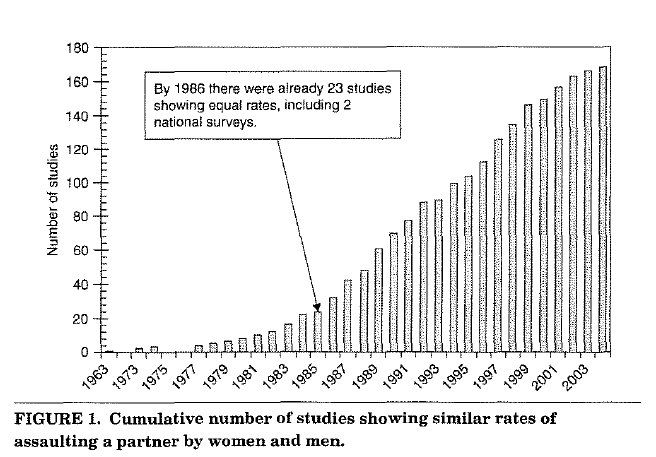
The same WA government web page was also the focus of this reddit mens rights discussion thread. Within that thread I came across an interesting post from someone with the moniker ‘dragonsandgoblins’. It’s interesting not just in relation to the information about domestic violence that it contains, but also because of how it demonstrates the censorship that occurs in relation to efforts to broaden the DV debate beyond the feminist-framed male perp/female victim model.
Anyway, this is what the author had to say:
“I actually wrote an article inspired by this exact webpage in 2013 that was published by http://rightnow.org.au/. Or at least it was published for about 4 hours before they pulled it. I’ll copy/paste it here because people may as well read it:
This webpage, hosted by the Government of Western Australia Department for Child Protection, contains two short paragraphs describing the domestic helpline services provided by this state government. The women’s helpline offers a range of services for women experiencing domestic violence. The men’s helpline on the other hand is more singularly focused, only offering counselling, and only for “men who are concerned about becoming violent or abusive“.
The Government of WA does not offer a helpline service to male victims, instead assuming that women are the only victims and that men will always be the perpetrators. This is despite a growing body of evidence that males do suffer from domestic and family violence in significant numbers. For example, the Personal Safety Survey (2006) by the Australian Bureau of Statistics (ABS) found that, 780,500 women and 325,700 men aged 15 years and over experienced violence from a current or previous partner in the last twenty years. In other words, 29.4 per cent of victims who suffered domestic violence were men. 92.5 per cent (301,400) of these male victims suffered this violence at the hands of a female partner.
The Publications and Resources webpage from the Government of WA provides domestic violence resources aimed at the general public and they are as gendered as the helpline services. Out of the “Freedom From Fear” resources, three fact sheets and one booklet are targeted at the violent party and, excluding the fact sheet “How do I know if I’m abusive?”, they all use gendered language that exclusively refers to the violent party as male and the victim as female. All of them bear subtitles describing themselves as being “for men who want to change”, with no reference to women who may want to do the same. The fact sheet aimed at victims also uses the same gendered language.
WA isn’t alone. For example, NSW Legal Aid offers a Domestic Violence Practitioner Service and a Women’s Domestic Violence Court Advocacy Program which aid women and children who are victims in legal matters such as getting Apprehended Domestic Violence Orders (ADVOs) and victims’ compensation. The NSW Government Family & Community Services Staying Home Leaving Violence program “…aims to prevent homelessness by working with the Police to remove the perpetrator from the family home so that women and children can remain safely where they are.” If the NSW Government offers similar programs specialising in male victims, I was unable to find them.
The federal government also discriminates against male victims. The National Plan to Reduce Violence against Women and their Children (The National Plan) paints a pitiful picture of the federal stance on male victims. Along with use of gender biased language The National Plan has seen the Commonwealth commit $86 million to support women and children who are victims and only $0.75 million to male victims. This discrepancy in funding is justified through the use of misleading statistics from the ABS Personal Safety Survey.
The section of the page that discusses male victims provides statistics that only 4.4 per cent (21,200) of men who were physically assaulted in the 12 months prior to the survey were assaulted by a current/previous partner compared with 31 per cent (73,800) of women who were physically assaulted. This is misleading because it doesn’t compare the quantity of male victims to female victims – instead it compares what percentage of all assaults against men were domestic violence to what percentage of all assaults against women were.
Looking at just these numbers – 21,200 male and 73,800 female victims – the divide in funding is twenty-five times greater than the divide in victims. The National Plan claims only “a small proportion of men are victims“, yet the ABS survey shows that they are roughly a quarter of all domestic violence victims. Is that really such a minority as to warrant less than one per cent of the funding committed under The National Plan?
Our state and federal governments are perpetrators of gender discrimination. Those discriminated against are not only men, they are victims. Victims who are denied services and support they need based on their gender.
(I apologise for the fact that some of the figures are out of date (for example I am pretty sure the funding disparity under the national plan has increased since 2013), and any dead links. This is presented unaltered from when it was written in 2013.)”
The author of the paper was then asked “Why was it pulled?” and responded:
“Well it was refined by 3 of their editors and myself before going up. After a while one of them was contacted by the editor in chief who pulled it and asked me to make changes such as explicitly mentioning that women are victims more than men (which I do already, since I actually state numbers), saying that I didn’t want funding for women reduced, and calling DV a gendered crime. He also said that I could be “more critical in relation to statistics”. Note that I only take stats from the Australian Bureau of Statistics, hardly a biased source. He also wanted me to mention that women under report DV. He also said and I quote:
The internet has provided a haven for those inclined to strike out at people in anonymity and usually without fear of repercussion.
The purpose of this blog post is not to propose solutions to this problem, but rather to take a step back and call for an objective, measured and truthful discussion of the relevant issues.
There’s no doubt that women are often targets of online abuse, although there does appear to be a tendency towards embellishment and exaggeration with regards to the nature and extent of such abuse. The author of this article, for example, would have us believe that life on the internet is unbearable for women due to the oppressive behaviour of male trolls.
What is generally absent from articles on this subject is an honest admission that a considerable amount of online abuse is directed at men, and that a substantial proportion of those perpetrating abuse are women/girls. Have a look at the information provided in the chart below, extracted from a 2014 paper by PEW Research. (see 2017 updated here)
Why do so many commentators and ‘experts’ fail to acknowledge these significant points?
Surely not the desire to support the feminist narrative of women as the perpetual victims of an unyielding male patriarchy?
The findings of a survey by Norton painted a different picture. Unfortunately however the results were compromised by poor methodology, a common problem with pro-feminist research. In this instance the researchers failed to include questions about male victimisation via online abuse.
So why has this issue garnered a large and increasing amount of attention in recent years? Are people becoming nastier? Is that nastiness becoming more gendered in nature?
There are a number of significant factors that need to be considered here.
Further along the scale one encounters behaviour that does not involve actual threats, but is so persistent and pervasive as to be genuinely threatening in nature.
At the other end are interactions that are little more than assertive dissent in relation to a particular idea or opinion being put forward.
More and more we are witnessing the definition of terms such as online abuse and ‘trolls’ expanded to include behaviour and people who seem undeserving of these pejoratives. Also troubling is the fact that the same types of behaviour decried as abuse or trollish when used by conservative/non-feminists, are seen as acceptable or even noble when used by feminists/leftists/woke. This issue of finessing definitions to suit a narrative is discussed in another blog post.
Why do people, particularly in this case feminists/woke, so readily misinterpret online communication in this way? I’d suggest that in part it is a deliberate strategy, whilst at other times simply a misunderstanding.
It has been suggested that feminists interpret relatively innocuous messages as hurtful because online communication is a forum where women are truly treated as equals. Men speak to women online as men would speak to other men in real life. It is said that many women are unaccustomed to this gloves-off banter, and interpret it as vindictive rather than as heartfelt and direct. I believe that there is an element of truth to this, although again it is but one of several factors in the mix.
One other reason for exaggerated claims of online hate and abuse is that it provides an excuse to instigate progressively harsher and more intrusive forms of censorship. Censorship is a recurring theme in real-world feminist tactics, and one which I address in another blog post.
Turning again to feminist research, let’s examine a project called the University of NSW ‘Cyberhate Project‘, which is being supported by the Australian Research Council (‘ARC’) with AUD$372,095 of public funding.
I was more than a little concerned to learn that this research project will only survey women. That looks an awful lot like a research project designed with a particular conclusion already firmly in mind. I immediately took this up with the ARC, who dismissed my complaint regarding this obvious ideological bias in the following manner:
“Proposals for ARC funding undergo a rigorous peer review process involving experts in their fields who assess the quality of projects and the capabilities and achievements of applicants. The planning and management of ARC-funded research projects is a matter for individual researchers and institutions (in accordance with ARC funding agreements).”
I’m left wondering just how many of those peers were likely either fellow feminists or sympathisers. Hands up who else thinks that this might not be the most effective vetting process in the case of a polarised issue such as this?
As is virtually de rigeur at The Conversation, readers comments that were deemed unsupportive of the feminist author’s position were quickly excised. In this case that amounted to at least one in four comments. Of the many I read before they disappeared, none of these were in the least bit threatening or abusive.
I posted one of those comments removed by the moderator. It simply stated:
“Emma, Is it not a fact that men are subject to more online harassment than are women? Is it not a fact that many of the perpetrators of online abuse are women? … Might it therefore not be more accurate to say that the real online divide is one between trolls and the rest of us, rather than between men and women as your paper implies?”
Given that men are subject to a considerable amount of online harassment, they should not be excluded from research on this subject. The fact that the finger of blame is often pointed at men alone, when we know full well that many women perpetrate online harassment/abuse, does tend to stick in this writer’s craw. One might consider at this point the example of Australian radfem Clementine Ford.
As with domestic violence and various other topics, feminists persist in labelling issues as “gendered” when they are not, in order to create support for their global war-against-women conspiracy.
What now follows is a collection of links to articles that provide various perspectives on the issue of online harassment/abuse:
The internet has provided a haven for those inclined to strike out at people in anonymity and usually without fear of repercussion.
The purpose of this blog post is not to propose solutions to this problem, but rather to take a step back and call for an objective, measured and truthful discussion of the relevant issues.
There’s no doubt that women are often targets of online abuse, although there does appear to be a tendency towards embellishment and exaggeration with regards to the nature and extent of such abuse. The author of this article, for example, would have us believe that life on the internet is unbearable for women due to the oppressive behaviour of male trolls.
What is generally absent from articles on this subject is an honest admission that a considerable amount of online abuse is directed at men, and that a substantial proportion of those perpetrating abuse are women/girls. Have a look at the information provided in the chart below, extracted from a 2014 paper by PEW Research. (see 2017 updated here)
Why do so many commentators and ‘experts’ fail to acknowledge these significant points?
Surely not the desire to support the feminist narrative of women as the perpetual victims of an unyielding male patriarchy?
The findings of a survey by Norton painted a different picture. Unfortunately however the results were compromised by poor methodology, a common problem with pro-feminist research. In this instance the researchers failed to include questions about male victimisation via online abuse.
So why has this issue garnered a large and increasing amount of attention in recent years? Are people becoming nastier? Is that nastiness becoming more gendered in nature?
There are a number of significant factors that need to be considered here.
Further along the scale one encounters behaviour that does not involve actual threats, but is so persistent and pervasive as to be genuinely threatening in nature.
At the other end are interactions that are little more than assertive dissent in relation to a particular idea or opinion being put forward.
More and more we are witnessing the definition of terms such as online abuse and ‘trolls’ expanded to include behaviour and people who seem undeserving of these pejoratives. Also troubling is the fact that the same types of behaviour decried as abuse or trollish when used by conservative/non-feminists, are seen as acceptable or even noble when used by feminists/leftists/woke. This issue of finessing definitions to suit a narrative is discussed in another blog post.
Why do people, particularly in this case feminists/woke, so readily misinterpret online communication in this way? I’d suggest that in part it is a deliberate strategy, whilst at other times simply a misunderstanding.
It has been suggested that feminists interpret relatively innocuous messages as hurtful because online communication is a forum where women are truly treated as equals. Men speak to women online as men would speak to other men in real life. It is said that many women are unaccustomed to this gloves-off banter, and interpret it as vindictive rather than as heartfelt and direct. I believe that there is an element of truth to this, although again it is but one of several factors in the mix.
One other reason for exaggerated claims of online hate and abuse is that it provides an excuse to instigate progressively harsher and more intrusive forms of censorship. Censorship is a recurring theme in real-world feminist tactics, and one which I address in another blog post.
Turning again to feminist research, let’s examine a project called the University of NSW ‘Cyberhate Project‘, which is being supported by the Australian Research Council (‘ARC’) with AUD$372,095 of public funding.
I was more than a little concerned to learn that this research project will only survey women. That looks an awful lot like a research project designed with a particular conclusion already firmly in mind. I immediately took this up with the ARC, who dismissed my complaint regarding this obvious ideological bias in the following manner:
“Proposals for ARC funding undergo a rigorous peer review process involving experts in their fields who assess the quality of projects and the capabilities and achievements of applicants. The planning and management of ARC-funded research projects is a matter for individual researchers and institutions (in accordance with ARC funding agreements).”
I’m left wondering just how many of those peers were likely either fellow feminists or sympathisers. Hands up who else thinks that this might not be the most effective vetting process in the case of a polarised issue such as this?
As is virtually de rigeur at The Conversation, readers comments that were deemed unsupportive of the feminist author’s position were quickly excised. In this case that amounted to at least one in four comments. Of the many I read before they disappeared, none of these were in the least bit threatening or abusive.
I posted one of those comments removed by the moderator. It simply stated:
“Emma, Is it not a fact that men are subject to more online harassment than are women? Is it not a fact that many of the perpetrators of online abuse are women? … Might it therefore not be more accurate to say that the real online divide is one between trolls and the rest of us, rather than between men and women as your paper implies?”
Given that men are subject to a considerable amount of online harassment, they should not be excluded from research on this subject. The fact that the finger of blame is often pointed at men alone, when we know full well that many women perpetrate online harassment/abuse, does tend to stick in this writer’s craw. One might consider at this point the example of Australian radfem Clementine Ford.
As with domestic violence and various other topics, feminists persist in labelling issues as “gendered” when they are not, in order to create support for their global war-against-women conspiracy.
What now follows is a collection of links to articles that provide various perspectives on the issue of online harassment/abuse:
The internet has provided a haven for those inclined to strike out at people in anonymity and usually without fear of repercussion.
The purpose of this blog post is not to propose solutions to this problem, but rather to take a step back and call for an objective, measured and truthful discussion of the relevant issues.
There’s no doubt that women are often targets of online abuse, although there does appear to be a tendency towards embellishment and exaggeration with regards to the nature and extent of such abuse. The author of this article, for example, would have us believe that life on the internet is unbearable for women due to the oppressive behaviour of male trolls.
What is generally absent from articles on this subject is an honest admission that a considerable amount of online abuse is directed at men, and that a substantial proportion of those perpetrating abuse are women/girls. Have a look at the information provided in the chart below, extracted from a 2014 paper by PEW Research. (see 2017 updated here)
Why do so many commentators and ‘experts’ fail to acknowledge these significant points?
Surely not the desire to support the feminist narrative of women as the perpetual victims of an unyielding male patriarchy?
The findings of a survey by Norton painted a different picture. Unfortunately however the results were compromised by poor methodology, a common problem with pro-feminist research. In this instance the researchers failed to include questions about male victimisation via online abuse.
So why has this issue garnered a large and increasing amount of attention in recent years? Are people becoming nastier? Is that nastiness becoming more gendered in nature?
There are a number of significant factors that need to be considered here.
Further along the scale one encounters behaviour that does not involve actual threats, but is so persistent and pervasive as to be genuinely threatening in nature.
At the other end are interactions that are little more than assertive dissent in relation to a particular idea or opinion being put forward.
More and more we are witnessing the definition of terms such as online abuse and ‘trolls’ expanded to include behaviour and people who seem undeserving of these pejoratives. Also troubling is the fact that the same types of behaviour decried as abuse or trollish when used by conservative/non-feminists, are seen as acceptable or even noble when used by feminists/leftists/woke. This issue of finessing definitions to suit a narrative is discussed in another blog post.
Why do people, particularly in this case feminists/woke, so readily misinterpret online communication in this way? I’d suggest that in part it is a deliberate strategy, whilst at other times simply a misunderstanding.
It has been suggested that feminists interpret relatively innocuous messages as hurtful because online communication is a forum where women are truly treated as equals. Men speak to women online as men would speak to other men in real life. It is said that many women are unaccustomed to this gloves-off banter, and interpret it as vindictive rather than as heartfelt and direct. I believe that there is an element of truth to this, although again it is but one of several factors in the mix.
One other reason for exaggerated claims of online hate and abuse is that it provides an excuse to instigate progressively harsher and more intrusive forms of censorship. Censorship is a recurring theme in real-world feminist tactics, and one which I address in another blog post.
Turning again to feminist research, let’s examine a project called the University of NSW ‘Cyberhate Project‘, which is being supported by the Australian Research Council (‘ARC’) with AUD$372,095 of public funding.
I was more than a little concerned to learn that this research project will only survey women. That looks an awful lot like a research project designed with a particular conclusion already firmly in mind. I immediately took this up with the ARC, who dismissed my complaint regarding this obvious ideological bias in the following manner:
“Proposals for ARC funding undergo a rigorous peer review process involving experts in their fields who assess the quality of projects and the capabilities and achievements of applicants. The planning and management of ARC-funded research projects is a matter for individual researchers and institutions (in accordance with ARC funding agreements).”
I’m left wondering just how many of those peers were likely either fellow feminists or sympathisers. Hands up who else thinks that this might not be the most effective vetting process in the case of a polarised issue such as this?
As is virtually de rigeur at The Conversation, readers comments that were deemed unsupportive of the feminist author’s position were quickly excised. In this case that amounted to at least one in four comments. Of the many I read before they disappeared, none of these were in the least bit threatening or abusive.
I posted one of those comments removed by the moderator. It simply stated:
“Emma, Is it not a fact that men are subject to more online harassment than are women? Is it not a fact that many of the perpetrators of online abuse are women? … Might it therefore not be more accurate to say that the real online divide is one between trolls and the rest of us, rather than between men and women as your paper implies?”
Given that men are subject to a considerable amount of online harassment, they should not be excluded from research on this subject. The fact that the finger of blame is often pointed at men alone, when we know full well that many women perpetrate online harassment/abuse, does tend to stick in this writer’s craw. One might consider at this point the example of Australian radfem Clementine Ford.
As with domestic violence and various other topics, feminists persist in labelling issues as “gendered” when they are not, in order to create support for their global war-against-women conspiracy.
What now follows is a collection of links to articles that provide various perspectives on the issue of online harassment/abuse:
Constructing the cyber-troll: Psychopathy, sadism, and empathy (December 2017 edition of ‘Personality and Individual Differences’) This study asserts that most trolls are male, but I suspect that the findings may have been compromised by one or more of the following factors:
* small sample size with 2/3 of respondents being women, and who were possibly self-selected
* incorrect assumptions (by survey respondents) regarding the gender of trolls
* differing and possibly gender-based judgments as to what constitutes trolling
The media dangerously misuses the word ‘trolling’ (3 July 2017) This article conveniently neglects to mention that this ‘problem’ has been primarily brought about through misusing the term ‘trolling’ to describe reasonable dissent against the prevailing leftist/feminist narrative.
Australia tackles revenge porn with new eSafety Commission (23 November 2016) AFAIK this agency’s brief was initially gender-neutral but it quickly assumed a pro-feminist stance, making its focus the online harassment of women and girls.
The top 20 Australian politicians, with respect to receiving online abuse, are all right wing males (1 July 2016) Australia. Typical feminist take on this issue, for e.g. mis-labels harassment as “online violence” and “sexual violence”, does not provide corresponding statistics for men/boys harassed online, nor divulge that much abuse is perpetrated by women/girls. The implication is, as always, men=bad & women=men’s hapless victims.
Eight things not to say to someone facing online abuse (20 April 2016) See point 4 in this article by misandrist Laura Bates: “Silencing is the end goal of the majority of abuse”. Erm, so all those feminists systematically lodging bogus reports to have people’s social media accounts closed, they would be online abusers then?
Girl gets Instagram revenge on cheating ex (25 March 2016) Reverse the genders in this story and “one poor lass” becomes ‘online harassment by abusive former boyfriend’
“A new survey by the Internet security company Norton (for which I’m an ambassador) shows that nearly half of all Australian women (47 per cent) experience online harassment. That rises to a staggering 76 per cent for women under 30. Unsurprisingly, 70 per cent of women believe online harassment is a significant problem and 60 per cent believe it has got worse in the past year.” And nowhere in this article will you find corresponding statistics in relation to men – the survey didn’t include questions about male victimisation. I wonder why not?
Online harassment of women at risk of becoming ‘established norm’, study finds (8 March 2016) Australia. Guardian article drawing on the Norton survey which air-brushed out male victimisation/female perpetration, and thus robbed the findings of social context. No doubt a good thing from a feminist perspective if that would have diminished the victim status on which their ideology is based.
Were examples of specific rape threats made public? No. How about a formal complaint to police? Apparently not. “Oh look, another politician ginning up fake threats to boost her feminist cred. Never seen that before….” (Source)
Emma Watson: Trolls threatened to publish nude photos of me (8 March 2015) This article quotes Emma as saying most of those posting threats were other women, yet this article (in pro-feminist news.com.au) claims that men were to blame. As mentioned earlier, this represents an all-too typical bending of the facts to suit the narrative.
#womenagainstfeminism receive hundreds of threats (Scroll down their Facebook timeline to 16 August 2014 for details) Somehow I don’t think it would be men issuing most of the threats … but surely not women?
This June 2014 reddit discussion thread, and linked newspaper article, is about female Twitter trolls
Constructing the cyber-troll: Psychopathy, sadism, and empathy (December 2017 edition of ‘Personality and Individual Differences’) This study asserts that most trolls are male, but I suspect that the findings may have been compromised by one or more of the following factors:
* small sample size with 2/3 of respondents being women, and who were possibly self-selected
* incorrect assumptions (by survey respondents) regarding the gender of trolls
* differing and possibly gender-based judgments as to what constitutes trolling
The media dangerously misuses the word ‘trolling’ (3 July 2017) This article conveniently neglects to mention that this ‘problem’ has been primarily brought about through misusing the term ‘trolling’ to describe reasonable dissent against the prevailing leftist/feminist narrative.
Australia tackles revenge porn with new eSafety Commission (23 November 2016) AFAIK this agency’s brief was initially gender-neutral but it quickly assumed a pro-feminist stance, making its focus the online harassment of women and girls.
The top 20 Australian politicians, with respect to receiving online abuse, are all right wing males (1 July 2016) Australia. Typical feminist take on this issue, for e.g. mis-labels harassment as “online violence” and “sexual violence”, does not provide corresponding statistics for men/boys harassed online, nor divulge that much abuse is perpetrated by women/girls. The implication is, as always, men=bad & women=men’s hapless victims.
Eight things not to say to someone facing online abuse (20 April 2016) See point 4 in this article by misandrist Laura Bates: “Silencing is the end goal of the majority of abuse”. Erm, so all those feminists systematically lodging bogus reports to have people’s social media accounts closed, they would be online abusers then?
Girl gets Instagram revenge on cheating ex (25 March 2016) Reverse the genders in this story and “one poor lass” becomes ‘online harassment by abusive former boyfriend’
“A new survey by the Internet security company Norton (for which I’m an ambassador) shows that nearly half of all Australian women (47 per cent) experience online harassment. That rises to a staggering 76 per cent for women under 30. Unsurprisingly, 70 per cent of women believe online harassment is a significant problem and 60 per cent believe it has got worse in the past year.” And nowhere in this article will you find corresponding statistics in relation to men – the survey didn’t include questions about male victimisation. I wonder why not?
Online harassment of women at risk of becoming ‘established norm’, study finds (8 March 2016) Australia. Guardian article drawing on the Norton survey which air-brushed out male victimisation/female perpetration, and thus robbed the findings of social context. No doubt a good thing from a feminist perspective if that would have diminished the victim status on which their ideology is based.
Were examples of specific rape threats made public? No. How about a formal complaint to police? Apparently not. “Oh look, another politician ginning up fake threats to boost her feminist cred. Never seen that before….” (Source)
Emma Watson: Trolls threatened to publish nude photos of me (8 March 2015) This article quotes Emma as saying most of those posting threats were other women, yet this article (in pro-feminist news.com.au) claims that men were to blame. As mentioned earlier, this represents an all-too typical bending of the facts to suit the narrative.
#womenagainstfeminism receive hundreds of threats (Scroll down their Facebook timeline to 16 August 2014 for details) Somehow I don’t think it would be men issuing most of the threats … but surely not women?
This June 2014 reddit discussion thread, and linked newspaper article, is about female Twitter trolls
Constructing the cyber-troll: Psychopathy, sadism, and empathy (December 2017 edition of ‘Personality and Individual Differences’) This study asserts that most trolls are male, but I suspect that the findings may have been compromised by one or more of the following factors:
* small sample size with 2/3 of respondents being women, and who were possibly self-selected
* incorrect assumptions (by survey respondents) regarding the gender of trolls
* differing and possibly gender-based judgments as to what constitutes trolling
The media dangerously misuses the word ‘trolling’ (3 July 2017) This article conveniently neglects to mention that this ‘problem’ has been primarily brought about through misusing the term ‘trolling’ to describe reasonable dissent against the prevailing leftist/feminist narrative.
Australia tackles revenge porn with new eSafety Commission (23 November 2016) AFAIK this agency’s brief was initially gender-neutral but it quickly assumed a pro-feminist stance, making its focus the online harassment of women and girls.
The top 20 Australian politicians, with respect to receiving online abuse, are all right wing males (1 July 2016) Australia. Typical feminist take on this issue, for e.g. mis-labels harassment as “online violence” and “sexual violence”, does not provide corresponding statistics for men/boys harassed online, nor divulge that much abuse is perpetrated by women/girls. The implication is, as always, men=bad & women=men’s hapless victims.
Eight things not to say to someone facing online abuse (20 April 2016) See point 4 in this article by misandrist Laura Bates: “Silencing is the end goal of the majority of abuse”. Erm, so all those feminists systematically lodging bogus reports to have people’s social media accounts closed, they would be online abusers then?
Girl gets Instagram revenge on cheating ex (25 March 2016) Reverse the genders in this story and “one poor lass” becomes ‘online harassment by abusive former boyfriend’
“A new survey by the Internet security company Norton (for which I’m an ambassador) shows that nearly half of all Australian women (47 per cent) experience online harassment. That rises to a staggering 76 per cent for women under 30. Unsurprisingly, 70 per cent of women believe online harassment is a significant problem and 60 per cent believe it has got worse in the past year.” And nowhere in this article will you find corresponding statistics in relation to men – the survey didn’t include questions about male victimisation. I wonder why not?
Online harassment of women at risk of becoming ‘established norm’, study finds (8 March 2016) Australia. Guardian article drawing on the Norton survey which air-brushed out male victimisation/female perpetration, and thus robbed the findings of social context. No doubt a good thing from a feminist perspective if that would have diminished the victim status on which their ideology is based.
Were examples of specific rape threats made public? No. How about a formal complaint to police? Apparently not. “Oh look, another politician ginning up fake threats to boost her feminist cred. Never seen that before….” (Source)
Emma Watson: Trolls threatened to publish nude photos of me (8 March 2015) This article quotes Emma as saying most of those posting threats were other women, yet this article (in pro-feminist news.com.au) claims that men were to blame. As mentioned earlier, this represents an all-too typical bending of the facts to suit the narrative.
#womenagainstfeminism receive hundreds of threats (Scroll down their Facebook timeline to 16 August 2014 for details) Somehow I don’t think it would be men issuing most of the threats … but surely not women?
This June 2014 reddit discussion thread, and linked newspaper article, is about female Twitter trolls
Many among the media, and the political and bureaucratic elite seem to get quite a hard-on about awareness campaigns. Indeed, some have suggested that such campaigns are a favoured device of the prevailing leftist/feminist hegemony. This despite the fact that the effectiveness of such campaigns is often difficult to assess. Or perhaps it’s because of that.
The American political philosopher Thomas Sowell observed “We should not be surprised to find the left concentrated in institutions where ideas do not have to work in order to survive.” (Source)
Ah, but not all awareness campaigns are the same. Campaigns concerning issues that are pivotal to the feminist cause are beyond reproach. Mild criticism is however tolerated in the case of campaigns on less ideologically revered topics.
A very different reaction to two public awareness campaigns
It’s May 2015 and the Australian federal government has released its annual budget. It proposes substantial allocations to two separate public awareness campaigns. One relates to drug use, specifically crystal methamphetamine – or ‘ice’ ($9 million). The other relates to domestic violence ($7 million).
Plenty of people have lined up to criticise the first campaign on the basis, for example, that it’s unoriginal, focuses too much on scare mongering, is unlikely to be cost-effective, and might even be counter-productive.
On that last point, one article included the statement that “When an ad is on television for a particular illicit drug, we know afterwards young people think it must be really, really common and so therefore it can increase their perception of how normal it is.”
In contrast the only public criticism that the domestic violence campaign has been subject to, is that not enough money has been provided. It is probably no coincidence that the feminist lobby is heavily invested in the DV campaign, but not the other.
So just how many parallels, if any, are there between the two campaigns?
“International evidence suggests such “awareness” campaigns are not the most appropriate way to address harmful methamphetamine use. In fact, fear-based approaches can increase stigma which possibly drives people away from, rather than towards, treatment.”
The article proceeds:
“Australian media outlets and politicians claim we’re facing a nationwide “ice epidemic” … the most up-to-date research estimates that the proportion of Australians who have used any type of methamphetamine (ice, “speed” powder) in the previous year has remained relatively stable for at least the last decade.
Nevertheless, the government and media’s continued use of hyperbolic language – in addition to a tendency to ignore and sometimes dismiss public health experts’ advice on ice – has the potential to incite unnecessary fear and misinform the public about this supposed “menace”.”
So there’s our first parallels, for neither campaign will be targeted and in both cases Australian media outlets and politicians are making exaggerated claims about an emerging epidemic.
The article then goes on to question whether the personal and public threat posed by drug use (as compared to the extent of drug use) has also been exaggerated.
The article states: “We need to accurately define the issue, including the nature and extent of methamphetamine use and related harms in rural and regional areas, to allow the development and implementation of cost-effective, evidence-based and timely responses.”
A further parallel is that the debate about domestic violence likewise does not accurately define the issue, focussing as it does wholly on uni-directional violence by men against women. I would also argue that the policy response is not evidence-based but rather driven by the ideology of those most heavily invested in the issue.
The article then goes on to talk about the success of health-related public awareness campaigns, noting that some “are costly, ineffective and possibly even counterproductive”.
In one example cited “The findings of one study suggest that the Montana Meth Project might actually increase acceptability and decrease perceptions of risk relating to using methamphetamine.” Elsewhere it noted that “fear-based approaches can lead to stigma and poor health outcomes, such as from reduced treatment-seeking.”
The article concludes with a discussion of the value of an alternative or supplementary strategy, that of “harm minimisation”. It notes:
“Because people will choose to engage in drug use (both licit and illicit) regardless of the policies and programs in place, we need to encourage them to do so as safely as possible. We also must continue to inform the public about options for managing drug-related consequences and appropriate and available means for professional support, such as telephone and internet counselling”.
The concept of ‘harm minimisation’ also applies to domestic violence when we consider the prevalence of bi-directional violence, as shown in the diagram below, and the fact that domestic violence may persist from one generation to the next. Perhaps we need to resign ourselves, that in some situations it may be more effective to focus more on the provision of short-term shelter accommodation, the removal of children into care, etc.
Assuming there are parallels between awareness campaigns for drug use and domestic violence, then why have the same criticisms not been raised in relation to the latter?
Indeed, why has no criticism at all been directed at those spending large amounts of taxpayer funds on domestic violence awareness campaigns? Doubly so, given that there have been many previous awareness campaigns undertaken, and that these all appear to have achieved little in terms of effecting a remedy for the problem.
Is this lack of criticism because those in positions of influence truly believe in the value of such campaigns, or is it simply a reflection of wishful thinking and/or the very real fear of feminist backlash against dissenting voices?
Do public awareness campaigns even work?
Many public organisations love awareness campaigns because for minimal work they provide maximum profile (i.e. ‘hey, look at us doing something about the problem!’). Just engage a marketing consultant, agree on a logo, and begin advertising.
The jury is out, however, on their effectiveness – in part because many public awareness campaigns are not subject to proper evaluation. This is probably, in part, because of the factor noted above – they are often created at short notice for reasons of political expediency.
It is known however that some types of awareness campaigns are more likely to be successful than others:
“Some police agencies participate in domestic violence awareness campaigns and school programming, such as classroom instruction to teens about dating violence and ways to handle conflict. Domestic violence prevention messages may target the general population or specific populations. For example, campaigns may be designed to encourage victim reporting, deter potential offenders, or raise the consciousness of potential witnesses of abuse (neighbours, friends, relatives).† However, the effect of these prevention strategies is unknown.
For instance, few of the programs developed to reduce teen dating violence have been evaluated, and of those that have, there have been mixed results. Although some report an increase in knowledge in the targeted population and greater familiarity with available resources to help victims, this does not necessarily translate into a reduction in the incidence level of dating violence.
† The Lancashire (United Kingdom) Police Constabulary placed messages about domestic violence on police vehicles, beer glass coasters in bars, utility bills, and lampposts, and used radio advertising to increase awareness of domestic violence.
As a rule, prevention is more likely to work if highly targeted. General campaigns are not typically effective. Highly targeted campaigns that focus on a specific target group or geographic area can have some impact. Offender-oriented campaigns, which are designed to raise potential offenders’ perceptions that there will be meaningful consequences to battering, are more likely to be effective than campaigns that appeal to potential offenders’ morals.” (Source)
Marriage vote: how advocacy ads exploit our emotions in divisive debates (13 September 2017) Now transpose the views expressed here across to domestic violence awareness campaigns, with the ‘yes’ lobby being those challenging the status quo by seeking a non-gendered approach to the issue. Again, “the ‘no’ campaign has many unfair advantages”. Though I suspect, most likely, not in the eyes of the typical reader of ‘The Conversation‘.
It is highly likely that the campaign that eventually emerges will focus solely, or almost solely, on men’s violence towards women. Issues like bi-directional violence, domestic violence in same-sex couples (especially women), and female on male violence will be ignored or minimised. The focus on gender and control will mean that other factors like social disadvantage and substance abuse will be played down. Political correctness will also rule out consideration of race, ethnicity or religion as potentially relevant factors.
What messages will this send? What biases and stereotyping will this reinforce?
Fear-based health information makes new mothers anxious (23 July 2015) Australia. Now consider DV campaigns that demonise all men despite them having no control over the small minority of men who abuse. The community seemingly sees no problem with making men feel “anxious” in that situation, even despite the fact that four times as many men commit suicide as do women.
Social Marketing for Preventing Violence Against Women: Making every action matter (June 2013) This paper is written from a pro-feminist pro-awareness campaign perspective, but provides a useful list of many previous awareness campaigns. It fails to provide serious/objective evaluations of individual campaigns or of awareness campaigns generally. Indeed, it’s telling that the only campaign against which it directs criticism is the ‘One in Three‘ campaign that draws attention to male victims of domestic violence. ‘One in Three‘ is an ongoing target for feminist criticism.
But more than that, Jane did exactly what feminists have long accused the MRM of doing, she sought to discredit the reality of substantial numbers of victims of domestic abuse on the basis of their gender. She sought to elevate the importance of the feminist-driven domestic violence industry by climbing on the backs of male victims.
Jane claimed that her action was necessary because “there’s a serious risk it [acknowledging significant numbers of male victims of DV] will alter the way governments approach the issue“. This is certainly one of the more absurd claims I have heard emerge from Australian feminists in recent times. And that’s saying something.
And the evidence in support of Jane’s fear is what exactly? None of the recent inquiries into domestic violence stepped outside the strict parameters of the DV debate as determined by the feminist lobby. Male victims of domestic violence are scarcely a faint blip on the political radar screen either federally, or in any of the state or territories. In fact, sadly, I see little evidence of politicians paying any attention to the ‘One in Three‘ organisation, or to the data it disseminates, or indeed to the MRM generally.
The relevant post in the Facebook page of publisher ‘Daily Life‘ attracted a substantial number of responses from readers, fairly evenly balanced between supporters and critics of Ms Gilmore’s article. This surprised me given that Daily Life is generally avoided by those who aren’t ardent feminists, thanks to a combination of biased content and hostile moderation. Many of those writing in support of Jane’s article came across as extremely ill-informed and sexist, but don’t take my word for it – click on the link above and see for yourself.
Ms. Gilmore herself added a comment on 1 May 2015 stating:
“I’m not going to get into any pointless arguments here, but I’d like to remind everyone that I said more than once in the article that anyone who needs help should get it, and quoted Karen Willis on the topic as well. This is not about denying services for men or the fact that male victims exist, it’s about understanding the facts and directing services where they are genuinely needed. And most importantly, gender is relevant in prevention and must be considered if primary prevention programs are going to be effective in keeping both men and women safer.”
But of course Jane’s article does, and can only, undermine efforts to address the ongoing denial of recognition and support for male victims of domestic violence. Such efforts are underway not only in Australia but also, for example, in Canada, the U.K and the United States.
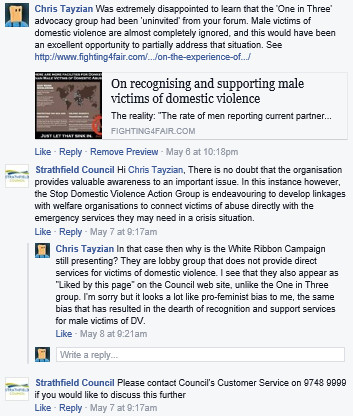
And indeed, within days of Jane’s article being published, the One in Three organisation was uninvited from presenting at a Forum on Family Violence hosted by Strathfield Council, and there will now be no voice for male victims of domestic violence. Although they do not provide front-line services to victims, the reason given for excluding One in Three, the pro-feminist White Ribbon Campaign will still be presenting. This course of events can only be seen as a further sad indictment of the misguided priorities of the feminist lobby.
The degree of impartiality of Strathfield Council was further called into question when they removed a comment I made on 8 May from the timeline of their Facebook page (before and after screen-saves provided below)
One in Three published a rebuttal to Jane Gilmore’s article here, and which I recommend that you read. Jim Muldoon, an Australian MRA, also published a critique of the Daily Life article here. (Jim also wrote an earlier article about Gilmore’s biased position on domestic violence, entitled ‘Jane Gilmore should stop with the rubbish domestic violence games‘, in December 2014)
One in Three subsequently published a disturbing account of the bias and antagonism that they encountered whilst contributing to the Senate Inquiry into Domestic Violence.
This August 2016 article describes how Clementine Ford attacked Erin Pizzey, the founder of the Women’s Shelter movement (but now campaigns for better recognition/support for male victims of DV. See related Reddit discussion thread here.
This Australian feminist group has lobbied to have trans-women excluded from DV shelters, so clearly CIS men have zero chance of being offered support. Discussion thread and linked article here.
Mildred Daley Pagelow is a feminist who claims that male victims of domestic violence violence are essentially an overstated farce that erodes finding available for female victims of domestic violence (Source 1) (Source 2) (Source 3)
I’ve had many of my comments removed and am on final warning prior to being banned from the site. On 1 April 2015 a moderator at The Conversation removed yet another comment, one that I added to this article about sexual assault. This is what I wrote:
“It’s deeply ironic that the title of your article is “let’s turn the spotlight on known perpetrators”, but within the first sentence you exclude acknowledgement or consideration of all female perpetrators of sexual assault. On what basis? There’s less reported crimes involving female perps, so it’s OK to just airbrush them out?
I’m also troubled by you referencing the 2013 National Community Attitudes Towards Violence Against Women survey, which didn’t bother to ask respondents about their attitudes towards violence to men. Thus the questions about violence towards women were robbed of context and so we don’t know the extent to which the issue is men’s attitudes towards women, or Australians attitudes towards violence generally.”
As usual my comments were fairly benign in the overall scheme of social discourse. But this time, on impulse I wrote to the two authors of the article to see how they felt about the level and nature of the moderation that was taking place:
“Dear Nicola and Anastasia
I write to you this morning in relation to your article in The Conversation entitled ‘Everyday rape: let’s turn the spotlight on known perpetrators’.
I’m a keen reader of The Conversation and like many other readers often feel compelled to offer a comment on the article presented therein. Also, like many other readers, I am frequently frustrated by the actions of the moderators in removing many of the comments contributed – indeed sometimes most of the comments contributed.
You will have noted that as of now, about half of the comments concerning your article have been removed (including one of mine btw). On this, as on previous occasions, my comments were neither offensive nor irrelevant to the matter being discussed.
I have previously raised my concerns about moderation policy with the relevant people at The Conversation. On those occasions when the moderators do not intervene as readily there have been some very good and quite robust discussions played out with no hint of undue unpleasantness.
Rather than just grumbling about it on this occasion, I was wondering how you – as authors – felt about the situation. Are you being consulted about which comments are removed? I assume not. Do you believe that your article – and indeed your own professional development – would be strengthened by allowing a freer interchange of ideas? My own view is that if one can’t have an honest and robust exchange of alternative viewpoints within a web site run/funded by universities, then where can you?
Thank you, and I look forward to hearing your views”
Dr Nicola Henry of Latrobe University, kindly wrote back on 2 April 2015:
“Thanks for your email. I think you raise a valid concern. I’ve read all of the comments that have thus far been removed (including yours). We of course have no say in this, but I did wonder why they were removed and personally wished they had remained on the site so that people can engage in debate about these issues. Sometimes there are very offensive personal attacks and inappropriate comments made on this site – so I can certainly see why moderation is important. In other words, I can understand why comments that contain vilification are removed, but not comments that pose an alternative view.
This is an issue that I discuss with my students who take my subjects – we discuss freedom of speech and censorship and the sometimes difficult lines that exist between offensive/discriminatory and opinionated speech (the latter I personally don’t think should be censored by the way).
I’m sorry I can’t offer you an explanation as to why your comment was removed from the Conversation site, but I can assure you that both Anastasia and I are always up for critical debate (that’s our job!).”
All good there. I wonder if other authors are mostly of the same view? If so then the problem lies with the attitudes of the management team at ‘The Conversation’.
I’ve said it before and I’ll say it again. The Conversation is a publicly funded forum for the discussion of current affairs and contemporary issues. It is operated under the auspices of Australian universities.
The Conversation should be about mature, free and open discussion (obviously sans expletives, threats and personal abuse).
The Conversation should not continue to be fettered by political correctness and ideologies du jour like gender feminism.
Here’s a relevant comment that appeared in an October 2015 reddit discussion thread concerning another biased gynocentric article appearing in The Conversation:
“I have opted out of The Conversation. Look at the number of “content removed by moderator” and you can bet that most of them were disagreement with the original article which Cory (the moderator) conflates with “breaching community standards” …
I have written several times to Cory pointing out that their editing is not ‘balanced’ and that they only publish a torrent of hate speech masquerading as academic “research”. His reply was to refer me the “community standards” which is a euphemism for a licence to censor opinions that they don’t like.”
This October 2015 Breitbart article provides an overview as to what is occurring in reader’s comments sections in left-leaning organisations like The Conversation.
And yet thankfully here and here we find evidence of a push-back beginning in some US universities. It’s been a long time coming & there’s such a long way to go.
Some of you may have read my earlier post about censorship and bias at a publicly-funded pro-feminist web site called The Conversation. I’m chuffed to see that post has attracted quite a lot of hits.
A comment contributed by one of their feminist readers struck a chord. It was pretty awful really.
And so I did something that I don’t recall having done before … I complained to the moderator:
“My main concern with Barbara’s comment was her unsubstantiated assertion that many of the people expressing concerns about the gender-bias in the debate surrounding domestic violence are perpetrators of abuse. This is an outrageous claim that is gender bigotry pure and simple. It is is like me saying that feminists are closet paedophiles because they remain silent about the now large numbers of female teachers who are caught having sexual relations with underage students. Hers was a completely inappropriate and inflammatory comment”
And lo and behold … Barbara’s post was consigned to the rubbish bin of history.
I can just imagine the gritted teeth of the resident white knight/SJW moderator as he pondered my request. But then, overcome with righteous fury, it appears he resolved to teach me a lesson. Something along the lines of “There’s no way I’m going to let this uppity MRA get away with this.”
And so it came to be that I was simultaneously advised:
Your comment on ‘Remove the burden of family violence from the victims, to the courts’ has been removed … For your reference, the removed comment was:
“Rob, I haven’t read your report yet (but will do so shortly), so the following comment is based on what I’ve read in the media. It appears that your report talks about the need for more & better intervention and behaviour modification programs for perpetrators, but that your recommendations in this regard are limited to male perpetrators.
Can I ask why you would not adopt a gender-neutral approach in this regard and have programs that catered for both male and female perpetrators. I mean, it’s not as though there are so few violent women that we can afford to just wave them away.
Feminists and their white knight allies raved about the Q&A program, unsurprising given that it was tailor-made for the feminist palate. I found it’s tone and content entirely predictable, and its contribution to the domestic violence debate largely unhelpful. The program’s focus – heterosexual men battering heterosexual women – was so narrow (in terms of the actual breadth of family violence – that it would have been more accurate to call it ‘The Violent Men Beating on Women Special‘.
A great deal of fuss was made about the fact there was a male compere and three men on the panel, but it did not make a lick of difference in terms of either the nature of material addressed and the manner in which it was addressed. The most significant thing about the gender balance of the panel was the revelation that ABC had pointedly turned down Dr Elizabeth Celi as a panellist. The details behind that move are addressed in Bill O’Chee’s article (linked below).
I just read the sentence below earlier today and, while it’s not specifically about domestic violence, it did remind me a lot of the Q&A program:
“The opposite of compassion is not hatred,” wrote one Florida prisoner, describing the violence he’d endured. “It’s indifference.” (Source)
“As a member of last night’s audience and I sat right behind Mr Coe I went home devastated as I realised the gender inequality within the DEBATE of DV is worse than I had originally anticipated. I left in silence and shock as I realised the when it comes to male victims of DV … they have no voice.
The rudeness displayed by the women in the audience towards Mr Coe particularly directly in front if him was disturbing, palpable and audible denigrating of this man’s experience could be heard. The notable agitation shown by Natasha was clearly evident and appalling for a person in her position.
Furthermore I don’t believe that the greater society do believe that men should be ignored. From what I am hearing, most people want NO ONE TO SUFFER DV NOT JUST WOMEN so why do male victims not even get a voice in the discussion. No one doubts that they are in the minority (but I would argue more equal statistics if you only take into account emotional and mental abuse and take the sexuality and physicality out of the statistics) HOWEVER WHEN DID START IGNORING THE MINORITIES IN THIS COUNTRY??? It is just not good enough in our sophisticated society, we need to be a shining light in the discussion of this appalling worldwide phenomenon that is DV.”
In addition to the comments contained within the Q&A Facebook page and Twitter stream, I would suggest reviewing the reader’s comments that follow the articles listed below:
“Your comment makes me want to throw up. Not only am I a male victim of DV, I was also falsely accused of DV so that ‘SHE’could get an ouster order that effectively made me homeless and economically destitute. Because of HER committing DV, I lost my house and home, my business and income, my friends, cash, pets, car, and was introduced to the floor below the poverty line for a 2 year stint… I’m STILL here on this floor!!
My child under 3 (at the time) copped the biggest shock when HER greed and malevolence extended to the innocent and defenseless. The child’s outright rejection of HER as a mother had me playing defender from HER physical and psychological attacks with my child literally screaming “Don’t want mummy!” HER multiple, double digit bullying and harassment complaints against HER at HER work did nothing to convince he magistrate that something was very wrong as the court system swallowed HER lies, hook, line, and sinker and SHE played on societies expected role of her, the battered woman, when in reality, SHE is a rabid, sick werewolf dressed in Little Bo Peep clothing. A dangerous Narcissist by any standard.
The ease with which SHE has been able to manipulate the system, and lie successfully to the courts with breathtaking effectiveness, and the very keen willingness of police to accept HER “story” over mine for no other reason than I am male and here was violence involved, was a repugnant and contemptuous experience that no ‘person’ should have to go through. You should get your facts straight before posting such ignorant comments. Men ARE dying too, or didn’t you read that part? I’m not dead because of my child and my desire to fight this sexist idea that men are from hell.” ‘Roger’ (26 February 2015)
I found out this afternoon that I had been blocked from a Twitter account – one belonging to an Australian journalist. The journalist in question is indeed a feminist, but by no means in the ‘barking mad’ misandrist league of Clementine Ford or Caitlin Roper, for example. Which makes her action all the more disconcerting.
I’m not sure how many others have blocked me from their Twitter accounts (and/or Facebook pages, etc), but there must be a few by now. Two that spring to mind are White Ribbon Australia and Our Watch, both of which are feminist advocacy groups.
Anyway, so there I was, reading a newly-minted article about domestic violence. More accurately, an article about that component of domestic violence involving male perpetrators and female victims. I posted a reader’s comment which failed to appear (other reader’s comments were uploaded). As I had some issues with both the article and certain comments that followed it, I sallied forth looking for another outlet through which to express myself. I turned to Twitter only to be greeted with the following message:
Had I been bombarding the poor woman with dozens of tweets? Nope, just one actually. Well, it must have been particularly vicious! Judge for yourself (by the way, that tweet became the basis for this blog post)
I haven’t ever blocked anyone from Twitter, etc, but I can certainly understand others doing so in situations involving persistent unwanted messages/posts of a threatening or obscene nature. But what I am talking about here and now are situations that are far more benign. Situations where it is simply a matter of ‘I don’t like what you have to say so I am not going to share information or communicate with you in any way, shape or form. So there.’
I have never sent or posted a threatening, abusive or obscene message to anyone, and I challenge anyone to prove otherwise. I choose not to, and I certainly don’t need to, in order to achieve what I am seeking to achieve.
Personally, when I read material produced by feminists and see how they respond in online forums, my mind is drawn to the Credit Union Australia adverts shown on Australian TV. In those ads people block out information they don’t want to hear/consider by covering their ears and saying “la la la”.
That blog post also noted that, despite the very different perception that feminists seek to portray as reality, more men than women are subject to online abuse and bullying, and substantial number of women/girls are responsible for this type of activity. I also noted the increasingly common tactic of feminists lodging false or exaggerated complaints with the intention of having other people’s Facebook or Twitter accounts suspended.
Whether feminists are blocking people from posting to their Facebook pages, from interacting with them via Twitter, or adding a comment to their article or blog post (that is, when they allow any reader’s comments at all). I’ve got to ask … what’s the point?
I guess it all comes back to the question of what are feminists trying to achieve via publishing material online. Sharing and persuading with/to the broader community, or simply seeking a platform to propagandise to the converted and to gullible ingenues.
What do feminists hope to achieve by blocking out alternative perspectives and information at variance with their own stated claims? Do they not see any value in facilitating dialogue about gender issues? In being inclusive with regards to people who hold perspectives other than their own? Are feminists now so infantilized and imbued with victim-mentality that they see any disagreement as an attack?
I know. Call me biased. But the feminist response seems so juvenile, pointless and counter-productive.
Just … lame
Snap#1: Another feminist – @misskylie77 – just blocked me from her Twitter stream after I replied to one of her tweets (26 February 2015)
Snap#2: The organisation Domestic Violence NSW blocked me from posting to their Facebook page the very first time I posted there – and then employed another common feminist tactic by lodging a complaint against me with Facebook (12 March 2015)
Update 15 April 2015: Care to guess which feminist journalist ‘spat the dummy’ this morning and deleted ALL the readers comments (about a dozen of them) because not one of them supported her convoluted sexist perspective on violence in the community.
Footnote in relation to the following comment from the author of the article
DV-deniers? Really? Readers raised concerns about the fact you had built your case on a series of crimes in which none of the alleged perpetrators had yet been convicted. That’s not denial, simply fact. Readers raised concerns that you based your article on events within a period of just a few weeks, which could greatly misrepresent the reality over (say) twelve months. Again, not denial, just conventional wisdom in the realm of statistical analysis.
Readers also raised concerns that you had not provided any statistics in relation to the number of men killed by their female partners (or alleged to be killed by partners) during this period. And indeed, you admit that you had not researched that topic. Surely both the actual nature of the problem, and the most appropriate remedial action, might be quite different were similar numbers of men being killed?
It looks a lot like you didn’t research the issue and then form an opinion, but cobbled together a somewhat dubious statistic that supported your pre-existing conclusion.
In fact the only denials about DV that I am seeing in this and in so many other articles, involve feminists denying men’s right to raise legitimate concerns about ongoing anti-male sexism and misrepresentation. Denials in particular about both the extent of male DV victimization and the substantial and growing level of female perpetration of violence.
Facing the challenge of online harassment (8 January 2015) Jacques Cuze, when discussing this article in the context of his concerns about feminist groups suppressing free speech, suggested that “Twitter (and other sites) should be transparent and specific about who is banned and why. Transparency in who is blocked or banned and why is a critical part of making sure anti-harassment strategies are not abused” (10 January 2015)
The nature of criticism put forward in relation to the men’s rights movement says a lot about both the MRM and it’s critics – just not in the way most authors intended.
At the outset let me note that while writers may claim to be directing their criticism towards the men’s rights movement, they are frequently either unknowingly or deliberately inaccurate.
As I’ve said elsewhere in this blog, one of the great things about those people who are supportive of the men’s rights movement is their extraordinary diversity. They may not agree with every aspect of MRA beliefs, nor us them, but they have taken the time energy to research and to present their views.
Bi-Annual Report From ‘Diverting Hate’ (March 2024) This project is funded by the US Department of Homeland Security’s Center for Prevention Programs and Partnerships
The Privilege Discussions We Need To Have (21 June 2017) If I get time I would love to write a rebuttal of this post. A classic example of someone who clearly thinks they know a great deal about the men’s rights movement but whose understanding is in fact deeply flawed.
New Hampshire State Rep Who Created Reddit’s ‘Red Pill’ Resigns (17 May 2017) Feminists can be as hateful and biased as they like but has one ever been forced to resign from public office? This selective and media-endorsed persecution of anti-feminists and MRA’s is why so many opt for anonymity in the first place.
On International Women’s Day, don’t forget men, by Ben Pobjie (8 March 2017) Australia. The secret to witty caricaturization is knowing your subject, and this guy is clearly clueless about MRA’s and the men’s rights movement. Then again, if he understood the movement, he’d be less inclined to mock it.
David Futrelle is a high-profile critic of the Men’s Rights movement. “Futrelle is considered the go-to expert on the Men’s Rights Movement by many mainstream journalists”. This web site discusses his work.
The MGTOW group really, really don’t like women (8 October 2016) You’d think feminists would be delighted to have more men disengaging from women, but no it’s just too good an opportunity to mock and misrepresent. This article is a knock-off of another article in The Independent (UK) a week earlier.
“Hanson’s audience is, as it always has been, bitterly angry white men, furious that their place at the front of every queue is no longer guaranteed by the power of their tiny, white penises”
Why I’ll never date a feminist (9 September 2016) Check out the readers comments, many of which attack the author regarding his physical appearance, etc etc. Further discussed here and here
“In response to Sonia Kruger’s comments, radio personality Meshel Laurie stated the bare facts: “The most dangerous people in Australia are Australian men who kill Australian women at a rate of one a week.”
“That’s more than any terrorist has ever done,’ pointed out her co-host, Matt Tilley. Following One Nation’s logic, is the solution to domestic violence to ban all men from entering Australia?”
” … there will be voters out there who really object to the Prime Minister calling out their attitudes towards women …”
So if you disagree with the Prime Minister’s ill-informed comments and/or the nature of his package of funding, then it’s because you hold negative attitudes towards women.
Men’s Rights Agency – Feminism (undated) Australia. Includes reference to comments by Judge Alistair Nicholson, who “publicly accused those who disagreed with the practices of the Family Court (mostly men), as being “discontented litigants, sometimes obviously dysfunctional“. Nicholson, the Chief Justice of the Family Court further abused his advantaged position, (i.e. protected from rebuttal under the secrecy provisions within the Family Law Act), by claiming “most persistent critics behaved in a way which cannot stand up to public scrutiny, particularly in relation to issues of violence against women and children“.”
“There is much fudging of stats by the Father’s Rights movement and IMO many (not all) of the men in those groups are [domestic violence] perpetrators posing as victims.” Reader’s comment by Barbara Roberts, Author of “Not Under Bondage: Biblical Divorce for Abuse, Adultery & Desertion.” Co-leader of A Cry For Justice (Source) 21 March 2015
The most visible elements of the domestic violence lobby in Australia are advocacy groups, charities and NGO’s such as ‘Our Watch‘, ‘DV Connect‘, the White Ribbon Foundation and ‘Domestic Violence NSW‘. Further groups are listed in this blog post, and with yet more examples provided here. And then in March 2020, 84 DV-related groups signed a letter to “Women’s Safety Ministers” calling for changes to purportedly better address violence against women.
In addition to scores of these mostly publicly-funded feminist groups, there exist various other significant pieces in the DVI jigsaw, particularly:
Feminist politicians and male colleagues imbued with a surfeit of chivalry (aka ‘white knights’)
Feminists leading or working within academia and in market research/consultancy companies, and
Feminist and ‘white knight’ journalists and media commentators
It would appear that a high degree of inter-connectivity exists between the various parties involved in the Australian Domestic Violence Industry (ADVI). The links in this web comprise mutually-beneficial flows of tangible and intangible benefits such as funding/employment opportunities, power/prestige, and an often misguided sense of achieving social justice.
Each of these groups or individuals perform an important function within the network, the unifying theme being a shared desire to maintain and expand the network and to defend it against perceived threats.
I would hazard a guess that many of these individuals share similar demographic characteristics, with further points of commonality that include:
having studied the same university courses
enjoying social and/or personal relationships with others in the network, and
there being varying degrees of financial inter-dependency between them
The primary output of this industry should be a sustained reduction in the incidence of domestic violence involving both male and female perpetrators. Secondary outputs should include the provision of support for all victims and perpetrators of domestic violence, facilitating training of front-line workers who provide that support, and public education concerning the nature of domestic violence and available avenues of assistance.
The ADVI’s public education function has, however, been subverted to disseminating propaganda that is heavily imbued with feminist dogma. This has the effect of generating heightened hysteria which serves to generate further public/political support. It has created a deeply misrepresentative picture of the nature of the problem, and hence the nature of the most appropriate policy response.
Anyway let’s turn our attention to the really important stuff – are these people actually getting runs on the board in terms of reducing the incidence and severity of domestic violence? For if they were then I might be inclined to keep these other concerns to myself. The reality though is that, as best we can tell, the ADVI seems to be making little or no progress at all.
How is the ADVI’s effectiveness measured? Well for the most part it isn’t, and that’s a big part of the problem. Most industries have measures of output, sometimes known as ‘key performance indicators’ (KPI). An obvious KPI for the ADVI would be the incidence of domestic violence in the community. But based on what the ADVI itself is telling us though, that figure is moving in the wrong direction (think now of the regular use of descriptors like ‘epidemic’).
On the issue of KPI’s, I came across a table in this article entitled ‘Survey of public information on key performance indicators for combating domestic violence in Australian jurisdictions‘. Sadly I note that the performance indicators for national, ACT, Tasmania, South Australia and Victorian government don’t address the safety of all citizens, only that of women and children.
In July 2016, a feminist-saturated non-profit organisation known as ANROWS, released a report that might constitute the first attempt to evaluate efforts to reduce the incidence of domestic violence against women. The summary included the following observations:
“Most evaluations used a mixed-methods design but few had robust outcome measures and none assessed the relative impact of specific components, so the authors were unable to identify effective components or service models.”
“To build an evidence base on effective integration, the report found that future evaluations should be theory-driven, measurement focused and comprehensive, including process, output and outcome indicators.”
Every industry includes dedicated and hard-working people who make a positive contribution. In the case of the ADVI however, an inordinate amount of energy and resources are devoted to simply sustaining itself … and to ballooning ever larger.
On that note, I have noticed a recent trend whereby larger players in the DVI are ‘up-sizing’ their services (and income streams) through a strategy of extending their influence and claimed expertise into other areas such as workplace harassment and in-school ‘educational’ programs.
Most of those calling for more money to be spent on domestic violence appear to be laboring under the misapprehension that the government is spending very little in its battle against domestic violence. Their memories extend no further back, nor broader than, the latest trumpeted hand-out. In truth, and in contrast, the amounts involved are quite staggering.
The total outlay towards combatting domestic violence, whilst difficult to accurately measure, is certainly be in the order of hundreds of millions of dollars. This was confirmed in a statement in 2015 by former Prime Minister Malcolm Turnbull:
“The fact is there are hundreds of millions, billions of dollars, spent across government that address issues connected to and related to domestic violence. You know, look at money that goes into homelessness, for example.”
It’s most troubling that no-one seems to have produced a detailed tally of how much money has been injected into the ADVI at the federal and state/territory level, including how funds were spent, by whom, and what the outcomes were. Not the media, nor feminist advocacy groups, not even hugely costly government inquiries. Compare and contrast this with the issue of trying to account for money channeled into the Indigenous lobby (Twitter thread on that issue).
Such an exercise would be difficult, but certainly not impossible. All that is required is sufficient political will to compile such a resource. The main difficulty arises because applicable funds would be allocated in various different portfolios even, for example, within a particular jurisdiction. Then again, such references usually only appear in the public domain when they paint a politically palatable picture. Perhaps that’s the real issue here.
A 2014 paper produced by the Parliament House library, although woefully incomplete, is one possible starting point in compiling such a spreadsheet. It’s weakness is that it only provides details of the dollar value of some of the relevant federal funding, and nothing whatsoever regarding state/territory funding.
(Addendum December 2019: Some further relevant government commitments made during the 2019 federal election campaign are noted in this other blog post)
Another indicator of the scale of expenditure at the state level is provided in the 2016 report of the Victorian Royal Commission into Family Violence, which informs us that “the Victorian Government estimates that funding for programs and services aimed at dealing with family violence in 2014–15 was $80.6 million” (p41).
A few further snippets of info can be gleaned from this other blog post wherein I briefly examine several feminist advocacy groups, noting both the level of public funding received and the nature of expenses incurred by each.
Financial statements for advocacy groups ‘Our Reach‘ and ‘White Ribbon Australia‘, for example, tell us that most of the funding received goes into the pockets of staff, directors and consultants. The average staff salary within such organisations is in excess of $80,000/year, consistent with information obtained from an online salary comparison site (pictured).
Regrettably though, only a trickle of money subsequently makes its way past generously-rewarded tertiary-educated femocrats and consultants to reach front-line workers assisting female victims of violence. Note that relatively speaking, only a miniscule amount is directed towards helping male victims.
Clearly, maintaining, building and controlling this torrent of public funding is central to what is at stake in maintaining the circle of influence that is the ADVI.
It is only common-sense to recognise that when one combines the elements listed below, one creates an environment in which substantial waste might occur and in which corrupt conduct could flourish:
a significant degree of cronyism
federal and state governments that equate being seen to care about an issue, with throwing money at it, with the aim of fashioning electoral popularity
little accountability and poorly defined or non-existent review or audit processes with regards to the expenditure of public funds
Regardless of whether criminal intent is present, or simply misguided or self-serving behaviour, the key common-sense questions that need to be answered include:
Exactly how much public money has been spent by federal/state and territory governments in recent years? Who received it?
Have public funds been distributed fairly, responsibly and cost-effectively? To what extent has auditing or program evaluation occurred, and was this done independently?
Are the resourcing decisions that emerge from this feminist milieu in the long-term best interests of the broader Australian community? Here’s a recent example of what can, and increasingly will, happen (re: Kids Company, UK). And on that note, kindly refer to this July 2021 paper by Canh Dang.
A further complication is that many people refuse to contemplate that these organisations may be contributing very little to a remedy, with a common attitude that ‘they mean well’ and thus should not be insulted with requests to verify/justify what they have done with the considered public funds that they have been given responsibility for. Conversely, those people seeking to impose accountability become the focus of aggression for even publicly considering that care agencies might be incompetent or dishonest. It must have been a similar situation, for example, when the first public claims were aired concerning Catholic priests sexually abusing children.
The subject of feminist enterprise centred around the issue of domestic violence has been addressed by well-known Canadian MRA Karen Straughan:
“Violence against women in any form has been a HUGE cash cow for feminism. The more they inflate their claims regarding its pervasiveness in society, the more money pours in, and the more power they have to tinker with legislation and policy. Because it is such an emotionally charged subject, any rational scepticism of these claims (as to whether they are true in the first place, or whether feminists are accurate in their estimates of pervasiveness), is easily deflected by attacking the sceptic.”
“You can demonstrate until the cows come home just how much certain feminists are profiting from generating an inflated fear of violence against women among the public (the average [almost always feminist] director of a battered women’s shelter here in Alberta rakes in over $100k/year, and in the US, that number can be significantly higher), and people won’t care, because ending violence against women is THAT important. They won’t see the people who claim to be working to end it as the exploitative con-artists or ideologically driven religious inquisitors that they are.
If you point out that a very lucrative industry has formed around these issues, and that like any organic entity, this industry will work to sustain and grow itself rather than the other way around, you get called a conspiracy theorist. Even though none of these claims require a conspiracy to be valid–all they require is human nature.”
Another good paper concerning the nature of the domestic violence industry can be found here (Dalrock, July 2013).
In closing I would make one further observation in relation to the ‘old girls club’ character of the ADVI. Most organisations within the ADVI have a board of directors and/or an advisory group. Whilst my research was hardly exhaustive, I was unable to find a single example of a board or advisory group that included representation by a men’s group or fathers group. This exclusion of relevant stake-holders, and general lack of gender diversity, is accentuated by the fact that many DV-related organisations have few or nil male employees. Surely this is very much at odds for a movement that elsewhere stridently champions the benefits of gender diversity and inclusiveness?
Let’s take the example of WESNET who state that they work “within a feminist framework“, which most would assume to include a strong commitment to gender equality. And yet in the next breath, “WESNET supports women only management committees as most appropriate to women and children focused services and to services employing women only.”
WESNET makes a feeble effort at an appearance of objectivity, stating that although “pro-women; this has sometimes been misconstrued as meaning “anti-men” but this is not the case.” Yet search as I did I could not find a single admission regarding female perpetration of violence, nor an expression of support for male victims of their violence.
Another similar example is an allied organisation known as AWAVA, whose advisory board is entirely female.
Finally in this interview with Rosie Batty on the ABC’s 7:30 program, Rosie discloses her frank assessment of likely progress in combating DV in Australia (based on continued reliance on the feminist/Duluth approach):
“HAYDEN COOPER: … We’ve all heard that horrendous statistic of one in three women who’ve experienced physical violence. Have you seen any sign yet that that statistic, that figure is improving?
ROSIE BATTY: Look, it’s going to be a heck of a long time before we start to see changes to our statistics turn around.” (Source)
Well no-one can accuse Rosie of setting the bar too high. Meanwhile just keep signing those cheques, Prime Minister.
This graph was posted on Twitter by @JamesLNuzzo – A link to it’s source can be found here.
Senator Katy Gallagher advises that the gov’ts 2023 Budget will be “dedicating almost $590 million to the National Plan to End Violence against Women & Children” (Source) No mention of male victims or female perpetrators, as is par for the course.
“One of the most egregious, shameless statistical falsehoods I’ve seen in a long time, one that thoroughly shames @MayorofLondon & @TenderUKin the recently published Teachers Toolkit on addressing gender-based violence & abuse” (22 February 2023) UK Twitter thread by Ally Fogg. But on the positive side, and only following lobbying by men’s rights activists, some statistical corrections were implemented
RISE row prompts fresh look at how sensitive contracts are awarded (27 July 2022) I’ve seen a few articles like this one and expect to see plenty more, as state/local administrative bodies increasingly find the courage to challenge previously funded non-performing feminist NGO’s
What women’s ministers should ask: why decades of no progress on violence? (7 April 2021) This article might be interesting, but behind a paywall
In the UK, it is estimated that the domestic abuse industry received close to £400 million a year for women. Yet despite acknowledging there were 786,000 male victims, the DA bill only sets aside £500,000 for male victims, 64p per male victim! (Source: Domestic Abuse Bill: policy equality statement Refer para 71)
“The package complements the $24.7 million coronavirus housing and homelessness response package announced by Housing Minister Mick de Brenni last month. It will also complement the Australian Government’s $150 million funding package announced by the Prime Minister late last month.
The COAG Women’s Safety Council where Queensland is represented by Minister Farmer, has agreed that $32.5 million will be provided as an initial response to states and territories to help meet urgent need, with a further $97.5 million to be allocated over the next six months”
“The NSW Domestic and Family Violence Blueprint for Reform is funded for $300 million over the next four years. While it might not match the $1.9 billion promised by the Victorian government, it’s certainly a huge step further than the minuscule $18.2 from the Federal government.”
“As Rosie Batty said at the forum last week, “cut out the word ‘family’, cut out the word ‘domestic’ – this is just violence. And let’s call it what it is. It’s terrorism.” (my comment: But it seems we can’t cut out the DV = violence against women label that appears on almost all inquiries or gov’t agencies or NGO’s)
“The same policies will only produce the same tragedies. That’s why I promised to change it all.” So said Premier Andrews, and yet the same fundamental approach is to be followed – with the addition of all those millions more taxpayer dollars. In other words an approach underpinned by feminist ideology/the Duluth Model, and with ‘awareness’ and support services run by the same feminist lobby groups who have previously received funds in the past. And this despite those groups shunning male victims, turning a blind eye to female perpetrators, and producing no measurable improvement in the incidence of DV.
Family Violence Workforce Census (April 2017) Interesting to see the feminist Victorian Government acknowledging this glad-handing network as an ‘industry’. Further details available here.
Domestic Violence Industry: Nights with Miranda Devine (12 January 2017) Miranda talks with Sex Therapist, Psychologist and Men’s rights activist, Bettina Arndt about the misuse of AVO’s and the industry that surrounds it. Australia
“What is the overall level of public funding to UK Domestic Violence (DV) charities? The answer is not widely known (is it known at all outside the closed doors of the sector itself?). The financing of the DV sector is obscure partly because of the many hundreds of different charities in the sector.” Just as is the case in Australia
Bashing of ‘domestic violence industry’ beyond the pale, by Anne Summers (3 September 2016) Wishy-washy defence of the ADVI that avoids ALL of the points of criticism, relying primarily on the straw-man argument that if you disrespect the ADVI then you are also disrespecting victims of domestic violence:
“How despicable – and un-Australian – for politicians and journalists to so cruelly mock those who suffer racism or violence with the ugly inference that they are just fodder for an “industry””
“the people who work to end the epidemic”? Firstly there is no “epidemic”, and secondly I am unaware of any evidence to support the assertion that the feminist ADVI is doing anything to “end” it … or even reduce it.
Rosie Batty’s legacy: more women leaving abusive relationships (24 January 2016) Please Sir! May I have more (money)? More calls from women (based on statistics generated by groups with a pecuniary interest, and which are unlikely to ever be verified/audited) does not necessarily equal lowering the incidence of domestic violence at all, let alone doing so in a cost-effective manner.
“I’m not discounting Turnbull’s commitment of $100m for domestic violence services. It is a good start” Except of course this commitment was hardly a “start”, more like the latest big ladle of mash in a very large trough. Note the author is already using the DV Connect call figures as leverage to argue for more funding.
Former Premier Anna calls on men to report mates guilty of domestic violence (15 September 2015) Domestic violence unabated? It’s nothing to do with the strategies being utilised and the underlying philosophy (i.e. feminism/Duluth Model), nope it’s because a) more government funding needed and/or b) men aren’t doing enough. Priceless!
A welcome response from government to domestic violence crisis (5 June 2015) Since when does handing millions more to the same groups, running the same programs, whilst not reducing the problem one iota, constitute governments “lifting their game“?
Baird promises Domestic Violence Minister (6 March 2015) More costly affectatious pandering to the feminist lobby. Disregard the fact that the cost of changing letterhead paper, brochures, business cards and office signage etc, would probably be enough to maintain a refuge for male victims of domestic violence for a couple of years. How about a Minister for Skin Cancer? Minister for Stopping Motor Vehicle Accidents? (Refer this blog post)
In January 2015 the West Australian government went against the flow and bravely decided to terminate a costly failed experiment (Domestic violence court axed). Despite the fact that they made it clear the decision was not based on saving money – that it was counter-productive in terms of victim outcomes – they were castigated by feminists on the basis of being uncaring about the welfare of ‘women and their children’:
“Attorney-General Michael Mischin’s decision comes nine months after the release of details of a draft review which found that offenders dealt with in the five Perth family violence courts, which cost close to $10 million a year to operate, were 2.4 times more likely to go on to commit further acts of violence than matched offenders in the mainstream system.”
In reading this article one recognises certain parallels between ‘rape culture’ and the ‘epidemic of domestic violence’, and the two-legged remoras that attach themselves to each: ‘The Hunting Ground’: Reaping Profit from Rape Hysteria (26 March 2015)