The same WA government web page was also the focus of this reddit mens rights discussion thread. Within that thread I came across an interesting post from someone with the moniker ‘dragonsandgoblins’. It’s interesting not just in relation to the information about domestic violence that it contains, but also because of how it demonstrates the censorship that occurs in relation to efforts to broaden the DV debate beyond the feminist-framed male perp/female victim model.
Anyway, this is what the author had to say:
“I actually wrote an article inspired by this exact webpage in 2013 that was published by http://rightnow.org.au/. Or at least it was published for about 4 hours before they pulled it. I’ll copy/paste it here because people may as well read it:
This webpage, hosted by the Government of Western Australia Department for Child Protection, contains two short paragraphs describing the domestic helpline services provided by this state government. The women’s helpline offers a range of services for women experiencing domestic violence. The men’s helpline on the other hand is more singularly focused, only offering counselling, and only for “men who are concerned about becoming violent or abusive“.
The Government of WA does not offer a helpline service to male victims, instead assuming that women are the only victims and that men will always be the perpetrators. This is despite a growing body of evidence that males do suffer from domestic and family violence in significant numbers. For example, the Personal Safety Survey (2006) by the Australian Bureau of Statistics (ABS) found that, 780,500 women and 325,700 men aged 15 years and over experienced violence from a current or previous partner in the last twenty years. In other words, 29.4 per cent of victims who suffered domestic violence were men. 92.5 per cent (301,400) of these male victims suffered this violence at the hands of a female partner.
The Publications and Resources webpage from the Government of WA provides domestic violence resources aimed at the general public and they are as gendered as the helpline services. Out of the “Freedom From Fear” resources, three fact sheets and one booklet are targeted at the violent party and, excluding the fact sheet “How do I know if I’m abusive?”, they all use gendered language that exclusively refers to the violent party as male and the victim as female. All of them bear subtitles describing themselves as being “for men who want to change”, with no reference to women who may want to do the same. The fact sheet aimed at victims also uses the same gendered language.
WA isn’t alone. For example, NSW Legal Aid offers a Domestic Violence Practitioner Service and a Women’s Domestic Violence Court Advocacy Program which aid women and children who are victims in legal matters such as getting Apprehended Domestic Violence Orders (ADVOs) and victims’ compensation. The NSW Government Family & Community Services Staying Home Leaving Violence program “…aims to prevent homelessness by working with the Police to remove the perpetrator from the family home so that women and children can remain safely where they are.” If the NSW Government offers similar programs specialising in male victims, I was unable to find them.
The federal government also discriminates against male victims. The National Plan to Reduce Violence against Women and their Children (The National Plan) paints a pitiful picture of the federal stance on male victims. Along with use of gender biased language The National Plan has seen the Commonwealth commit $86 million to support women and children who are victims and only $0.75 million to male victims. This discrepancy in funding is justified through the use of misleading statistics from the ABS Personal Safety Survey.
The section of the page that discusses male victims provides statistics that only 4.4 per cent (21,200) of men who were physically assaulted in the 12 months prior to the survey were assaulted by a current/previous partner compared with 31 per cent (73,800) of women who were physically assaulted. This is misleading because it doesn’t compare the quantity of male victims to female victims – instead it compares what percentage of all assaults against men were domestic violence to what percentage of all assaults against women were.
Looking at just these numbers – 21,200 male and 73,800 female victims – the divide in funding is twenty-five times greater than the divide in victims. The National Plan claims only “a small proportion of men are victims“, yet the ABS survey shows that they are roughly a quarter of all domestic violence victims. Is that really such a minority as to warrant less than one per cent of the funding committed under The National Plan?
Our state and federal governments are perpetrators of gender discrimination. Those discriminated against are not only men, they are victims. Victims who are denied services and support they need based on their gender.
(I apologise for the fact that some of the figures are out of date (for example I am pretty sure the funding disparity under the national plan has increased since 2013), and any dead links. This is presented unaltered from when it was written in 2013.)”
The author of the paper was then asked “Why was it pulled?” and responded:
“Well it was refined by 3 of their editors and myself before going up. After a while one of them was contacted by the editor in chief who pulled it and asked me to make changes such as explicitly mentioning that women are victims more than men (which I do already, since I actually state numbers), saying that I didn’t want funding for women reduced, and calling DV a gendered crime. He also said that I could be “more critical in relation to statistics”. Note that I only take stats from the Australian Bureau of Statistics, hardly a biased source. He also wanted me to mention that women under report DV. He also said and I quote:
The internet has provided a haven for those inclined to strike out at people in anonymity and usually without fear of repercussion.
The purpose of this blog post is not to propose solutions to this problem, but rather to take a step back and call for an objective, measured and truthful discussion of the relevant issues.
There’s no doubt that women are often targets of online abuse, although there does appear to be a tendency towards embellishment and exaggeration with regards to the nature and extent of such abuse. The author of this article, for example, would have us believe that life on the internet is unbearable for women due to the oppressive behaviour of male trolls.
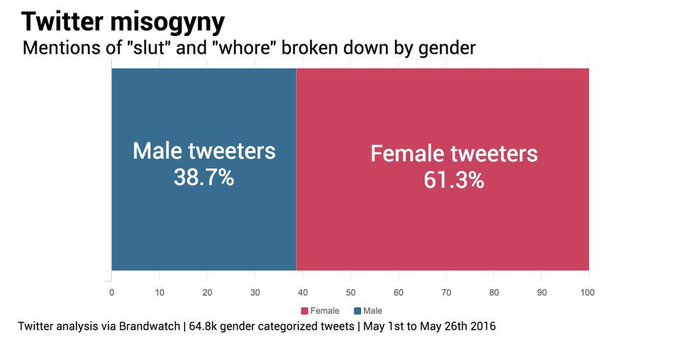
What is generally absent from articles on this subject is an honest admission that a considerable amount of online abuse is directed at men, and that a substantial proportion of those perpetrating abuse are women/girls. Have a look at the information provided in the chart below, extracted from a 2014 paper by PEW Research. (see 2017 updated here)
Why do so many commentators and ‘experts’ fail to acknowledge these significant points?
Surely not the desire to support the feminist narrative of women as the perpetual victims of an unyielding male patriarchy?
The findings of a survey by Norton painted a different picture. Unfortunately however the results were compromised by poor methodology, a common problem with pro-feminist research. In this instance the researchers failed to include questions about male victimisation via online abuse.
So why has this issue garnered a large and increasing amount of attention in recent years? Are people becoming nastier? Is that nastiness becoming more gendered in nature?
There are a number of significant factors that need to be considered here.
Further along the scale one encounters behaviour that does not involve actual threats, but is so persistent and pervasive as to be genuinely threatening in nature.
At the other end are interactions that are little more than assertive dissent in relation to a particular idea or opinion being put forward.
More and more we are witnessing the definition of terms such as online abuse and ‘trolls’ expanded to include behaviour and people who seem undeserving of these pejoratives. Also troubling is the fact that the same types of behaviour decried as abuse or trollish when used by conservative/non-feminists, are seen as acceptable or even noble when used by feminists/leftists/woke. This issue of finessing definitions to suit a narrative is discussed in another blog post.
Why do people, particularly in this case feminists/woke, so readily misinterpret online communication in this way? I’d suggest that in part it is a deliberate strategy, whilst at other times simply a misunderstanding.
It has been suggested that feminists interpret relatively innocuous messages as hurtful because online communication is a forum where women are truly treated as equals. Men speak to women online as men would speak to other men in real life. It is said that many women are unaccustomed to this gloves-off banter, and interpret it as vindictive rather than as heartfelt and direct. I believe that there is an element of truth to this, although again it is but one of several factors in the mix.
One other reason for exaggerated claims of online hate and abuse is that it provides an excuse to instigate progressively harsher and more intrusive forms of censorship. Censorship is a recurring theme in real-world feminist tactics, and one which I address in another blog post.
Turning again to feminist research, let’s examine a project called the University of NSW ‘Cyberhate Project‘, which is being supported by the Australian Research Council (‘ARC’) with AUD$372,095 of public funding.
I was more than a little concerned to learn that this research project will only survey women. That looks an awful lot like a research project designed with a particular conclusion already firmly in mind. I immediately took this up with the ARC, who dismissed my complaint regarding this obvious ideological bias in the following manner:
“Proposals for ARC funding undergo a rigorous peer review process involving experts in their fields who assess the quality of projects and the capabilities and achievements of applicants. The planning and management of ARC-funded research projects is a matter for individual researchers and institutions (in accordance with ARC funding agreements).”
I’m left wondering just how many of those peers were likely either fellow feminists or sympathisers. Hands up who else thinks that this might not be the most effective vetting process in the case of a polarised issue such as this?
As is virtually de rigeur at The Conversation, readers comments that were deemed unsupportive of the feminist author’s position were quickly excised. In this case that amounted to at least one in four comments. Of the many I read before they disappeared, none of these were in the least bit threatening or abusive.
I posted one of those comments removed by the moderator. It simply stated:
“Emma, Is it not a fact that men are subject to more online harassment than are women? Is it not a fact that many of the perpetrators of online abuse are women? … Might it therefore not be more accurate to say that the real online divide is one between trolls and the rest of us, rather than between men and women as your paper implies?”
Given that men are subject to a considerable amount of online harassment, they should not be excluded from research on this subject. The fact that the finger of blame is often pointed at men alone, when we know full well that many women perpetrate online harassment/abuse, does tend to stick in this writer’s craw. One might consider at this point the example of Australian radfem Clementine Ford.
As with domestic violence and various other topics, feminists persist in labelling issues as “gendered” when they are not, in order to create support for their global war-against-women conspiracy.
What now follows is a collection of links to articles that provide various perspectives on the issue of online harassment/abuse:
The internet has provided a haven for those inclined to strike out at people in anonymity and usually without fear of repercussion.
The purpose of this blog post is not to propose solutions to this problem, but rather to take a step back and call for an objective, measured and truthful discussion of the relevant issues.
There’s no doubt that women are often targets of online abuse, although there does appear to be a tendency towards embellishment and exaggeration with regards to the nature and extent of such abuse. The author of this article, for example, would have us believe that life on the internet is unbearable for women due to the oppressive behaviour of male trolls.
What is generally absent from articles on this subject is an honest admission that a considerable amount of online abuse is directed at men, and that a substantial proportion of those perpetrating abuse are women/girls. Have a look at the information provided in the chart below, extracted from a 2014 paper by PEW Research. (see 2017 updated here)
Why do so many commentators and ‘experts’ fail to acknowledge these significant points?
Surely not the desire to support the feminist narrative of women as the perpetual victims of an unyielding male patriarchy?
The findings of a survey by Norton painted a different picture. Unfortunately however the results were compromised by poor methodology, a common problem with pro-feminist research. In this instance the researchers failed to include questions about male victimisation via online abuse.
So why has this issue garnered a large and increasing amount of attention in recent years? Are people becoming nastier? Is that nastiness becoming more gendered in nature?
There are a number of significant factors that need to be considered here.
Further along the scale one encounters behaviour that does not involve actual threats, but is so persistent and pervasive as to be genuinely threatening in nature.
At the other end are interactions that are little more than assertive dissent in relation to a particular idea or opinion being put forward.
More and more we are witnessing the definition of terms such as online abuse and ‘trolls’ expanded to include behaviour and people who seem undeserving of these pejoratives. Also troubling is the fact that the same types of behaviour decried as abuse or trollish when used by conservative/non-feminists, are seen as acceptable or even noble when used by feminists/leftists/woke. This issue of finessing definitions to suit a narrative is discussed in another blog post.
Why do people, particularly in this case feminists/woke, so readily misinterpret online communication in this way? I’d suggest that in part it is a deliberate strategy, whilst at other times simply a misunderstanding.
It has been suggested that feminists interpret relatively innocuous messages as hurtful because online communication is a forum where women are truly treated as equals. Men speak to women online as men would speak to other men in real life. It is said that many women are unaccustomed to this gloves-off banter, and interpret it as vindictive rather than as heartfelt and direct. I believe that there is an element of truth to this, although again it is but one of several factors in the mix.
One other reason for exaggerated claims of online hate and abuse is that it provides an excuse to instigate progressively harsher and more intrusive forms of censorship. Censorship is a recurring theme in real-world feminist tactics, and one which I address in another blog post.
Turning again to feminist research, let’s examine a project called the University of NSW ‘Cyberhate Project‘, which is being supported by the Australian Research Council (‘ARC’) with AUD$372,095 of public funding.
I was more than a little concerned to learn that this research project will only survey women. That looks an awful lot like a research project designed with a particular conclusion already firmly in mind. I immediately took this up with the ARC, who dismissed my complaint regarding this obvious ideological bias in the following manner:
“Proposals for ARC funding undergo a rigorous peer review process involving experts in their fields who assess the quality of projects and the capabilities and achievements of applicants. The planning and management of ARC-funded research projects is a matter for individual researchers and institutions (in accordance with ARC funding agreements).”
I’m left wondering just how many of those peers were likely either fellow feminists or sympathisers. Hands up who else thinks that this might not be the most effective vetting process in the case of a polarised issue such as this?
As is virtually de rigeur at The Conversation, readers comments that were deemed unsupportive of the feminist author’s position were quickly excised. In this case that amounted to at least one in four comments. Of the many I read before they disappeared, none of these were in the least bit threatening or abusive.
I posted one of those comments removed by the moderator. It simply stated:
“Emma, Is it not a fact that men are subject to more online harassment than are women? Is it not a fact that many of the perpetrators of online abuse are women? … Might it therefore not be more accurate to say that the real online divide is one between trolls and the rest of us, rather than between men and women as your paper implies?”
Given that men are subject to a considerable amount of online harassment, they should not be excluded from research on this subject. The fact that the finger of blame is often pointed at men alone, when we know full well that many women perpetrate online harassment/abuse, does tend to stick in this writer’s craw. One might consider at this point the example of Australian radfem Clementine Ford.
As with domestic violence and various other topics, feminists persist in labelling issues as “gendered” when they are not, in order to create support for their global war-against-women conspiracy.
What now follows is a collection of links to articles that provide various perspectives on the issue of online harassment/abuse:
The internet has provided a haven for those inclined to strike out at people in anonymity and usually without fear of repercussion.
The purpose of this blog post is not to propose solutions to this problem, but rather to take a step back and call for an objective, measured and truthful discussion of the relevant issues.
There’s no doubt that women are often targets of online abuse, although there does appear to be a tendency towards embellishment and exaggeration with regards to the nature and extent of such abuse. The author of this article, for example, would have us believe that life on the internet is unbearable for women due to the oppressive behaviour of male trolls.
What is generally absent from articles on this subject is an honest admission that a considerable amount of online abuse is directed at men, and that a substantial proportion of those perpetrating abuse are women/girls. Have a look at the information provided in the chart below, extracted from a 2014 paper by PEW Research. (see 2017 updated here)
Why do so many commentators and ‘experts’ fail to acknowledge these significant points?
Surely not the desire to support the feminist narrative of women as the perpetual victims of an unyielding male patriarchy?
The findings of a survey by Norton painted a different picture. Unfortunately however the results were compromised by poor methodology, a common problem with pro-feminist research. In this instance the researchers failed to include questions about male victimisation via online abuse.
So why has this issue garnered a large and increasing amount of attention in recent years? Are people becoming nastier? Is that nastiness becoming more gendered in nature?
There are a number of significant factors that need to be considered here.
Further along the scale one encounters behaviour that does not involve actual threats, but is so persistent and pervasive as to be genuinely threatening in nature.
At the other end are interactions that are little more than assertive dissent in relation to a particular idea or opinion being put forward.
More and more we are witnessing the definition of terms such as online abuse and ‘trolls’ expanded to include behaviour and people who seem undeserving of these pejoratives. Also troubling is the fact that the same types of behaviour decried as abuse or trollish when used by conservative/non-feminists, are seen as acceptable or even noble when used by feminists/leftists/woke. This issue of finessing definitions to suit a narrative is discussed in another blog post.
Why do people, particularly in this case feminists/woke, so readily misinterpret online communication in this way? I’d suggest that in part it is a deliberate strategy, whilst at other times simply a misunderstanding.
It has been suggested that feminists interpret relatively innocuous messages as hurtful because online communication is a forum where women are truly treated as equals. Men speak to women online as men would speak to other men in real life. It is said that many women are unaccustomed to this gloves-off banter, and interpret it as vindictive rather than as heartfelt and direct. I believe that there is an element of truth to this, although again it is but one of several factors in the mix.
One other reason for exaggerated claims of online hate and abuse is that it provides an excuse to instigate progressively harsher and more intrusive forms of censorship. Censorship is a recurring theme in real-world feminist tactics, and one which I address in another blog post.
Turning again to feminist research, let’s examine a project called the University of NSW ‘Cyberhate Project‘, which is being supported by the Australian Research Council (‘ARC’) with AUD$372,095 of public funding.
I was more than a little concerned to learn that this research project will only survey women. That looks an awful lot like a research project designed with a particular conclusion already firmly in mind. I immediately took this up with the ARC, who dismissed my complaint regarding this obvious ideological bias in the following manner:
“Proposals for ARC funding undergo a rigorous peer review process involving experts in their fields who assess the quality of projects and the capabilities and achievements of applicants. The planning and management of ARC-funded research projects is a matter for individual researchers and institutions (in accordance with ARC funding agreements).”
I’m left wondering just how many of those peers were likely either fellow feminists or sympathisers. Hands up who else thinks that this might not be the most effective vetting process in the case of a polarised issue such as this?
As is virtually de rigeur at The Conversation, readers comments that were deemed unsupportive of the feminist author’s position were quickly excised. In this case that amounted to at least one in four comments. Of the many I read before they disappeared, none of these were in the least bit threatening or abusive.
I posted one of those comments removed by the moderator. It simply stated:
“Emma, Is it not a fact that men are subject to more online harassment than are women? Is it not a fact that many of the perpetrators of online abuse are women? … Might it therefore not be more accurate to say that the real online divide is one between trolls and the rest of us, rather than between men and women as your paper implies?”
Given that men are subject to a considerable amount of online harassment, they should not be excluded from research on this subject. The fact that the finger of blame is often pointed at men alone, when we know full well that many women perpetrate online harassment/abuse, does tend to stick in this writer’s craw. One might consider at this point the example of Australian radfem Clementine Ford.
As with domestic violence and various other topics, feminists persist in labelling issues as “gendered” when they are not, in order to create support for their global war-against-women conspiracy.
What now follows is a collection of links to articles that provide various perspectives on the issue of online harassment/abuse:
Constructing the cyber-troll: Psychopathy, sadism, and empathy (December 2017 edition of ‘Personality and Individual Differences’) This study asserts that most trolls are male, but I suspect that the findings may have been compromised by one or more of the following factors:
* small sample size with 2/3 of respondents being women, and who were possibly self-selected
* incorrect assumptions (by survey respondents) regarding the gender of trolls
* differing and possibly gender-based judgments as to what constitutes trolling
The media dangerously misuses the word ‘trolling’ (3 July 2017) This article conveniently neglects to mention that this ‘problem’ has been primarily brought about through misusing the term ‘trolling’ to describe reasonable dissent against the prevailing leftist/feminist narrative.
Australia tackles revenge porn with new eSafety Commission (23 November 2016) AFAIK this agency’s brief was initially gender-neutral but it quickly assumed a pro-feminist stance, making its focus the online harassment of women and girls.
The top 20 Australian politicians, with respect to receiving online abuse, are all right wing males (1 July 2016) Australia. Typical feminist take on this issue, for e.g. mis-labels harassment as “online violence” and “sexual violence”, does not provide corresponding statistics for men/boys harassed online, nor divulge that much abuse is perpetrated by women/girls. The implication is, as always, men=bad & women=men’s hapless victims.
Eight things not to say to someone facing online abuse (20 April 2016) See point 4 in this article by misandrist Laura Bates: “Silencing is the end goal of the majority of abuse”. Erm, so all those feminists systematically lodging bogus reports to have people’s social media accounts closed, they would be online abusers then?
Girl gets Instagram revenge on cheating ex (25 March 2016) Reverse the genders in this story and “one poor lass” becomes ‘online harassment by abusive former boyfriend’
“A new survey by the Internet security company Norton (for which I’m an ambassador) shows that nearly half of all Australian women (47 per cent) experience online harassment. That rises to a staggering 76 per cent for women under 30. Unsurprisingly, 70 per cent of women believe online harassment is a significant problem and 60 per cent believe it has got worse in the past year.” And nowhere in this article will you find corresponding statistics in relation to men – the survey didn’t include questions about male victimisation. I wonder why not?
Online harassment of women at risk of becoming ‘established norm’, study finds (8 March 2016) Australia. Guardian article drawing on the Norton survey which air-brushed out male victimisation/female perpetration, and thus robbed the findings of social context. No doubt a good thing from a feminist perspective if that would have diminished the victim status on which their ideology is based.
Were examples of specific rape threats made public? No. How about a formal complaint to police? Apparently not. “Oh look, another politician ginning up fake threats to boost her feminist cred. Never seen that before….” (Source)
Emma Watson: Trolls threatened to publish nude photos of me (8 March 2015) This article quotes Emma as saying most of those posting threats were other women, yet this article (in pro-feminist news.com.au) claims that men were to blame. As mentioned earlier, this represents an all-too typical bending of the facts to suit the narrative.
#womenagainstfeminism receive hundreds of threats (Scroll down their Facebook timeline to 16 August 2014 for details) Somehow I don’t think it would be men issuing most of the threats … but surely not women?
This June 2014 reddit discussion thread, and linked newspaper article, is about female Twitter trolls
Constructing the cyber-troll: Psychopathy, sadism, and empathy (December 2017 edition of ‘Personality and Individual Differences’) This study asserts that most trolls are male, but I suspect that the findings may have been compromised by one or more of the following factors:
* small sample size with 2/3 of respondents being women, and who were possibly self-selected
* incorrect assumptions (by survey respondents) regarding the gender of trolls
* differing and possibly gender-based judgments as to what constitutes trolling
The media dangerously misuses the word ‘trolling’ (3 July 2017) This article conveniently neglects to mention that this ‘problem’ has been primarily brought about through misusing the term ‘trolling’ to describe reasonable dissent against the prevailing leftist/feminist narrative.
Australia tackles revenge porn with new eSafety Commission (23 November 2016) AFAIK this agency’s brief was initially gender-neutral but it quickly assumed a pro-feminist stance, making its focus the online harassment of women and girls.
The top 20 Australian politicians, with respect to receiving online abuse, are all right wing males (1 July 2016) Australia. Typical feminist take on this issue, for e.g. mis-labels harassment as “online violence” and “sexual violence”, does not provide corresponding statistics for men/boys harassed online, nor divulge that much abuse is perpetrated by women/girls. The implication is, as always, men=bad & women=men’s hapless victims.
Eight things not to say to someone facing online abuse (20 April 2016) See point 4 in this article by misandrist Laura Bates: “Silencing is the end goal of the majority of abuse”. Erm, so all those feminists systematically lodging bogus reports to have people’s social media accounts closed, they would be online abusers then?
Girl gets Instagram revenge on cheating ex (25 March 2016) Reverse the genders in this story and “one poor lass” becomes ‘online harassment by abusive former boyfriend’
“A new survey by the Internet security company Norton (for which I’m an ambassador) shows that nearly half of all Australian women (47 per cent) experience online harassment. That rises to a staggering 76 per cent for women under 30. Unsurprisingly, 70 per cent of women believe online harassment is a significant problem and 60 per cent believe it has got worse in the past year.” And nowhere in this article will you find corresponding statistics in relation to men – the survey didn’t include questions about male victimisation. I wonder why not?
Online harassment of women at risk of becoming ‘established norm’, study finds (8 March 2016) Australia. Guardian article drawing on the Norton survey which air-brushed out male victimisation/female perpetration, and thus robbed the findings of social context. No doubt a good thing from a feminist perspective if that would have diminished the victim status on which their ideology is based.
Were examples of specific rape threats made public? No. How about a formal complaint to police? Apparently not. “Oh look, another politician ginning up fake threats to boost her feminist cred. Never seen that before….” (Source)
Emma Watson: Trolls threatened to publish nude photos of me (8 March 2015) This article quotes Emma as saying most of those posting threats were other women, yet this article (in pro-feminist news.com.au) claims that men were to blame. As mentioned earlier, this represents an all-too typical bending of the facts to suit the narrative.
#womenagainstfeminism receive hundreds of threats (Scroll down their Facebook timeline to 16 August 2014 for details) Somehow I don’t think it would be men issuing most of the threats … but surely not women?
This June 2014 reddit discussion thread, and linked newspaper article, is about female Twitter trolls
Constructing the cyber-troll: Psychopathy, sadism, and empathy (December 2017 edition of ‘Personality and Individual Differences’) This study asserts that most trolls are male, but I suspect that the findings may have been compromised by one or more of the following factors:
* small sample size with 2/3 of respondents being women, and who were possibly self-selected
* incorrect assumptions (by survey respondents) regarding the gender of trolls
* differing and possibly gender-based judgments as to what constitutes trolling
The media dangerously misuses the word ‘trolling’ (3 July 2017) This article conveniently neglects to mention that this ‘problem’ has been primarily brought about through misusing the term ‘trolling’ to describe reasonable dissent against the prevailing leftist/feminist narrative.
Australia tackles revenge porn with new eSafety Commission (23 November 2016) AFAIK this agency’s brief was initially gender-neutral but it quickly assumed a pro-feminist stance, making its focus the online harassment of women and girls.
The top 20 Australian politicians, with respect to receiving online abuse, are all right wing males (1 July 2016) Australia. Typical feminist take on this issue, for e.g. mis-labels harassment as “online violence” and “sexual violence”, does not provide corresponding statistics for men/boys harassed online, nor divulge that much abuse is perpetrated by women/girls. The implication is, as always, men=bad & women=men’s hapless victims.
Eight things not to say to someone facing online abuse (20 April 2016) See point 4 in this article by misandrist Laura Bates: “Silencing is the end goal of the majority of abuse”. Erm, so all those feminists systematically lodging bogus reports to have people’s social media accounts closed, they would be online abusers then?
Girl gets Instagram revenge on cheating ex (25 March 2016) Reverse the genders in this story and “one poor lass” becomes ‘online harassment by abusive former boyfriend’
“A new survey by the Internet security company Norton (for which I’m an ambassador) shows that nearly half of all Australian women (47 per cent) experience online harassment. That rises to a staggering 76 per cent for women under 30. Unsurprisingly, 70 per cent of women believe online harassment is a significant problem and 60 per cent believe it has got worse in the past year.” And nowhere in this article will you find corresponding statistics in relation to men – the survey didn’t include questions about male victimisation. I wonder why not?
Online harassment of women at risk of becoming ‘established norm’, study finds (8 March 2016) Australia. Guardian article drawing on the Norton survey which air-brushed out male victimisation/female perpetration, and thus robbed the findings of social context. No doubt a good thing from a feminist perspective if that would have diminished the victim status on which their ideology is based.
Were examples of specific rape threats made public? No. How about a formal complaint to police? Apparently not. “Oh look, another politician ginning up fake threats to boost her feminist cred. Never seen that before….” (Source)
Emma Watson: Trolls threatened to publish nude photos of me (8 March 2015) This article quotes Emma as saying most of those posting threats were other women, yet this article (in pro-feminist news.com.au) claims that men were to blame. As mentioned earlier, this represents an all-too typical bending of the facts to suit the narrative.
#womenagainstfeminism receive hundreds of threats (Scroll down their Facebook timeline to 16 August 2014 for details) Somehow I don’t think it would be men issuing most of the threats … but surely not women?
This June 2014 reddit discussion thread, and linked newspaper article, is about female Twitter trolls
My Facebook account was locked last Friday. I think it happened because someone reported me to Facebook HQ as being guilty of promulgating hate speech and/or perpetrating other vile lapses of the Facebook Terms of Use.
I’d say it was no coincidence that it occurred the day after I had an encounter with a couple of aggressive/threatening women whilst I was commenting on an article in the Facebook page of The Guardian Australia. (Hi, Louise and Rebecca).
It’s not the first time this has happened to me, and I doubt it will be the last. But for the time being at least, I couldn’t be bothered persisting with Facebook.
I didn’t actually say or do anything hateful on that day, or on any other day. I didn’t upload porno. Or threaten anyone. Or even use profanity (unlike the two women in question). But those that reported me didn’t care about Facebook rules per se. They just wanted to stop me, and people like me, expressing our views online. And they sought to have all trace of that which had already been posted, removed.
You see, all of my posts using that Facebook account concerned gender-related issues. More specifically, my stance generally contrasts with the feminist position, and feminists don’t take kindly to dissenting views.
I could try to contact Facebook HQ (as I have attempted in the past) to discover what was alleged, and to rebut those allegations. But that would be difficult/impossible because whilst Facebook has streamlined the reporting process, they clearly don’t want to get involved in time-consuming dispute resolution. Read about another person’s experience with Facebook here.
Given previous feminist campaigns against Facebook, I suspect that Facebook is as wary of feminists as our politicians appear to be. And of course, those who made the allegations against me know this.
People reading this who have crossed swords with feminists online would be rolling their eyes at this point in time. They would be thinking “well what does this person expect? Everyone knows that feminists do that stuff all the time”.
The thing is though, I don’t think people in the broader community are fully awake to this. Not even those people sympathetic to what they understand to be feminist ideals.
So to those who don’t realise how real-world feminists behave, consider this post your very own ‘heads-up’. For I can assure you that many in the feminist movement make it their mission to consistently and persistently block the dissemination of messages that run contrary to the feminist narrative.
Feminists even discuss ways and means of getting people off-line – refer examples here and here. It’s always phrased in noble terms such as stopping “trolling” “online bullying”, etc. But the truth is that in the hard-done-by & perpetual-victim mindset of the fervent gender feminist, ANY dissent constitutes trolling, no matter how tactfully expressed.
And indeed I have seen this scenario played out more times than I care to remember. This blog post talks more about this issue, and indeed the theme is revisited in several other posts.
The various tactics that feminists utilise to try to deny their perceived enemies a voice, include:
Blocking specific people from posting on pro-feminist Facebook pages
Removing posts from pro-feminist Facebook pages when they disagree with the views being expressed
Blocking specific people from accessing/posting to pro-feminist Twitter accounts
Lodging exaggerated or false reports with Facebook or Twitter in order to have certain peoples’ accounts suspended/closed
Not uploading readers comments to blogs or web sites when they are seen as unsupportive of the feminist position on the matter
Removing readers comments from blogs or web sites (ditto)
Reporting posts to moderators when they are seen as negative towards the feminist position on the matter
Not allowing any readers comments to be posted
What does it say about the credibility of a social movement when its adherents devote so much time and energy to blocking debate and suppressing information, rather that doing the opposite?
The truth is that feminists of this ilk don’t want to engage in debate, and they don’t want to provide a ‘right of reply’ (even after they have attacked a specific organisation or individual). And they certainly don’t want information circulated that provides the contextual background the public needs to properly consider feminist claims/grievances, particularly when it serves as evidence of feminist double-standards or hypocrisy.
Why not? Well in part it’s because this unchecked element of the feminist movement carry such intense feelings of contempt and anger towards those who question their cause. And in part it’s because they realise that their position on many issues simply cannot be supported with facts and logic. Thus they far more to lose from enabling informed debate, than they have to gain.
So they stifle debate, censor, deflect and misrepresent. Because they can. Any way they can. And feel completely justified and exonerated in doing so. Like so many cockroaches scuttling about in dark places.
TL:DR version: I posted perfectly civil comments in relation to pro-feminist article in The Guardian that weren’t fully supportive of the author’s position. The article was about the horribleness of women’s voices being silenced online. TG then:
deleted my comments from their web site
deleted my comments from their Facebook timeline (in relation to post on same article)
I would suggest that you read the article now and then come back for a brief discussion.
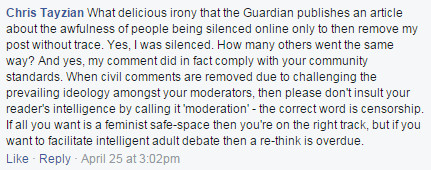
I submitted a comment on the article which briefly appeared online only to then be removed without trace. It didn’t even get the usual place-marker of “This comment was removed by a moderator because it didn’t abide by our community standards“. Well, I have read the “standards” and (hand on heart) my comment did not contravene them.
So just how hypocritical is that? Publish an article bemoaning how people are silenced online only to then silence others. Not that The Guardian is any stranger to employing heavy-handed pro-feminist censorship.
Let’s look at a couple of the readers comments that made it through the wringer:
“I dunno. Speaking as a female here, I’ve never had a problem being bullied by the boys online. If we disagree, I can usually deliver a sufficiently ferocious tongue-lashing to make them cringe back in respect. More often, though, we end up flirting through our discussions.
I’ve also had more than one off-putting experience in heavily-moderated forums. While I’m all for civility and respect for fellow-commenters, emotions will rise, taboo words will be used for emphasis, and respecting diversity needs to include accepting that many people don’t share the Official Civilized View on any given issue. There are otherwise intelligent and moral people who have genuine reasons for supporting racist, sexist, and homophobic viewpoints, often backed by science which is at least as solid as that backing the Politically Correct Ideology. And it’s these off-center, alternative, maverick views which offer the most interesting diversity in the marketplace of ideas. Moderating them out of existence because someone will be offended is the worst way to prevent intelligent conversation.
I know I’m not a typical female. But frankly, “typical females” bore me, and I’m afraid that when internet forums are made safe and secure enough for the lame and timorous, it’s the intellectual equivalent of pulling half the water out of a swimming pool so that it’s safe for the little kids. I’m not a little kid anymore, and I don’t swim in the wading pool.” (Cynndara)
Another reader stated:
“Whilst you may have a some of data, on “who” is posting, your analysis is deeply flawed. Let’s start with the click-bait: “Women are silenced online, just as in real life”
The first analysis of your article shows that women are quiet (vs silenced) online and this probably matches offline behaviour. (Yes, in ANY gender balanced group, the loudest are often males… oh goodness… online news matches)
Sadly, this hyperbole characterises much of the rest of your article. Limited data – eg. a paucity of obviously female pseudonyms on some news commenting sites – are extrapolated to such breath taking gender stereotypes as:
Many women are still doing the primary family management and caring roles, so don’t have time.
Yeah, that’s implied by the data isn’t it? Me (a male name) must be hacking out comments whilst my female-type partner (if I have one) would be cleaning the kitchen and caring for the kiddies! Jeez men are slobs.
Of course, matching the template for a standard gender-based argument, the next sentence completely contradicts this:
On the other hand, women are bigger users than men of Facebook, Instagram and Pinterest, platforms that offer a public voice in a personally controlled social environment.
Whut!? No time to write, but time for FaceBook… yes, of course… no problem, keep that mud slinging…
And so we move on to “hey, but women don’t post because THEY’RE FRIGHTENED!!” (ie. women are abused)
Yes, people – and probably more women – are abused online. although seriously, the “article” that you use to support this – 100,000 tweets mentioning rape – hardly merits mention on scientific grounds, let alone relevance for news-based blogs.
Then we go beyond mere hyperbolic extrapolation of limited data, to explaining the whole news-blog world should be reformed in the image of a single web site, because
moderators silently delete, block and ban rather than facilitate conversation, and journalists don’t take part.
Wrong! Sorry, but even here, on the Guardian, where you’re making this claim article authors DO sometimes contribute. In fact (in my anecdotal experience) the most common authors who respond are those with female-like names! And the Guardian already gives the ability to “up vote” (but not good enough, because they don’t throw in a buzz word like respect…)
Moreover, it is best practice to remove (without trace) reported comments. It does not improve the conversation to tolerate/facilitate trolls.
Here’s a thought: stick to what you can argue from the data, and don’t use a sample to help drive your own barrow. For future research you might consider: 1/ IS there ANY relation to female/male roles on the posting of news items — eg. why is it that most Guardian posts are NOT during evening times and other “males do nothing in the home” time periods, but rather, during normal office hours?
2/ MAYBE (just maybe) women AREN’T INTERESTED on commenting on the news and opinions of random strangers. I’m taking a sample size of one here, in that I actually asked an actual female, rather than impying gender from anonymous poster names, but I say that’s one more than you’ve done.
It could be shocking to internet-gender researchers, but a LOT of people could not care less about commenting into the void, and many females (at least that I talk to) find it quite funny that so many men do so: no-one is hiding 19th century style, they just have whole lives to lead.
3/ TOP posters are irrelevant. They are just loud. Look for meaningful attributions, such as “who becomes a Guardian featured poster” OR “who gets lots of replies”
4/ Keep your abuse tags to where they are relevant. Yes, on Twitter there is a surfeit of abusive idiots. Here, less so. As a male-pseudonym, I get ‘abused’ 2 posts out of 5 or so. Of the most critical, I’d say 50% are female pseudonyms. Why not actually look at (on this site) (i) the type of articles that attract abusers (I can give you some guesses) (ii) the type of post that attracts abusers (iii) the “gender” of abusers.
5/ How many female authors have posted, but then stopped. Preferably with correlation against abusive responses.
At that point, please, feel free to extrapolate.” (Stephen Weaven)
I also subsequently posted a comment on the Facebook entry for this story, which can be found here. That entry is no longer visible in the Guardian’s Facebook timeline, having been removed soon after I posted my comment (shown below). Was this a coincidence? Perhaps, but probably unlikely given that other stories uploaded the same day are still visible.
Below again you can see another person’s comment taken from the Facebook entry for the article. This is one that perfectly typifies the entitled feminist mentality that anyone not fully supportive of the feminist position is a “male troll” whose views are unworthy of publication. On the other hand, feminists who “challenge too directly” are victimised when their posts are deleted.
I’ve had many of my comments removed and am on final warning prior to being banned from the site. On 1 April 2015 a moderator at The Conversation removed yet another comment, one that I added to this article about sexual assault. This is what I wrote:
“It’s deeply ironic that the title of your article is “let’s turn the spotlight on known perpetrators”, but within the first sentence you exclude acknowledgement or consideration of all female perpetrators of sexual assault. On what basis? There’s less reported crimes involving female perps, so it’s OK to just airbrush them out?
I’m also troubled by you referencing the 2013 National Community Attitudes Towards Violence Against Women survey, which didn’t bother to ask respondents about their attitudes towards violence to men. Thus the questions about violence towards women were robbed of context and so we don’t know the extent to which the issue is men’s attitudes towards women, or Australians attitudes towards violence generally.”
As usual my comments were fairly benign in the overall scheme of social discourse. But this time, on impulse I wrote to the two authors of the article to see how they felt about the level and nature of the moderation that was taking place:
“Dear Nicola and Anastasia
I write to you this morning in relation to your article in The Conversation entitled ‘Everyday rape: let’s turn the spotlight on known perpetrators’.
I’m a keen reader of The Conversation and like many other readers often feel compelled to offer a comment on the article presented therein. Also, like many other readers, I am frequently frustrated by the actions of the moderators in removing many of the comments contributed – indeed sometimes most of the comments contributed.
You will have noted that as of now, about half of the comments concerning your article have been removed (including one of mine btw). On this, as on previous occasions, my comments were neither offensive nor irrelevant to the matter being discussed.
I have previously raised my concerns about moderation policy with the relevant people at The Conversation. On those occasions when the moderators do not intervene as readily there have been some very good and quite robust discussions played out with no hint of undue unpleasantness.
Rather than just grumbling about it on this occasion, I was wondering how you – as authors – felt about the situation. Are you being consulted about which comments are removed? I assume not. Do you believe that your article – and indeed your own professional development – would be strengthened by allowing a freer interchange of ideas? My own view is that if one can’t have an honest and robust exchange of alternative viewpoints within a web site run/funded by universities, then where can you?
Thank you, and I look forward to hearing your views”
Dr Nicola Henry of Latrobe University, kindly wrote back on 2 April 2015:
“Thanks for your email. I think you raise a valid concern. I’ve read all of the comments that have thus far been removed (including yours). We of course have no say in this, but I did wonder why they were removed and personally wished they had remained on the site so that people can engage in debate about these issues. Sometimes there are very offensive personal attacks and inappropriate comments made on this site – so I can certainly see why moderation is important. In other words, I can understand why comments that contain vilification are removed, but not comments that pose an alternative view.
This is an issue that I discuss with my students who take my subjects – we discuss freedom of speech and censorship and the sometimes difficult lines that exist between offensive/discriminatory and opinionated speech (the latter I personally don’t think should be censored by the way).
I’m sorry I can’t offer you an explanation as to why your comment was removed from the Conversation site, but I can assure you that both Anastasia and I are always up for critical debate (that’s our job!).”
All good there. I wonder if other authors are mostly of the same view? If so then the problem lies with the attitudes of the management team at ‘The Conversation’.
I’ve said it before and I’ll say it again. The Conversation is a publicly funded forum for the discussion of current affairs and contemporary issues. It is operated under the auspices of Australian universities.
The Conversation should be about mature, free and open discussion (obviously sans expletives, threats and personal abuse).
The Conversation should not continue to be fettered by political correctness and ideologies du jour like gender feminism.
Here’s a relevant comment that appeared in an October 2015 reddit discussion thread concerning another biased gynocentric article appearing in The Conversation:
“I have opted out of The Conversation. Look at the number of “content removed by moderator” and you can bet that most of them were disagreement with the original article which Cory (the moderator) conflates with “breaching community standards” …
I have written several times to Cory pointing out that their editing is not ‘balanced’ and that they only publish a torrent of hate speech masquerading as academic “research”. His reply was to refer me the “community standards” which is a euphemism for a licence to censor opinions that they don’t like.”
This October 2015 Breitbart article provides an overview as to what is occurring in reader’s comments sections in left-leaning organisations like The Conversation.
And yet thankfully here and here we find evidence of a push-back beginning in some US universities. It’s been a long time coming & there’s such a long way to go.
On 25th November 2014 the White Ribbon Campaign (WRC) celebrated its annual ‘White Ribbon Day’, whereupon they beat their chests about the wonderful job they (say they) are doing, and sought to fill their coffers via donations and merchandise sales.
I visited their Facebook page at that time and noticed quite a number of dissenters posting comments there. In true feminist fashion these were slyly removed during the course of the day (as discussed in this blog post). WRC representatives responded to the nay-sayers by castigating them for complaining about WRC’s focus on female victims, and/or by telling them to go and start their own organisation to address violence towards men.
Without doubt there would be many people out there who would say, how could anyone be so mean-spirited as to criticise the White Ribbon Campaign? So what if they focus solely on female victims of domestic violence, at least they are still helping someone? Surely any publicity that raises awareness of the problem of domestic violence is a good thing? Lots of celebrities support WRC so they must be doing something useful otherwise those people wouldn’t risk their reputations, right? Right?
The WRC believes, or at least tries to make others believe, that those opposing it are misogynists who are angry about its sole focus on female victims. In actual fact, in most cases, that is not the root cause of disquiet about their operation.
So, if this issue isn’t the main issue of concern, then what is?
1. WRC’s lack of honesty and transparency, and their censorship, shaming and attacks on others holding alternative views
Publicly, the WRC’s rationale for focusing solely on female victims is based on their claim that the “overwhelming” majority of domestic violence is perpetrated by males upon females. Privately, the driving force behind WRC is its rigid adherence to feminist ideology.
These false assertions have the effect of denying male victims of domestic violence appropriate recognition or support, and of unfairly demonising men in general. Another outcome is the lack of attention given to abusive women through, for example, the provision of behaviour modification programs for female offenders.
Thus the problem is not that the WRC focuses on male violence towards women, but that – for strategic reasons – they fail to acknowledge other significant elements of domestic violence. No, in fact they do more than that. They argue that those whose priorities differ from their own are (at best) ignorant and misguided, and at worst that they are abusers themselves.
The message disseminated by WRC seeks to make a complex social issue appear simple. This is useful in attracting and maintaining the interest, and subsequently the financial support, of the public. Part of this involves inventing a single easily-identifiable bogey-man – the heterosexual male.
WRC’s approach also handily puts the onus for addressing the problem onto men and absolves women of any responsibility in relation to either causing the problem or fixing it.
2. The fact that WRC diverts, both strategically and inadvertently, public and private funds away from programs where they might be used more effectively in the fight against domestic violence and/or in assisting victims of DV
The effects of misrepresentations by WRC, when combined with substantial marketing efforts, political acumen, and a social environment highly supportive of feminism, sees WRC exert a significant influence on government policies and decisions regarding resource allocation to DV.
WRC compromise efforts to reduce domestic violence and assist male victims because they misrepresent both the nature of the problem and the nature of potential solutions. In so doing they side-track us from identifying and implementing more effective solutions. This skews the nature of research undertaken, in turn skewing the nature of support services provided.
WRC are not satisfied for a reasonable share of funds to be directed towards feminist groups like their own, they want all available funds so directed.
Questions have also been raised as to WRC’s ability to competently manage public funds, and the extent to which its operations are financially self-serving. Ironically this is happening at the expense of men, given that men contribute the majority of tax revenue.
According to White Ribbon Australia’s corporate annual report for 2013, they gambled their donations in the stock market and lost one fourth of their current assets! In other words, they lost almost $500,000 AUS playing the stock market with the public’s donations! Here is what their corporate annual report states:
“Total equity declined from $1,193,398 to $751,611 as a result of the trading loss.”
Society’s current predilection for placing feminism and feminist organisations on a pedestal, goes hand in hand with inadequate government oversight and serious lapses in accountability. History has shown us that this type of situation usually ends badly. It is quite simply a scandal waiting to happen. (I talk about this problem in my post on the Domestic Violence Industry)
WRC’s involvement in running programs in schools
White Ribbon’s involvement in running what are essentially feminist indoctrination programs in schools has been a source of considerable concern for many. This is the subject of the sources listed below, and is discussed further in this blog post.
Why does the White Ribbon Campaign make these errors of judgement, and why will it continue to do so?
WRC will continue down its current path because doing so supports feminist ideology and helps grow the influence of that movement, a goal that is of paramount importance to them. As a consequence, targeting anything or anyone that threatens the feminist narrative in relation to domestic violence is accorded a high priority (see my posts on Tanveer Ahmed and Sallee McLaren for example).
Secondly, it is financially lucrative for WRC to continue their current operating model. Misrepresenting the nature of domestic violence, and exaggerating its scale, stimulates further public support and government funding. This then channels additional funds towards themselves, other feminist enterprises and individual feminists (as per my post on the Domestic Violence Industry).
We stop violence at the source. And the source is men (28 June 2016) White Ribbon CEO Libby Davies defends White Ribbon (see article below), and in so doing happily throws men under the bus. Oh, but see the readers comments that follow (240+ at last count), NONE of which support Libby’s misandric stance. Here is a subsequent radio interview with Tom Elliot concerning Libby’s article, with further comments from Tom here.
I read an article yesterday entitled ‘A connection to hope in a world of violence‘, concerning the operation of a charity active in the sphere of domestic violence and sexual assault called ‘DV Connect‘. It featured the usual feminist spin that comes with the territory, but the part that turned my stomach was the following:
“Every now and then a perpetrator calls, desperate to find where his spouse is. Often these men present themselves as victims, hoping to unearth the addresses where their partners might be seeking safety from the storm.“
Now, just a quick reminder to readers that at least one third of the victims of domestic violence are men. Staff at DV Connect are apparently so astute that they can confidently differentiate between those men (actual victims) and that very small minority of men who are actually abusers. A remarkable feat by any standards.
“DVConnect is the only state wide telephone service offering anyone affected by domestic or family violence a free ‘crisis hotline’ 24 hours a day 7 days a week
We offer free, professional and non-judgemental telephone support, wherever you live in Queensland.
DVConnect Womensline takes over 4000 calls every month from Queensland women who are in fear of or in immediate threat of danger from Domestic or Family Violence, and on average we assist over 350 of them and often more than 400 children to be moved to safety every month.
We can arrange practical assistance such as counselling, intervention, transport and emergency accommodation for Queensland women and children who are in danger from a violent partner or family member”.
Yes, you read that correctly, their telephone support is “non-judgemental”. I guess they just mean the service provided for female callers, because they seem perfectly willing to judge the men who call … as mainly comprising perpetrators.
And notice how, within the space of a few lines, they morph from an organisation providing services to “anyone affected by domestic or family violence“, to one that’s here to help “Queensland women“.
DV Connect provides both a Mensline and Womensline service. The Mensline page in their web site has been re-written since I originally wrote this post, and now makes mention of men seeking help as both perpetrators and victims of domestic violence. The Womensline page assumes that women can only be victims of domestic violence despite this being obviously untrue.
Details regarding how the Mensline services operates in a discriminatory manner can be found in this reddit discussion thread.
I was unable to locate DV Connect within the Australian Charities and Not-for-Profits Commission’s register, but their 2013/14 annual report can be downloaded here. A few extracts illustrating the gynocentric bias within this organisation are shown below:
(p9) “We not only work with almost every specialist and community service throughout Queensland around the safety needs of women and children but we also have the unique position of having a ‘helicopter view’ of the sector as a whole … The physical and psychological safety of women and children living with domestic violence is the overriding focus of our work both on Womensline and Mensline.”
(p14) “An even smaller number of men call Mensline because of violence from a female partner or family member. Often this violence is on a very different level to that experienced where the male is the perpetrator of violence. Most of these situations do not have the element of fear in these relationships …”
(p17/18) “Sadly, hundreds of women, children and their beloved pets across Queensland are constrained in violent and fearful relationships because the fear and practical challenges of leaving are just too overwhelming.”
“Every month in Australia six women die at the hands of their intimate partner, at least one of them is from Queensland” and “Sadly in the year ended June 2014 we held 10 rallies for 18 women who died at the hands of their male partners“.
Minimal mention is made of male victims, apparently less important than pets. And when they are acknowledged (as above) their experience is discounted/diminished. And no mention anywhere, in the entire report, of female perpetrators.
I wish I could say that this type of unfair gender-stereotyping was rare or unusual, but I can’t. The fact is that most organisations working in the field, both government and non-government, are just as biased. Their web pages, their helplines, and their brochures and PR material, all relentlessly drive home a message of men as perpetrators and women as their victims. I provide a few examples of this in other posts within my blog, such as this one.
One of the outcomes of this situation is that only a small number of men call seeking assistance and/or to report what is happening in their homes. I would further suggest that another outcome is the large number of suicides by men involved in situations of actual or alleged domestic violence.
Perversely, DV advocacy groups then use this fact (very small number of male callers versus female callers) to to ‘prove’ their claims that very few men are victims of domestic violence. They also use it as a basis for, for example, reducing the level of services provided for men whilst ramping up the services for women.
Men know full well that they won’t be taken seriously if they call these organisations, and that they may be accused of being perpetrators in denial. Many also know that even if they are given a sympathetic hearing then there are no actual support services available to them (e.g. beds in shelters). In fact, by and large, the only services provided for men are anger management classes (yet, ironically, no such classes are available for the women abusing them).
And invariably (and ridiculously) when anyone dares to question the status quo they are attacked on the basis that they are either ignorant, wilfully denying that women are victims of DV and/or uncaring about the plight of female victims.
But back now to DV Connect’s annual report. The financial statement included within the report informs us that the organisation’s total revenue in 2014 was $3,231,446. The statement does not provide a breakdown of their revenue sources, which is somewhat unusual. I have, however, subsequently been advised by the relevant agency that:
“DVConnect Ltd received $2,853,133 in 2013-2014 and $2,666,064 in 2012-2013 from the Department of Communities, Child Safety and Disability Services to provide domestic and family violence and sexual assault support services.”
As is typical for the sector, the overwhelming bulk of DV Connect’s expenditure goes towards salaries and employee-related expenses:
“DVConnect now employs 54 staff including a small management and administration team and almost 50 counselling staff all of whom work varying shifts to cover our 7 day 24 hour telephone service.”
In May 2015 it was announced that “DV Connect will receive an extra $750,000 per year for two years, on top of existing funding ($3.17m in 2014/15) for services including counsellors to expand its Womensline telephone support service.”
This reddit.com discussion thread discusses the discriminatory nature of the Mensline service, and calls on people to write letters in an attempt to resolve this situation.
Further information about DV Connect is available from their web site and Facebook page
And elsewhere in Queensland?
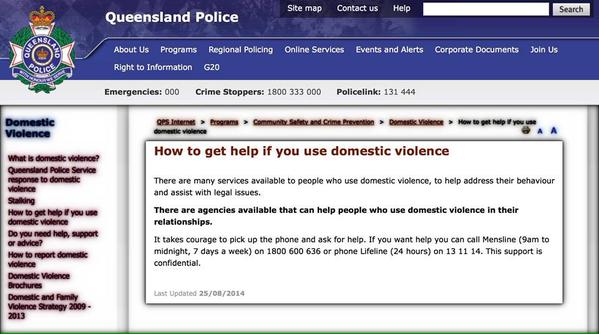
Here are two screenshots from the web site of a Queensland Government agency. The wording assumes that any men seeking help in relation to domestic violence are perpetrators, and that any women seeking help are victims.
Unfortunately this bias is replicated in the web sites of other similar Australian government and non-government agencies. One example, involving a Western Australian government agency, is addressed in another post in my blog.
Postscript 27 March 2015: In order to provide further insight into the mindset within DV Connect, let me relay what just occurred. I contributed a comment to the Facebook page of DV Connect, in relation to an item about the release of the QLD Task Force report on family violence. I simply noted that I had prepared some comments on the report and included a link to the relevant page (refer screensave below). By the next morning the comment that I posted had been removed from public view. It seems that DV Connect wants to prevent their supporters accessing alternative perspectives. That looks a lot like ‘controlling behaviour’ to me.
To the left is what I see when I visit DV Connect’s page whilst logged-in to my Facebook account. The screen-save below shows what is visible to members of the public, i.e. no comments
Postscript 14 April 2015: Further censorship with the removal of my comment in response to an inaccurate statement in the DV Connect web site. I simply cited the relevant ABS statistic, but I guess the reality that men face more violence than women was just too triggering.
On 11 September 2015 Di Mangan was quoted as saying that they couldn’t justify running the Mens Helpline on a 24 hour basis as so few calls were being received. Gee, I wonder why?
Fast forwarding now to January 2016 and along comes another advertorial for DV Connect, naturally with male victims & female perps air-brushed out of the picture.
“Mangan said abusive men were “emboldened” by the public murders that shook Queensland in 2015, noting that many of the calls received by DV Connect were from men warning that they wanted to harm their partners. Some of the men wanted help while others were calling to make a threat.”
In November 2017, the Courier-Mail published ‘DV Connect chief executive Diane Mangan axed from role amid dispute‘. I’d like to think this move was about improving efficiency & accountability, rather than just personalities, but have little faith in either of the parties involved.
The sort of gender discrimination practiced by DV Connect has been discontinued in one part of the United Kingdom as described in this November 2017 article by HEquel.
Postscript 6 March 2022: This form of anti-male gender-bigotry is now VIC government policy
“I’m proud to announce the Palaszczuk Government is providing additional funding of $2 million to DVConnect to keep up with the high demand”said Shannon Fentiman (3 August 2022).
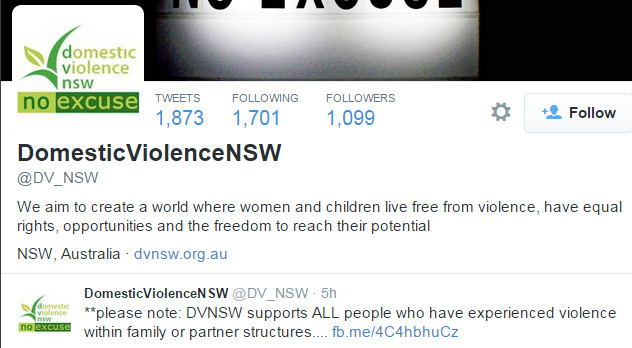
I spent some time the other day browsing content within the ‘Facebook page of Domestic Violence NSW’. As a first-time visitor I was somewhat taken aback at the extent of anti-male and pro-feminist bias evident in the material posted there.
By way of background, Domestic Violence NSW is a Sydney-based charity that received over $6 million in government funding in the period August 2013 – August 2014.
During my visit I submitted a review of their site, noting that:
“When people google your organisation this is what they read: “Domestic Violence information site for Australian mothers seeking to leave abusive relationships, including contact details for various help services.” Yet when they arrive at your home page the message stated is that ‘domestic violence can happen to anyone, any gender, etc…’
My question is then, if you recognise male victims of domestic violence then why not amend the google summary to be consistent? ie. “information site for Australians seeking to leave abusive relationships…” The only reason to not do so would appear to be a desire to appease the feminists who seem to control the DV ‘debate’ in this country. Please consider and respect both sexes”.
At the same time I submitted that review, I contributed three comments in response to various items posted in the timeline. Whilst the review remained in place for a couple of days (I’m guessing they took a while to notice it), my comments disappeared within hours.
DV NSW then blocked me from making further posts on their Facebook page, and lodged a complaint with Facebook admin. Both of these moves are recognised as common feminist tactics used to try to silence those with whom they disagree.
I saw no evidence of dissenting views posted by others, and from that I assume that the timeline is regularly sanitised as is often the case with online feminist forums.
My crime? My crime was simply to put forward a view at odds with the material posted in the timeline. I can assure readers that my comments were quite cordial and offered free of malice, the most offensive terms included therein probably being “male victims” and “female perpetrators”.
Domestic Violence NSW forwarded this message:
“Hi Chris, All content DVNSW posts comes from credible media sources, using statistical information gathered by that source. We CLEARLY use descriptors when posting content that is an opinion or editorial. DVNSW does not prescribe to these opinions, we simply post the content. Our media monitors capture the daily media involving domestic and family violence and we share articles that meet our policy guidelines.
The issue with your post is that a) it comes from a source outside of Australia, which means it is not drawn from our ABS data collected here and b) it does not contain credible sources of information and references.
If you’d like to read about male victims of domestic violence, we would suggest looking into the work of Dr Michael Flood. He is well researched and knowledgable in this area and highly respected within our Australian context.”
I wrote back seeking clarification:
“I’m afraid I’m a little confused as to how I have infringed your posting guidelines. Your message refers to my post, but it would appear that you have removed several of my posts from your timeline. As far as I recall only one of my posts included a hyperlink, and that was linking to an Australian blog. That blog page did in turn include further links to a variety of sources, most if not all of which I would categorize as “credible”.
As I clearly have an interest in the subject and will no doubt visit your page again, I would like to better understand the nature of your concerns. Would you mind providing copies of the posts that you removed, in each case identifying the offending elements of each? Many thanks for your assistance. Chris
PS: I am aware of Mr Flood’s work and I regret to inform you that, outside of feminist circles, he is anything but “highly regarded”.
I’ll post their reply here should I receive one, but I’m not going to be holding my breath waiting for that to happen.
Postscript (later the same day): Oh (massive facepalm) this reaction is either juvenile beyond belief … or indicative of a generous measure of paranoia. Upon visiting the Twitter stream of Domestic Violence NSW I was alerted to the following announcement:
Dear followers, Sadly we have become aware that our Facebook page is currently being targeted by troll groups who remain highly opposed to our exposure of latest boosts in media surrounding the current, credible statistics concerning the death rate of people (the majority women and children) from domestic and family violence this year and last. We are aware that these individuals are creating fake profiles and recruiting others to attack our page with spam from a particular mens rights website. As such, whilst we investigate this and proceed with a course of action, we are regrettably restricting all comments on our posts. We are incredibly disappointed by having to do this as we love your interaction and support of awareness and changing the culture that exists around Domestic and Family violence.
We have made this choice for several reasons, these are;
1. These individuals are posting links to websites and media that we believe could trigger and distress many of our audience who have had experience living with violence. We do not wish to risk the health and safety of any of our supporters.
2. Our media is unable to be monitored 24/7 and it is monitored by staff members, thus making it a work environment. As we would never allow our staff to work in an unsafe work environment, we feel that this content is inappropriate for staff members to have to work around.
3. We feel that whilst we investigate this behaviour, and possible breaches in legislation, we can actively end this continuing further and reach out to those who feel this behaviour is appropriate.
Please note: WE WILL STILL BE POSTING MEDIA AND THIS WILL BE ABLE TO BE SHARED BY YOU.
We can assure you we are still able to be contacted whenever necessary and you can contact us via the information on our website: www.dvnsw.org.au/html/contact.htm and we encourage you to do so.
We will aim to enable comments again ASAP and we thank you all for your continued support.
We all have a right to be heard and to present diverse opinions when this is done respectfully and with maturity.
Thank you and please be kind to one another.
The DVNSW Team
Assuming this is not droll humour, I’m embarrassed for these people.
Feminists reject the term ‘victim’ in favour of ‘survivor’. And yet dismissing those with alternative perspectives as trolls, and concealing or misrepresenting their message, embodies the very essence of perpetual victimhood. It is the behaviour one might expect from infantilized, narcissistic sissie-girls.
Those who are so invested in equality could begin by extending equality to others. You value inclusiveness? Then include others. You want to fashion meaningful reform directed towards achieving real social justice? Come back to the table when you’re ready to act like grown-ups.
Postscript 16 March 2015: A couple of days after DV NSW deleted my posts they inserted a statement in their timeline saying that they supported all victims of domestic violence (pictured). They also inserted a couple of posts about male victims and one about a girl bashed by her mum. In and of itself that’s a good thing, but I suspect it was done more ‘for show’ than to demonstrate real commitment to gender equality.
I also happened across an interesting post online which immediately struck a cord given that it mirrored my own experience with DV NSW:
“The fact is the people pushing this notion that Family Violence is a gendered issue know full well they are lying. I used to believe they were misguided or ill informed but I have had a couple of personal dealings with groups running online support and fundraising for the female victims of domestic violence. When I questioned them and presented some facts in a very polite, respectful manner, the same two things happened on three occasions. 1. My comments were deleted. 2. An article on male victims of DV was posted with a statement reminding everyone that anyone can be a victim of domestic violence. When I scrolled down their page I discovered this was the only mention anywhere on their page of male victims. They only put up that one because they want to cover their arses in case another informed reader questioned their bigotry.” (Source – See comment from Mark Mooroolbark)
I posted a brief response noting my experience with DV NSW, and then things got even more interesting when Mark replied to me in the following manner:
“That is one of the mobs I was referring to! Just this week I wrote a polite comment on their Facebook page and someone responded with that false statistic that DV is the leading cause of death and disability in women between the ages of 15 and 49. I responded by simply stating that this was not correct and listed the five leading causes of death and disability before adding a few more points-all reasonable and polite. I returned to find my comments deleted and a post explaining that due to trolling from a Men’s Right Group they are blocking all comments -they said the women monitoring the site may feel unsafe and that the comments posted were disrespectful, immature etc…
I was so angry that I immediately wrote to Moo Baulch the CEO of the Domestic Violence NSW organisation stating exactly what happened and asking for an explanation. She responded to my email and said she would ring me sometime this week. If the call ever takes place it will be interesting to hear her defence of this censorship”.
Could it be that DV NSW interpreted two individuals independently offering feedback on DV NSW’s priorities as constituting a targeted attack by “troll groups“? Could they really be that stupid or delusional? What do you think?
The CEO of Domestic Violence NSW, Moo Baulch, is quoted in this article indicating her resistance to free and open discussion of domestic violence, and criticizing the nature of statistics provided by the Police.
As one reader subsequently observed:
“Interesting how bigots like Jenna Price bemoan the ‘lack of context’ and a ‘proper breakdown of the statistics’ when the greatest concern most non feminists have about feminists is their complete and utter disregard for context and the the proper representation of statistics. In fact, it is feminists who are the greatest abusers of ‘statistics’ through misrepresentation.”
On 4 March 2015 staff of the Australian Prime Minister, Tony Abbott, uploaded this post to his Facebook page. It was all about Tony pledging his support to the pro-feminist #HeforShe campaign which I discuss here.
I then contributed my own thoughts on the matter. Oh, wait you can’t see anything. That’s because the site administrator filtered it out of the timeline. I assume this was because he/she is either pro-feminist, or anti-MRA, or both. I can’t think of any other reason, for example, there is no profanity in my post. It was not due to my post containing a hyperlink (many other visible posts include hyperlinks), and I note that there are some fairly strident pro-feminist posts left visible.
Anyway, after I logged into my account, there was my post (visible in the second screen save), just below the post by Henry Poulsen.
That, folks is what you call ideological censorship. Whereas the office of the Prime Minister should be right at the forefront of protecting our democratic right to self-expression, here they are seen to be inhabiting a very different place.
Yet another of the tremendous advances achieved by the feminist movement.
#sarcasm
Malcolm Turnbull (then Minister for Communications) uploaded a very similar post onto his Facebook page on 2 March, and I provided the same response. It’s pleasing to note that in his case my post was not removed.
Ah, but then in September 2015 Malcolm Turnbull was appointed Prime Minister, and guess who suddenly fell into lockstep with the feminist lobby?
“The PM told Today’s Lisa Wilkinson that “the issue of family violence, or domestic violence as it’s often called – which is just violence against women, which is the way I prefer to describe it – is an enormous one.” (Source)
No Malcolm, domestic violence is emphatically not “just violence against women”.
On 24 September 2015 the Prime Minister announced a huge swathe of public funding to address the issue of domestic violence. Here is the media release … you will see that public comments are enabled. That’s great, but unfortunately once the tide of comments turned against the Prime Minister’s position, the moderator stopped uploading all contributed comments (no matter how civil they were).
In the screen-save provided below (from my Disqus account) you can see a number of posts marked “pending”. Thus rather than deleting comments, the moderator simply didn’t approve/upload those critical of the Prime Minister’s approach.
I found out this afternoon that I had been blocked from a Twitter account – one belonging to an Australian journalist. The journalist in question is indeed a feminist, but by no means in the ‘barking mad’ misandrist league of Clementine Ford or Caitlin Roper, for example. Which makes her action all the more disconcerting.
I’m not sure how many others have blocked me from their Twitter accounts (and/or Facebook pages, etc), but there must be a few by now. Two that spring to mind are White Ribbon Australia and Our Watch, both of which are feminist advocacy groups.
Anyway, so there I was, reading a newly-minted article about domestic violence. More accurately, an article about that component of domestic violence involving male perpetrators and female victims. I posted a reader’s comment which failed to appear (other reader’s comments were uploaded). As I had some issues with both the article and certain comments that followed it, I sallied forth looking for another outlet through which to express myself. I turned to Twitter only to be greeted with the following message:
Had I been bombarding the poor woman with dozens of tweets? Nope, just one actually. Well, it must have been particularly vicious! Judge for yourself (by the way, that tweet became the basis for this blog post)
I haven’t ever blocked anyone from Twitter, etc, but I can certainly understand others doing so in situations involving persistent unwanted messages/posts of a threatening or obscene nature. But what I am talking about here and now are situations that are far more benign. Situations where it is simply a matter of ‘I don’t like what you have to say so I am not going to share information or communicate with you in any way, shape or form. So there.’
I have never sent or posted a threatening, abusive or obscene message to anyone, and I challenge anyone to prove otherwise. I choose not to, and I certainly don’t need to, in order to achieve what I am seeking to achieve.
Personally, when I read material produced by feminists and see how they respond in online forums, my mind is drawn to the Credit Union Australia adverts shown on Australian TV. In those ads people block out information they don’t want to hear/consider by covering their ears and saying “la la la”.
That blog post also noted that, despite the very different perception that feminists seek to portray as reality, more men than women are subject to online abuse and bullying, and substantial number of women/girls are responsible for this type of activity. I also noted the increasingly common tactic of feminists lodging false or exaggerated complaints with the intention of having other people’s Facebook or Twitter accounts suspended.
Whether feminists are blocking people from posting to their Facebook pages, from interacting with them via Twitter, or adding a comment to their article or blog post (that is, when they allow any reader’s comments at all). I’ve got to ask … what’s the point?
I guess it all comes back to the question of what are feminists trying to achieve via publishing material online. Sharing and persuading with/to the broader community, or simply seeking a platform to propagandise to the converted and to gullible ingenues.
What do feminists hope to achieve by blocking out alternative perspectives and information at variance with their own stated claims? Do they not see any value in facilitating dialogue about gender issues? In being inclusive with regards to people who hold perspectives other than their own? Are feminists now so infantilized and imbued with victim-mentality that they see any disagreement as an attack?
I know. Call me biased. But the feminist response seems so juvenile, pointless and counter-productive.
Just … lame
Snap#1: Another feminist – @misskylie77 – just blocked me from her Twitter stream after I replied to one of her tweets (26 February 2015)
Snap#2: The organisation Domestic Violence NSW blocked me from posting to their Facebook page the very first time I posted there – and then employed another common feminist tactic by lodging a complaint against me with Facebook (12 March 2015)
Update 15 April 2015: Care to guess which feminist journalist ‘spat the dummy’ this morning and deleted ALL the readers comments (about a dozen of them) because not one of them supported her convoluted sexist perspective on violence in the community.
Footnote in relation to the following comment from the author of the article
DV-deniers? Really? Readers raised concerns about the fact you had built your case on a series of crimes in which none of the alleged perpetrators had yet been convicted. That’s not denial, simply fact. Readers raised concerns that you based your article on events within a period of just a few weeks, which could greatly misrepresent the reality over (say) twelve months. Again, not denial, just conventional wisdom in the realm of statistical analysis.
Readers also raised concerns that you had not provided any statistics in relation to the number of men killed by their female partners (or alleged to be killed by partners) during this period. And indeed, you admit that you had not researched that topic. Surely both the actual nature of the problem, and the most appropriate remedial action, might be quite different were similar numbers of men being killed?
It looks a lot like you didn’t research the issue and then form an opinion, but cobbled together a somewhat dubious statistic that supported your pre-existing conclusion.
In fact the only denials about DV that I am seeing in this and in so many other articles, involve feminists denying men’s right to raise legitimate concerns about ongoing anti-male sexism and misrepresentation. Denials in particular about both the extent of male DV victimization and the substantial and growing level of female perpetration of violence.
Facing the challenge of online harassment (8 January 2015) Jacques Cuze, when discussing this article in the context of his concerns about feminist groups suppressing free speech, suggested that “Twitter (and other sites) should be transparent and specific about who is banned and why. Transparency in who is blocked or banned and why is a critical part of making sure anti-harassment strategies are not abused” (10 January 2015)