I have absolutely nothing personal against Rosie Batty, and in fact as a parent myself I have a great deal of sympathy for anyone who has lost a child under such horrific circumstances. Her tragic loss has provided her with a unique and potentially valuable insight, but it does not qualify her to direct public policy on dealing with domestic violence in the community. She is but one person affected by a scourge that has affected thousands of Australians.
This is a complex topic and we need to hear about, and be open to, the experiences and opinions of many others. We should also ensure that we consider different theoretical/ideological perspectives and not, as is done now, exclude serious consideration of all but one approach (feminism/Duluth Model).
Rosie has transformed herself and/or allowed herself to be transformed, into a veritable battering ram for the domestic violence industry. Feminist advocates and their allies in the media and political sphere have, like so many roman centurions, arranged themselves around her and are pressing her forward. Broader political events here in Australia have added further momentum as politicians look about for suitable populist issues with which to score cheap points and/or divert attention from other matters. This is patently obvious in Prime Minister Malcom Turnbull’s adoption of DV as one of his personal cause celebre.
This focussing of attention could have been a great thing in terms of getting decisive action on the issue of family violence and related issues like child abuse and elder abuse. But it won’t be. It won’t be because the whole episode is being choreographed by the archly-feminist domestic violence industry.
As a result all we will get is more of the same old failed and shockingly biased resourcing decisions and ‘initiatives’:
The continued turning-the-other-way when it comes to supporting male victims of DV and their children
The continued turning-the-other-way in relation the incidence of violent behaviour by women
The continued insistence that both the problem and its solution rests entirely in the hands of men
The continued emphasis on the discredited ‘Duluth model‘ of theorising domestic violence
The continued pouring of millions of dollars of public funds towards feminist consultants and advocacy groups
The creation of yet more consultative groups and the convening of more inquiries/royal commissions.
None of which have been proven to have any significant effect on reducing actual rates of perpetration and/or re-offending
And thus now we are witnessing a competition amongst state and federal politicians as to who cares the most about domestic violence, with ‘care’ manifesting itself through hideously costly inquiries and hand-outs to advocacy groups.
“The mother of Luke Batty says Australians need to have a greater understanding of family violence. Rosie Batty has also urged men to address the problem, in a long and emotional interview less than a week after her 11-year-old son was killed by his father at a Victorian cricket ground.”
Federal Opposition Leader Bill Shorten seized the opportunity of Rosie’s appointment to climb higher upon the feminist bandwagon by calling for a federal Royal Commission on domestic violence. Someone should remind him that a federal inquiry is already underway and is due to report in March 2015.
Predictably the media then went to the Government to ask them whether they would support a national Royal Commission. Thank goodness that the Government stood its ground against this misguided proposal – at least thus far – although they did make other concessions.
Ken Lay is one of the most well-recognised ‘white knights‘ on behalf of the Australian feminist movement, known for his frequent use of the incorrect statement that the “overwhelming majority” of domestic violence was perpetrated by men upon women.
I posted a quite cordial comment in response to this article but gee whiz, look what happened:
This comment was removed by a moderator because it didn’t abide by our community standards. Replies may also be deleted. For more detail see our FAQs.
Imagine that, a pro-feminist news source (The Guardian) censoring a (polite and non-threatening) dissenting viewpoint. Seriously now, this happens so often that I really must get into the habit of creating screen-saves each time I post a comment. (And so I did – refer below)
Rosie Batty on why passion must lead to change on family violence (7 Feb 2015) In this article Rosie again makes no mention of the existence of male victims or female perpetrators. Rosie also suggests that the courts are biased towards the interests of the men’s rights movement and the rights of fathers.
‘Stop blaming the victim’: Rosie Batty to address MPs (2 March 2015) Rosie admits that the factors driving violent behaviour are “not readily understood“, whilst in the same paragraph asserting that it’s all about “gender inequality and “men’s sense of entitlement that a woman is their possession“. Except for violence committed by women, of course.
“The prospect of a feminist party in Australia intrigues Ms Batty. But she is not sure if she would make the giant step from activist to politician. “I would never discount it … who knows, all I do know is that I genuinely want to make a difference and so if I was comfortable and confident that I could make a significant difference through a political career, I think I would definitely consider that. I think it would be a real privilege to be given that opportunity.””
Is Rosie Batty Using Her Child’s Death For Her Own Fame And Fortune? (25 Jan 2015) Whilst many will consider this an unduly harsh and cynical assessment of the situation, I’ll let you be the judge as to the validity of the points raised within the context of the broader Australian DV debate.
In exchanges within the reader’s comments section that follow various articles on the topic of DV, I have noted supporters of Ms Batty asserting that she is a champion for all victims of domestic violence. Her own Twitter profile makes it quite clear that is not the case.
“We welcome your comments, or additional information which is relevant to a post. These can be added by clicking on the ‘Add your comment’ option above. Please note that the Parliamentary Library will moderate comments, and reserves the right not to publish comments that are inconsistent with the objectives of FlagPost. This includes spam, profanity and personal abuse, as well as comments that are factually incorrect or politically partisan.”
I considered it to be a rather biased and obviously pro-feminist attempt at addressing the issue of WRD and domestic violence. I subsequently submitted a comment that pointed out the one-sided nature of the information presented, noting that many had concerns about the approach adopted by the White Ribbon movement, and mentioning some of the issues noted elsewhere in this blog.
Anyway my comment never emerged from moderation and so I wrote to the head of the Parliament House Library, Dr Dianne Heriot, on 1 December 2014:
“Dear Dr Heriot I’m sorry to trouble you with this matter but I could not find an email address related to the Flagpost section of your web site. Would you mind please passing it on to the relevant member of staff?
Some days ago I posted a response to an article in Flagpost (URL below), and received an auto message that it would be reviewed by a moderator. My comment, which was quite inoffensive, never appeared and I am wondering what happened. As other items in Flagpost all seem to be lacking any comments, perhaps any such comments have been lost in the system (?) Pls advise.”
Joanne James, Director Client Relations, responded the same day, stating:
“Dr Heriot has asked me to respond to your enquiry. Your comment was received on Friday afternoon, and was forwarded on this morning to the author of the post for consideration (we do not work on the weekends). We do not receive a lot of comments on our blog, but we do receive quite a bit of spam directed as comments – these tend to take a bit of time to sift through.
Janet will consider your thoughts as soon as possible, but as it is a sitting week, she may be caught up with other requests from the parliament.”
I thanked Joanne and waited patiently until 16 December 2014, when I wrote to her again:
“Hi Joanne. Just touching base again about the reader comment I contributed.
The comment has yet to be uploaded, nor have I heard from Janet. Given that my comment does not appear to breach your posting guidelines, it would be appreciated if you would kindly pass on a gentle reminder. You mentioned that not many people contribute comments to the blog – this might be one reason.”
Thus finally on the 17th December 2014 I received the following news:
“I have spoken to the author and their Director. They advise that the comment wasn’t published as it was deemed not to be relevant to the post, which was specifically about the International Day for the Elimination of Violence against Women (White Ribbon Day).
They also indicated that the Parliamentary Library paper referred to in the post, Domestic, family and sexual violence in Australia: an overview of the issues, updates several previous Parliamentary Library publications specifically on the levels of violence experienced by women in Australia. The paper acknowledges that men experience high levels of violence and refers readers to the ABS Personal Safety Survey for more detail on the nature of the violence experienced specifically by men in Australia.”
Harking back to the comment that I originally submitted (and of which I regrettably neglected to retain a copy), let’s just quickly run through the Library’s criteria to see if I crossed the line:
Spam – no, profanity – no, personal abuse – no, factually incorrect – I don’t believe so, politically partisan – no. That just leaves “the objectives of FlagPost“, so I wrote back to Joanne seeking details thereof.
Jonathan Curtis, head of the research branch in the Library, kindly wrote back to me on 19 December 2014 advising:
“The general objective that appears on the website is: “FlagPost is a blog on current issues of interest to members of the Australian Parliament”. More generally, it is to provide timely, brief, summary information to our clients (ie. MPs and Senators) and to alert them to recent research, publications and information.
However, as Joanne noted, your comment was not published because the Director considered that it was not directly relevant to main subject of the post.”
So in other words ‘we reserve the right to use hitherto unmentioned reasons to block reader feedback in relation to our articles, as and when it runs contrary to the personal views of the author’.
My subsequent response to Jonathan read as follows:
“Thank you for getting back to me with those further details.
So it would appear that I was correct in my assumption that my comment was blocked on the basis of criteria other than those stipulated in your web site.
The article provided background to White Ribbon Day, together with a degree of embellishment that presumably reflected the author’s own perspective on the matter. In my comment I sought to indicate that many people have significant reservations about the appropriateness or effectiveness of addressing domestic violence by focussing solely on violence against women – this being at the core of the White Ribbon movement. I also sought to indicate the existence of reasonable and fairly widely-held concerns regarding the accuracy of statements made by White Ribbon Campaign to support their position.
You note the primary function of the Library as being “to provide timely, brief, summary information to our clients (ie. MPs and Senators) and to alert them to recent research, publications and information.” I believe that it is vitally important that our elected representatives are kept abreast of alternative perspectives, rather than only being exposed to one particular position that happens to be most in vogue at the time.
I believe that blocking the voices of those who question or disagree with a particular position put forward by a member of the Library’s staff amounts to censorship of the basis of ideology, and that that is not an appropriate function of an Australian library. This same view is noted for example at http://www.sl.nsw.gov.au/services/public_libraries/docs/accesstoinformation.pdf:
“A public library has a role as an unbiased source of information and ideas, including online content. It must accept responsibility for providing free access to materials and information presenting, as far as possible, all points of view on current and historical issues, including controversial issues.””
Deleting blog posts is so much cleaner and easier than burning books. It’s a win/win situation … for feminism and the environment.
I wanted to draw your attention to a disturbing development involving the Australian arm of the White Ribbon Campaign (‘WRC’). Before proceeding, I should clarify that this particular organisation is separate and fundamentally different from the White Ribbon Campaign led by Ms. Erin Pizzey. The distinction between the two groups is discussed in this other post.
In summary, Erin’s organisation recognises and advocates for victims of both genders. It believes that the root cause of domestic violence lies in generational family violence, and that the patriarchy is an ideological concept devoid of value or meaning within the context of the debate regarding domestic violence.
The role of ambassadors within the Australian arm of the White Ribbon Campaign is described as follows:
“White Ribbon Ambassadors are men who recognise the importance of men taking responsibility and playing a leadership role in preventing men’s violence against women.
White Ribbon Ambassadors are formal representatives of White Ribbon Australia who have the knowledge, skills, attributes and determination to influence Australian men to critically evaluate their attitudes and behaviours toward women.” (Source)
Tanveer did just that. He showed leadership by writing an article about domestic violence that presented a perspective that included an acknowledgment of female perpetrators of violence, as well as a discussion of certain factors underpinning violent behaviour by both men and women.
For feminists this was like a red rag to a bull. They incorrectly interpreted “factors underpinning perpetration” as meaning “excuses for men to commit violence against women”. And as for his claims that significant numbers of women are also committing violence, well, every feminist knows that’s not true.
I should also point out that the sorts of ideas Tanveer shared in his article have been proposed by others and are hardly new or revolutionary. This fact sheet from SAVE, for example, also identifies various factors as being potential precursors of partner violence (refer Fact #5).
Here are some of the key items that have appeared in the media thus far:
Look at how the feminists turned on Tanveer by perusing his Twitter stream around 9/10/11 February 2015. See the brickbats hurled at him by high-profile feminists like Jane Caro and Elizabeth Broderick, as well as countless faceless SJW, their mouths frothing with spittle. It’s ironic how online bullying morphs from patriarchal scourge to sacred duty when someone dares to question the holy grail of feminism.
In a lengthy statement issued by WRC on 10 February 2015 it was noted that “Dr. Ahmed has agreed to participate in the Ambassador recommitment process”. (Source) Shades of totalitarianism … quite chilling really.
Yet despite the issuing of this statement an angry feminist horde continued to bay for Tanveer’s blood across the social media. See, for example, the WRC Facebook page (extract below) and Twitter stream. Perhaps somewhat surprising, most of the comments in the Facebook page were posted by women. Surprising only in that WRC is ostensibly an organisation for men. I guess the male supporters were well and truly cowed, just how their feminist masters wish them to be.
Australian ‘White Knight’ politician Tim Watts, now teetering on the cusp of becoming a fully-fledged ‘Mangina’, stood up in federal parliament to demand that Dr Ahmed stand down from his role with WRC. A video of Tim’s speech is provided in his Facebook page (see 11 February), with further righteous fury evident in Tim’s Tweets.
The feminist’s message is crystal clear: “Men, we want you nice and visible up the front but don’t you dare say anything that isn’t 100% in accord with the feminist narrative or we will turn on you in a flash.”
The WRC is not an organisation that is interested in accurately describing the nature of domestic violence, in objectively teasing it apart into its component pieces, and in considering the widest possible range of solutions. This is an organisation that places a higher priority on maintaining the ‘integrity’ of the feminist narrative, and in pursuing both individual and collective self-interest.
Thus WRC portrays a picture of DV that conforms to their biased viewpoint, and that only acknowledges those causes and those solutions that fit neatly into the framework that they themselves have fashioned.
The thing is, we have already thrown many years and many million of dollars at that approach, only to have the self-same feminists come back to the public-funding trough claiming that the problem is getting worse and that we are now facing an “epidemic” of domestic violence. “Oh, but if only we had more funding we could keep the women and children safe“.
The ideologues at WRC and elsewhere in the femosphere now chanting ‘cast him out’ are nothing less than blinkered gender fascists. How any right-thinking adult could continue to support this group simply beggars belief.
Rightly or wrongly I see some parallels with the case of recently-released Al Jazeera journalist Peter Greste. I think I can state with confidence though, that any irony will be lost on SJW who pledged support for one, only to subsequently attack the other.
Tanveer’s next best step would be to accept a role as an ambassador for Erin Pizzey’s group, securing a far more inclusive outlet for his passion, as well as according him the opportunity to offer a one-fingered wave to his misguided former colleagues-in-arms.
White Ribbon Day (25 November), and the days before and after it, saw quite a flurry of activity on the White Ribbon Australia Facebook page. I visited the page a number of times during this period to monitor discussion, occasionally contribute some comments, and generally check out what was going on.
I was interested to note the unexpectedly large number of posts from people drawing attention to the fact that many men were victims of domestic violence, that support services for male victims were inadequate or non-existent, and so on. I was also surprised to see a number of occasions where moderators sought to hose down dissent by uploading posts like this one:
“White Ribbon Australia believes that all forms of violence are unacceptable and acknowledges that domestic violence is experienced by both men and women. However, we also acknowledge that the majority of victims of domestic violence are women. We are aware that there are other organisations working to stop violence against men and we commend any work they do to stop violence. If you’re a male experiencing violence, please contact MensLine on 1300 78 99 78 . Similarly, the White Ribbon Campaign has a central focus; end violence against women.”
Another post, from a WRC ‘ambassador’, was similar but also earnestly invited communication with those who held views that differed from those espoused by WRC.
I was surprised because I haven’t noted comments like this in the WRC web site, or in their literature or submissions to inquiries, etc.
But alas, the positive spin ends there.
For at the same time that WRC were proffering soothing words, they were progressively removing posts from people who questioned their female-only focus or were in any way critical of their mission or their claims. They didn’t do this straight away however. I guess that would have amounted to too-obvious censorship. No they waited a half a day or a day before they quietly disappeared those troubling and clearly unacceptable posts. I’m guessing the rationale was to preserve the ideological purity of their message for the benefit of future generations. But they didn’t stop there. Oh, no. In my case, and I doubt I was alone in this regard, they banned me from making any future posts on their Facebook page.
When later I saw a particular comment posted, I simply had to respond and so I used an alternate Facebook account. The one comment to which I responded was “1 woman per week dies at the hand of her partner or ex in Aus – what a sad stat”. All I said in response was “and every ten days a man dies at the hand of his partner or ex – also a sad stat” and provided a link to a web page in which that stat was discussed.
The next day I discovered that my final comment had also been removed AND my Facebook account was locked – presumably as a result of a complaint to Facebook HQ. Given that I had not used that account for some time or for any other purpose, I think it’s reasonably safe to assume that the complaint came from WRC.
I made mention of an Australian web site called The Conversation in an earlier post. The Conversation features articles that range from politics and general current affairs to more esoteric matters, with a marked predisposition towards the tastes and values of left-leaning progressive liberals.
Most readers comments seem to be penned by sycophantic members of the ‘chardonnay set’ and career academics, although it’s hard to say if they are truly representative of the overall readership given that many other comments are moderated into oblivion.
Feminism and feminist topics are heavily covered (example), whilst mens issues are all but ignored. As a consequence, The Conversation often runs articles concerning domestic violence, sexual assault, and the ‘wage gap’ with only minor variations around the standard feminist theme on those subjects.
On 1 October 2014 they ran an article entitled ‘Why don’t we speak up when we see signs of domestic violence?‘ by Sarah Wendt. There was nothing exceptional about the article – it claimed that domestic violence was a gendered issue, made no mention of male victims or female perpetrators, and slipped in a promo for the author’s book. Absolutely typical of its genre really.
No, the exceptional part was the fact that almost all of the readers comments were critical of the biased treatment of the subject. Later, many also raised the issue of the relatively large number of comments being removed. Some readers also queried why the author of the article had chosen not to contribute her thoughts regarding the unfolding discussion.
I launched into the fray quite early on, commenting thus:
“So “Domestic violence is about gender power relations”? What then of recent research that tells us that lesbian couples are the most predisposed towards partner violence?
This ongoing feminist monopolisation of the DV debate is tired and its wrong. If we want to tackle the scourge of DV, rather than just lob grenades in a war against a mythical patriarchy, then we need to acknowledge, discuss and address the entire problem not just the bits that fit into the feminist narrative.”
Based on my earlier experience with The Conversation I was surprised by the lack of punitive action by the site’s moderator. All that changed the next afternoon, however, when the thought police suddenly appeared on the scene and removed sixteen of the comments. By the time the site stopped accepting readers comments at lunchtime the following day, a total of twenty-seven comments had been removed.
In a final hurrah before the editorial team took their bat and ball and ran home, Helen Westerman, Deputy Managing Editor at The Conversation, posted a comment stating that:
“Nowhere does this piece suggest that domestic violence does not affect men. We have run many pieces making the point that men are also subject to partner violence (by women or other men) and I thank the men here who have shared their experiences. They are moving and valid.
And I would ask that this understanding is also extended to the viewpoint of women around this topic and that women be allowed to speak about this issue. And I also thank the women who have left their experiences here. They are moving and valid.
Sadly, this debate so often this devolves into a zero sum game: if women’s perspectives on violence are written about, then somehow it means that men’s are being “ignored”. Simply not true.
The hard truth is whichever way you cut the cake, women are affected disproportionately more than men by domestic violence. However, men are more affected by violence in general.
Neither fact should make us feel particularly proud – and should make us want to change this situation. The common ground here is that it shouldn’t happen to anybody, not matter who is meting it out.
It makes for very uncomfortable reading and elicit strong emotions. But we’ve got to talk about it.”
To this I replied:
“Helen, thank you for contributing your thoughts but please, your opening sentence is an embarrassingly poor defence in response to the legitimate concerns that have been raised about both the bias of the article and in the subsequent moderation of comments.
Seriously, if the shoe was on the other foot, and you were reading an article about (only) male victims of domestic abuse … would you accept the excuse that “the article never said women were not victims”?
None of those commenting here have suggested that women not “be allowed to speak about this issue”, and that includes those comments that were binned. I think everyone, like myself, appreciates the opportunity to hear all perspectives on the subject. But this forum is for grown-ups and some questioning and rebuttal is an expected feature of adult ‘conversation’
Yes I agree, “we’ve got to talk about it”. Now about those moderated comments”
Highlights of the comments section included several insightful and incisive comments from psychologist Adam Blanch, including:
“Domestic violence is about people who are angry, jealous, distressed and mentally ill acting out their frustration. The motive for ‘control’ and ‘power’ is only present in a very small percentage of DV, and both sexes do it to the same extent.
The entire Duluth model, which assets that domestic violence is about ‘Gender power relations’, has been so extensively disproven by legitimate researchers that no fair minded person without a ‘gender agenda’ could possibly subscribe to it.
PS. the ABS personal safety survey has some serious methodological issues that appear to have been built in, twice, to bias the outcome in favour of a ‘Gendered’ view of DV.”
There was also this classic comment from a guy called Andy George:
“Definition of irony:
A website called ‘THE CONVERSATION’, publishes an article titled “Why don’t we speak up when we see signs of domestic violence” calling on people to talk about the issue, then censors comments that are from male victims of domestic violence but leaves the equivalent posts by women who were victims of domestic violence.”
Negative aspects of the comments section included examples of those tiresome, incorrect yet oft-repeated assertions of feminists that:
men should just listen to discussions about domestic violence but not contribute their thoughts (unless to offer unqualified agreement) because to do so only “derails” the discussion
men only raise the subject of male victims and/or female perpetrators in order to excuse/minimise the behaviour of male batterers and/or deny/minimise the experiences of battered women
by raising concerns about the appropriateness of feminists continually asserting that ‘domestic violence = men’s violence towards women’ men are attacking and denigrating female victims, and women generally
Anyway, well done to all the men and women who made the effort to bring the author’s sexist bias to account. Hopefully this will be a harbinger of the reaction to the inevitable future displays of sexism and gender bias at The Conversation, and in the media generally. Enough is enough.
See also:
Reddit discussion thread concerning moderation in relation to another article at The Conversation
“As the site’s charter admits, it hopes to ‘give experts a greater voice in shaping scientific, cultural and intellectual agendas’, and aims to work for the advancement of the ‘public good.’ It also promises to be ‘editorially independent’, provide ‘diverse’ content and be ‘free of commercial or political bias.’ Whether it achieves this is open to question.
Professor Judith Sloan, another academic who can boast a tangible impact on policy and public debate, is unconvinced:
‘this site strikes me as emblematic of all that is wrong with Australian universities. Crammed with puerile, naïve, left-wing tosh, the contributing academics…really have no idea when it comes to serious public policy contributions.'”
A rather one-sided ‘conversation’, by Tony Thomas (14 February 2014) Another group – not MRA-related – express their concern about the level of bias evident at The Conversation
Postscript 25 January 2015: There are a few occasions when the moderator remains in his/her kennel, and then it’s refreshing to see that adults can indeed engage in vigorous debate without chaos ensuing. Look at this article for example.
Postscript 23 March 2015: A moderator removed a comment I added to this article about domestic violence. My comment was as follows:
“Rob, I haven’t read your report yet (but will do so shortly), so the following comment is based on what I’ve read in the media. It appears that your report talks about the need for more & better intervention and behaviour modification programs for perpetrators, but that your recommendations in this regard are limited to male perpetrators.
Can I ask why you would not adopt a gender-neutral approach in this regard and have programs that catered for both male and female perpetrators. I mean, it’s not as though there are so few violent women that we can afford to just wave them away.
Postscript 1 April 2015: A moderator removed a comment I added to this article about sexual assault. My comment was as follows:
“It’s deeply ironic that the title of your article is “let’s turn the spotlight on known perpetrators”, but within the first sentence you exclude acknowledgement or consideration of all female perpetrators of sexual assault. On what basis? There’s less reported crimes involving female perps, so it’s OK to just airbrush them out?
I’m also troubled by you referencing the 2013 National Community Attitudes Towards Violence Against Women survey, which didn’t bother to ask respondents about their attitudes towards violence to men. Thus the questions about violence towards women were robbed of context and so we don’t know the extent to which the issue is men’s attitudes towards women, or Australians attitudes towards violence generally.”
Reader Craig asked: Why was a dissenting comment regarding information contained in this article, with links to support its claims, removed by the moderator? There was no abuse or apparent breaching of the Community Standards (unless it was a Twitter technicality?)
Moderator Cory replies: We also require research that’s credible:
“Back up your ideas with evidence and fact where possible. If you’re claiming something as scientific fact, try to provide credible references.”
While some of the links were fine, many of them – upon reading them – were less than credible. They were closer to a smear campaign than anything resembling research. This is also prohibited in our community standards:
“We’ll distinguish between constructive comments and smear campaigns. We’ll remove any deliberate attempts to misinform, distort facts or misrepresent the opinions of others.”
Smear campaign? WTF? “astrategytodiscreditaperson,esp.apublicfigure,throughdisparagingremarksorfalseaccusations“. We are talking about ideas, Cory. Can anyone point me towards any of the linked papers on this page that attacked a person. Aren’t the readers of The Conversation mature enough to, you know, exercise their own judgement about others’ opinions?
Firstly, what do I mean by the term “fudging” in the context of this blog post?
to present or deal with (something) in a vague or inadequate way, especially so as to conceal the truth or mislead and/or
to adjust or manipulate (facts or figures) so as to present a desired picture.
So how do feminists and their allies, go about fudging statistics? Well the most common technique used, so prevalent that it’s virtually a hallmark of feminist literature, is to report statistics in relation to female victimhood in the absence of comparative figures for men and boys. Such information is (or at least, was) generated in surveys but usually went unreported, unless doing so would support the feminist perspective.
Thus subsequently, and in a worrying trend, more and more research projects undertaken by pro-feminist organisations don’t include male subjects in surveys. Here is an example from the Australian Human Rights Commission (July 2023):
Nor does contemporary research typically investigate impacts on males and/or attitudes towards men (examples here, here, here, here, here, and here).
Clearly with corresponding data in relation to males unavailable then rapporteurs can easily deflect requests for contextual information. Information which would, in many cases, otherwise weaken their claims of gendered victimhood.
Thus biased researchers can represent a social problem as being gendered when it is not. And so the next researcher builds on existing incomplete research and concludes and/or implies in their report … this problem rarely affects men, or affects men in different & lesser ways, etc (but we can’t be sure because no data). And the cycle of gender bias in research, and subsequently in policy formulation, rolls on.
The Bill & Melinda Gates Foundation believe the reverse to be true, and that there is a ‘gender data gap’ with “male-biased surveys that fail to capture women’s perspectives, their needs and their economic value”. They provide a 3rd world example upon which I am not qualified to comment, but with regards to 1st world countries their proposition is laughable. This Australian feminist writer, Kristine Ziwica, is pushing the same line (12 March 2019).
A paper by Dr. Murray Straus addressed the issue of feminists distorting domestic violence data. He identified the seven primary methods they used as being:
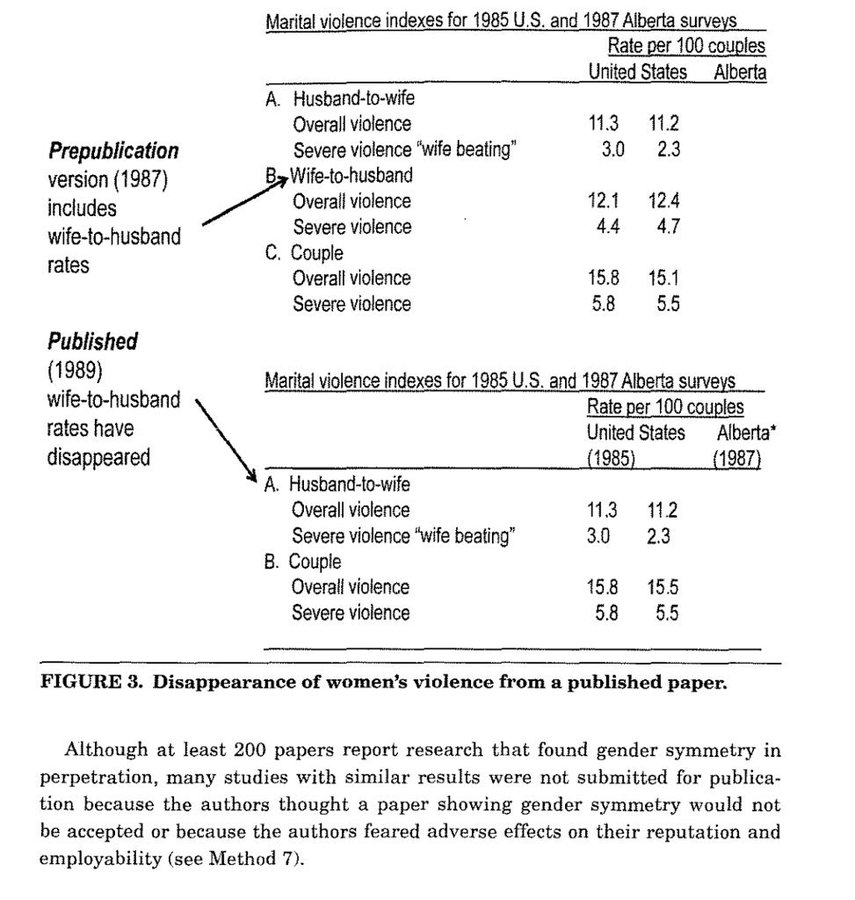
To suppress Evidence
To avoid obtaining data inconsistent with the Patriarchal Dominance Theory
To cite only studies that show Male Perpetration
To conclude that results support Feminist beliefs when they do not
To create “evidence” by citation
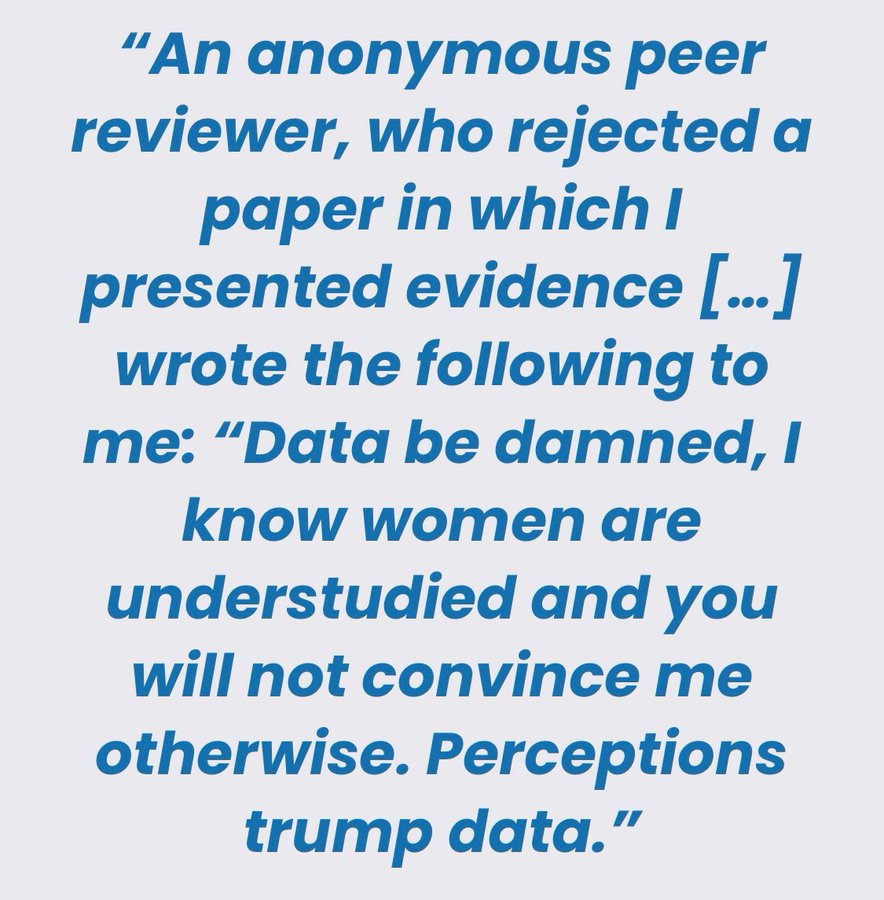
To obstruct publication of articles and obstruct funding research that might contradict the idea that male dominance is the cause of PV (see this post)
To harass, threaten, and penalize researchers who produce evidence that contradicts feminist beliefs (see this post)
I was studying the readers comments in relation to a rather biased article about domestic violence. One comment was from a respected spokesperson on men’s health issues, Adam Blanch. Adam was talking about the latest ‘Personal Safety Survey‘ undertaken by the Australian Bureau of Statistics. This is what Adam had to say:
“Domestic violence is about people who are angry, jealous, distressed and mentally ill acting out their frustration. The motive for ‘control’ and ‘power’ is only present in a very small percentage of DV, and both sexes do it to the same extent.
The entire Duluth model, which asserts that domestic violence is about ‘Gender power relations’, has been so extensively disproven by legitimate researchers that no fair minded person without a ‘gender agenda’ could possibly subscribe to it.
PS. the ABS personal safety survey has some serious methodological issues that appear to have been built in, twice, to bias the outcome in favour of a ‘Gendered’ view of DV.
The 2012 report sampled less than 20% the number of women than men, down from 25% in the 2005 survey. though overall they increased the numbers for both genders for 2012, the male sample size is so small that many of the findings are unreliable again.
They were criticised for only using female interviewers in 2005, so in 2012 they trained a few male interviewers to be available on request. However, they don’t appear to have told the interviewees that they were available. This was based don ‘expert advice’ that both men and women would be more comfortable with female interviewers, these experts are unnamed. Who are they. Are they male? have they worked with male victims of abuse? What qualifies them as experts. I’ve worked with thousands of men, and I can assure you that most men will not reveal the same information to a woman that they will to a man.
This lack of transparency and sample balance is unacceptable for research conducted at this level.”
The Bureau shrugged-off this criticism and in September 2016 successfully obtained AHRC approval to only employ female interviewers in relation to a survey that encompasses the issue of domestic violence.
“Professor Triggs granted the ABS the exemption, accepting their submission, which included studies from not-for-profit groups, stating men were more likely to be perpetrators of DV and women were more likely to tell their stories to other women” And so disregarding the flipside … that male victims would be more likely to tell THEIR story to other men.
This is hardly the first time I have encountered concerns raised by authoritative sources regarding the credibility of domestic violence research, and in fact it appears to be an ongoing issue.
Australia’s ABC has a reputation for pushing the feminist agenda, with one example being the article ‘Domestic violence of epidemic proportions a ‘national emergency’: campaign groups‘ by Ursula Malone and Juanita Phillips. Nothing like turning up the rhetoric to keep that government funding flowing through to feminists and their organisations during these difficult economic times. And all based on fudged statistics, in particular that “Domestic violence is the leading cause of death and injury in women under 45“.
That statistic was sourced from this 2004 report by VicHealth. Indeed, that report was essentially 44 pages of taxpayer-funded feminist bias wherein violence towards men was dismissed in one sentence in the preamble: “Although men are among the victims of intimate partner violence, evidence suggests that the vast majority of victims are women and that women are more vulnerable to its health impacts”. That statistic was discussed in this 2014 article by Greg Canning and in this scorching rebuttal of the Malone/Phillips article by Men’s Rights Sydney (also available on the AVfM web site).
Now let’s look at three examples of misrepresentation from Australian feminist advocacy group ‘Our Watch‘:
1. This well-written 2013 letter from Dr Greg Canning to Natasha Stott Despoja concerns serious omissions and misrepresentations in a speech that she gave on DV (see also the reader’s comments). I am advised that a reply was never received from Ms Despoja.
2. This February 2015 article is laughably disingenuous and quite likely signals a new tactic by players in the Domestic Violence Industry: ‘Natasha Stott Despoja: ‘people are sick and tired of the statistics‘. Or in other words, ‘we are getting called-out for using false or misleading statistics too often now, so let’s publicly discredit all statistics and continue the argument on the basis of subjective and anecdotal evidence alone’.
“The vast majority of sexual assaults are not reported to the police. Given for example that only 17 percent of women who experienced sexual assault by a male perpetrator (in their most recent incident of violence) reported it to the police (ABS 2012), the actual percentage of false cases is likely to be tiny. By one estimate, the actual percentage of false cases as a proportion of all rapes (reported and unreported) may be closer to 0.005 percent.” (Flood, M, 2014)
An Australian MRA by the name of Paul Rogers brought this error to their attention stating (in part) that:
“Even Wikipedia doesn’t suggest that false rape allegations are as low as you claim, which is saying something. I have provided an excerpt below from Wikipedia to highlight that your claim is many orders of magnitude lower than even the lowest value claimed by most authorities … I urge you to state the truth rather than continue to cherry-pick outlier claims because they support your misandry.”
I should also point out that it’s not only feminist groups that engage is this sort of misrepresentation. In this media release, the advocacy group SAVE denounces the use of misleading information on domestic violence by none other than (then) President Obama himself.
Demonstrating the remarkably one-sided manner in which feminists view the world, in the following article a feminist journo criticizes a men’s rights group on their use of statistics:
In a further blog post I look at the feminist predilection towards ‘tweaking’ the definition of terms such ‘domestic violence’ and ‘sexual assault’ in order to better support their claims of female victimhood and generally bolster public support: See Finessing definitions to preserve the image of female victimhood
The references listed below alternately discuss or exemplify bias against men, as perpetrated by journalists and others (often working in the sphere of domestic violence, sexual violence and related fields):
One of the most egregious, shameless statistical falsehoods I’ve seen in a long time, one that thoroughly shames @MayorofLondon & @TenderUKin the recently published Teachers Toolkit on addressing gender-based violence & abuse (22 February 2023) UK Twitter thread by Ally Fogg. But on the positive side, and following lobbying by men’s rights activists, some statistical corrections were implemented
Our uni teachers were already among the world’s most stressed. COVID and student feedback have just made things worse (19 July 2021) Some student respondents in a survey said some mildly critical things about some teachers, a bit more in the case of female teachers. In the old days you would take about the factors that may have contributed to these perceived weaknesses in teaching practice. Not now though. Now the snowflake patrol moves into action to spend the rest of the paper talking about why the survey respondents were wrong. Sexist and wrong. Damn them.
Elite journal under fire over racism (13 April 2021) Article by Stephen Rice which is behind a paywall at ‘The Australian’. Not directly related to misandry, but an example of how social problems are massaged to satisfy the fears or preferences of woke folk.
Not the full story (30 March 2021) Media Watch video. Yet another example of what happen when you start with a pre-determined narrative and then have to make everything fit around it.
Domestic violence on the rise during pandemic (13 July 2020) “The survey of 15,000 Australian women in May provides the most detailed information in the world about the prevalence and nature of domestic violence experienced by women during the pandemic.” How many men did they say were surveyed? That would be *none*. Here is a link to the web page of the agency that produced this research.
Domestic Abuse: The latest lie (19 July 2019) Most men who are victims of partner violence are in homosexual relationships, right? Wrong. But it doesn’t stop feminists from claiming it is true.
Whose research got us a picture of a ‘black hole’ in 2019? It was a girl right? See this tweet from Tom Golden with linked video that tells the story that the media didn’t.
Articles like the linked one now tell us how horrible the “trolls” are for “targeting” the female scientist, but funny how they don’t address the facts of the case – did she only produce 6% of the coding or not? See also this paper from ‘A Voice for Men’.
‘Blatant spin’: SBS accused of sifting data to show ‘sexist’ Australia, and SBS’s ‘sexism’ doco is just blatant propaganda (21 November 2018) Both of these articles appeared in The Australian newspaper, and are behind a ‘paywall’. Watch this Bettina Arndt video for some good background on this issue.
And of course there were various flow-on articles, such as ‘Are men victims of sexism?‘ (3 December 2018) which conceded that the male gender had some problems, that none of these were due to women, but that men were using feminism as a “scapegoat”. Then ‘Here’s how audiences reacted to ‘Is Australia Sexist?‘ (4 December 2018)
La Trobe bans my talk on the fake rape crisis, by Bettina Arndt (2 August 2018) This article concerns the exaggeration of the incidence of sexual assault in Australian universities by the Australian Human Rights Commission and others.
When care becomes control – financial abuse cuts across cultures (17 January 2017) As I state in this post, most papers on financial abuse ignore the reality of male victimisation, and this is yet another example. In the absence of conclusive proof that only women were victimised one would expect a researcher to survey men and women. Failure to do so, as in this and many other cases, is evidence of gender bias to support a particular ideological narrative.
Cutting to numb the pain of sex abuse: interviews with young women in drug treatment (12 August 2016) Australia. Although this article focuses on the needs of young women, the underlying research surveyed both genders. Whilst I have yet to review the findings in detail, my default position is one of disquiet regarding the merit of applying different fixes to men and women. Without a very thorough understanding of all contributing factors, esp. in relation to cause/effect, there is a real danger that we may misinterpret the true situation. Also, from what has happened in the field of domestic violence for example, there is a real danger of a monopolisation of all available resources for the treatment of women.
Anti-abuse campaign targets university students (22 February 2016) Australia. Typical of Our Watch research this survey appears designed to deliver a pre-determined finding of gendered female victimhood. The article reports one part of the picture, but where are the responses to (for example) how many boys were pressured “to do sexual things”? Whether girls respect the ability to consent in relation to boys who are drunk, etc.
(I believe there to be a question mark over the extent to which the Australian Research Council is itself free of gender bias. I say this not in terms of funds provided to male versus female researchers, but in terms of social research projects with a feminist orientation being strongly favoured. Consider the examples provided of feminist research mentioned in this other blog post, as well as this article which will be discussed in a future post. The author of this article presenting a feminist-concordant perspective on the gender pay gap was also ARC-funded. These spreadsheets look at the nature of projects funded by the ARC)
“The Children’s Rights Report being released today found one in every 28 people had also experienced sexual abuse as a child, while a further 23 per cent of children have witnessed violence against their mother”. This conveniently neglects to mention that various studies have found that as many kids have seen their mum hit their dad, as per vice versa. Here is one Australian source.
Victim-blaming rampant in Australians’ attitudes towards violence against women – study (25 November 2015) And what of victim-blaming when men are the victims? And of community attitudes regarding violence towards males? Guess we’ll never know because the last thing feminist researchers want to do is provide context for their claims of female victimisation.
In this June 2015 paper the One in Three advocacy group recounts the bias and antagonism they faced whilst contributing to the Australian Senate Inquiry into Domestic Violence
ABC misleads. No, it’s not more dangerous to be a woman, by Andrew Bolt (14 April 2015) One of the precious few examples of an Australian journalist pointing out the distortion of data by feminists. And here and here are examples of the types of pro-feminist articles that Andrew was railing against.
The following collection of reddit discussion threads detail moderator bias and censorship in relation to threads/posts concerning domestic violence and child abuse – See example 1, example 2, example 3, example 4, example 5 and example 6 (27 October 2014) Includes the following quote from a moderator responding to a query as to why a post was removed: “It needs to be the right information from the right people. Here’s a shorthand guide: if you are an MRA or TRP, you need not bother posting. If your information may tend to make women look bad, same.”
Are domestic violence figures bogus? (22 February 2014) Includes discussion of the notorious ‘intimate partner homicide is the leading cause of death for African-American women ages 15 to 45’ statistic myth
I spoke to hundreds of men about rape and domestic violence (24 September 2014) Note that this is a different survey to that discussed by Adam Blanch earlier. It is certainly feasible that interviewers might influence survey respondents. It hardly fills one with confidence about the reliability of the results when interviewers are prepared to go on record with such strong views on the matter being investigated.
If manipulating and misrepresenting statistics to suit an agenda was a crime then the feminist authors of this “fact-sheet” should be in jail. Many of these so-called facts are debunked in papers listed in this other post about domestic violence, whilst others demand the smallest measure of common-sense to confirm just how misleading they are.
“A third of family murders involved a female as the killer. In sibling murders, females were 15% of killers, and in murders of parents, 18%. But in spouse murders, women represented 41% of killers. In murders of their offspring, women predominated, accounting for 55% of killers” (Source)
The paragraph above was extracted from a 1994 publication, not because patterns of gender perpetration have changed greatly but because the feminist filter has been imposed so completely now, that we only see articles like this one that present statistics in a manner suggesting that women are the perpetual victims of oppressive male malevolence. (Refer to Reddit discussion thread here)
These final linked articles address the predominant influence asserted by feminists in conducting research, and in the subsequent formulation of DV policy:
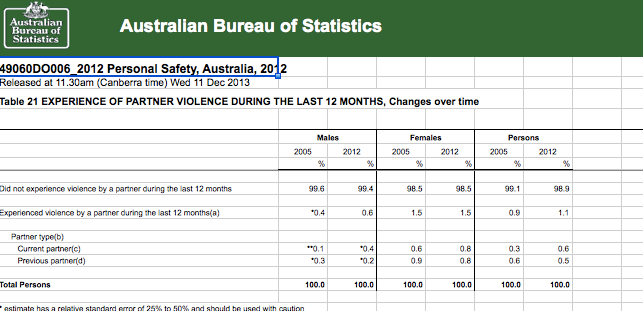
Regarding the table below … hardly an ‘epidemic’. The only increase is in male victimisation. It’s no wonder that, in pushing its ‘epidemic’ barrow, the Domestic Violence Industry increasingly relies on statistics generated by help-line call centres instead. And of course we can trust the integrity of those sources.
“Advocacy research consists of collating available evidence or producing new information to support a pre-determined policy position. Advocacy research is commonly carried out by pressure groups, lobby groups and interest groups (such as trade unions) and, occasionally, by political parties, journalists and academics – especially those working in the social policy field.”
“It is difficult to criticize advocacy research without giving an impression of caring less about the problem under consideration than do those who are engaged in magnifying its size. But one may be deeply concerned about problems such as rape, child abuse, and homelessness yet still wish to see a rigorous and objective analysis of their dimensions. Advocacy research that uncovers a problem, measures it with reasonable accuracy, and brings it to public attention performs a valuable service by raising public consciousness. The current trend in advocacy research is to inflate problems and redefine them in line with the advocates’ ideological preferences. The few impose their definition of social ills on the many – seeking to incite moral panics. This type of advocacy research invites social policies that are likely to be neither effective nor fair.”
With regards to the Latrobe Uni study noted above, why not include people of any gender who are concerned about any form of harassment or assault on public transport? In other words get the big picture of what’s occurring. Ditto for all the studies/article regarding workplace harassment that restrict themselves to considering ‘sexual harassment’, knowing full well that this is likely to focus attention on the female perspective.
My initial post about domestic violence within this blog can be found here, whilst other DV-related posts can be located by clicking on the ‘domestic violence’ tag at the bottom of this page. It is suggested that this post also be read in conjunction with:
Firstly, might I suggest that you read the article that started this whole affair – here it is here. The article was called ‘Colleges become the victims of progressivism’, was written by George Will, and published on 6 June 2014.
George’s article concerned the mythical rape culture and associated culture of female victimhood that has taken root and is flourishing in North American university campuses.
I originally mentioned this issue in my post about feminist censorship, but the subject has now taken on a life of its own and well and truly warrants its own post. What makes it so significant is that it perfectly typifies what feminism has done, and is continuing to do, in stamping out dissenting views. Or more specifically, in stamping out people who dare to express dissenting views.
The feminist backlash against the publication of George’s article was immediate and soon resulted in him being sacked from his role at the newspaper in question. Yup, so much for the Land of the Free. Yay feminism!
Feminist activism designed to stop the conference being held was clearly unsuccessful – this included street marches, online petitions and direct approaches to relevant authorities, and even anonymous threats of violence. These threats ultimately led to the conference being relocated to another venue under unusual circumstances as is described in this article.
Here is a Youtube video that was made to support a fund-raising drive needed to cover additional costs resulting from threats made to the venue hotel.
Well, as it transpired, thankfully there were no feminist protesters present at the Conference and it was by all accounts a peaceful and productive event.
Media coverage of the conference
Media coverage of the conference covered a spectrum from supportive and thoughtful to shallow, dismissive and side-tracking. Many of the articles attracted many hundreds of readers comments, hence even the articles with a strong anti-MRA bias provided a useful function of encouraging debate.
As you will see, in each of the above cases, large numbers of men and women have posted comments pointing out the negativity, bias and hypocrisy shown by the authors. Indeed there are some very thoughtful and insightful comments amongst these – recommended reading!
NCFM Vice President responds to criticism about MRA’s and the AVfM conference in Detroit (25 July 2014) See http://www.avoiceformen.com/mens-rights/ncfm-vice-president-responds-to-criticism-about-mras-and-the-avfm-conference-in-detroit/
In 1913 a gentleman by the name of Ernest Bax wrote:
“When, however, the bluff is exposed… then the apostles of feminism, male and female, being unable to make even a plausible case out in reply, with one consent resort to the boycott, and by ignoring what they cannot answer, seek to stop the spread of the unpleasant truth so dangerous to their cause. The pressure put upon publishers and editors by the influential Feminist sisterhood is well known.”[From The Fraud of Feminism, p.1-2]
In this post I am using a broad definition of censorship that includes blocking or excluding or misrepresenting people/groups or opinions that are at odds with all or part of the feminist narrative.
I should mention that it is not only anti-feminist perspectives that are censored, but also sometimes perspectives offered by men who identify as feminists, or by women who identify as (for example) equity feminists rather than gender feminists.
An example of feminist men being excluded can be seen in this article about a pro-abortion rally in Ireland where men in the audience were told to “know your place” and to remember that “this is a women’s movement“.
Personally, when I read material produced by feminists and see how they respond in online forums, my mind is drawn to the Credit Union Australia adverts shown on Australian TV. In those ads people block out information they don’t want to hear/consider by covering their ears and saying “la la la”. Except that feminists often substitute the la la la with somewhat saltier language.
What is happening is that any view that runs contrary to feminist ideology is branded misogynistic and hateful, and thus automatically unworthy of consideration. In my eyes, alternative viewpoints are not necessarily hateful. Sure they might cause hurt feelings, but that is part and parcel of debate in intelligent adult society.
Feminists say they are addressing both mens and womens issues, and will make the world a better place if we just stay the F**K away and let them do what they need to do. This is a nonsense. Has there been even a single policy change initiated or achieved by feminists that has had a tangible benefit for men collectively? (Cue: sound of crickets)
Good quote about feminism: “That’s what gets me about them — for thirty years, they screamed that slogan [make the personal, political] at the top of their lungs. And then, once men start turning to politics to make the personal political, they start hemming and hawing about whether or not this issue or that one is really a ‘mens’ issue. But somehow, everything on earth is a women’s issue.” (Source)
Let’s be quite clear that we are talking about censorship based on ideology and personal preferences here. I have no problem with moderators taking action against posts that are threatening, incoherent, or peppered with profanity.
So what then are some of the techniques commonly employed by feminists/SJW to isolate those putting forward alternative positions?
Blocking and/or removal of posts or readers comments in online blogs and mainstream media web sites
A major factor in motivating me to create this blog was the annoyance I experience when I’m continually thwarted upon trying to post my views in online fora, for example in blogs, discussion forums, and mainstream news sites like news.com.au.
This blocking or removal of dissenting posts is extremely prevalent in sites related to discussions of gender and feminism. It generally occurs when I, and others like me, put forward perspectives that conflict with cherished notions held by the (usually female feminist) author or moderator. These are people who are, more often than not, singularly unwilling to accommodate alternative positions. I lost track long ago of the number of times this has happened to me … examples here, here, here, here, and here … courteous posts that were either not uploaded, or uploaded but subsequently removed.
This September 2016 article about domestic violence by Rebecca Poulson is an example where readers comments were overwhelmingly critical of the author’s perspective. The author complained on social media of her comments thread being “hijacked”, with many of those comments subsequently being removed by the moderator.
I don’t mean to be pedantic but the use of the term “hijack” demonstrates the sense of entitlement shown by many feminist writers. The definition of this word entails illegal seizure (of an aircraft, ship, or vehicle for e.g.) whilst in transit, and the use of force to make it travel to a different destination. Readers offering their views is neither illegal nor does it involve force, and others are free at any time to offer their own views.
The following collection of reddit discussion threads detail moderator bias and censorship in relation to threads/posts concerning domestic violence and child abuse – See example 1, example 2, example 3, example 4, example 5 and example 6 (27 October 2014) Includes the following quote from a moderator responding to a query as to why a post was removed: “It needs to be the right information from the right people. Here’s a shorthand guide: if you are an MRA or TRP, you need not bother posting. If your information may tend to make women look bad, same.”
Let’s consider the experience of another who has had similar experiences:
M the Atheist wrote on 3 September 2013 “… I found a thread about rape and power and spent the time to read the post and all the comments, did not seem too hateful and had some reasonable stuff … I wrote a very reasonable and objective post about rape, power and rape culture (based on one of GWW’s videos). I included data, reason, personal experience and points from GWW’s video; and was surprised that it got posted …
I went back a few hours later to find that my post was removed; and I could not figure out why. I went through great pains to make it neuter, people inclusive, and posited GWW’s hypothesis in what I thought was a well mannered and calm, dispassionate way.
They had also posted and allowed to remain other males’ posts. So why not mine? I then realized that they only allow mens’ posts to remain if they can destroy them or if they are easily group-attacked.”
Something similar also happened to Australian TV personality David Koch when he sought to respond to an attack on him posted in a feminist web site. Another example here from the UK.
With the exception of reddit/r/mensrights and a few others, there is a high probability that any post made that challenges the leftist or feminist narrative will quickly be made to disappear. It will either be removed by a moderator on their own volition or on the basis of the post being reported by users of the forum. This is not ‘tin-foil hat’ stuff, it happened to me as recently as this morning.
Two other common occurrences on Reddit, involving those making posts that challenge or question the prevailing feminist/SJW commentary, are:
Posts being removed from view to due to down-voting. The speed at which this occurs, plus the large number of votes cast, suggest that this is an organised strategy employed by like-minded activists.
Reddit users being banned from posting in particular forums for posting often remarkably benign comments or questions. Examples of this are provided in reddit/r/mensrights on an almost daily basis.
Another common tactic employed by feminists on social media is to lodge reports, which may be exaggerated or completely bogus, about Facebook pages maintained by others. They often do so in a co-ordinated manner with their friends/associates, with the aim of having the relevant pages suspended/removed. And in many cases they are successful.
It would be one thing if the administrators at Facebook were applying these rules and restrictions evenly across the board, but that is not the case. What is happening is that Facebook pages with a conservative or egalitarian or anti-feminist slant are being targetted. Meanwhile a blind eye is being turned to questionable content within pages with a leftist/liberal/SJW or feminist slant.
There are further examples and discussion of this trend in articles listed later, in addition to the following:
Developments on Facebook have helped drive many people, both those with anti-feminist/SJW views and trolls alike, across to Twitter where until recently there was a relatively unimpeded flow of ideas and information. Things are now also tightening up there also, both in terms of actions taken by Twitter staff and other users. For an example of the former, google search to see how Twitter have pursued MRA and anti-feminists such as Milo Yiannopoulos. More recently Twitter has introduced tools to enable greater censorship (see here and here).
Many feminists/SJW not only block those that they encounter, but also make use of shared block-lists. Clementine Ford, for example, blocks 133,000 Twitter accounts and invites other feminists to use her list.
Another Australian feminist, Van Badham, revels in her ability to block in this 2019 article.
This means that a Twitter user can find him/herself blocked from another user’s stream even when they have never had contact with that particular person or group. In some cases this may occur simply because your account was red-flagged due to others that you follow.
I have lost count of the number of times I have been blocked – Here are two examples:
In my first example a feminist journalist by the name of Lindy West blocked me. I don’t know Lindy from a bar of soap, but apparently she considers my views on anything/everything to be unacceptable. Really Lindy? As one cheeky reader commented in response to this article, perhaps you’d be better off blocking Twinkies instead.
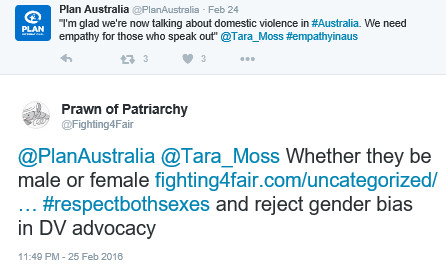
At least in my second example I actually had some contact with the blocker (Tara Moss) before the hammer fell. That single solitary tweet is shown below:
Lobbying against planned events by anti-feminists or men’s rights advocates and/or disrupting events whilst they are underway
In what is becoming a popular strategy to prevent opposing views being heard, feminists are setting off fire alarms at venues hosting MHRA or anti-feminists speakers. If you want to get some idea of how widespread this form of nuisance ‘activism’ is becoming then google on the words ‘feminist protesters pull fire alarm’. Go ahead – you can start by reading this and this. And only recently feminist protestors disrupted a presentation by CAFE.
Christina Hoff Sommers debated Roxane Gay in Sydney & Melbourne in late March 2019. Refer this article and linked Twitter stream for now, whilst I try to locate a better review (oh and here’s a SMH offering with reader’s comments). Apparently Gay’s leftist supporters focused on disrupting the event rather than letting an actual debate take place.
The term ‘anti-democratic’ is way too insipid to describe this pattern of behaviour. This is something more negative, much darker and more pervasive, and which all but precludes any meaningful dialogue. Indeed the direction in which this is already heading is that any comments that are deemed to be anti-feminist and/or sexist will be made illegal on the grounds of combating hate-speech (example). Opposing this trend, at least for those that have the means to take legal action, is legal precedent such as this.
A curious aspect of feminist censorship is that one of its key functions is to block open debate of their own issues. Even the noisiest feminists only want to be heard when they can control the ‘dialogue’. Otherwise … well this challenge by Milo Yiannopolous to Anita Sarkeesian (thus far) illustrates what shrinking violets even high-profile feminists can be when someone else seizes the initiative. Mike Buchanan’s web site features many examples of his own unacknowledged public challenges to feminists to debate significant issues.
Feminists don’t want to debate issues or engage with their opponents, they want to neutralise them by almost any means necessary. What follows is a brief extract fromRules for Radicals‘ as cited in a blog post by Anne Althouse:
“Pick the target, freeze it, personalize it, and polarize it. Cut off the support network and isolate the target from sympathy. Go after people and not institutions; people hurt faster than institutions. (This is cruel, but very effective. Direct, personalized criticism and ridicule works.)”
Some articles on the general issue of the gradual death of free speech and/or the unwillingness of the liberal left to engage constructively
Two good articles in The Australian on 24/25 September 2016 (if you can get behind the paywall): ‘What more in the name of love?‘ by David Crowe, and ‘Straight-out hate in politics of identity‘ by Brendan O’Neill. Neither article specifically mentions feminists, yet very accurately describe their tactics.
“Labels are important tools in identifying socio-cultural problems. Privilege exists. Shaming exists. But when we adopt labels, project them onto others, or create new ones, we sometimes take broad social concepts and individualize them. We use labels to silence those who don’t agree with us, which keeps us from engaging in open, honest conversations. Many people with legitimate opinions and solid ideas are afraid to participate because they are afraid they might say the wrong thing, or say the right thing in the wrong way. When people are silenced, the conversation suffers.”
“The Google employee behind a ten-page viewpoint diversity manifesto that went viral online has been fired. James Damore, whose manifesto criticizing the politically correct corporate culture at Google prompted outrage from left-wing employees and social justice warriors online, revealed that he had been fired” (Source) More at:
To Milo or not to Milo? (21 February 2017) How the left neutralised a very annoying thorn in their side. A story rich in hypocrisy given what various feminists/SJW have previously said & done & walked away from without penalty.
Archetypal mangina David Futrelle seeks to undermine credibility of film-maker Cassie Jaye because she dared to produce a fair-minded representation of the men’s rights movement. See here, here and here for example
Columbia student newspaper disables sexual assault comments, while picking and choosing opinions published – Reddit discussion thread and linked article
And now to close with something a little different, this April 2015 article in The Guardian claims that men post far more comments online (think news and current affairs web sites), and that this has the effect of “silencing” women. The author also claims, amongst other things, that many women are posting online using male names for “protection“. Firstly this begs the questions how could he know how many of those posting were men/women. Secondly it would be counter-productive to assume a male name for this reason when surveys show that men attract significantly more online abuse/harassment than do women. But the best bit is that the moderator removed my comment. They didn’t even leave the usual “Your comment was removed” message. They silenced me!
“The anarchist Bob Black predicted back in 1982 that feminism would eventually become a totalitarian movement to rival history’s most oppressive tyrannies. Most people find this idea absurd due to gynocentrism, “women are wonderful” and neoteny (and frankly, male vanity). However Black made the point that feminism — since its arguments are completely illogical and do not stand up to scrutiny — could not maintain power except through censorship.
Feminists are attempting to turn all of society into a “safe space” for feminists (not women, not children, certainly not men, just feminists). That includes cyberspace. As more and more people debunk feminist ideology online, calls will grow to “end online misogyny,” with predictable results. There is already a huge chilling effect underway.” (Source)
One of the many feminist criticisms of the mens rights movement, and particularly MHRA web sites like ‘A Voice for Men’, is that they are characterised by the frequent use of descriptors of women that are offensive and sexist … terms such as sluts or whores.
Personally I have noticed that there is surprisingly little usage of such terms in MRA sites or blogs. Moreover when such terms do appear they are generally found within comments contributed by readers (some of whom are trolls), rather than in the body of posts or articles themselves. Such put-downs also almost invariably relate to feminists rather than women per se.
It was with interest then that I came across this study ‘Cursing in English on Twitter‘ (see section entitled ‘Cursing Vs Gender’ on page 8). Granted, the study wasn’t about MRA/feminist sites, but the findings are still interesting. The study found, for example, that the the use of terms ‘bitch’ ‘slut’ and ‘whore’ by women was more prevalent than the level of use by men.
This post looks at the issue of online harassment, whilst in another blog post I discuss the terms gender traitor, white knight and mangina.
Another related term that has come to be used increasingly widely is ‘cuck‘, which is the shortened version of ‘cuckold‘. The common meaning seems to be a person (generally male) who does the bidding of another whilst not truly invested in that person’s (or groups) cause, for example a politician who supports feminist programs out of fear of castigation and/or in the hope of winning the ‘women’s vote’.