I wanted to draw your attention to a disturbing development involving the Australian arm of the White Ribbon Campaign (‘WRC’). Before proceeding, I should clarify that this particular organisation is separate and fundamentally different from the White Ribbon Campaign led by Ms. Erin Pizzey. The distinction between the two groups is discussed in this other post.
In summary, Erin’s organisation recognises and advocates for victims of both genders. It believes that the root cause of domestic violence lies in generational family violence, and that the patriarchy is an ideological concept devoid of value or meaning within the context of the debate regarding domestic violence.
The role of ambassadors within the Australian arm of the White Ribbon Campaign is described as follows:
“White Ribbon Ambassadors are men who recognise the importance of men taking responsibility and playing a leadership role in preventing men’s violence against women.
White Ribbon Ambassadors are formal representatives of White Ribbon Australia who have the knowledge, skills, attributes and determination to influence Australian men to critically evaluate their attitudes and behaviours toward women.” (Source)
Tanveer did just that. He showed leadership by writing an article about domestic violence that presented a perspective that included an acknowledgment of female perpetrators of violence, as well as a discussion of certain factors underpinning violent behaviour by both men and women.
For feminists this was like a red rag to a bull. They incorrectly interpreted “factors underpinning perpetration” as meaning “excuses for men to commit violence against women”. And as for his claims that significant numbers of women are also committing violence, well, every feminist knows that’s not true.
I should also point out that the sorts of ideas Tanveer shared in his article have been proposed by others and are hardly new or revolutionary. This fact sheet from SAVE, for example, also identifies various factors as being potential precursors of partner violence (refer Fact #5).
Here are some of the key items that have appeared in the media thus far:
Look at how the feminists turned on Tanveer by perusing his Twitter stream around 9/10/11 February 2015. See the brickbats hurled at him by high-profile feminists like Jane Caro and Elizabeth Broderick, as well as countless faceless SJW, their mouths frothing with spittle. It’s ironic how online bullying morphs from patriarchal scourge to sacred duty when someone dares to question the holy grail of feminism.
In a lengthy statement issued by WRC on 10 February 2015 it was noted that “Dr. Ahmed has agreed to participate in the Ambassador recommitment process”. (Source) Shades of totalitarianism … quite chilling really.
Yet despite the issuing of this statement an angry feminist horde continued to bay for Tanveer’s blood across the social media. See, for example, the WRC Facebook page (extract below) and Twitter stream. Perhaps somewhat surprising, most of the comments in the Facebook page were posted by women. Surprising only in that WRC is ostensibly an organisation for men. I guess the male supporters were well and truly cowed, just how their feminist masters wish them to be.
Australian ‘White Knight’ politician Tim Watts, now teetering on the cusp of becoming a fully-fledged ‘Mangina’, stood up in federal parliament to demand that Dr Ahmed stand down from his role with WRC. A video of Tim’s speech is provided in his Facebook page (see 11 February), with further righteous fury evident in Tim’s Tweets.
The feminist’s message is crystal clear: “Men, we want you nice and visible up the front but don’t you dare say anything that isn’t 100% in accord with the feminist narrative or we will turn on you in a flash.”
The WRC is not an organisation that is interested in accurately describing the nature of domestic violence, in objectively teasing it apart into its component pieces, and in considering the widest possible range of solutions. This is an organisation that places a higher priority on maintaining the ‘integrity’ of the feminist narrative, and in pursuing both individual and collective self-interest.
Thus WRC portrays a picture of DV that conforms to their biased viewpoint, and that only acknowledges those causes and those solutions that fit neatly into the framework that they themselves have fashioned.
The thing is, we have already thrown many years and many million of dollars at that approach, only to have the self-same feminists come back to the public-funding trough claiming that the problem is getting worse and that we are now facing an “epidemic” of domestic violence. “Oh, but if only we had more funding we could keep the women and children safe“.
The ideologues at WRC and elsewhere in the femosphere now chanting ‘cast him out’ are nothing less than blinkered gender fascists. How any right-thinking adult could continue to support this group simply beggars belief.
Rightly or wrongly I see some parallels with the case of recently-released Al Jazeera journalist Peter Greste. I think I can state with confidence though, that any irony will be lost on SJW who pledged support for one, only to subsequently attack the other.
Tanveer’s next best step would be to accept a role as an ambassador for Erin Pizzey’s group, securing a far more inclusive outlet for his passion, as well as according him the opportunity to offer a one-fingered wave to his misguided former colleagues-in-arms.
White Ribbon Day (25 November), and the days before and after it, saw quite a flurry of activity on the White Ribbon Australia Facebook page. I visited the page a number of times during this period to monitor discussion, occasionally contribute some comments, and generally check out what was going on.
I was interested to note the unexpectedly large number of posts from people drawing attention to the fact that many men were victims of domestic violence, that support services for male victims were inadequate or non-existent, and so on. I was also surprised to see a number of occasions where moderators sought to hose down dissent by uploading posts like this one:
“White Ribbon Australia believes that all forms of violence are unacceptable and acknowledges that domestic violence is experienced by both men and women. However, we also acknowledge that the majority of victims of domestic violence are women. We are aware that there are other organisations working to stop violence against men and we commend any work they do to stop violence. If you’re a male experiencing violence, please contact MensLine on 1300 78 99 78 . Similarly, the White Ribbon Campaign has a central focus; end violence against women.”
Another post, from a WRC ‘ambassador’, was similar but also earnestly invited communication with those who held views that differed from those espoused by WRC.
I was surprised because I haven’t noted comments like this in the WRC web site, or in their literature or submissions to inquiries, etc.
But alas, the positive spin ends there.
For at the same time that WRC were proffering soothing words, they were progressively removing posts from people who questioned their female-only focus or were in any way critical of their mission or their claims. They didn’t do this straight away however. I guess that would have amounted to too-obvious censorship. No they waited a half a day or a day before they quietly disappeared those troubling and clearly unacceptable posts. I’m guessing the rationale was to preserve the ideological purity of their message for the benefit of future generations. But they didn’t stop there. Oh, no. In my case, and I doubt I was alone in this regard, they banned me from making any future posts on their Facebook page.
When later I saw a particular comment posted, I simply had to respond and so I used an alternate Facebook account. The one comment to which I responded was “1 woman per week dies at the hand of her partner or ex in Aus – what a sad stat”. All I said in response was “and every ten days a man dies at the hand of his partner or ex – also a sad stat” and provided a link to a web page in which that stat was discussed.
The next day I discovered that my final comment had also been removed AND my Facebook account was locked – presumably as a result of a complaint to Facebook HQ. Given that I had not used that account for some time or for any other purpose, I think it’s reasonably safe to assume that the complaint came from WRC.
A white ribbon or a symbol denoting a white ribbon has been used by a number of movements in recent history as described in the relevant entry in Wikipedia.
Two of those entities are active in addressing the problem of domestic violence. For the purpose of this discussion I will refer to them as the the White Ribbon Campaign, and the White Ribbon Campaign (feminist version) respectively.
The first of these organisations is committed to addressing all forms of domestic violence, and is led by respected domestic violence campaigner Ms Erin Pizzey. This organisation pursues a gender-neutral approach and utilises unbiased professionally conducted research. Here is their web site and Facebook page.
Until recently their web site address was www.whiteribbon.org, but legal action taken by the organisation discussed below now prevents them from using that domain name.
The role of the White Ribbon Campaign (feminist version) is limited to addressing violence by men against women. They publicise research results that support the notion that domestic violence as a gendered crime, and assert that virtually all domestic violence is perpetrated by men. They ignore or seek to discredit research that does not support their position. Here is their Australian web site (& Facebook page) and their Canadian web site.
Many people have expressed concerns over the years regarding the policies and the actions of the White Ribbon Campaign (feminist version). This can be readily ascertained by googling on the words ‘White Ribbon Campaign criticism’ – some examples can be seen here, here, here, here, here and here. Here is also a reddit discussion thread on Bunnings Warehouse and the ‘White Ribbon Campaign’ plus an article by a feminist who is decrying mens objections in relation to advertising undertaken by the ‘White Ribbon Campaign’.
I believe that we will only make meaningful inroads into solving the scourge of domestic violence if we commit to addressing the entire DV problem, not just the parts that don’t threaten the validity of feminist narrative of men=perpetrator and women=victim.
I believe that we should provide adequate support to ALL victims of domestic violence.
I believe that we should recognise and provide treatment programs for all perpetrators of intimate partner violence, regardless of race, gender, age or sexual orientation.
Ever since it was created the White Ribbon Campaign has been the subject of relentless feminist attack. What strikes me as ironic is that these attacks have generally been on the basis that it is a vehicle to “scam” money from members of the public and/or that donated funds would be better directed towards “real charities” … presumably like the White Ribbon Campaign (feminist version).
The thing is though … how many of these “real charities” actually spend donated funds on providing practical assistance and support to victims of DV versus spending it all on salaries, expensive marketing campaigns and conferences? How much government oversight is there to ensure that objectives are being set and achieved and money not misspent or wasted?
And just how much of that marketing is simply about building brand awareness of themselves and of feminism generally, about promoting an exaggerated perception of the scale of the DV problem, and about generating suspicion and hostility between the genders? All of which, not coincidentally, serves to rev-up the gravy train of government funding.
Firstly, and by way of background, the concept of institutional misandry has been described as:
“The collective failure of an organisation to provide an appropriate and professional service to people because of their status as male. It can be seen or detected in processes, attitudes and behaviour which amount to discrimination through unwitting prejudice, ignorance, thoughtlessness and misandric stereotyping which disadvantage males.”
It persists because of the failure of the organisation openly and adequately to recognise and address its existence and causes by policy, example and leadership. Without recognition and action to eliminate such misandry it can prevail as part of the ethos or culture of the organisation. It is a corrosive disease.
— After section 6.34, page 49, Cm 4262-I, Lawrence. The Stephen Lawrence Inquiry Report of an Inquiry by Sir William Macpherson of Cluny. February 1999. (Source)
I frequently encounter the online footprints of Australian organisations whose interests encompass one or more gender-related issues, and who appear to demonstrate a significant degree of anti-male bias. Many of these organisations:
provide minimal or no services or support for men, and often only reference men in the context of (for example) perpetrators of sexual assault or domestic violence
are strongly biased towards, or influenced by, feminist ideology
have weak oversight or disclosure mechanisms in place, for example annual reports, financial statements/independent auditing, and measures of performance which (if they exist) are not publicly available, and
have either no men working within them, or only very few (gender quotas anyone?)
I find this situation to be of considerable concern bearing in mind the hundreds of millions of dollars flowing into just the domestic violence sector alone each year. What’s more, that amount continues to increase and in July 2014 it was announced that millions more were to be poured into agencies to protect “women and their children“ (whilst still assiduously ignoring male victims and violent women).
It also worries me that this list is not restricted to private lobby groups or not-for-profits that benefit from substantial government funding or contracts. Indeed, there are many government agencies and groups within the tertiary education sector that display almost as much gender bias.
I have already allocated blog posts to several such organisations:
Workplace Gender Equality Agency (Annual budget $5 million) $5 million a year to propagate a feminist myth and to shake a finger at companies that won’t buy into their delusion. Their contribution to the Australian community consists of burning public money on the altar of feminism. (Postscript November 2018: Budget doubled)
Men’s Referral Service (Government funding was around $2million/annum but they are now to be the recipient of a further allocation of $13 million over four years)
The E-Safety Office (Annual government funding is currently around $100 million)
In this blog post my intention is to eventually corral and list basic details of other similar organisations, and then subsequently do further research on each.
Who’ll be the next cab off the rank? Oh, we have oh so many contenders …
Monash Gender and Family Violence Prevention Centre – Hmm, where to start here. Well firstly check out how many men they have on board with regards to Advisory Board members/key researchers/HDR researchers/visiting scholars. Think, one or none tokenism. But more to report here folks – back soon.
Women’s Safety NSW – This group came to my attention due to their lobbying against a proposed Family Law Inquiry. You can review their tweets (@womenssafetynsw) in relation to that issue distributed around mid-late September 2019. Their ACNC register entry is here – you will note that they received $253,869 in government grants in 2019/20 whilst spending $192,710 on “Employee Expenses” (with only one fulltime employee). The CEO and Board are wholly female. (Newsflash: Their Twitter account states “Women’s Safety NSW is no longer in operation” as at 27 July 2021. Their former CEO, Hayley Foster, is now CEO of another organisation called ‘Rape and Domestic Violence Services Australia’).
Full Stop Foundation is registered as a charity with annual income approaching $2 million. Their patron is feminist Tara Moss, and all seven board members are women. Looking at their web site and ACNC register entry, it’s uncertain though to what extent they receive government funding. What exactly is “contract income”? (See note 4). Also, whilst they list the Australian Human Rights Commission as supporters they don’t seem to clarify what form this support takes (?)
Or another … this one is called ‘Safe Steps Family Violence Response Centre’, but don’t let “family” fool you. Safe Steps “is committed to assisting all women and children in the community experiencing family violence. We are an organisation that values inclusivity, diversity and intersectionality”. All female board and staff. Income of $12 million in financial year 2017/18 according to latest annual report on their web site, but which doesn’t specify the extent of grant funding. Safe Steps is listed in the ACNC register but no information seems to be held for them. (?)
Just out of curiosity I typed “male victims” into their web site search facility, and got “Oops, we are really sorry but no results were found“.
Or how about Women’s Community Shelters Ltd who came to my attention via their daily paid placement in my Twitter feed? Their ACNC register entry mentions a total annual income of almost $3.5m, of which just over 1/3 arrives by way of government funding. This mostly comes from the NSW Dept. of FaCS, who explain here the “facts” about domestic and family violence (no need to complicate things by mentioning male victims).
Or perhaps Relationships Australia? I understand that they don’t have many male counsellors nowadays, and one less after the departure of Rob Tiller.
“International Women’s Development Agency (IWDA) has an EEO exemption (H298/2018) and requests applications from women only. IWDA has a Child Rights and Protection Policy and directors are required to undertake a National Police Check and endorse IWDA’s Child Rights and Protection Code of Conduct.”
I wonder why IWDA were granted an EEO exemption and whether an application from a MRA organisation would be treated similarly? See here and here. Oh and IWDA seem to get plenty of government financial support too:
“Grant income represents 81% of our total income and grew by 43% in 2016/17. This is based on a combined Grants total of $8.59mil, of which 29.81% is sourced directly from the Australian Government’s Aid Program.” (Source, p27)
Or how about ‘The Australian Centre for the Study of Sexual Assault‘? This is the page that I came across first. It reads like a grant application for a feminist spend-fest doesn’t it? I had a very quick look at their site and found nothing along the lines of guidelines to help female perpetrators, or anything about male victims. I searched on “sexual assault of men” and did come across a page entitled ‘Engaging men in sexual assault prevention‘ though. You know the sort of advice that helps us men curb the frothing rapist lurking within each and every one of us.
The ‘About us‘ page tells us that there are no male staff at the Centre, as well as providing the following information:
The Australian Centre for the Study of Sexual Assault (ACSSA) was established in 2003 by the Commonwealth Office for Women. It is funded by the Department of Social Services and is hosted by the Australian Institute of Family Studies.
ACSSA is a central collection point for research, information and resources about sexual assault in Australia. Our key role is to facilitate access to the growing evidence-base on sexual assault and to support organisations, agencies and others use research and evidence in shaping policy, practice and research directions in responding to, and reducing, sexual assault.
We collect, synthesise and summarise developments in:
research and evaluation;
practice knowledge and resources;
law reform and legislation; and
policy initiatives.
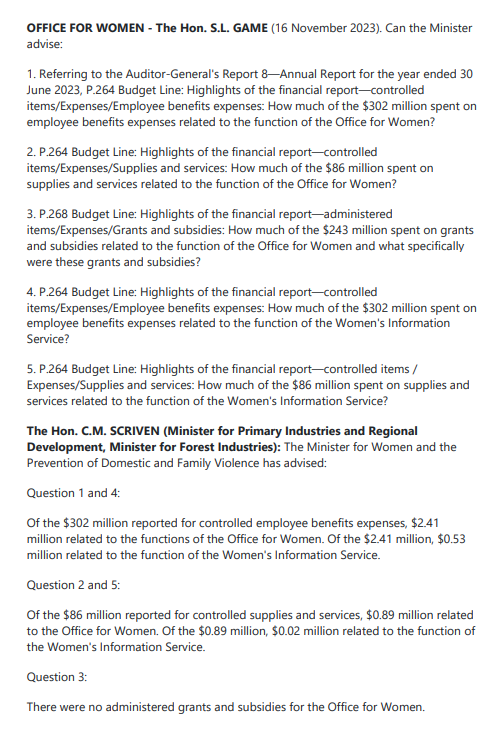
OK, well there is no mention there of the agency being restricted to only dealing with the sexual assault of women by men. Given, however, that it’s an offshoot of the ‘Commonwealth Office for Women’, I think it would be a safe bet that that is in fact the case. Of course if there was a corresponding ‘Office for Men’, then I guess that they would deal with male victims and female perpetrators. But there isn’t, because … men can deal with it (?)
With regards to their budget, all I’ve found at the moment is this somewhat dated page for the Government’ entire ‘Womens Safety Agenda‘, which mentions a total budget of $75.7 million over four years. The 2014/15 budget shows an allocation of $3.5 million for the Office of Women this year (refer page 31), but there may well be further allocations under the Social Services budget (and elsewhere?). On 23 June 2014 I sent an email to Treasury seeking this information:
“I am aware that a womens budget statement is regularly prepared to identify expenditure that is expressly designed to support Australian women. I would like to know if there is a similar statement identifying expenditure designed to support men.
Alternatively, and assuming there is not … is there any source that you can either provide me with – or point me towards – that enables a side-by-side comparison of expenditure for men and women? I look forward to receiving your advice on this matter. Thank you”
… but no reply since. Hmm.
Postscript: Sarah Game MLC has provided the following information regarding the Office for Women in a Twitter discussion thread (February 2024)
Meanwhile over in the USA Barack Obama introduced one (1) federal program to assist men and boys (as against the dozens that assist women and girls), only to have the feminist backlash begin immediately (and see related reddit discussion here). Somehow, sadly, I can’t see Malcolm Turnbull stepping into the breech with anything similar here in Australia. Ooh, please don’t call me a misogynist, please, please! (See this blog post re: lack of political support for men/boys)
See the article at http://www.canberratimes.com.au/act-news/women-are-the-biggest-budget-losers-20140523-zrl4n.html (22 May 2014) It seems quite extraordinary to me that the journalist who wrote this piece felt justified in claiming that “women are the biggest losers” without providing any information whatsoever about what men received/lost in the budget. It’s moments like these I feel like a member of the forgotten gender!
Rape & Domestic Violence Services Australia Senior staff and Board members are all women. In the year ending 30 June 2015 the organisation was the recipient of $8,194,146 in government grant funding, out of a total annual income of $8,795,650. Their main expense was ‘Salaries and On-costs’ at $7,502,877 (Source)
The latest annual report and financial statement provided in the ANROWS web site as of July 2022 is for the financial year 2020-21. ANROWS receives substantial government funding support and in 2020/21 “grants income” was listed as being $6,628,189. In 2019/20 it amounted to $10,410,025, and the year earlier it received $4,995,793.
Now I wonder how much the federal government budgeted for researching men’s issues in recent years? Absolutely nothing? But I shouldn’t ask naughty questions like that – it’s probably why ANROWS blocked me on social media.
The Centre is listed in the ACNC register here. That’s just as well as there does not appear to be any financial details provided in their web site, and only vague information about who is running the organisation – and how. The Centre employs 12 f/t employees, 20 p/t employees, and three casuals.
The Centre is wholly supported by government funding, with no donations or bequests received in 2014/15. The consolidated income statement shows receipts of around $2.8 million per annum in goverment grants (refer page 5). The main costs for the Centre are “salaries and on costs” ($1.9 million per annum), “office and centre expenses” ($407,167), rent ($227,841), and superannuation ($174,128).
An article from May 2016 citing disparaging comments about male victims of DV made by Centre director Amy Compton-Keen can be accessed here (NB: Reader reaction to that article was illuminating).
Y-Gap/Polished man campaign (level of government support currently unknown). Y-Gap’s ACNC register entry is here. Related Reddit mensrights discussion thread here.
Queensland Centre for Domestic and Family Violence Research based at CQ University, Mackay Campus. All female staff? tick Only consult with female-focussed groups with just a token male for appearance sake? tick Statistics within web site ignores male victimisation and resources for men assume they are perpetrators of violence? tick (see ‘Working with Men’).
“The Queensland Centre for Domestic and Family Violence Research receives defined term funding from the Queensland Department of Communities, Child Safety and Disability Services to undertake research and develop educational resources pertaining to domestic and family violence in Queensland. In addition, CDFVR is supported by CQUniversity and receives grants from a range of other sources to conduct research and professional development activities.”
Queensland University of Technology, Crime and Justice Research Centre Perform research and teach in subject areas including sexual assault and domestic violence. They appear to have a strong pro-feminist bias and from what I have read of their work thus far, they routinely follow and promote the men perpetrators/women victims model. (More details here)
The 2013 Annual Report here tells us that DVV’s total income in 2013 was $677,211 of which $609,361 arrived in the form of grants. Some of their major expenses included wages $489,783, super contributions $42,618, media awards $35,251, provision for holiday and long service leave $32,789, consultants $10,675, board fees $4,500 and staff training/welfare/amenities $3,261 (these items totalling $618,877)
Canberra Men’s Centre Outwardly compassionate about men’s welfare but it’s been suggested that CMC are a feminist ‘Trojan horse’ that dances to the men bad/woman victim tune. Their annual report for the year ending 30 June 2013 (the most recent in their web site as of March 2015) informs us that they received around $2 million from the ACT Dept. of Disability, Housing and Community Services in both 2011/12 and 2012/13. Their main expenses were lease payments ($340,118 in 2012/13) and salaries ($277,799 in 2012/13).
This Victorian organisation first came to my attention when I heard about a function they were planning for 6 May 2015 at which they will be lighting candles for women and children. On 27 April 2015 I submitted a cordial post to their Facebook page just querying why men killed through domestic violence would not be similarly remembered. Well, that post was deleted faster than you can say ‘feminist censorship’.
One hundred per cent female directors and staff (Source, see p9)
Total income in both 2012/13 and 2013/14 exceeded $3 million – nature of source not disclosed. Salary costs and director remuneration not disclosed (p10)
Fast forward to 28 January 2020 and Safe Steps issued this tweet:
“Women, children and young people are not the only ones affected by #familyviolence. Often, women need to leave but are reluctant to leave their beloved pet behind. We assist where possible to enable women and their children to leave safely with their pets.”
That’s right, no men in the families that this group deals with. Funny thing that.
In a segment on the ‘Sunrise’ morning TV show there appeared a video where actors simulated a display of partner harassment/violence in a public space. In the first scenario the man was the aggressor, and in the second scenario they reversed the roles. The differing reaction by members of the public was profound. The same clip has been circulating on the internet for some time now and has been the subject of much discussion in fora such as Reddit Mens Rights (see link below).
I was interested to see how the topic was dealt with on Sunrise for a couple of reasons. Firstly in promotional clips they seem to suggest that the story was about whether members of the public should intervene in instances of partner violence – rather than about the different reaction to having a male as aggressor versus female as aggressor.
Secondly, I was interested because one of those presenting the story was Andrew O’Keefe who is heavily involved in the ‘White Ribbon Campaign’ in Australia. The issue here is that the ‘White Ribbon Campaign’ is complicit in injecting into the public’s consciousness the notion that ‘domestic violence = men’s violence towards women’. In so doing the ‘Campaign’ and other domestic violence advocacy groups like it, divert attention from the other facets of domestic violence (i.e. M+M, F+F, and female on male violence).
It was indeed ironic then that Andrew tut-tutted the contrasting public reaction to female on male violence shown in the video, given that could be viewed as an outcome of the message broadcast by the White Ribbon Campaign and many pro-feminist organisations like it.
The unfortunate fact is that the average member of the public simply does not now recognise a woman’s aggression towards a male as being domestic violence, or that women’s aggression generally is of any particular social significance.
Youtube has apparently removed at least one video showing women abusing men (after it hit 6,000,000 views), but has left online videos showing men abusing women – details in this reddit discussion thread (30 October 2014)
In this hidden camera experiment a women is seen spiking her date’s drink – see how bystanders react. And yes, drink-spiking by women occurs quite often in real life – here is just the latest incident to appear in the media.
In this hidden camera experiment first a woman, and then a man, take money from a sleeping homeless guy. See the differing reaction by members of the public.
Another hidden camera experiment – Many people come to the aid of a women being abused, but yet again no-one comes to the aid of a male being subjected to abuse by a woman
This discussion thread and linked video isn’t about partner violence, but it does show how many members of the public will paint a man as the aggressor even when a woman initiates violence and continues despite efforts to reason with her.
This paper contains many links to further sources proving examples of male victims of domestic abuse not being taken seriously.
Also not about partner violence but still relevant – this video shows a female student assaulting a male student while a female teacher watches on but fails to control the situation.
Lone women drivers are top priority, says AA after tweet backlash (22 January 2022) This article has nothing to do with partner violence but is included here to illustrate the pervasive gender bias in the media. “We are more at risk physically than men in that situation. It’s just a fact, I’m afraid.” No, it’s not a fact at all.
Another clip seen on Twitter. As usual when girl attacks boy, no-one intervenes until he defends himself … then both males and females aggressively seek to stop & punish the male (2 September 2019)
Bystanders often don’t intervene in sexual harassment – but should they? (21 February 2017) Although artfully camouflaged, the gender bias runs deep in this article. It ignores violence against men, ignores violence by women, and suggests that women more likely to intervene to stop violence.
It’s not clear whether this incident at a US school was partner violence or not, but I have included it here as the media coverage and school commentary certainly display a gender-based double standard (18 February 2016)
Anti-bullying video carried empowering message (29 October 2015) But no mention of the corresponding reaction when a boy was bullied. Why not? Well perhaps because it was produced by the same guy who did the infamous street harassment of a woman in New York video.
An article about gynocentrism: This paper concerns the mindset that underpins the widespread failure to recognise men as being worthy of assistance or positive intervention in situations like domestic violence. This concept is further explored here.
Elsewhere in this blog you might be interested in reading:
Yet another case of two steps forward and one step back. In two earlier posts in this blog I described how members of the ‘Sunrise’ TV show purposefully stood their ground against strident feminist criticism. I had hoped that they would keep the positive momentum going with some segments about the excesses and mistruths of the contemporary feminist movement. Unfortunately that was not to be the case. Well, at least not yet. (Postscript: Pleased to see ‘Sunrise’ step up with this interview with MRA Paul Elam on 5 July 2014 … kudos to ‘Sunrise’)
I just watched a segment on ‘Sunrise‘ – an interview involving Michael Kaufman of the ‘White Ribbon Campaign‘ and Sunrise’s resident ‘White Knight‘, Andrew O’Keefe . The segment came across as something of an attempt by ‘Sunrise’ to win back some street-cred with pro-feminist viewers. It’s sad that they feel the need to curry favour with a movement represented by this, this and this.
The ‘White Ribbon Campaign‘ is a pro-feminist organisation whose goal is to stop violence by men towards women. They ignore violence by women, and for the most part they ignore violence by men towards other men. They do acknowledge problems that disproportionately affect men like suicide and homelessness, but claim that these are a reflection of the pressures of gender stereotypes imposed on boys and men (i.e. be a man!). The solution, they say, is for men to be comfortable showing what are seen as feminine attributes – and then they would not have to hurt women. The ‘White Ribbon’ crowd thus conveniently choose to ignore more potent forces such as the increasingly toxic environment in schools and universities for male students, the pervasive anti-male bias in the media, etc etc.
By all means please do address the problem of violence – violence by people of all genders. And by all means address the imposition of negative gender stereotypes – again, by people of all genders. But by focussing entirely on violence by men towards women, the White Ribbon Campaign reinforces the prevailing stereotype of men as brutes and women as victims. That being the case, they are as much part of the problem as they are part of the solution.
One of the outcomes of this telescopic view of ‘domestic violence = mens violence towards women’ is the trivialising of the other dimensions of intimate partner violence (i.e. womens violence towards men, male on male violence, and female on female violence). This bias is a pervasive influence across society, and is discussed and demonstrated in another blog post which includes links to videos showing public reaction to male and female actors playing out different scenarios of partner violence.
The concerns of others regarding the White Ribbon Campaign can be ascertained by googling on the words ‘White Ribbon Campaign criticism’ (some examples here, here, here, here, here and here).
Upon entering the search term ‘feminist good manners’ into google one day, one of the first papers to crop up was one entitled “No chivalry, thanks”.
The author of that article sought to differentiate between the notion of ‘good manners/politeness’ on the one hand and ‘chivalry’ on the other. Her position was that good manners are mostly OK, whilst ‘chivalry’ is bad. I agree with her that chivalry can be a negative factor … but not for the reason she states.
Let’s detour for a moment to visit www.thefreedictionary.com, where upon entering the term “good manners” we bring up the following related words:
courtesy
personal manner, manner – a way of acting or behaving
niceness, politeness – a courteous manner that respects accepted social usage
urbanity – polished courtesy; elegance of manner
graciousness – excellence of manners or social conduct
chivalry, politesse, gallantry – courtesy towards women
respectfulness, deference, respect – courteous regard for people’s feelings; “in deference to your wishes”; “out of respect for his privacy”
civility – formal or perfunctory politeness
The definition of the term ‘chivalry’, on the other hand, includes “The qualities idealized by knighthood, such as bravery, courtesy, honor, and gallantry toward women”, and “kindness and courteousness especially towards women or the weak”.
Back now to the ‘No chivalry, thanks‘ article where the author takes aim at two criticisms of feminism, which she describes as being:
The “cake and eat it too” complaint: “This anti-feminist argument says that women want to be independent and strong when it’s convenient for them, but they don’t want to lose the option for men to buy them dinner, open doors, and all around make them feel special. We want all the rights afforded to men, but that we also want to be treated better than men. Feminists want special, not equal, treatment, or in other words, they want their cake and to eat it too”, and
The “feminists hate manners!” complaint: “Other anti-feminists have chosen to smack-talk feminism by claiming that any stance which truly speaks out against chivlary (sic) is actually an affront to good manners.”
The author indicates that she’d “like to dismantle these complaints”, but in fact her views only serve to reinforce the validity of those complaints whilst undermining the feminist perspective generally. Her comments include:
The core of my disdain for chivalry is that it’s rooted in a gendered premise. Its very notion is that women need special assistance and wooing, which I flat out disagree with. Given this, I can say fully that I do not want or expect chivalry. In that way, the “cake and eat it too” complaint is nonsense to me. I do not want any person to look at me and treat me differently based off of (sic) my gender, even if that treatment is favourable.
(Mod: My emphasis added. LOL … I think we could readily find a plethora of exceptions to that with respect to feminist goals and achievements generally!)
“The same goes for stereotypes of all sorts–just because something is “nice” (ie Asians are so smart!) doesn’t make it any less racist. So with chivalry, just because it’s “friendly,” doesn’t make it any less sexist.”
“All in all, I simply feel that chivalry and feminism are inherently incompatible. I would never expect to be treated both equally and special. That’s an oxymoron. In fact, I’m not entirely sure that there are women who actually are advocating for both. Yes, some women want chivalry, but I would suspect they do not typically identify as feminists. To me, it seems a to be a straw man situation, as is the claim that feminists are really attacking manners. Nevertheless, it is important for us to understand the arguments used against our viewpoints, no matter how trivial.”
So in short, many feminists abhor chivalry because they perceive it as a pattern of behaviour intended to subjugate and patronise women, and as a manifestation of what they term ‘benevolent sexism‘.
Ah, but it gets confusing. In yet another of their breathtaking displays of hypocrisy, feminists strongly rely upon and encourage chivalry to achieve their goals. Look at all the calls for men to mobilise against other men in stopping domestic abuse and rape. Consider the #HeForShe campaign and many other similar campaigns. In none of these examples do feminists call for, or support, corresponding campaign for women to support men or men’s rights.
In contrast, the core of my ambivalence in relation to chivalry is that:
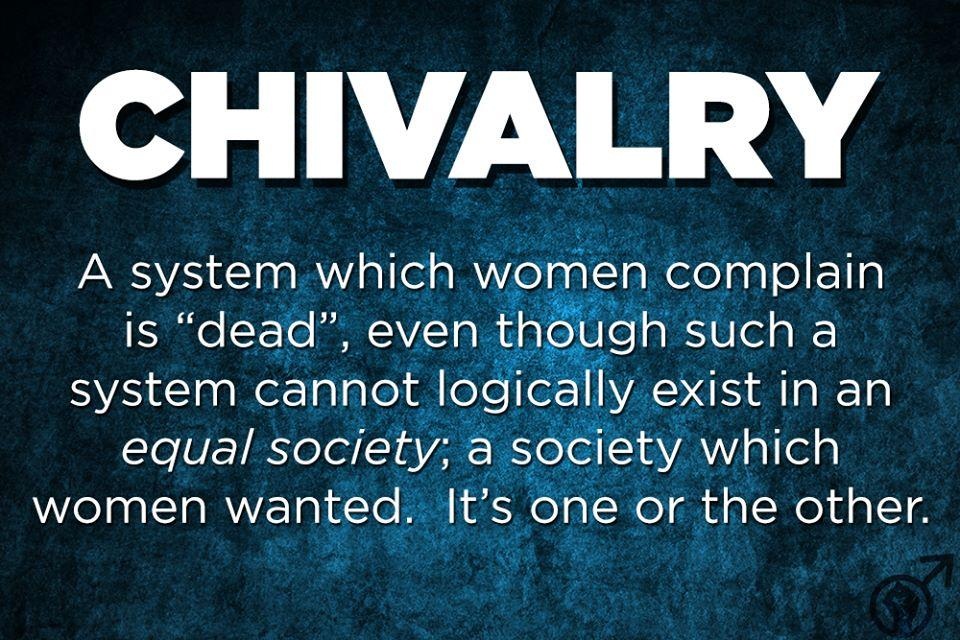
I believe in gender equality, and chivalry cannot and should not exist where there is true equality
Chivalry stands in the way of objective reasoning. Chivalry causes men to conflate the often unreasonable assertions and demands of feminists, with the welfare of women generally. I see this happening in almost every mainstream media article that permits readers to contribute comments, wherein men attack one another in the mistaken belief that any progress on achieving men’s rights is not just a set-back for women, but somehow akin to spitting in their face. If only such men would make an effort to familiarise themselves with not just the specific issue under consideration, but also both the nature of feminism and of men’s rights advocacy generally.
No, chivalry is not dead – but it’s about time it was (18 January 2022) I suspect that feminists have no idea of the extent to which the strength of their lobby relies on the continued existence of rampant and endemic chivalry (sans any chivalric expectations re: women’s conduct).
Here’s a recent newspaper item that features a prat-like whinge from a woman who would like men to leave her alone – after they perform whatever service she requires. Presumably men are meant to magically realise that she is a feminist and is not interested in social overtures. But on the other hand they are magically meant to know that although she is a feminist, she does appreciate men helping her by performing manual labour in relation to her overweight carry-on luggage. Perhaps if she held up a sign providing all this information, then men might be more co-operative/compliant. A subsequent online discussion can be found here.
And here is an article on the subject of holding doors open (plus readers comments) in a feminist blog.
Here is an article entitled ‘He also pays for his own dinners‘ that , in a patronising tone, sniffs at the notion of men displaying chivalry and their motivations for doing so. The best thing about the article was this readers comment:
“The most generous and helpful thing a man can do for a woman on an individual level is to hold her accountable – no letting her off because she’s female.
If traditional expressions of chivalry are important to women, let women do them. My girlfriend brought me flowers last night because I had a bad day. Fine. I’ll cook her dinner sometime.
Listen men, chivalry backfires. If you pay for the first date you’re losing a valuable opportunity to screen out the women who will see you as nothing but an ATM machine. And there’s no such thing as paying for a first date anyway. When you pay for a first date, you’re making it cheaper for her to go on another date with somebody else. You’re just subsidizing her search for the perfect man. Do yourself a favour and make women chip in for their quest for Mr. Right.
And men, while we’re on the subject of chivalry, remember you’re not a human punching bag. Make it very clear at the beginning of the relationship: if she ever hits you, screams at you, or calls you names, or tries to humiliate you in front of your friends, or destroys any of your property on purpose, or tries to use sex as a bargaining chip, that’s the end of the relationship, right then, right there. No questions asked. No looking back. Just walk away.
Don’t let your sense of chivalry turn you into a victim. You’re better than that.”
“Men were 1.5 times more likely than women to have concerns about transgender women using women’s bathrooms.”
Man stabbed in Southbank while coming to woman’s aid (25 February 2017) Australia. It appears the female being assaulted left the scene – did you she render any assistance to her rescuer? Don’t be that guy. Timely that this incident occurred the same week as this article in The Conversation.
Chivalry is not dead when it comes to morality (8 June 2016) We’re more likely to sacrifice a man than a woman when it comes to both saving the lives of others and in pursuing our self-interests, a team of psychology researchers has found.
Where are the stand up men? (29 May 2016) This special snowflake rant earned itself some rather forthright readers comments. Further commentary here.
“I just knew, they wouldn’t hit me … I was glad, right then, that I was a woman. I felt they wouldn’t hit me because of that, and that might mean I could slow things down a bit. I’m pretty sure if I was one of the guys I probably would have been hit as well.”
“The most despicable thing about the feminist movement is that it exploits male protective instincts and male virtues such as self-sacrifice for the “greater good” in order to expand female privilege. It doesn’t actually challenge these gender roles in any meaningful sense. But I agree it’s time to put an end to chivalry. The cat is out of the bag and it’s not going back in.” (Source)
And more recently, an article entitled ‘Equality is essential but so is chivalry‘ (Herald Sun 16 June 2014). This one very much in the all rights/no responsibility vein. It starts of bemoaning the fact that nobody stood up for a pregnant woman on a train and then goes on and on from there. The usual feminist theme of … there’s a problem, men caused it, and it’s mens responsibility to fix it … to our specifications. No readers comments were permitted – wonder why? Thank goodness that this MRA made the time to prepare a great rebuttal.
How to be a 21st Century ‘Gentleman’ (12 September 2014) I liked this reader’s comment: “Are there any classes teaching women some basic etiquette, too? Why are we just gripping on men when women need just as much a major make-over on behavior”. This theme is oft repeated – recent versions here and here, and with a rebuttal article here
Now for the background to this article you’ll need to take a look at this other blog post. In the article feminist author, Lauren Rosewarne, lashes out at those concerned about comments made by a federal parliamentarian. That politician told journalists that she wanted a male partner who was rich, well-endowed and who didn’t talk. Lauren haughtily admonishes us, “today the sane amongst us dismiss such notions as laughably repressive and egregiously controlling.”
Domestic violence (DV), also referred to as Intimate Partner Violence (IPV) or Family & Domestic Violence (FDV), is a shocking blight on the community. This is a scourge that inflicts substantial negative impacts on the lives of countless men, women and children. Whilst definitions have evolved and broadened, DV is loosely defined as “physical, sexual, or psychological harm by a current or former partner or spouse“.
It is important to acknowledge that DV encompasses man on man, women on women, man on woman, and woman on man violence (both cis- and transgender). Further, in many instances violence is perpetrated by both partners as shown in the accompanying diagram. There is also a strong nexus between the incidence of child abuse/neglect and subsequent perpetration of domestic violence by affected individuals upon reaching adulthood.
The Wikipedia entry for ‘Epidemiology of domestic violence‘ provides readers with useful background information on this topic. For those willing to read something a little meatier, I would recommend this paper by esteemed DV researcher Malcolm George. Malcolm walks the reader through the historical context to the current debate about gender differences in violent behaviour and the way that society responds to the issue.
Many of those working within the DV sector, particularly here in Australia, only choose to acknowledge one element of the problem – that part involving male perpetrators and female victims. It is no coincidence that most staff within these government agencies, universities and NGO’s are strongly influenced by, and biased towards, feminist ideology. The feminist position is unequivocal, and it is that domestic violence = men’s violence towards women. Here is an example of that mindset, and here are many others.
This routine failure by feminists to recognise and discuss male victims, female perpetrators and bi-directional violence is no accident or coincidence. It is a deliberate strategy to build their brand, and in so doing demonise the overwhelming majority of men who have never, and would never, hurt or abuse their partner.
As a result, and in order to support the feminist narrative, a great deal of ‘cherry-picking’ and misrepresentation occurs in relation to the statistics provided in DV literature. In addition, the design and implementation of survey instruments is too often tainted with bias. This issue, that of feminist efforts to hide or discredit legitimate research and/or generate false or misleading statistics, is explored in this further blog post.
You will note, as you scroll down this page, that there are a multitude of sources of DV statistics, particularly the United Kingdom and the United States. Here in Australia, much less research has been undertaken – particularly in relation to male victimisation. One of the more significant sources is the Australian Bureau of Statistics Personal Safety Survey 2012, which found that one in three victims of domestic abuse were male. The results of overseas studies generally found levels of male and female victimisation that were closer to parity, and in some instances even higher rates of victimisation for men that women.
Unfortunately many journalists display remarkable tunnel-vision when addressing the topic of IPV. Indeed some have suggested that the media is complicit in the same sort of systemic gender bias against males noted earlier amongst those working in the field of DV.
Turning to my first example, an article called ‘Til death do us part’ which appeared in The Australian newspaper. It consisted of five pages of heart-wrenching coverage of men’s violence towards female partners, but made no mention of any other form of domestic violence, i.e. m-m, f-f, or women on men. Similarly this February 2014 article from The Mail newspaper also neglected to mention that men can be victims too.
Fiona McCormack also ignores male victims and female abusers this item on Australian ABC TV … except in an aside where she implies that anyone who raises the issue of women abusers is only seeking to “excuse” the behaviour of male abusers. This is very much akin to the feminist predilection of labelling anyone who questions various aspects of sexual assault (e.g. false rape allegations) as being “rape apologists” “victim blamers” etc.
Now let’s turn to this article by Charlie Pickering (more about Charlie here). Charlie is concerned that more attention is paid to the issue of random one-punch attacks on men, than on the violence visited nightly on women people in their homes. He goes on to state:
“For a long time, the termdomestic violence has softened and normalised what is really going on. A more accurate term is ‘men’s violence against women’. Not ‘violence against women’, because that takes the responsibility for it away from those who need to be made responsible.”
This belief, that by acknowledging male victims and female perpetrators, we are somehow ignoring the validity and the pain of female victims is absurd, yet unfortunately commonplace in public discourse. The fact that there may be somewhat fewer male victims does not, nor should not, make domestic violence a gendered issue.
A precious few writers, like this one, suggest a more practical and unbiased approach to the issue:
“When it comes to the statistics about domestic abuse, it doesn’t matter to me how many men to how many women experience domestic violence. Domestic violence is a power issue more than a gender issue. Intimate Partner Violence affects men and women, and I really do not care in what proportion …
Within anti-domestic violence advocacy, there seems to be a trend to pit female victims against male victims and vice-versa. I do not know who is behind it, nor do I know if there is a “who” to blame. I do know that blame has no place in this fight against domestic abuse, especially when victim blames victim for any reason …
In a perfect society, men and women are equally protected under the law not because more laws were made to protect one sex but because in each mind and heart of all people, women and men are respected equally, and the individual contributions or crimes are our only measures of judgment. However, this ideal is as far away from our current reality as the idea that no person would seek power over another.”
Many others within the wider community have, however, embraced a biased and incomplete representation of DV, liberally salted with misinformation, at face value. Who could blame them, given that so many sources are bellowing out the same relentless message about male perpetrators and female victims, whilst studiously ignoring other elements of the issue.
Here in Australia, let’s look at this page within the web site of the Department of Social Services entitled ‘Women’s safety’, and the linked 28 page literature review prepared by ‘Urbis’ consultants at a cost of $220,000. One would have assumed, especially given the enormous cost, that the review would have encompassed all forms of abuse and perpetration. But, unfortunately, it did not.
In fact the review states that “Male perpetrators of domestic violence or sexual assault against men and female perpetrators of either offence against men have not been considered in this literature review. It is acknowledged that in practice the great majority of programs will be targeted towards men who commit domestic violence or sexual assault against women.”
Yes, that makes perfect sense … there are no programs for female offenders so let’s pretend they don’t exist. Such circular logic is (almost) unbelievable. And no, there is no corresponding ‘Mens Safety’ page within the DSS web site.
To be fair, the authors of some studies do admit that there are many female perpetrators and male victims, and that little research has been directed towards these groups. They also admit that there are probably many similarities between male and female perpetrators of IPV. They then invariably proceed, however, to offer a variety of justifications to continue their focus on the ‘domestic violence = Mens violence towards women’ model (example).
When misleading statistics are repeatedly exposed the feminist reaction is to move the goalposts by expanding the reach of the definition of domestic violence to encompass sexual violence, and less tangible forms of non-physical ‘violence’. This serves to both maximise the perceived magnitude of the problem, as well as support the anti-male narrative.
Naturally those areas where female perpetration is substantial, such as child abuse and elder abuse, are totally ‘out of bounds’. This theme is explored in this separate blog post. The same approach has been taken by feminists to prop up the notion of the existence of a ‘rape culture‘ in western societies.
Those of us concerned about men’s rights seek to have all aspects of domestic violence considered, as well as seeking remedies to specific issues such as:
the lack of resources to assist abused men and their children
laws and legal procedures that are based on the assumption that the male in the relationship is the abuser
negative and biased behaviour towards men who seek assistance, for example the screening of (only) male callers to abuse help-lines to determine if they are in fact perpetrators (example)
A selection of statistical sources that haven’t been doctored to support the feminist narrative
References examining assaults by women on their spouses or male partners: An Annotated Bibliography by Martin S. Fiebert. This bibliography examines 286 scholarly investigations: 221 empirical studies and 65 reviews and/or analyses, which demonstrate that women are as physically aggressive, or more aggressive, than men in their relationships with their spouses or male partners. Here is a link to an updated June 2013 version of Fiebert’s bibliography.
Partner Abuse, Volume 1, No. 1, 2010 The first edition of a new journal created to showcase academic research into domestic violence without gender bias
“Almost 24% of all relationships had some violence, and half (49.7%) of those were reciprocally violent. In non-reciprocally violent relationships, women were the perpetrators in more than 70% of the cases.”
More than 125,000 women homeless because of domestic violence (15 February 2016). The only figures for male victimisation that were mentioned – because they appeared to support the feminist perspective – were drawn from this media release from a government agency. What’s not mentioned though is that the relatively low numbers of men seeking assistance are indicative of factors other than simply lower rates of male victimisation, incl.:
the rampant genderbias of ‘help-lines’, advocacy groups and even government agencies
the (widely-known) lack of resources available to help male victims (with or without children, and
the much greater incidence of non-reporting of DV by men (compared to women)
This article and related reddit discussion concern a move in Victoria, Australia, to alter the law in relation of using self-defence where death of a partner occurs (article) (discussion)
General sources regarding Intimate Partner Violence
Prevalence of recorded family and domestic violence offending: A birth cohort study (17 September 2024) The Australian Institute of Criminology has a known pro-feminist bias, but one statistic was interesting “nearly 1 in 10 men (9.6%) born in NSW were found to have been processed against by police for a family or domestic violence offence by the age of 37.” Now we just need to account for the influence of distorting factors such as false allegations.
Domestic abuse: The latest lie (19 July 2019) UK. This article addresses, amongst other things, the feminist myth that most men who suffer domestic violence are the victims of other men.
“The proportion of male victims who told police about their domestic abuse increased from 10.4% in 2014-15 to 14.7% this year as charities said more men were shaking off the stigma of talking about their suffering.“
How Victoria’s family violence system fails some victims – by assuming they’re perpetrators (14 November 2017) I thought this paper was going to talk about men being misidentified as DV aggressors, but oh no, apparently it happens to women all the time <facepalm> and men exploit this to obtain intervention orders to protect themselves (& their children) from women who aren’t really hitting/abusing them.
Shocking domestic abuse statistics don’t show the real picture: it’s even worse (14 December 2016) UK. This is one of several articles written by feminists in response to the recent release of stats showing the large (and increasing) number of male victims. Essentially they say ‘it doesn’t matter how many men are victims, women have it worse and we should focus entirely on them’.
Stopping Fathers Committing Family Violence (13 December 2016) The Victorian Government (Australia) ignores female perpetrators of domestic violence – it’s something only dads do! Disgusting bias
This is one of countless examples of how feminist DV advocacy groups seek to minimise both women’s role in perpetrating abusive behaviours, and its degree of impact on male victims.
“The findings of an in-depth domestic violence study, which showed violent conduct almost evenly split between the genders, are potentially cause for concern, a senior police officer says.”
The gender of domestic violence (8 June 2016) NZ video concerning the difficulty experienced by researchers whose findings showed that women were equally likely to abuse.
For Nelson Women’s Refuge manager Katie O’Donnell, the solution to New Zealand’s domestic violence problem is more straightforward. “People say it’s a really complex issue. Well, it is a complex issue but also it isn’t – guys just have to stop doing it”
The surprisingly common reason John hits his partner (14 October 2015) Of course a male batterer is profiled, but watch the fur fly when someone suggests a contributing factor that doesn’t fit the feminist Duluth Model.
Tara Moss: ‘We can’t let trolls hijack the domestic violence conversation’ (5 March 2015) Australia. This is the feminist concept of a “conversation” – we talk & you shut-up. If you try to join our conversation then you are a troll. And, as is becoming increasingly common of late, no reader’s comments were permitted on this article.
Can domestic abusers be rehabilitated? (1 February 2015) Gynocentric/pro-feminist bias but worth reading in conjunction with the comments contributed by readers
Telstra introduces domestic violence leave (13 January 2015) Australia. Article implies only women are victims of domestic violence and leaves us guessing as to whether the company policy is sexist/discriminatory – or just the journalism
Why don’t we speak up when we see signs of domestic violence? (1 October 2014) This article in a pro-feminist web site provides a stereotypical feminist perspective on the subject. What was notable was that almost all the readers comments attacked the author’s obvious anti-male bias. This article forms the focus of this blog post.
In this article a feminist writer, Amanda Hess, attempts to rationalise why domestic violence by a female sports star should be addressed differently than in the case of a male sports star (22 September 2014) Most of the 600+ readers comments that followed disagreed and told her so in no uncertain terms.
‘Lollies at a childrens party and other myths: Violence, protection orders and fathers rights groups’ by Miranda Kaye and Julia Tomie (1998). Another detailed but flawed paper in support of the feminist position on DV. Its main line of attack is that available statistics don’t support claims made by men’s rights advocates. It conveniently ignores the fact that most Australian DV research is undertaken by feminists and biased towards finding ‘evidence’ to support a pre-determined conclusion. Thus the accuracy and impartiality of the research is the real issue, rather than the credibility of the whistle-blowers.
The paper also misinterprets and/or takes out of context, many of the comments it attributes to fathers groups in an attempt to portray them as irrational or unreasonable. Finally the authors attack specific statements put forward by fathers groups despite the same arguments having been used (at other times) by feminists in support of their own (feminist) perspective. The authors of this paper, for example, want to jump from one camp to the other (and back again) in relation to the issue of whether behaviour other than physical violence should be included in the definition of domestic violence.
We need to show it’s just not manly to hit out (9 July 2014) Nonsense article dripping with white knight bias … “The idea that the woman may be equally to blame, even if she is also violent and even the initiator of the violence, is simply not acceptable”
A reddit discussion thread about the anti-male bias evident in the web site of an American domestic violence centre’s web site. Unfortunately such bias (i.e. stating or implying that all men accessing the site are abusers and that all women are victims) is also common in domestic violence centres in Australia.