There’s been a lot happening on North American campuses with regards to the evolving debate regarding consent, sexual assault, and freedom to discuss gender issues. As a result I have incorporated related information into several pre-existing posts in this blog, including for example:
Earlier today I read a new article entitled ‘Diagnosed with Liberalism‘. It addresses the peculiar behaviour of social justice warriors (‘SJW’), with special mention being made of the infamous case of ‘The Mattress Girl‘.
Reading that article prompted me to create a new post just dealing with that case, and with some other similar incidents. All of which, it would seem, have either been proven to be false or are widely considered to be highly dubious. I think I am also right in saying that in each case legal action is being pursued by the male accused against the relevant university.
1. Emma Sulkowicz (aka ‘Mattress Girl or ‘Mattress Mule’) – Columbia University, New York
Columbia student: I didn’t rape her (3 February 2015) One of many articles about female university student, Emma Sulkowicz, who carried a mattress all around her campus after claiming she had been raped.
The young man accussed of rape, Paul Nungesser, later sued Columbia University and lost that case (see related Reddit discussion thread here). Further developments are anticipated.
The internet has provided a haven for those inclined to strike out at people in anonymity and usually without fear of repercussion.
The purpose of this blog post is not to propose solutions to this problem, but rather to take a step back and call for an objective, measured and truthful discussion of the relevant issues.
There’s no doubt that women are often targets of online abuse, although there does appear to be a tendency towards embellishment and exaggeration with regards to the nature and extent of such abuse. The author of this article, for example, would have us believe that life on the internet is unbearable for women due to the oppressive behaviour of male trolls.
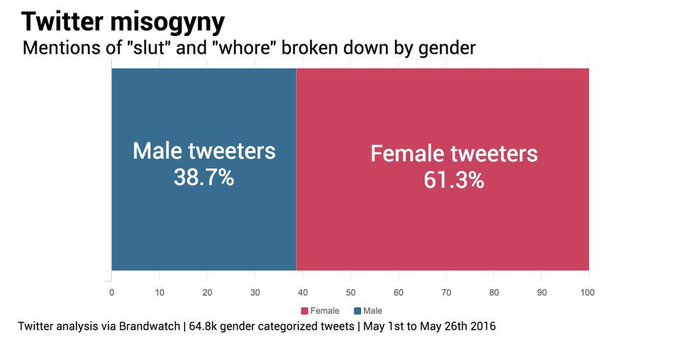
What is generally absent from articles on this subject is an honest admission that a considerable amount of online abuse is directed at men, and that a substantial proportion of those perpetrating abuse are women/girls. Have a look at the information provided in the chart below, extracted from a 2014 paper by PEW Research. (see 2017 updated here)
Why do so many commentators and ‘experts’ fail to acknowledge these significant points?
Surely not the desire to support the feminist narrative of women as the perpetual victims of an unyielding male patriarchy?
The findings of a survey by Norton painted a different picture. Unfortunately however the results were compromised by poor methodology, a common problem with pro-feminist research. In this instance the researchers failed to include questions about male victimisation via online abuse.
So why has this issue garnered a large and increasing amount of attention in recent years? Are people becoming nastier? Is that nastiness becoming more gendered in nature?
There are a number of significant factors that need to be considered here.
Further along the scale one encounters behaviour that does not involve actual threats, but is so persistent and pervasive as to be genuinely threatening in nature.
At the other end are interactions that are little more than assertive dissent in relation to a particular idea or opinion being put forward.
More and more we are witnessing the definition of terms such as online abuse and ‘trolls’ expanded to include behaviour and people who seem undeserving of these pejoratives. Also troubling is the fact that the same types of behaviour decried as abuse or trollish when used by conservative/non-feminists, are seen as acceptable or even noble when used by feminists/leftists/woke. This issue of finessing definitions to suit a narrative is discussed in another blog post.
Why do people, particularly in this case feminists/woke, so readily misinterpret online communication in this way? I’d suggest that in part it is a deliberate strategy, whilst at other times simply a misunderstanding.
It has been suggested that feminists interpret relatively innocuous messages as hurtful because online communication is a forum where women are truly treated as equals. Men speak to women online as men would speak to other men in real life. It is said that many women are unaccustomed to this gloves-off banter, and interpret it as vindictive rather than as heartfelt and direct. I believe that there is an element of truth to this, although again it is but one of several factors in the mix.
One other reason for exaggerated claims of online hate and abuse is that it provides an excuse to instigate progressively harsher and more intrusive forms of censorship. Censorship is a recurring theme in real-world feminist tactics, and one which I address in another blog post.
Turning again to feminist research, let’s examine a project called the University of NSW ‘Cyberhate Project‘, which is being supported by the Australian Research Council (‘ARC’) with AUD$372,095 of public funding.
I was more than a little concerned to learn that this research project will only survey women. That looks an awful lot like a research project designed with a particular conclusion already firmly in mind. I immediately took this up with the ARC, who dismissed my complaint regarding this obvious ideological bias in the following manner:
“Proposals for ARC funding undergo a rigorous peer review process involving experts in their fields who assess the quality of projects and the capabilities and achievements of applicants. The planning and management of ARC-funded research projects is a matter for individual researchers and institutions (in accordance with ARC funding agreements).”
I’m left wondering just how many of those peers were likely either fellow feminists or sympathisers. Hands up who else thinks that this might not be the most effective vetting process in the case of a polarised issue such as this?
As is virtually de rigeur at The Conversation, readers comments that were deemed unsupportive of the feminist author’s position were quickly excised. In this case that amounted to at least one in four comments. Of the many I read before they disappeared, none of these were in the least bit threatening or abusive.
I posted one of those comments removed by the moderator. It simply stated:
“Emma, Is it not a fact that men are subject to more online harassment than are women? Is it not a fact that many of the perpetrators of online abuse are women? … Might it therefore not be more accurate to say that the real online divide is one between trolls and the rest of us, rather than between men and women as your paper implies?”
Given that men are subject to a considerable amount of online harassment, they should not be excluded from research on this subject. The fact that the finger of blame is often pointed at men alone, when we know full well that many women perpetrate online harassment/abuse, does tend to stick in this writer’s craw. One might consider at this point the example of Australian radfem Clementine Ford.
As with domestic violence and various other topics, feminists persist in labelling issues as “gendered” when they are not, in order to create support for their global war-against-women conspiracy.
What now follows is a collection of links to articles that provide various perspectives on the issue of online harassment/abuse:
The internet has provided a haven for those inclined to strike out at people in anonymity and usually without fear of repercussion.
The purpose of this blog post is not to propose solutions to this problem, but rather to take a step back and call for an objective, measured and truthful discussion of the relevant issues.
There’s no doubt that women are often targets of online abuse, although there does appear to be a tendency towards embellishment and exaggeration with regards to the nature and extent of such abuse. The author of this article, for example, would have us believe that life on the internet is unbearable for women due to the oppressive behaviour of male trolls.
What is generally absent from articles on this subject is an honest admission that a considerable amount of online abuse is directed at men, and that a substantial proportion of those perpetrating abuse are women/girls. Have a look at the information provided in the chart below, extracted from a 2014 paper by PEW Research. (see 2017 updated here)
Why do so many commentators and ‘experts’ fail to acknowledge these significant points?
Surely not the desire to support the feminist narrative of women as the perpetual victims of an unyielding male patriarchy?
The findings of a survey by Norton painted a different picture. Unfortunately however the results were compromised by poor methodology, a common problem with pro-feminist research. In this instance the researchers failed to include questions about male victimisation via online abuse.
So why has this issue garnered a large and increasing amount of attention in recent years? Are people becoming nastier? Is that nastiness becoming more gendered in nature?
There are a number of significant factors that need to be considered here.
Further along the scale one encounters behaviour that does not involve actual threats, but is so persistent and pervasive as to be genuinely threatening in nature.
At the other end are interactions that are little more than assertive dissent in relation to a particular idea or opinion being put forward.
More and more we are witnessing the definition of terms such as online abuse and ‘trolls’ expanded to include behaviour and people who seem undeserving of these pejoratives. Also troubling is the fact that the same types of behaviour decried as abuse or trollish when used by conservative/non-feminists, are seen as acceptable or even noble when used by feminists/leftists/woke. This issue of finessing definitions to suit a narrative is discussed in another blog post.
Why do people, particularly in this case feminists/woke, so readily misinterpret online communication in this way? I’d suggest that in part it is a deliberate strategy, whilst at other times simply a misunderstanding.
It has been suggested that feminists interpret relatively innocuous messages as hurtful because online communication is a forum where women are truly treated as equals. Men speak to women online as men would speak to other men in real life. It is said that many women are unaccustomed to this gloves-off banter, and interpret it as vindictive rather than as heartfelt and direct. I believe that there is an element of truth to this, although again it is but one of several factors in the mix.
One other reason for exaggerated claims of online hate and abuse is that it provides an excuse to instigate progressively harsher and more intrusive forms of censorship. Censorship is a recurring theme in real-world feminist tactics, and one which I address in another blog post.
Turning again to feminist research, let’s examine a project called the University of NSW ‘Cyberhate Project‘, which is being supported by the Australian Research Council (‘ARC’) with AUD$372,095 of public funding.
I was more than a little concerned to learn that this research project will only survey women. That looks an awful lot like a research project designed with a particular conclusion already firmly in mind. I immediately took this up with the ARC, who dismissed my complaint regarding this obvious ideological bias in the following manner:
“Proposals for ARC funding undergo a rigorous peer review process involving experts in their fields who assess the quality of projects and the capabilities and achievements of applicants. The planning and management of ARC-funded research projects is a matter for individual researchers and institutions (in accordance with ARC funding agreements).”
I’m left wondering just how many of those peers were likely either fellow feminists or sympathisers. Hands up who else thinks that this might not be the most effective vetting process in the case of a polarised issue such as this?
As is virtually de rigeur at The Conversation, readers comments that were deemed unsupportive of the feminist author’s position were quickly excised. In this case that amounted to at least one in four comments. Of the many I read before they disappeared, none of these were in the least bit threatening or abusive.
I posted one of those comments removed by the moderator. It simply stated:
“Emma, Is it not a fact that men are subject to more online harassment than are women? Is it not a fact that many of the perpetrators of online abuse are women? … Might it therefore not be more accurate to say that the real online divide is one between trolls and the rest of us, rather than between men and women as your paper implies?”
Given that men are subject to a considerable amount of online harassment, they should not be excluded from research on this subject. The fact that the finger of blame is often pointed at men alone, when we know full well that many women perpetrate online harassment/abuse, does tend to stick in this writer’s craw. One might consider at this point the example of Australian radfem Clementine Ford.
As with domestic violence and various other topics, feminists persist in labelling issues as “gendered” when they are not, in order to create support for their global war-against-women conspiracy.
What now follows is a collection of links to articles that provide various perspectives on the issue of online harassment/abuse:
The internet has provided a haven for those inclined to strike out at people in anonymity and usually without fear of repercussion.
The purpose of this blog post is not to propose solutions to this problem, but rather to take a step back and call for an objective, measured and truthful discussion of the relevant issues.
There’s no doubt that women are often targets of online abuse, although there does appear to be a tendency towards embellishment and exaggeration with regards to the nature and extent of such abuse. The author of this article, for example, would have us believe that life on the internet is unbearable for women due to the oppressive behaviour of male trolls.
What is generally absent from articles on this subject is an honest admission that a considerable amount of online abuse is directed at men, and that a substantial proportion of those perpetrating abuse are women/girls. Have a look at the information provided in the chart below, extracted from a 2014 paper by PEW Research. (see 2017 updated here)
Why do so many commentators and ‘experts’ fail to acknowledge these significant points?
Surely not the desire to support the feminist narrative of women as the perpetual victims of an unyielding male patriarchy?
The findings of a survey by Norton painted a different picture. Unfortunately however the results were compromised by poor methodology, a common problem with pro-feminist research. In this instance the researchers failed to include questions about male victimisation via online abuse.
So why has this issue garnered a large and increasing amount of attention in recent years? Are people becoming nastier? Is that nastiness becoming more gendered in nature?
There are a number of significant factors that need to be considered here.
Further along the scale one encounters behaviour that does not involve actual threats, but is so persistent and pervasive as to be genuinely threatening in nature.
At the other end are interactions that are little more than assertive dissent in relation to a particular idea or opinion being put forward.
More and more we are witnessing the definition of terms such as online abuse and ‘trolls’ expanded to include behaviour and people who seem undeserving of these pejoratives. Also troubling is the fact that the same types of behaviour decried as abuse or trollish when used by conservative/non-feminists, are seen as acceptable or even noble when used by feminists/leftists/woke. This issue of finessing definitions to suit a narrative is discussed in another blog post.
Why do people, particularly in this case feminists/woke, so readily misinterpret online communication in this way? I’d suggest that in part it is a deliberate strategy, whilst at other times simply a misunderstanding.
It has been suggested that feminists interpret relatively innocuous messages as hurtful because online communication is a forum where women are truly treated as equals. Men speak to women online as men would speak to other men in real life. It is said that many women are unaccustomed to this gloves-off banter, and interpret it as vindictive rather than as heartfelt and direct. I believe that there is an element of truth to this, although again it is but one of several factors in the mix.
One other reason for exaggerated claims of online hate and abuse is that it provides an excuse to instigate progressively harsher and more intrusive forms of censorship. Censorship is a recurring theme in real-world feminist tactics, and one which I address in another blog post.
Turning again to feminist research, let’s examine a project called the University of NSW ‘Cyberhate Project‘, which is being supported by the Australian Research Council (‘ARC’) with AUD$372,095 of public funding.
I was more than a little concerned to learn that this research project will only survey women. That looks an awful lot like a research project designed with a particular conclusion already firmly in mind. I immediately took this up with the ARC, who dismissed my complaint regarding this obvious ideological bias in the following manner:
“Proposals for ARC funding undergo a rigorous peer review process involving experts in their fields who assess the quality of projects and the capabilities and achievements of applicants. The planning and management of ARC-funded research projects is a matter for individual researchers and institutions (in accordance with ARC funding agreements).”
I’m left wondering just how many of those peers were likely either fellow feminists or sympathisers. Hands up who else thinks that this might not be the most effective vetting process in the case of a polarised issue such as this?
As is virtually de rigeur at The Conversation, readers comments that were deemed unsupportive of the feminist author’s position were quickly excised. In this case that amounted to at least one in four comments. Of the many I read before they disappeared, none of these were in the least bit threatening or abusive.
I posted one of those comments removed by the moderator. It simply stated:
“Emma, Is it not a fact that men are subject to more online harassment than are women? Is it not a fact that many of the perpetrators of online abuse are women? … Might it therefore not be more accurate to say that the real online divide is one between trolls and the rest of us, rather than between men and women as your paper implies?”
Given that men are subject to a considerable amount of online harassment, they should not be excluded from research on this subject. The fact that the finger of blame is often pointed at men alone, when we know full well that many women perpetrate online harassment/abuse, does tend to stick in this writer’s craw. One might consider at this point the example of Australian radfem Clementine Ford.
As with domestic violence and various other topics, feminists persist in labelling issues as “gendered” when they are not, in order to create support for their global war-against-women conspiracy.
What now follows is a collection of links to articles that provide various perspectives on the issue of online harassment/abuse:
Constructing the cyber-troll: Psychopathy, sadism, and empathy (December 2017 edition of ‘Personality and Individual Differences’) This study asserts that most trolls are male, but I suspect that the findings may have been compromised by one or more of the following factors:
* small sample size with 2/3 of respondents being women, and who were possibly self-selected
* incorrect assumptions (by survey respondents) regarding the gender of trolls
* differing and possibly gender-based judgments as to what constitutes trolling
The media dangerously misuses the word ‘trolling’ (3 July 2017) This article conveniently neglects to mention that this ‘problem’ has been primarily brought about through misusing the term ‘trolling’ to describe reasonable dissent against the prevailing leftist/feminist narrative.
Australia tackles revenge porn with new eSafety Commission (23 November 2016) AFAIK this agency’s brief was initially gender-neutral but it quickly assumed a pro-feminist stance, making its focus the online harassment of women and girls.
The top 20 Australian politicians, with respect to receiving online abuse, are all right wing males (1 July 2016) Australia. Typical feminist take on this issue, for e.g. mis-labels harassment as “online violence” and “sexual violence”, does not provide corresponding statistics for men/boys harassed online, nor divulge that much abuse is perpetrated by women/girls. The implication is, as always, men=bad & women=men’s hapless victims.
Eight things not to say to someone facing online abuse (20 April 2016) See point 4 in this article by misandrist Laura Bates: “Silencing is the end goal of the majority of abuse”. Erm, so all those feminists systematically lodging bogus reports to have people’s social media accounts closed, they would be online abusers then?
Girl gets Instagram revenge on cheating ex (25 March 2016) Reverse the genders in this story and “one poor lass” becomes ‘online harassment by abusive former boyfriend’
“A new survey by the Internet security company Norton (for which I’m an ambassador) shows that nearly half of all Australian women (47 per cent) experience online harassment. That rises to a staggering 76 per cent for women under 30. Unsurprisingly, 70 per cent of women believe online harassment is a significant problem and 60 per cent believe it has got worse in the past year.” And nowhere in this article will you find corresponding statistics in relation to men – the survey didn’t include questions about male victimisation. I wonder why not?
Online harassment of women at risk of becoming ‘established norm’, study finds (8 March 2016) Australia. Guardian article drawing on the Norton survey which air-brushed out male victimisation/female perpetration, and thus robbed the findings of social context. No doubt a good thing from a feminist perspective if that would have diminished the victim status on which their ideology is based.
Were examples of specific rape threats made public? No. How about a formal complaint to police? Apparently not. “Oh look, another politician ginning up fake threats to boost her feminist cred. Never seen that before….” (Source)
Emma Watson: Trolls threatened to publish nude photos of me (8 March 2015) This article quotes Emma as saying most of those posting threats were other women, yet this article (in pro-feminist news.com.au) claims that men were to blame. As mentioned earlier, this represents an all-too typical bending of the facts to suit the narrative.
#womenagainstfeminism receive hundreds of threats (Scroll down their Facebook timeline to 16 August 2014 for details) Somehow I don’t think it would be men issuing most of the threats … but surely not women?
This June 2014 reddit discussion thread, and linked newspaper article, is about female Twitter trolls
Constructing the cyber-troll: Psychopathy, sadism, and empathy (December 2017 edition of ‘Personality and Individual Differences’) This study asserts that most trolls are male, but I suspect that the findings may have been compromised by one or more of the following factors:
* small sample size with 2/3 of respondents being women, and who were possibly self-selected
* incorrect assumptions (by survey respondents) regarding the gender of trolls
* differing and possibly gender-based judgments as to what constitutes trolling
The media dangerously misuses the word ‘trolling’ (3 July 2017) This article conveniently neglects to mention that this ‘problem’ has been primarily brought about through misusing the term ‘trolling’ to describe reasonable dissent against the prevailing leftist/feminist narrative.
Australia tackles revenge porn with new eSafety Commission (23 November 2016) AFAIK this agency’s brief was initially gender-neutral but it quickly assumed a pro-feminist stance, making its focus the online harassment of women and girls.
The top 20 Australian politicians, with respect to receiving online abuse, are all right wing males (1 July 2016) Australia. Typical feminist take on this issue, for e.g. mis-labels harassment as “online violence” and “sexual violence”, does not provide corresponding statistics for men/boys harassed online, nor divulge that much abuse is perpetrated by women/girls. The implication is, as always, men=bad & women=men’s hapless victims.
Eight things not to say to someone facing online abuse (20 April 2016) See point 4 in this article by misandrist Laura Bates: “Silencing is the end goal of the majority of abuse”. Erm, so all those feminists systematically lodging bogus reports to have people’s social media accounts closed, they would be online abusers then?
Girl gets Instagram revenge on cheating ex (25 March 2016) Reverse the genders in this story and “one poor lass” becomes ‘online harassment by abusive former boyfriend’
“A new survey by the Internet security company Norton (for which I’m an ambassador) shows that nearly half of all Australian women (47 per cent) experience online harassment. That rises to a staggering 76 per cent for women under 30. Unsurprisingly, 70 per cent of women believe online harassment is a significant problem and 60 per cent believe it has got worse in the past year.” And nowhere in this article will you find corresponding statistics in relation to men – the survey didn’t include questions about male victimisation. I wonder why not?
Online harassment of women at risk of becoming ‘established norm’, study finds (8 March 2016) Australia. Guardian article drawing on the Norton survey which air-brushed out male victimisation/female perpetration, and thus robbed the findings of social context. No doubt a good thing from a feminist perspective if that would have diminished the victim status on which their ideology is based.
Were examples of specific rape threats made public? No. How about a formal complaint to police? Apparently not. “Oh look, another politician ginning up fake threats to boost her feminist cred. Never seen that before….” (Source)
Emma Watson: Trolls threatened to publish nude photos of me (8 March 2015) This article quotes Emma as saying most of those posting threats were other women, yet this article (in pro-feminist news.com.au) claims that men were to blame. As mentioned earlier, this represents an all-too typical bending of the facts to suit the narrative.
#womenagainstfeminism receive hundreds of threats (Scroll down their Facebook timeline to 16 August 2014 for details) Somehow I don’t think it would be men issuing most of the threats … but surely not women?
This June 2014 reddit discussion thread, and linked newspaper article, is about female Twitter trolls
Constructing the cyber-troll: Psychopathy, sadism, and empathy (December 2017 edition of ‘Personality and Individual Differences’) This study asserts that most trolls are male, but I suspect that the findings may have been compromised by one or more of the following factors:
* small sample size with 2/3 of respondents being women, and who were possibly self-selected
* incorrect assumptions (by survey respondents) regarding the gender of trolls
* differing and possibly gender-based judgments as to what constitutes trolling
The media dangerously misuses the word ‘trolling’ (3 July 2017) This article conveniently neglects to mention that this ‘problem’ has been primarily brought about through misusing the term ‘trolling’ to describe reasonable dissent against the prevailing leftist/feminist narrative.
Australia tackles revenge porn with new eSafety Commission (23 November 2016) AFAIK this agency’s brief was initially gender-neutral but it quickly assumed a pro-feminist stance, making its focus the online harassment of women and girls.
The top 20 Australian politicians, with respect to receiving online abuse, are all right wing males (1 July 2016) Australia. Typical feminist take on this issue, for e.g. mis-labels harassment as “online violence” and “sexual violence”, does not provide corresponding statistics for men/boys harassed online, nor divulge that much abuse is perpetrated by women/girls. The implication is, as always, men=bad & women=men’s hapless victims.
Eight things not to say to someone facing online abuse (20 April 2016) See point 4 in this article by misandrist Laura Bates: “Silencing is the end goal of the majority of abuse”. Erm, so all those feminists systematically lodging bogus reports to have people’s social media accounts closed, they would be online abusers then?
Girl gets Instagram revenge on cheating ex (25 March 2016) Reverse the genders in this story and “one poor lass” becomes ‘online harassment by abusive former boyfriend’
“A new survey by the Internet security company Norton (for which I’m an ambassador) shows that nearly half of all Australian women (47 per cent) experience online harassment. That rises to a staggering 76 per cent for women under 30. Unsurprisingly, 70 per cent of women believe online harassment is a significant problem and 60 per cent believe it has got worse in the past year.” And nowhere in this article will you find corresponding statistics in relation to men – the survey didn’t include questions about male victimisation. I wonder why not?
Online harassment of women at risk of becoming ‘established norm’, study finds (8 March 2016) Australia. Guardian article drawing on the Norton survey which air-brushed out male victimisation/female perpetration, and thus robbed the findings of social context. No doubt a good thing from a feminist perspective if that would have diminished the victim status on which their ideology is based.
Were examples of specific rape threats made public? No. How about a formal complaint to police? Apparently not. “Oh look, another politician ginning up fake threats to boost her feminist cred. Never seen that before….” (Source)
Emma Watson: Trolls threatened to publish nude photos of me (8 March 2015) This article quotes Emma as saying most of those posting threats were other women, yet this article (in pro-feminist news.com.au) claims that men were to blame. As mentioned earlier, this represents an all-too typical bending of the facts to suit the narrative.
#womenagainstfeminism receive hundreds of threats (Scroll down their Facebook timeline to 16 August 2014 for details) Somehow I don’t think it would be men issuing most of the threats … but surely not women?
This June 2014 reddit discussion thread, and linked newspaper article, is about female Twitter trolls
In another post in this blog I mention the fact that there are scarcely any individual politicians in Australia, let alone political parties, that are prepared to move out of lockstep with the feminist lobby.
Also in another blog post I briefly discuss the position of the major parties on feminism and men’s rights, in the context of the 2016 Australian federal election.
In this current blog post I thought it might be interesting to put this question to some of the smaller parties. First up we hear from Senator Bob Day of the Family First Party:
“Subject: Your party’s position on feminism vs mens issues
Good morning. I would be interested to learn about the position of family first concerning the influence of feminist ideology in Australia, and
particularly in the political sphere and public service. I would also be interested to learn if FF has a position in relation to one or more of the men’s issues as nominated and discussed in my blog at www.fighting4fair.com.
Thank you, and I look forward to hearing from you in due course”
Response received on 10 June 2015:
“Thank you for your email to Senator Day regarding Family First’s position on feminism. Feminism has brought about social change, improved treatment & representation of women and improved productivity. These gains are now considered commonplace factors in everyday Australian life. Our focus as a modern political party is on the question of family and how that basic foundational institution in society can be encouraged, supported and protected from harm and government excesses of power.
Family First supports the role of the family as the foundation for Australian society, and acknowledges that male and female are complimentary, each able to make valuable contributions to the community. We encourage you to visit Senator Day’s website: www.senatorbobday.com.au or Family First’s website www.familyfirst.org.au for further information.
Your blog www.fighting4fair.com discusses many different issues with a common theme being the role of male and female within the family sphere (domestic violence, legal custody battles, or matters pertaining to parenting in general). Regarding this matter, Family First supports the traditional family and whatever can be done to ensure that families with children stay together. The sad reality today is that many relationships fail, and then there are public policy questions about dealing with the breakdown. Thankfully, throughout the Australian community there are in the majority of cases accepted norms about how child access and support is resolved after separation.
A great many families resolve their post-breakdown arrangements without resort to lawyers, violence or alienation of a parent from their child or children. Often they do so to put the children first, and the parents’ disputes second. Regrettably, in some cases the breakdown is so acrimonious that violence and/or alienation of a parent occurs. Moves in recent times to exclude lawyers and prefer mediation at the first opportunity have been welcome shifts away from adversarial resolution of post-breakdown child support and access questions, towards an approach that focusses on what is agreed between the parents.
Family First supports a child having the involvement of a father and mother in their life. Studies show this is vital to their healthy development. However, it must be stressed that there are exemptions to this position. Modern society now has a myriad of social problems, from drug, alcohol and other substance abuse; to domestic violence; to child physical and/or sexual abuse. Mental health of children and/or parents is also a major factor in family breakdown. Children must be protected from situations that might expose them to harm. The court system is so overwhelmed with allegations of this behaviour that it is rare that it gets to the bottom of those allegations.
The handling of family breakdown is further complicated by yet another example of state and federal jurisdictional ambiguity. States and territories are responsible for laws concerning child protection and domestic violence, whereas federal law regulates child support and family law concerning post-breakdown child access and distribution of property. At times the two areas do not connect properly with one another, at times – for instance – seeing at-risk children ordered by a federal court to go to a parent who may place those children at risk of harm.
Senator Day appreciates that you have written to him about a current issue that concerns you. The Senator has been elected as a Family First Senator for South Australia on a platform of “Every family, a job and a house”. This is a massive task which promotes independence and self-reliance, reducing the need for government intervention. This leads to smaller government, lower taxes and therefore more money in the pockets of families. Senator Day therefore has a limited capacity to advocate for (a) issues outside of his State or (b) policy priorities beyond that focus. Having said that, Senator Day has indicated above what he has to say about the issues that you have raised.”
Next I sought to profile the Liberal Democratic Party, but they did not reply to my emailed invitation to put forward their views on the issues discussed in this blog. I did however note this reddit discussion thread regarding their platform, and this article in which Bill Shorten attacks Senator David Leyonhjelm regarding his views in relation to broadasting women’s sport.
It is encouraging that Senator Leyonhjelm has since written some articles in support of a gender-neutral approach to domestic violence, such as this one. He has also done some good work in committees – see this video in particular. In this video he discusses domestic violence and diversity.
I approached Nick Xenophon Team and await their response. Their policy position on family violence appears gender-neutral, which is a positive sign.
Another federal parliamentarian, Bob Katter (Katter’s Australian Party) has previously expressed concern regarding anti-male bias within the family court system.
I also approached the Glenn Lazarus Team for comment (also nil response). The Team appears to have just one gender-related policy, which relates to removing the GST on women’s sanitary products:
“The Glenn Lazarus Team believes women should not be penalised financially for the need to purchase essential items such as tampons and sanitary napkins, and all women should have access to these basic sanitary items during times of difficulty and hardship. Sanitary items are essential products for women and must be GST free.” (Source)
On that note, perhaps the most positive thing to emerge from the 2016 election campaign was the success of Pauline Hanson’s One Nation. This article appeared during the campaign: ‘Pauline Hanson claims women make frivolous DV complaints‘, with the party’s actual policy available here.
Immediately following the election we were treated to two click-bait article attacking both Pauline and advocates for men’s issues generally. In both cases the majority of readers comments were at odds with the biased views of the writers.
The first was entitled ‘How ‘angry man’ vote resurrected Pauline Hanson‘ (news.com.au). Apparently from this journalist’s perspective, when the major parties focus exclusively on women’s issues, that’s gender equality. In contrast, when One Nation proposes to address men’s issues, that’s indicative of a “blokes’ show“. Psst, Malcolm Farr, your white-knightery is showing.
A subsequent article, ‘Even for Pauline Hanson, doing the bidding of mean men is risky’, was from feminist journalist Wendy Tuohy. This very negative and scare-mongering offering paints Pauline as a foolish ingénue toying with drooling sociopaths (otherwise known as people seeking to have men’s issues properly acknowledged and addressed).
I had to laugh when I read this article in The Conversation where the academic author states – presumably not tongue-in-cheek – that for Pauline Hanson and the “paranoid right“, “the normal rules of political engagement – coherence, consistency, fact, logic, proportion – do not apply“. That which is “normal” for feminists and the regressive left? I’m thinking D-e-l-u-s-i-o-n-a-l
(Footnote – April 2019: I just noticed this mostly negative review of the policies of the ‘Australian Better Families Party’)
Overseas examples
An interesting development across the water in New Zealand, where David Seymour of the ACT Party is ruffling a few feminist feathers with his proposal to introduce a Minister for Men, discussed in more detail here.
In this paper a fellow put forward some ideas for consideration by political parties in relation to the 2015 UK election … these are also useful thought-starters for Australian political parties.
My Facebook account was locked last Friday. I think it happened because someone reported me to Facebook HQ as being guilty of promulgating hate speech and/or perpetrating other vile lapses of the Facebook Terms of Use.
I’d say it was no coincidence that it occurred the day after I had an encounter with a couple of aggressive/threatening women whilst I was commenting on an article in the Facebook page of The Guardian Australia. (Hi, Louise and Rebecca).
It’s not the first time this has happened to me, and I doubt it will be the last. But for the time being at least, I couldn’t be bothered persisting with Facebook.
I didn’t actually say or do anything hateful on that day, or on any other day. I didn’t upload porno. Or threaten anyone. Or even use profanity (unlike the two women in question). But those that reported me didn’t care about Facebook rules per se. They just wanted to stop me, and people like me, expressing our views online. And they sought to have all trace of that which had already been posted, removed.
You see, all of my posts using that Facebook account concerned gender-related issues. More specifically, my stance generally contrasts with the feminist position, and feminists don’t take kindly to dissenting views.
I could try to contact Facebook HQ (as I have attempted in the past) to discover what was alleged, and to rebut those allegations. But that would be difficult/impossible because whilst Facebook has streamlined the reporting process, they clearly don’t want to get involved in time-consuming dispute resolution. Read about another person’s experience with Facebook here.
Given previous feminist campaigns against Facebook, I suspect that Facebook is as wary of feminists as our politicians appear to be. And of course, those who made the allegations against me know this.
People reading this who have crossed swords with feminists online would be rolling their eyes at this point in time. They would be thinking “well what does this person expect? Everyone knows that feminists do that stuff all the time”.
The thing is though, I don’t think people in the broader community are fully awake to this. Not even those people sympathetic to what they understand to be feminist ideals.
So to those who don’t realise how real-world feminists behave, consider this post your very own ‘heads-up’. For I can assure you that many in the feminist movement make it their mission to consistently and persistently block the dissemination of messages that run contrary to the feminist narrative.
Feminists even discuss ways and means of getting people off-line – refer examples here and here. It’s always phrased in noble terms such as stopping “trolling” “online bullying”, etc. But the truth is that in the hard-done-by & perpetual-victim mindset of the fervent gender feminist, ANY dissent constitutes trolling, no matter how tactfully expressed.
And indeed I have seen this scenario played out more times than I care to remember. This blog post talks more about this issue, and indeed the theme is revisited in several other posts.
The various tactics that feminists utilise to try to deny their perceived enemies a voice, include:
Blocking specific people from posting on pro-feminist Facebook pages
Removing posts from pro-feminist Facebook pages when they disagree with the views being expressed
Blocking specific people from accessing/posting to pro-feminist Twitter accounts
Lodging exaggerated or false reports with Facebook or Twitter in order to have certain peoples’ accounts suspended/closed
Not uploading readers comments to blogs or web sites when they are seen as unsupportive of the feminist position on the matter
Removing readers comments from blogs or web sites (ditto)
Reporting posts to moderators when they are seen as negative towards the feminist position on the matter
Not allowing any readers comments to be posted
What does it say about the credibility of a social movement when its adherents devote so much time and energy to blocking debate and suppressing information, rather that doing the opposite?
The truth is that feminists of this ilk don’t want to engage in debate, and they don’t want to provide a ‘right of reply’ (even after they have attacked a specific organisation or individual). And they certainly don’t want information circulated that provides the contextual background the public needs to properly consider feminist claims/grievances, particularly when it serves as evidence of feminist double-standards or hypocrisy.
Why not? Well in part it’s because this unchecked element of the feminist movement carry such intense feelings of contempt and anger towards those who question their cause. And in part it’s because they realise that their position on many issues simply cannot be supported with facts and logic. Thus they far more to lose from enabling informed debate, than they have to gain.
So they stifle debate, censor, deflect and misrepresent. Because they can. Any way they can. And feel completely justified and exonerated in doing so. Like so many cockroaches scuttling about in dark places.
Imagine a major social problem. Hundreds of millions of dollars of public funds have been thrown at it over the past few years in the hope of effecting a solution. Millions more have been allocated. The same types of solutions based on the same philosophical approach have been funded time and time again. And yet instead of the problem getting smaller, the people responsible for both allocating and for spending the money, are saying it is getting worse and worse.
In most other situations people would be saying “hey, it’s time we looked at the problem from other angles and tried different solutions“. But not in the case of domestic violence. Because here sensible pragmatism is well and truly trumped by the imperative of remaining safely within the confines of feminist dogma.
The other day The Age newspaper published an article entitled ‘The part women play in domestic violence‘ It was written by Sallee McLaren, a Melbourne-based clinical psychologist. With a title like that I thought it was going to be about female perpetrators, but that was not the case.
In fact, there was not ONE WORD about violence perpetrated by women. Yet despite that, feminists still reacted with fury. That’s a testament to the reality of just how distorted and one-sided the debate about domestic violence has become.
You see Sallee had the audacity to suggest that women in abusive relationships had some limited measure of control over the situation. That their behaviour sometimes exerted some influence over the circumstances that they now find themselves in. That they are something other than completely helpless victims. Yes, in the eyes of feminists, she was a VICTIM-BLAMER.
If this sounds like a familiar story, it is. You might recall the case of Tanveer Ahmed.
Further examples of the feminist backlash against Sallee’s article can be found here, here and here. Naturally, social media is also awash with harsh comments about both Ms McLaren and The Age (for publishing such heretical and insensitive material).
And now I see that both Sallee and Tanveer Ahmed rate a mention in this article regarding the feminist infiltration of the Australian trade union movement.
For the benefit of overseas readers, Anzac Day commemorates “all Australians and New Zealanders who served and died in all wars, conflicts, and peacekeeping operations” and “the contribution and suffering of all those who have served.”
This year (2015) is of special significance in that it marks the 100th anniversary of the landing at Gallipoli (Turkey) in April 1915. As a consequence we are currently being bombarded with all things Anzac – documentaries, mini-series, promotional products, and so on. But this is understandable as the Anzac phenomenon is recognised by most Australians as a pivotal element in our ‘nation building’ narrative.
Whilst the focus has always been on our fallen soldiers, an increasing amount of attention is now being given to the role played by women in the First World War, particularly with regards to nurses working close to the front line.
Nevertheless the feminist lobby have long associated Anzac Day with ‘toxic masculinity’ and men’s innate desire to initiate wars and engage in wholesale violence (for example).
The wikipedia entry cited in my opening paragraph, for example, mentions that in 1978, “a women’s group laid a wreath dedicated to all the women raped and killed during war, and movements for feminism, gay rights, and peace used the occasion to draw attention to their respective causes at various times during the 1980s. In the 1980s, Australian feminists used the annual Anzac Day march to protest against rape and violence in war and were banned from marching.”
In condemning Anzac Day as a celebration of men’s propensity for violence, feminists appear to be either be blissfully unaware of, or to conveniently overlook, the existence of a movement known as the Order of the White Feather.
“The organization aimed to shame men into enlisting in the British Army by persuading women to present them with a white feather if they were not wearing a uniform.
This was joined by prominent feminists and suffragettes of the time, such as Emmeline Pankhurst and her daughter Christabel. They, in addition to handing out the feathers, also lobbied to institute an involuntary universal draft, which included those who lacked votes due to being too young or not owning property.“
The White Feather movement facilitated the war deaths of untold numbers of young men, as well as the shaming and suicide of many other men who either chose not to join the army or who were denied active service (which could occur for a variety of reasons).
On a final note, some have compared the White Feather movement to the present-day White Ribbon campaign, given the level of feminist influence surrounding both and their shared emphasis on male shaming.
Whilst some – most notably those on the payroll of the Domestic Violence Industry – are praising this is an appropriate response to the level of public concern about violent crime, others like myself are highly sceptical.
My take on this move is that it is motivated partly by the desire to be ‘seen to be doing something’, and partly as a sop to the feminist lobby. Surely only the most hard-line feminist could seriously believe that creating a new ministry will, in itself, make any significant difference in the ongoing quest to reduce the incidence of sexual/domestic violence?
So how about we take our foot off the ‘we spend because we care’ pedal, and pause a moment to ponder questions such as:
What more can be achieved with a new minister/ministry, than could be achieved in the absence of such changes? Is this administrative change really necessary in terms of delivering the sorts of tangible benefits that the community wants?
If there exists a sincere belief that a new ministry will expedite progress then, using the same logic, why not create a Minister for Reducing Traffic Accidents and/or Minister for Finding a Cure for Cancer?
Will this new initiative to anything to help break down the current substantial extent of gender bias which has seen both domestic violence and sexual assault portrayed as women’s problems with men as their root cause? Will, finally, serious attention be given to female perpetrators and their male victims?
How much will the creation of a new Ministry cost? Will it be cost-effective?
On that last point I can tell you that the costs of such a seemingly simple administrative change will far exceed what most people would imagine. I would guesstimate this to be in the low hundreds of thousands of dollars. And I think I can safely state that, barring perhaps an FOI request, you will NOT subsequently read about this impost in the media.
What then are some of these additional costs that are about to be borne by the taxpayers of NSW?
Creation of new corporate logo
Design and printing of business cards for all employees
Design, production and installation of new building/office signage
Production of new stationary, brochures and other printed material
Production of new corporate gifts and products such as coffee mugs with logo, etc
The destruction/disposal of pre-existing stationary, corporate livery, etc
Updating of web site and any other online presence
Employment of new staff/redeployment of existing staff/redundancies
Bear in mind, please, that each dollar spent (wasted) to pay for the creation of a new ministry means one less dollar available to actually address the central issues of concern … reducing domestic violence, and treating/supporting its perpetrators and victims.
Some of you may have read my earlier post about censorship and bias at a publicly-funded pro-feminist web site called The Conversation. I’m chuffed to see that post has attracted quite a lot of hits.
A comment contributed by one of their feminist readers struck a chord. It was pretty awful really.
And so I did something that I don’t recall having done before … I complained to the moderator:
“My main concern with Barbara’s comment was her unsubstantiated assertion that many of the people expressing concerns about the gender-bias in the debate surrounding domestic violence are perpetrators of abuse. This is an outrageous claim that is gender bigotry pure and simple. It is is like me saying that feminists are closet paedophiles because they remain silent about the now large numbers of female teachers who are caught having sexual relations with underage students. Hers was a completely inappropriate and inflammatory comment”
And lo and behold … Barbara’s post was consigned to the rubbish bin of history.
I can just imagine the gritted teeth of the resident white knight/SJW moderator as he pondered my request. But then, overcome with righteous fury, it appears he resolved to teach me a lesson. Something along the lines of “There’s no way I’m going to let this uppity MRA get away with this.”
And so it came to be that I was simultaneously advised:
Your comment on ‘Remove the burden of family violence from the victims, to the courts’ has been removed … For your reference, the removed comment was:
“Rob, I haven’t read your report yet (but will do so shortly), so the following comment is based on what I’ve read in the media. It appears that your report talks about the need for more & better intervention and behaviour modification programs for perpetrators, but that your recommendations in this regard are limited to male perpetrators.
Can I ask why you would not adopt a gender-neutral approach in this regard and have programs that catered for both male and female perpetrators. I mean, it’s not as though there are so few violent women that we can afford to just wave them away.
On 4 March 2015 staff of the Australian Prime Minister, Tony Abbott, uploaded this post to his Facebook page. It was all about Tony pledging his support to the pro-feminist #HeforShe campaign which I discuss here.
I then contributed my own thoughts on the matter. Oh, wait you can’t see anything. That’s because the site administrator filtered it out of the timeline. I assume this was because he/she is either pro-feminist, or anti-MRA, or both. I can’t think of any other reason, for example, there is no profanity in my post. It was not due to my post containing a hyperlink (many other visible posts include hyperlinks), and I note that there are some fairly strident pro-feminist posts left visible.
Anyway, after I logged into my account, there was my post (visible in the second screen save), just below the post by Henry Poulsen.
That, folks is what you call ideological censorship. Whereas the office of the Prime Minister should be right at the forefront of protecting our democratic right to self-expression, here they are seen to be inhabiting a very different place.
Yet another of the tremendous advances achieved by the feminist movement.
#sarcasm
Malcolm Turnbull (then Minister for Communications) uploaded a very similar post onto his Facebook page on 2 March, and I provided the same response. It’s pleasing to note that in his case my post was not removed.
Ah, but then in September 2015 Malcolm Turnbull was appointed Prime Minister, and guess who suddenly fell into lockstep with the feminist lobby?
“The PM told Today’s Lisa Wilkinson that “the issue of family violence, or domestic violence as it’s often called – which is just violence against women, which is the way I prefer to describe it – is an enormous one.” (Source)
No Malcolm, domestic violence is emphatically not “just violence against women”.
On 24 September 2015 the Prime Minister announced a huge swathe of public funding to address the issue of domestic violence. Here is the media release … you will see that public comments are enabled. That’s great, but unfortunately once the tide of comments turned against the Prime Minister’s position, the moderator stopped uploading all contributed comments (no matter how civil they were).
In the screen-save provided below (from my Disqus account) you can see a number of posts marked “pending”. Thus rather than deleting comments, the moderator simply didn’t approve/upload those critical of the Prime Minister’s approach.
Feminists and their white knight allies raved about the Q&A program, unsurprising given that it was tailor-made for the feminist palate. I found it’s tone and content entirely predictable, and its contribution to the domestic violence debate largely unhelpful. The program’s focus – heterosexual men battering heterosexual women – was so narrow (in terms of the actual breadth of family violence – that it would have been more accurate to call it ‘The Violent Men Beating on Women Special‘.
A great deal of fuss was made about the fact there was a male compere and three men on the panel, but it did not make a lick of difference in terms of either the nature of material addressed and the manner in which it was addressed. The most significant thing about the gender balance of the panel was the revelation that ABC had pointedly turned down Dr Elizabeth Celi as a panellist. The details behind that move are addressed in Bill O’Chee’s article (linked below).
I just read the sentence below earlier today and, while it’s not specifically about domestic violence, it did remind me a lot of the Q&A program:
“The opposite of compassion is not hatred,” wrote one Florida prisoner, describing the violence he’d endured. “It’s indifference.” (Source)
“As a member of last night’s audience and I sat right behind Mr Coe I went home devastated as I realised the gender inequality within the DEBATE of DV is worse than I had originally anticipated. I left in silence and shock as I realised the when it comes to male victims of DV … they have no voice.
The rudeness displayed by the women in the audience towards Mr Coe particularly directly in front if him was disturbing, palpable and audible denigrating of this man’s experience could be heard. The notable agitation shown by Natasha was clearly evident and appalling for a person in her position.
Furthermore I don’t believe that the greater society do believe that men should be ignored. From what I am hearing, most people want NO ONE TO SUFFER DV NOT JUST WOMEN so why do male victims not even get a voice in the discussion. No one doubts that they are in the minority (but I would argue more equal statistics if you only take into account emotional and mental abuse and take the sexuality and physicality out of the statistics) HOWEVER WHEN DID START IGNORING THE MINORITIES IN THIS COUNTRY??? It is just not good enough in our sophisticated society, we need to be a shining light in the discussion of this appalling worldwide phenomenon that is DV.”
In addition to the comments contained within the Q&A Facebook page and Twitter stream, I would suggest reviewing the reader’s comments that follow the articles listed below:
“Your comment makes me want to throw up. Not only am I a male victim of DV, I was also falsely accused of DV so that ‘SHE’could get an ouster order that effectively made me homeless and economically destitute. Because of HER committing DV, I lost my house and home, my business and income, my friends, cash, pets, car, and was introduced to the floor below the poverty line for a 2 year stint… I’m STILL here on this floor!!
My child under 3 (at the time) copped the biggest shock when HER greed and malevolence extended to the innocent and defenseless. The child’s outright rejection of HER as a mother had me playing defender from HER physical and psychological attacks with my child literally screaming “Don’t want mummy!” HER multiple, double digit bullying and harassment complaints against HER at HER work did nothing to convince he magistrate that something was very wrong as the court system swallowed HER lies, hook, line, and sinker and SHE played on societies expected role of her, the battered woman, when in reality, SHE is a rabid, sick werewolf dressed in Little Bo Peep clothing. A dangerous Narcissist by any standard.
The ease with which SHE has been able to manipulate the system, and lie successfully to the courts with breathtaking effectiveness, and the very keen willingness of police to accept HER “story” over mine for no other reason than I am male and here was violence involved, was a repugnant and contemptuous experience that no ‘person’ should have to go through. You should get your facts straight before posting such ignorant comments. Men ARE dying too, or didn’t you read that part? I’m not dead because of my child and my desire to fight this sexist idea that men are from hell.” ‘Roger’ (26 February 2015)