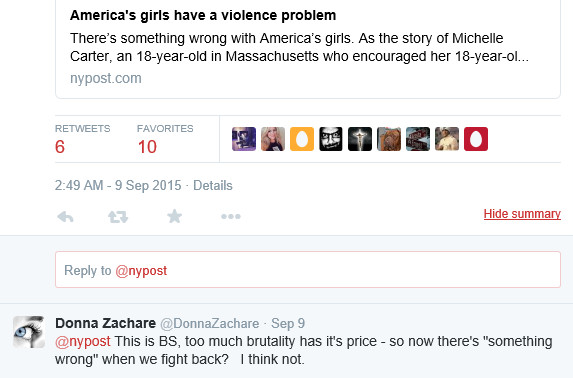
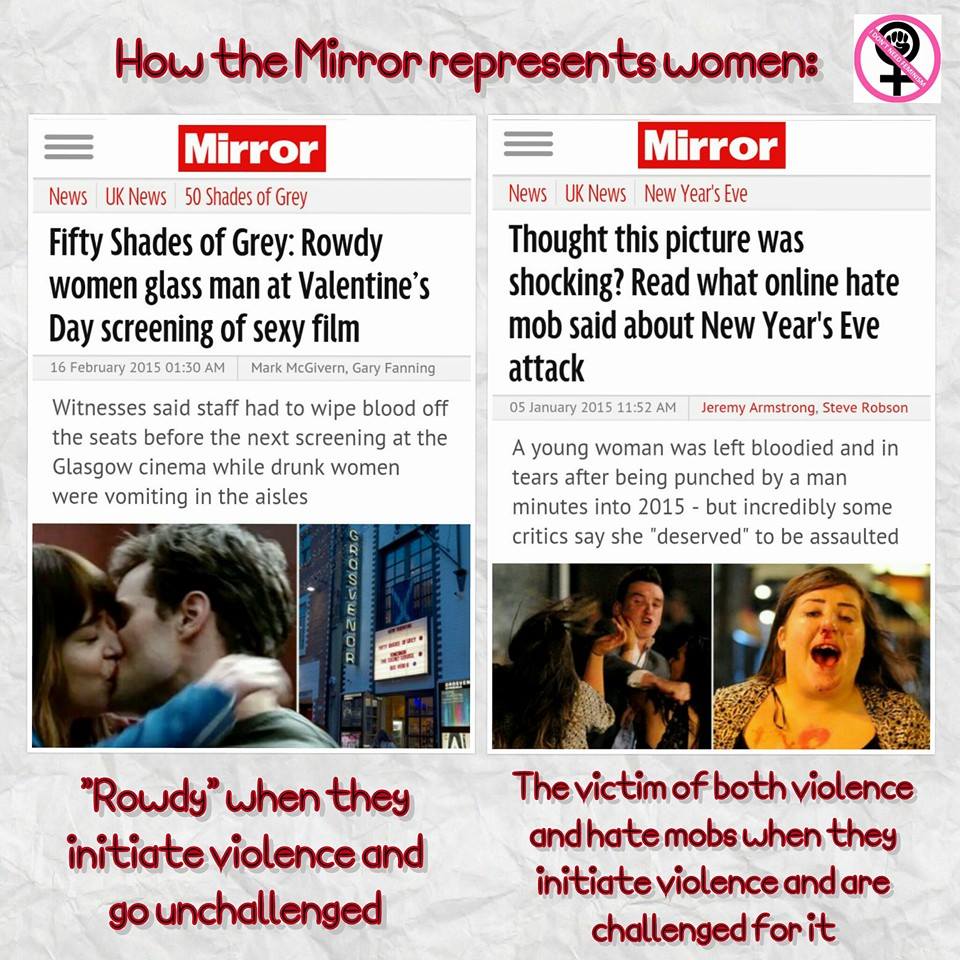
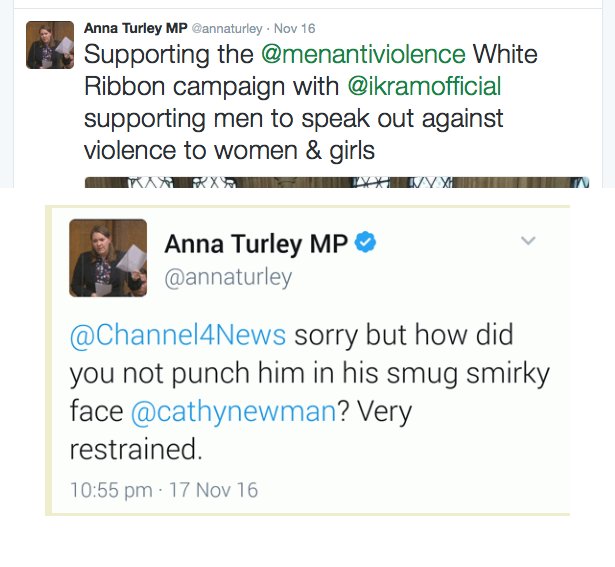
Female aggression is now increasingly being portrayed and seen as acceptable, and almost a hallmark of an empowered woman. Look for example at some of the speeches made by female celebrities following the election of President Trump in the USA.
The feminist logic appears to be:
Women are oppressed
Men are oppressors
Violence against the oppressors is liberation (Source: ‘Sinisus’)
Ms Garner’s comments aren’t unusual – I have simply chosen hers as but one example of a long line of articles/comments that I have read expressing similar sentiments. This is the flip-side of a culture increasingly being moulded by feminist organisations like ‘White Ribbon Campaign’, whereby female aggression is downplayed or completely ignored whilst male-perpetrated violence is exaggerated.
In July 2014 Whoopi Goldberg started a feminist firestorm with her comments on a US talk show in which she said that women should not hit their partners, and that if they did they should not be surprised if the man hit them back. Feminists have misrepresented Whoopi’s position as being one of supporting men who hit women, but in fact she just said that she supported the position of the innocent party who was hit first (whether that be a man or woman). Her position was that neither party had the right to hit the other.
Inherent in this discussion is the view amongst many feminist women that because men are bigger/stronger [which is not always the case] that men never had the right to hit women, regardless of whether the woman struck the first blow. The video clip of Whoopi’s statement is here, and here are some discussion threads and articles: Vfm article by Paul Elam, VfM discussion thread, reddit #1.
Twitter discussion thread regarding the excuse of ‘just a slap’, beginning with assertion by UK feminist organisation ‘Refuge’ that it is used to minimise violence against women (23 June 2020)
Women kicking balls, I’d like to see that (22 January 2017) New TV ad promoting women’s sport. Imagine an ad ‘Men grabbing pussy, I’d like to see that’. Appropriate or humorous? Didn’t work for Don Trump and this one will reflect poorly on the AFL.
Joe Mixon videos released (16 December 2016) Video. USA. NB: Hit someone and there’s a good chance you’ll get hit back. Women included. Welcome to equality.
Wife chops off cheating husband’s penis, twice (14 January 2015) Somehow I don’t think a story about a man cutting off his wife’s breast would be given the same whimsical treatment as per this article
In case you’ve been living under a rock in past weeks a British scientist by the name of Dr Matt Taylor landed in a world of hurt because the shirt he wore at a media conference offended some feminists. Dr Taylor is part of a team that had just managed to land a spacecraft on a comet.
In a breathtaking display of pettiness and vindictiveness a number of feminists targeted him for abuse and harassment eventually leading to an emotional apology by Dr Taylor for hurting their feelings via his choice of clothing. Said feminists claimed that Dr Taylor’s shirt embodied rampant sexism within the STEM field of professions, that was in turn instrumental in discouraging women from entering this sphere of endeavour.
“I watched that clip of Dr. Taylor’s apology – at the moment of his supreme professional triumph – and I felt the red mist come down. It was like something from the show trials of Stalin, or from the sobbing testimony of the enemies of Kim Il-sung, before they were taken away and shot. It was like a scene from Mao’s cultural revolution when weeping intellectuals were forced to confess their crimes against the people.”
I hold significant reservations in relation to the operation of the staunchly feminist group ‘Our Watch‘, formerly known at the ‘Foundation to Prevent Violence against Women and their Children‘. The feeling appears to be mutual as, despite being a law-abiding Australian taxpayer, I have been blocked from both their Facebook page and Twitter stream since late 2014.
My concerns include, but are not limited to:
The cost-effectiveness of allocating public monies to ‘Our Watch‘ with regards to achieving a measurable reduction in the incidence of domestic violence and/or providing tangible assistance to all victims of domestic violence
The extent to which the activities of ‘Our Watch‘ are driven by a desire to maximise the acceptance and influence of feminist ideology rather than a desire to maximise the two outcomes listed above
The effect of ongoing misrepresentations made by ‘Our Watch‘ in relation to the allocation of resources towards research into female perpetration of violence, the level of support provided to male victims of domestic violence, and the availability of counselling/treatment options for violent women and couples
On the first point, I believe that it is appropriate that the government both participate, and support the participation of others, in combating domestic violence and in assisting its victims. But this should be done in a manner that is both impartial and cost-effective. There should also be complete transparency and accountability on the part of both those allocating and those receiving public monies.
In 2013/14 ‘Our Watch‘ received a whopping $4,675,550 in government funding whilst raising a paltry $6,083 in donations. These funds were sourced from the federal government ($1 million/year) and the governments of Victoria, South Australia and the Northern Territory. A financial report for ‘Our Watch’ can be sourced from the web site of the Australian Charities and Not-for-Profits Commission (see the relevant ACNC registry entry here and a related blog post here).
As with the White Ribbon Campaign (another Australian feminist DV advocacy group), ‘Our Watch‘ do not directly assist victims of domestic violence. Instead they rent office space, employ many feminists staff, and run various PR/’education’ campaigns. These campaigns are divisive and involve the dissemination of misinformation that demonises men whilst failing to deal with female perpetration of violence. I am dubious about the extent to which their campaigns reduce the incidence of domestic violence, and indeed this has yet to be demonstrated.
I note that former MP turned journalist Gary Johns was subjected to harsh criticism after querying the effectiveness of government funds being provided to advocacy groups like ‘Our Watch‘ in lieu of directly funding service provision by government agencies.
‘Our Watch‘ advocates for female victims of domestic violence, which in and of itself is a laudable goal. A problem arises however when ‘Our Watch’ justifies their focus by claiming that the overwhelming majority of domestic violence is perpetrated by men upon women, and then seeking to validate this assertion through the ongoing misrepresentation of information concerning patterns of DV perpetration (example).
I don’t think there is any doubt that statements by politically astute groups such as ‘Our Watch’ do have a significant influence on decisions by government in relation to policies, priorities and funding allocation related to the sphere of domestic violence. This has resulted in a situation whereby government agencies treat all men as potential (if not, actual) violent abusers, where there are almost no resources available to battered men (and their children), and violent women are essentially waved away until such time as they commit a serious felony.
Those who visit Our Watch‘s Facebook page and Twitter stream will note that surprisingly little of the communication emanating from that organisation is directly related to their purported area of primary concern – domestic violence. What you will see instead is considerable self-promotion, and a preponderance of material that could only be described as feminist propaganda.
On a visit to their Facebook page on 26 October 2014 for example I noted the following:
Reader Kath Kerr: It is not fair and it is not right that privileged men who murder are consistently granted lenient sentences.
Our Watch: Too many young people in Australia have witnessed acts of physical domestic violence against a parent. (No mention that equal number of kids have seen their mum abuse their dad, as have seen their dad abuse their mum – Source)
Our Watch: It’s time to stop asking what about men (in relation to this article)
Our Watch: Strong language Warning: Oh my! Language, ladies. *clutches pearls* This is F*cking brilliant and quite possibly the best thing on the internet. Ask yourself, What is more offensive? A little girl saying ‘f*ck’ or the f*cking unequal and sexist way society treats girls and women?” http://vimeo.com/109573972
Avril Mesh, Ben Lakos, Domestic Violence Resource Service Mackay and 63 others like this.
If any readers of my blog have yet to witness this video, and wish to see just how far feminism has fallen, then click on the above link (Strong language warning)
Ok, enough! And so I proceeded to raise my concerns with the ministers of those agencies that see fit to hand millions of our tax dollars over to ‘Our Watch‘ … namely the federal Government, the Northern Territory Government, and the Governments of Victoria and South Australia.
“Dear Minister
I write to you today to voice my strong objection to material posted in the facebook page of the group known as ‘Our Watch’ (refer attached ‘screensave’). I do so as I am aware that they receive a substantial amount of ongoing gov’t funding, and thus should be at least somewhat accountable to broader public standards.
I believe that their support for such an ‘initiative’ is reprehensible and they should be required to remove both this and other radical feminist material from their web site, twitter account and facebook page. I don’t know if you look at the material that they promote in their facebook page, but it is almost entirely either pure self promotion for key personnel or strongly pro-feminist ideological material that has only cursory relevance to the subject that is meant to be their focus – domestic violence.
Please would you act on this matter as it is clear that ‘Our Watch’ require much greater oversight if they are to continue to receive large amounts of taxpayer-funded support. Thank you for your anticipated prompt intervention concerning this matter.”
I subsequently received a response to my complaint from John Elferink, Attorney-General and Minister for Justice, with the Northern Territory Government:
“I write to you in response to your email dated 28 October 2014 in regards to a Facebook post ‘Potty-Mouthed Kids Drop F-Bombs for Feminism by FCKH8.com’ shared by the group ‘Our Watch’.
As you are aware the role of Our Watch is to drive long term cultural and attitudinal change from the ground up through community engagement and advocacy and working in close partnership with the Second Action Plan to the National Plan to Reduce Violence Against Women and their Children.
The Northern Territory Government is committed to reducing domestic violence. The financial contribution to Our Watch is just one of the ways that this Government is supporting initiatives which seek to drive attitudinal and cultural change.
Whilst the initiative that was placed on their Facebook page was divisive, this should not detract from the important work that Our Watch does in the primary prevention of violence sphere. I thank you for your vigilance in monitoring the material placed on the Our Watch social media pages and bringing it to my attention. I believe the offending post has since been removed and I have instructed the Domestic Violence Directorate to monitor the site content regularly.”
The Hon Kevin Andrews MP, Federal Member for Menzies and Minister for Social Services sent the following reply dated 3 December 2014:
“I appreciate you raising your concerns regarding the link to a video Our Watch posted on 21 October 2014. Our Watch was established as an independent company by the Commonwealth and Victorian governments in June 2013, as an initiative under the National Plan to Reduce Violence against Women and their Children 2010-2022.
Our Watch will work to provide national leadership to prevent all forms of violence against women and their children. This will be done by changing attitudes, behaviours, social norms, and practices that create violence against women and children, including the promotion of gender equality. There is a growing body of evidence showing that people with a poor understanding of gender equality may also have attitudes and behaviours that support violence.
The long term outcome of Our Watch is to encourage public conversations in Australia to support gender equality and understand the links between gender inequality and violence against women. Content on the Our Watch Facebook page is chosen to engage people in the debate by raising awareness about the importance of gender equality, challenging stereotypes and preconceived myths regarding the role of women in our society.”
So there we have it … promoting a video of pre-teen girls swearing their heads off = providing “national leadership“, a further aspect of which involves Our Watch encouraging “public conversations” by removing dissenting Facebook posts and banning their authors from contributing further. Would the Minister be equally comfortable with a men’s rights group promoting a similar video “challenging stereotypes and preconceived myths regarding the role of (men) in our society.” Probably I guess, unless, of course that would involve facilitating just a little too much real gender equality.
The Hon Jay Weatherill MP, Premier of South Australia sent a very basic acknowledgement only, and the Hon Heidi Victoria, Minister for the Arts, Minister for Women’s Affairs, Minister for Consumer Affairs, has yet to provide me with a response. I will update this post should such a response be received.
Oh, but look what happens when videos are made using allegedly right-wing kids who employ bad language, e.g. Joe Bernstein’s coverage of ‘Soph’. Clearly not seen as cool & empowering in that situation, huh? And yet another feminist double-standard (May 2019)
What follows is just one example of feminist hypocrisy. Not the worst example by any means. But just one that happened to come across my desk the other day. The author is a feminist journalist working for an Australian pro-feminist media group, an organisation that has been mentioned in one or two of my other blog posts due to it’s routine anti-male bias.
Well that’s reasonable isn’t it? Of course it is sad that men are all too aware that they are viewed as potential predators. Very sad. But let’s think about how this situation came about.
Firstly, and undeniably, it is partly due to actual perpetration of sex crimes by a very small number of men, against a small minority of children. The actions of these people are obviously inexcusable, and clearly such offenders need to be dealt with to the full extent of the law.
But then the media, advocacy groups and public agencies take over, building that kernel of evil wrong-doing into a mountain of fear and foreboding. They do this not only in relation to their handling of the specific issue of child sexual abuse by men, but also with regards to how they address the topics of (for example) domestic violence, sexual violence/‘rape culture‘, and workplace discrimination and harassment.
I need to digress here for a moment because feminists are wont to respond to what they imagine men are saying, rather than to what is actually said:
Men are not saying:
That the issues mentioned above are not real and/or do not warrant remedial action being taken
That all men are innocent of wrongdoing in relation to these issues
That the misrepresentation of men’s culpability is indicative of a global conspiracy against men (as is the case for example with feminists and their belief in the existence of a patriarchy)
Men are saying:
That media coverage of the issues listed above generally asserts (or at least implies) that men are almost always the perpetrators and that women are victims, when this is often not the case
That even in those situations where rates of male perpetration are substantially greater than female perpetration, this is not a valid justification for failing to acknowledge and address female perpetrators and male victims
That this biased misrepresentation of the actual situation appears to be a deliberate attempt of the part of many writers to damage the credibility of men and/or support and further the cause of feminist ideology
That this ongoing misrepresentation is unfair and unhelpful in addressing the issues under consideration
Let’s think about the broader picture of how men are presented in the media generally, and that is anything but a positive portrayal. It is no coincidence that the Australian media is overwhelmingly influenced and shaped by feminists and their white-knight cohorts. Should you doubt this fact then start reading almost any of the posts in this blog.
Let’s think about why women are not similarly viewed as potential predators despite the fact that they are responsible for most (non-sexual) child abuse and neglect, much elder abuse, and given that there are now almost daily incidents involve adult women preying on underage boys and girls.
A major factor here is, yet again, pro-feminist and anti-male bias in the media. This pervasive sexist bigotry sees men’s transgressions amplified, whilst women’s are minimised or ignored entirely. The general public then comes away with the idea that men’s perpetration is commonplace, deliberate, and severe, whilst women’s crimes are rare aberrations for which there are usually extenuating circumstances.
Let’s think about what feminists in general, and feminist journalists in particular, are doing to address this issue of men being portrayed as evil. I mean apart from shedding crocodile tears by way of superficial space-filler articles like the one introduced earlier.
Are feminists, for example, lobbying for airlines to stop their discriminatory policy of not allowing men to sit next to unaccompanied minors? Are they lobbying for the imposition of gender quotas for male primary school teachers? Are they doing anything at all to help? Please prove me wrong, but I think you will find that the answer is no. No, they are much too busy pushing in the opposite direction.
PS: By the way, I did try to share my views about the article in the Herald-Sun web site via submitting a readers comment, but alas it was not posted. I’m hardly surprised … such censorship moderation is absolutely par for the course when it comes to feminists seeking to avoid having their precious ideology critiqued derailed. Oh, and then the author of the article blocked me from her Twitter page – presumably in retaliation – rather than providing a mature and lucid rebuttal. This is what a feminist looks like.
I came across a feminist article entitled ‘Feminist bitches – Who needs them?‘ (11 August 2014)
The article itself was codswallop but one thing I saw that’s well worth remarking upon, was a series of comments by a reader named ‘Bowspearer’ (see footnote). I’ll reproduce his opening comment below, and would recommend that you read the entire discussion at http://theaimn.com/feminist-bitches-needs/#comment-168495. This guy has got some great insights to impart. (Update: The discussion thread recommenced on 31 October 2014, and the recent comments are excellent)
“The article is deeply flawed and ironically endemic of the vast multitude of problems which feminism has which in terms of it’s ideological model, make it actually a barrier towards gender equality.
Firstly, the article talks about women in power whilst clearly being oblivious to what real power is in this world. Politicians aren’t powerful by any means- they’re nothing more than puppets. The real power in this world belongs to the Money Power – be it investment bankers, mining magnates or any member of the hegemonic class. This is the class of 0.1%ers who are rarely, if ever, visible and reduce our politicians to nothing more than puppets. Included in that class is the British monarch – who has actually been female for 132 of the past 232 years. The reality is with the exception of Gina Rinehart, such power is rarely, if ever seen – in the case of either hegemonic men or hegemonic women.
Two examples come to mind of this. The first is Melissa Babbage, who until the GFC worked as a majhor derivatives trader for Deutsche Bank and whose investment portfolio was so massive that it’s clear that it is she, rather than Joe Hockey, who is the breadwinner of that family. The second example which comes to mind is an old school friend’s stepmother who again, is a highly wealthy and influential member of the banking class who was even an advisor in the 2nd Bush administration – where the real power lies and this was one of the more powerful advisory positions.
Gina Rinehart has also made their position abundantly clear. Such individuals in the hegemonic class, male or female – care little for plight of the subordinate class and would have us all working for slave wages if they had their way. Any notion which women at the top are “part of the sisterhood” is pure, romanticised drivel. Furthermore, any notion that we are even aware of just what the exact gender breakdown, gendered wealth breakdown and opportunities are for men and women within the hegemonic class – especially when much of that class keep their power and themselves hidden, is misguided.
Secondly, it ignores power dynamics. The fact is that there are a wide raft of factors which determine power in this world of which determine just how powerful or powerless someone is. The fact is that a disabled man will always face greater discrimination in this world than an able-bodied woman, non-caucasian men are more likely to experience discrimination that white women ( especially Middle Eastern men I might add) – in addition to factors such as class, transgender and sexual orientation. Yet feminism discards this complex reality for the theory of “Patriarchy”, whereby all men are falsely elevated to some imagined bourgeois and all women are falsely relegated to some imagined proleteriat. Feminism will certainly claim to acknowledge this inequality, but the cold hard truth is that feminism views it through the lens of “women HAVE problems; men ARE problems”.
Feminists lament their perceived lack of access to the hegemonic class, whilst ignoring that with the way gender dynamics are actually structured in this world, it is men who fare worst in the world. Men make up 95% of workplace fatalities – all so they can be the “good providers [for “women and children”]” which society demands them to be, which in cases of large scale infrastructure involve examples such as the construction of the Panama Canal, where 28,000 men were killed in its construction. Likewise, men make up the primary victims of war, all so they can fulfill the social expectation of being “good protectors [of women and children]” – which results in incidents like the 1 million dead in the battle of the Somme being, all too common in war.
Yet according to the feminist theory of “patriarchy”, men relegated to subordinate masculinities such as this somehow magically oppress women – even hegemonic women like Gina Rinehart who would love nothing more than to use them as slave labour. Furthermore if hegemonic females are just as culpable of this as hegemonic males, then how can a male-power-focused model of patriarchy, even remotely be accurate?
Before I move onto third world issues, let’s take more of a look at first world issues. Feminism perpetuates the myth that when it comes to abuse, “men are [exclusively] perpetrators; women are [exclusively] victims[; anything to the contrary is to be dismissed as a statistical anomaly]“.
In terms of rape, this plays out in the form of the myth that non-consensual sex is only rape when the victim is forcibly penetrated – despite the fact that when studies like the 2010 NIPSVS in the US have kept track of men being forced to penetrate someone against their will, they have found that not only are half of all rape victims men, but that 40% of all rapes are committed by women. Yet this is barely recognised in a society where feminism perpetuates the flawed notion that rape culture is entirely perpetrated upon women by men.
In terms of domestic violence, despite studies having shown for over 4 decades that roughly half of all domestic violence is bi-directional, roughly a quarter is exclusively male-on-female abuse and roughly a quarter is exclusively female-on-male abuse. Yet the collective “[men’s] violence against women” mantra which society dogmatically chants on this issue, results in society treating battered men as urban-myths/perpetual-liars who “had it coming to them” and regards individual victims as effectively being cheap, filthy, worthless sluts”. So vile is this entrenched sexism, that in several states here, police have been trained to automatically view the male as the aggressor on domestic violence call-outs, resulting in many domestic violence victims being arrested, simply because they have a penis between their legs.
In terms of child sex trafficking, it is portrayed in the media as exclusively being men preying on girls. However the reality is, in the US for example, that half of all child sex trafficking victims are boys, 35% of all child sex traffickers are female and studies have found that 40% of boys and 13% of girls service female clients.
In terms of pedophilia in general, society views a boy being raped by an older woman as a “rite of passage” – so much so that laws in the US for example, mandate that a male child rape victim must pay child support to their rapist if a child results from the rape. Furthermore researchers in the UK have found that victims of female child predators, male or female, are far less likely to be believed than victims of male child sex predators when they disclose their abuse – even to police.
This is of course, just a handful of issues in the developed world of many. Then there are problems in the third world faced by men – such as the epidemic of war rape against men in the Congo, to which both women and men are active participants in.
People cite the brutality of women in Shari Law abiding Islamic countries, whilst completely ignoring the plight of homosexual men there being just as brutal.
Then you have India where female violence against men not only gets a free pass, but the victims are mocked if they are witnessed or dare to speak out.
Again, these are just a couple of examples of countless many.
The thing is, if feminism is so concerned with gender equality, then where is it’s genuine recognition of these issues in terms of men HAVING issues, as opposed to men BEING issues?
Where is feminism’s recognition of both subordinate masculinities and hegemonic femininities?
Where is feminism’s recognition of the existence of female privilege (which btw is a significant barrier in addressing female hypoagency) as well as male privilege and the effect that both forms of privilege have in maintaining traditional gender inequalities? For that matter where is feminism’s accurate understanding that “privilege” is nothing more than a conditionally granted set of permissions designed to glorify and maintain traditional gender norms that are revoked the instant an individual deviates too far from acceptable gender norms.
Ms McQuade laments the page she found, yet she is clearly blind to why egalitarian women would have serious concerns over feminism as a movement in an ideological sense or the fact that if feminism cleaned house (beginning with recognising the existence of female privilege and how it has poisoned feminism) it would ironically be well on the way to addressing female hypoagency and therefore achieving genuine gender equality as a foundational level of society – whilst gaining support from egalitarians, who have surpassed feminism’s flawed and superficial gender understandings.
Sadly, much like paleo-masculinists, PUAs and Beta Male Traditionalists are blind to how toxic and self-destructive male privilege is, so too are traditionalist females and feminists blind to how toxic and self-destructive female privilege is. Until such time as that changes, more and more people are going to discard feminism as a toxic and academically superficial gender model.”
Footnote: I subsequent learnt that ‘Bowspearer’ is Andrew Richards (Twitter handle = @bowspearer)
I made mention of an Australian web site called The Conversation in an earlier post. The Conversation features articles that range from politics and general current affairs to more esoteric matters, with a marked predisposition towards the tastes and values of left-leaning progressive liberals.
Most readers comments seem to be penned by sycophantic members of the ‘chardonnay set’ and career academics, although it’s hard to say if they are truly representative of the overall readership given that many other comments are moderated into oblivion.
Feminism and feminist topics are heavily covered (example), whilst mens issues are all but ignored. As a consequence, The Conversation often runs articles concerning domestic violence, sexual assault, and the ‘wage gap’ with only minor variations around the standard feminist theme on those subjects.
On 1 October 2014 they ran an article entitled ‘Why don’t we speak up when we see signs of domestic violence?‘ by Sarah Wendt. There was nothing exceptional about the article – it claimed that domestic violence was a gendered issue, made no mention of male victims or female perpetrators, and slipped in a promo for the author’s book. Absolutely typical of its genre really.
No, the exceptional part was the fact that almost all of the readers comments were critical of the biased treatment of the subject. Later, many also raised the issue of the relatively large number of comments being removed. Some readers also queried why the author of the article had chosen not to contribute her thoughts regarding the unfolding discussion.
I launched into the fray quite early on, commenting thus:
“So “Domestic violence is about gender power relations”? What then of recent research that tells us that lesbian couples are the most predisposed towards partner violence?
This ongoing feminist monopolisation of the DV debate is tired and its wrong. If we want to tackle the scourge of DV, rather than just lob grenades in a war against a mythical patriarchy, then we need to acknowledge, discuss and address the entire problem not just the bits that fit into the feminist narrative.”
Based on my earlier experience with The Conversation I was surprised by the lack of punitive action by the site’s moderator. All that changed the next afternoon, however, when the thought police suddenly appeared on the scene and removed sixteen of the comments. By the time the site stopped accepting readers comments at lunchtime the following day, a total of twenty-seven comments had been removed.
In a final hurrah before the editorial team took their bat and ball and ran home, Helen Westerman, Deputy Managing Editor at The Conversation, posted a comment stating that:
“Nowhere does this piece suggest that domestic violence does not affect men. We have run many pieces making the point that men are also subject to partner violence (by women or other men) and I thank the men here who have shared their experiences. They are moving and valid.
And I would ask that this understanding is also extended to the viewpoint of women around this topic and that women be allowed to speak about this issue. And I also thank the women who have left their experiences here. They are moving and valid.
Sadly, this debate so often this devolves into a zero sum game: if women’s perspectives on violence are written about, then somehow it means that men’s are being “ignored”. Simply not true.
The hard truth is whichever way you cut the cake, women are affected disproportionately more than men by domestic violence. However, men are more affected by violence in general.
Neither fact should make us feel particularly proud – and should make us want to change this situation. The common ground here is that it shouldn’t happen to anybody, not matter who is meting it out.
It makes for very uncomfortable reading and elicit strong emotions. But we’ve got to talk about it.”
To this I replied:
“Helen, thank you for contributing your thoughts but please, your opening sentence is an embarrassingly poor defence in response to the legitimate concerns that have been raised about both the bias of the article and in the subsequent moderation of comments.
Seriously, if the shoe was on the other foot, and you were reading an article about (only) male victims of domestic abuse … would you accept the excuse that “the article never said women were not victims”?
None of those commenting here have suggested that women not “be allowed to speak about this issue”, and that includes those comments that were binned. I think everyone, like myself, appreciates the opportunity to hear all perspectives on the subject. But this forum is for grown-ups and some questioning and rebuttal is an expected feature of adult ‘conversation’
Yes I agree, “we’ve got to talk about it”. Now about those moderated comments”
Highlights of the comments section included several insightful and incisive comments from psychologist Adam Blanch, including:
“Domestic violence is about people who are angry, jealous, distressed and mentally ill acting out their frustration. The motive for ‘control’ and ‘power’ is only present in a very small percentage of DV, and both sexes do it to the same extent.
The entire Duluth model, which assets that domestic violence is about ‘Gender power relations’, has been so extensively disproven by legitimate researchers that no fair minded person without a ‘gender agenda’ could possibly subscribe to it.
PS. the ABS personal safety survey has some serious methodological issues that appear to have been built in, twice, to bias the outcome in favour of a ‘Gendered’ view of DV.”
There was also this classic comment from a guy called Andy George:
“Definition of irony:
A website called ‘THE CONVERSATION’, publishes an article titled “Why don’t we speak up when we see signs of domestic violence” calling on people to talk about the issue, then censors comments that are from male victims of domestic violence but leaves the equivalent posts by women who were victims of domestic violence.”
Negative aspects of the comments section included examples of those tiresome, incorrect yet oft-repeated assertions of feminists that:
men should just listen to discussions about domestic violence but not contribute their thoughts (unless to offer unqualified agreement) because to do so only “derails” the discussion
men only raise the subject of male victims and/or female perpetrators in order to excuse/minimise the behaviour of male batterers and/or deny/minimise the experiences of battered women
by raising concerns about the appropriateness of feminists continually asserting that ‘domestic violence = men’s violence towards women’ men are attacking and denigrating female victims, and women generally
Anyway, well done to all the men and women who made the effort to bring the author’s sexist bias to account. Hopefully this will be a harbinger of the reaction to the inevitable future displays of sexism and gender bias at The Conversation, and in the media generally. Enough is enough.
See also:
Reddit discussion thread concerning moderation in relation to another article at The Conversation
“As the site’s charter admits, it hopes to ‘give experts a greater voice in shaping scientific, cultural and intellectual agendas’, and aims to work for the advancement of the ‘public good.’ It also promises to be ‘editorially independent’, provide ‘diverse’ content and be ‘free of commercial or political bias.’ Whether it achieves this is open to question.
Professor Judith Sloan, another academic who can boast a tangible impact on policy and public debate, is unconvinced:
‘this site strikes me as emblematic of all that is wrong with Australian universities. Crammed with puerile, naïve, left-wing tosh, the contributing academics…really have no idea when it comes to serious public policy contributions.'”
A rather one-sided ‘conversation’, by Tony Thomas (14 February 2014) Another group – not MRA-related – express their concern about the level of bias evident at The Conversation
Postscript 25 January 2015: There are a few occasions when the moderator remains in his/her kennel, and then it’s refreshing to see that adults can indeed engage in vigorous debate without chaos ensuing. Look at this article for example.
Postscript 23 March 2015: A moderator removed a comment I added to this article about domestic violence. My comment was as follows:
“Rob, I haven’t read your report yet (but will do so shortly), so the following comment is based on what I’ve read in the media. It appears that your report talks about the need for more & better intervention and behaviour modification programs for perpetrators, but that your recommendations in this regard are limited to male perpetrators.
Can I ask why you would not adopt a gender-neutral approach in this regard and have programs that catered for both male and female perpetrators. I mean, it’s not as though there are so few violent women that we can afford to just wave them away.
Postscript 1 April 2015: A moderator removed a comment I added to this article about sexual assault. My comment was as follows:
“It’s deeply ironic that the title of your article is “let’s turn the spotlight on known perpetrators”, but within the first sentence you exclude acknowledgement or consideration of all female perpetrators of sexual assault. On what basis? There’s less reported crimes involving female perps, so it’s OK to just airbrush them out?
I’m also troubled by you referencing the 2013 National Community Attitudes Towards Violence Against Women survey, which didn’t bother to ask respondents about their attitudes towards violence to men. Thus the questions about violence towards women were robbed of context and so we don’t know the extent to which the issue is men’s attitudes towards women, or Australians attitudes towards violence generally.”
Reader Craig asked: Why was a dissenting comment regarding information contained in this article, with links to support its claims, removed by the moderator? There was no abuse or apparent breaching of the Community Standards (unless it was a Twitter technicality?)
Moderator Cory replies: We also require research that’s credible:
“Back up your ideas with evidence and fact where possible. If you’re claiming something as scientific fact, try to provide credible references.”
While some of the links were fine, many of them – upon reading them – were less than credible. They were closer to a smear campaign than anything resembling research. This is also prohibited in our community standards:
“We’ll distinguish between constructive comments and smear campaigns. We’ll remove any deliberate attempts to misinform, distort facts or misrepresent the opinions of others.”
Smear campaign? WTF? “astrategytodiscreditaperson,esp.apublicfigure,throughdisparagingremarksorfalseaccusations“. We are talking about ideas, Cory. Can anyone point me towards any of the linked papers on this page that attacked a person. Aren’t the readers of The Conversation mature enough to, you know, exercise their own judgement about others’ opinions?
Firstly, what do I mean by the term “fudging” in the context of this blog post?
to present or deal with (something) in a vague or inadequate way, especially so as to conceal the truth or mislead and/or
to adjust or manipulate (facts or figures) so as to present a desired picture.
So how do feminists and their allies, go about fudging statistics? Well the most common technique used, so prevalent that it’s virtually a hallmark of feminist literature, is to report statistics in relation to female victimhood in the absence of comparative figures for men and boys. Such information is (or at least, was) generated in surveys but usually went unreported, unless doing so would support the feminist perspective.
Thus subsequently, and in a worrying trend, more and more research projects undertaken by pro-feminist organisations don’t include male subjects in surveys. Here is an example from the Australian Human Rights Commission (July 2023):
Nor does contemporary research typically investigate impacts on males and/or attitudes towards men (examples here, here, here, here, here, and here).
Clearly with corresponding data in relation to males unavailable then rapporteurs can easily deflect requests for contextual information. Information which would, in many cases, otherwise weaken their claims of gendered victimhood.
Thus biased researchers can represent a social problem as being gendered when it is not. And so the next researcher builds on existing incomplete research and concludes and/or implies in their report … this problem rarely affects men, or affects men in different & lesser ways, etc (but we can’t be sure because no data). And the cycle of gender bias in research, and subsequently in policy formulation, rolls on.
The Bill & Melinda Gates Foundation believe the reverse to be true, and that there is a ‘gender data gap’ with “male-biased surveys that fail to capture women’s perspectives, their needs and their economic value”. They provide a 3rd world example upon which I am not qualified to comment, but with regards to 1st world countries their proposition is laughable. This Australian feminist writer, Kristine Ziwica, is pushing the same line (12 March 2019).
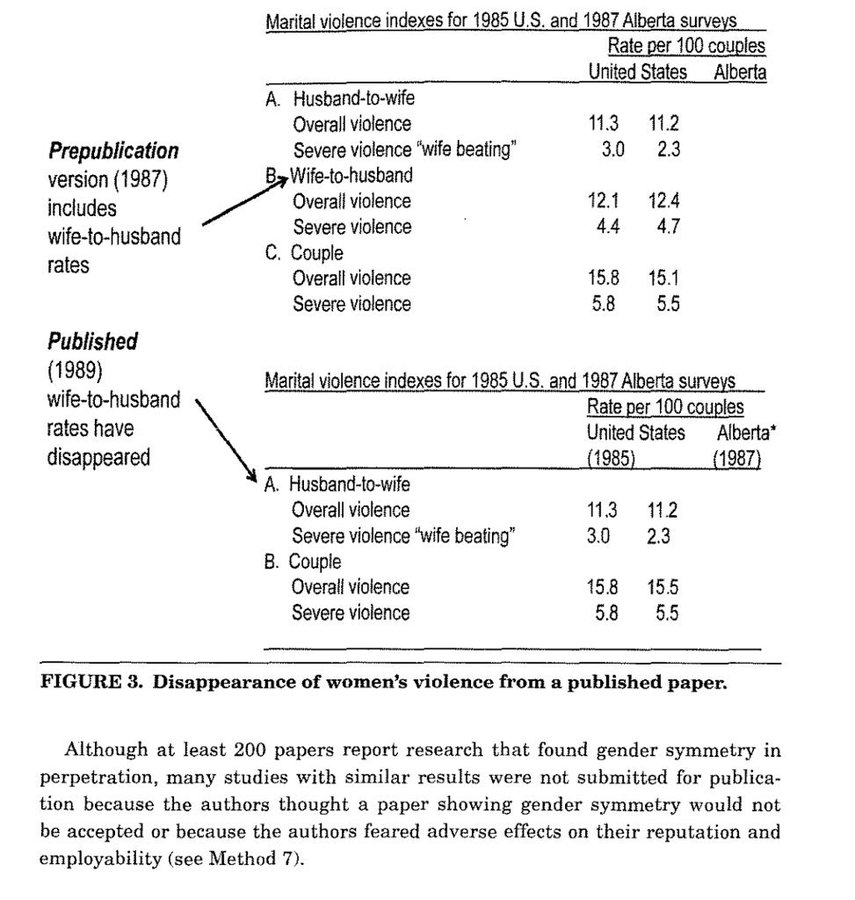
A paper by Dr. Murray Straus addressed the issue of feminists distorting domestic violence data. He identified the seven primary methods they used as being:
To suppress Evidence
To avoid obtaining data inconsistent with the Patriarchal Dominance Theory
To cite only studies that show Male Perpetration
To conclude that results support Feminist beliefs when they do not
To create “evidence” by citation
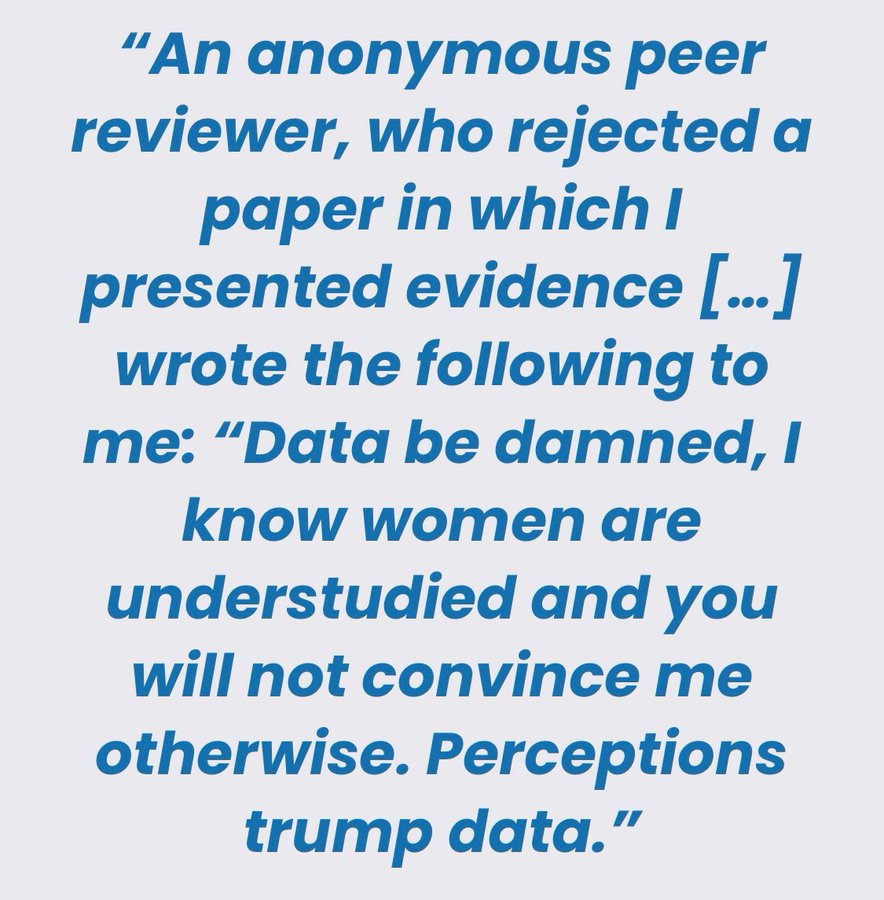
To obstruct publication of articles and obstruct funding research that might contradict the idea that male dominance is the cause of PV (see this post)
To harass, threaten, and penalize researchers who produce evidence that contradicts feminist beliefs (see this post)
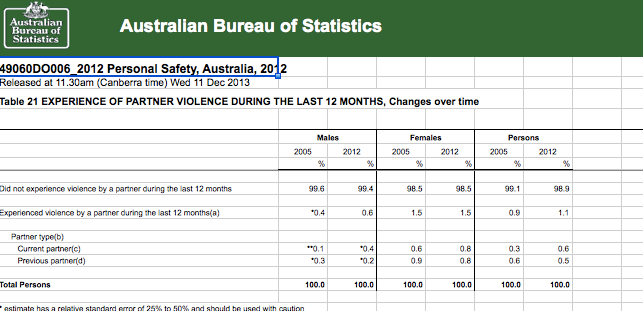
I was studying the readers comments in relation to a rather biased article about domestic violence. One comment was from a respected spokesperson on men’s health issues, Adam Blanch. Adam was talking about the latest ‘Personal Safety Survey‘ undertaken by the Australian Bureau of Statistics. This is what Adam had to say:
“Domestic violence is about people who are angry, jealous, distressed and mentally ill acting out their frustration. The motive for ‘control’ and ‘power’ is only present in a very small percentage of DV, and both sexes do it to the same extent.
The entire Duluth model, which asserts that domestic violence is about ‘Gender power relations’, has been so extensively disproven by legitimate researchers that no fair minded person without a ‘gender agenda’ could possibly subscribe to it.
PS. the ABS personal safety survey has some serious methodological issues that appear to have been built in, twice, to bias the outcome in favour of a ‘Gendered’ view of DV.
The 2012 report sampled less than 20% the number of women than men, down from 25% in the 2005 survey. though overall they increased the numbers for both genders for 2012, the male sample size is so small that many of the findings are unreliable again.
They were criticised for only using female interviewers in 2005, so in 2012 they trained a few male interviewers to be available on request. However, they don’t appear to have told the interviewees that they were available. This was based don ‘expert advice’ that both men and women would be more comfortable with female interviewers, these experts are unnamed. Who are they. Are they male? have they worked with male victims of abuse? What qualifies them as experts. I’ve worked with thousands of men, and I can assure you that most men will not reveal the same information to a woman that they will to a man.
This lack of transparency and sample balance is unacceptable for research conducted at this level.”
The Bureau shrugged-off this criticism and in September 2016 successfully obtained AHRC approval to only employ female interviewers in relation to a survey that encompasses the issue of domestic violence.
“Professor Triggs granted the ABS the exemption, accepting their submission, which included studies from not-for-profit groups, stating men were more likely to be perpetrators of DV and women were more likely to tell their stories to other women” And so disregarding the flipside … that male victims would be more likely to tell THEIR story to other men.
This is hardly the first time I have encountered concerns raised by authoritative sources regarding the credibility of domestic violence research, and in fact it appears to be an ongoing issue.
Australia’s ABC has a reputation for pushing the feminist agenda, with one example being the article ‘Domestic violence of epidemic proportions a ‘national emergency’: campaign groups‘ by Ursula Malone and Juanita Phillips. Nothing like turning up the rhetoric to keep that government funding flowing through to feminists and their organisations during these difficult economic times. And all based on fudged statistics, in particular that “Domestic violence is the leading cause of death and injury in women under 45“.
That statistic was sourced from this 2004 report by VicHealth. Indeed, that report was essentially 44 pages of taxpayer-funded feminist bias wherein violence towards men was dismissed in one sentence in the preamble: “Although men are among the victims of intimate partner violence, evidence suggests that the vast majority of victims are women and that women are more vulnerable to its health impacts”. That statistic was discussed in this 2014 article by Greg Canning and in this scorching rebuttal of the Malone/Phillips article by Men’s Rights Sydney (also available on the AVfM web site).
Now let’s look at three examples of misrepresentation from Australian feminist advocacy group ‘Our Watch‘:
1. This well-written 2013 letter from Dr Greg Canning to Natasha Stott Despoja concerns serious omissions and misrepresentations in a speech that she gave on DV (see also the reader’s comments). I am advised that a reply was never received from Ms Despoja.
2. This February 2015 article is laughably disingenuous and quite likely signals a new tactic by players in the Domestic Violence Industry: ‘Natasha Stott Despoja: ‘people are sick and tired of the statistics‘. Or in other words, ‘we are getting called-out for using false or misleading statistics too often now, so let’s publicly discredit all statistics and continue the argument on the basis of subjective and anecdotal evidence alone’.
“The vast majority of sexual assaults are not reported to the police. Given for example that only 17 percent of women who experienced sexual assault by a male perpetrator (in their most recent incident of violence) reported it to the police (ABS 2012), the actual percentage of false cases is likely to be tiny. By one estimate, the actual percentage of false cases as a proportion of all rapes (reported and unreported) may be closer to 0.005 percent.” (Flood, M, 2014)
An Australian MRA by the name of Paul Rogers brought this error to their attention stating (in part) that:
“Even Wikipedia doesn’t suggest that false rape allegations are as low as you claim, which is saying something. I have provided an excerpt below from Wikipedia to highlight that your claim is many orders of magnitude lower than even the lowest value claimed by most authorities … I urge you to state the truth rather than continue to cherry-pick outlier claims because they support your misandry.”
I should also point out that it’s not only feminist groups that engage is this sort of misrepresentation. In this media release, the advocacy group SAVE denounces the use of misleading information on domestic violence by none other than (then) President Obama himself.
Demonstrating the remarkably one-sided manner in which feminists view the world, in the following article a feminist journo criticizes a men’s rights group on their use of statistics:
In a further blog post I look at the feminist predilection towards ‘tweaking’ the definition of terms such ‘domestic violence’ and ‘sexual assault’ in order to better support their claims of female victimhood and generally bolster public support: See Finessing definitions to preserve the image of female victimhood
The references listed below alternately discuss or exemplify bias against men, as perpetrated by journalists and others (often working in the sphere of domestic violence, sexual violence and related fields):
One of the most egregious, shameless statistical falsehoods I’ve seen in a long time, one that thoroughly shames @MayorofLondon & @TenderUKin the recently published Teachers Toolkit on addressing gender-based violence & abuse (22 February 2023) UK Twitter thread by Ally Fogg. But on the positive side, and following lobbying by men’s rights activists, some statistical corrections were implemented
Our uni teachers were already among the world’s most stressed. COVID and student feedback have just made things worse (19 July 2021) Some student respondents in a survey said some mildly critical things about some teachers, a bit more in the case of female teachers. In the old days you would take about the factors that may have contributed to these perceived weaknesses in teaching practice. Not now though. Now the snowflake patrol moves into action to spend the rest of the paper talking about why the survey respondents were wrong. Sexist and wrong. Damn them.
Elite journal under fire over racism (13 April 2021) Article by Stephen Rice which is behind a paywall at ‘The Australian’. Not directly related to misandry, but an example of how social problems are massaged to satisfy the fears or preferences of woke folk.
Not the full story (30 March 2021) Media Watch video. Yet another example of what happen when you start with a pre-determined narrative and then have to make everything fit around it.
Domestic violence on the rise during pandemic (13 July 2020) “The survey of 15,000 Australian women in May provides the most detailed information in the world about the prevalence and nature of domestic violence experienced by women during the pandemic.” How many men did they say were surveyed? That would be *none*. Here is a link to the web page of the agency that produced this research.
Domestic Abuse: The latest lie (19 July 2019) Most men who are victims of partner violence are in homosexual relationships, right? Wrong. But it doesn’t stop feminists from claiming it is true.
Whose research got us a picture of a ‘black hole’ in 2019? It was a girl right? See this tweet from Tom Golden with linked video that tells the story that the media didn’t.
Articles like the linked one now tell us how horrible the “trolls” are for “targeting” the female scientist, but funny how they don’t address the facts of the case – did she only produce 6% of the coding or not? See also this paper from ‘A Voice for Men’.
‘Blatant spin’: SBS accused of sifting data to show ‘sexist’ Australia, and SBS’s ‘sexism’ doco is just blatant propaganda (21 November 2018) Both of these articles appeared in The Australian newspaper, and are behind a ‘paywall’. Watch this Bettina Arndt video for some good background on this issue.
And of course there were various flow-on articles, such as ‘Are men victims of sexism?‘ (3 December 2018) which conceded that the male gender had some problems, that none of these were due to women, but that men were using feminism as a “scapegoat”. Then ‘Here’s how audiences reacted to ‘Is Australia Sexist?‘ (4 December 2018)
La Trobe bans my talk on the fake rape crisis, by Bettina Arndt (2 August 2018) This article concerns the exaggeration of the incidence of sexual assault in Australian universities by the Australian Human Rights Commission and others.
When care becomes control – financial abuse cuts across cultures (17 January 2017) As I state in this post, most papers on financial abuse ignore the reality of male victimisation, and this is yet another example. In the absence of conclusive proof that only women were victimised one would expect a researcher to survey men and women. Failure to do so, as in this and many other cases, is evidence of gender bias to support a particular ideological narrative.
Cutting to numb the pain of sex abuse: interviews with young women in drug treatment (12 August 2016) Australia. Although this article focuses on the needs of young women, the underlying research surveyed both genders. Whilst I have yet to review the findings in detail, my default position is one of disquiet regarding the merit of applying different fixes to men and women. Without a very thorough understanding of all contributing factors, esp. in relation to cause/effect, there is a real danger that we may misinterpret the true situation. Also, from what has happened in the field of domestic violence for example, there is a real danger of a monopolisation of all available resources for the treatment of women.
Anti-abuse campaign targets university students (22 February 2016) Australia. Typical of Our Watch research this survey appears designed to deliver a pre-determined finding of gendered female victimhood. The article reports one part of the picture, but where are the responses to (for example) how many boys were pressured “to do sexual things”? Whether girls respect the ability to consent in relation to boys who are drunk, etc.
(I believe there to be a question mark over the extent to which the Australian Research Council is itself free of gender bias. I say this not in terms of funds provided to male versus female researchers, but in terms of social research projects with a feminist orientation being strongly favoured. Consider the examples provided of feminist research mentioned in this other blog post, as well as this article which will be discussed in a future post. The author of this article presenting a feminist-concordant perspective on the gender pay gap was also ARC-funded. These spreadsheets look at the nature of projects funded by the ARC)
“The Children’s Rights Report being released today found one in every 28 people had also experienced sexual abuse as a child, while a further 23 per cent of children have witnessed violence against their mother”. This conveniently neglects to mention that various studies have found that as many kids have seen their mum hit their dad, as per vice versa. Here is one Australian source.
Victim-blaming rampant in Australians’ attitudes towards violence against women – study (25 November 2015) And what of victim-blaming when men are the victims? And of community attitudes regarding violence towards males? Guess we’ll never know because the last thing feminist researchers want to do is provide context for their claims of female victimisation.
In this June 2015 paper the One in Three advocacy group recounts the bias and antagonism they faced whilst contributing to the Australian Senate Inquiry into Domestic Violence
ABC misleads. No, it’s not more dangerous to be a woman, by Andrew Bolt (14 April 2015) One of the precious few examples of an Australian journalist pointing out the distortion of data by feminists. And here and here are examples of the types of pro-feminist articles that Andrew was railing against.
The following collection of reddit discussion threads detail moderator bias and censorship in relation to threads/posts concerning domestic violence and child abuse – See example 1, example 2, example 3, example 4, example 5 and example 6 (27 October 2014) Includes the following quote from a moderator responding to a query as to why a post was removed: “It needs to be the right information from the right people. Here’s a shorthand guide: if you are an MRA or TRP, you need not bother posting. If your information may tend to make women look bad, same.”
Are domestic violence figures bogus? (22 February 2014) Includes discussion of the notorious ‘intimate partner homicide is the leading cause of death for African-American women ages 15 to 45’ statistic myth
I spoke to hundreds of men about rape and domestic violence (24 September 2014) Note that this is a different survey to that discussed by Adam Blanch earlier. It is certainly feasible that interviewers might influence survey respondents. It hardly fills one with confidence about the reliability of the results when interviewers are prepared to go on record with such strong views on the matter being investigated.
If manipulating and misrepresenting statistics to suit an agenda was a crime then the feminist authors of this “fact-sheet” should be in jail. Many of these so-called facts are debunked in papers listed in this other post about domestic violence, whilst others demand the smallest measure of common-sense to confirm just how misleading they are.
“A third of family murders involved a female as the killer. In sibling murders, females were 15% of killers, and in murders of parents, 18%. But in spouse murders, women represented 41% of killers. In murders of their offspring, women predominated, accounting for 55% of killers” (Source)
The paragraph above was extracted from a 1994 publication, not because patterns of gender perpetration have changed greatly but because the feminist filter has been imposed so completely now, that we only see articles like this one that present statistics in a manner suggesting that women are the perpetual victims of oppressive male malevolence. (Refer to Reddit discussion thread here)
These final linked articles address the predominant influence asserted by feminists in conducting research, and in the subsequent formulation of DV policy:
Regarding the table below … hardly an ‘epidemic’. The only increase is in male victimisation. It’s no wonder that, in pushing its ‘epidemic’ barrow, the Domestic Violence Industry increasingly relies on statistics generated by help-line call centres instead. And of course we can trust the integrity of those sources.
“Advocacy research consists of collating available evidence or producing new information to support a pre-determined policy position. Advocacy research is commonly carried out by pressure groups, lobby groups and interest groups (such as trade unions) and, occasionally, by political parties, journalists and academics – especially those working in the social policy field.”
“It is difficult to criticize advocacy research without giving an impression of caring less about the problem under consideration than do those who are engaged in magnifying its size. But one may be deeply concerned about problems such as rape, child abuse, and homelessness yet still wish to see a rigorous and objective analysis of their dimensions. Advocacy research that uncovers a problem, measures it with reasonable accuracy, and brings it to public attention performs a valuable service by raising public consciousness. The current trend in advocacy research is to inflate problems and redefine them in line with the advocates’ ideological preferences. The few impose their definition of social ills on the many – seeking to incite moral panics. This type of advocacy research invites social policies that are likely to be neither effective nor fair.”
With regards to the Latrobe Uni study noted above, why not include people of any gender who are concerned about any form of harassment or assault on public transport? In other words get the big picture of what’s occurring. Ditto for all the studies/article regarding workplace harassment that restrict themselves to considering ‘sexual harassment’, knowing full well that this is likely to focus attention on the female perspective.
My initial post about domestic violence within this blog can be found here, whilst other DV-related posts can be located by clicking on the ‘domestic violence’ tag at the bottom of this page. It is suggested that this post also be read in conjunction with:
Well, doesn’t time fly? This site has now been up for six months, features around 100 posts, and has attracted more than 40,000 spam attempts and even a few real live humans.
During that time I’ve read scores of articles on the topics of feminism, men’s rights, and on specific mens issues like domestic abuse, sexual assault, marriage and fatherhood, and the portrayal of men in the media. So much is happening, and bearing in mind other demands on my time, that I haven’t been able to write nearly as many articles as I would have liked.
That being the case this site remains more of an annotated bibliography than a blog in its own right. Nevertheless I still hope that it might prove to be a useful resource, especially bearing in mind the fact that existing online information ‘clearing-houses’ addressing gender-related matters, all but ignore material that is favourable towards the mens rights perspective.
So, what have I seen and/or learnt during this time? Well, quite a bit actually, but the following observations most readily spring to mind:
I have become increasingly disillusioned with feminism and feminists, and further inclined towards the view that one cannot be both an effective men’s rights advocate and a supporter of feminism. This has been a direct result of encountering more and more evidence of feminist duplicity and double-standards, and of their tendency towards vindictiveness and censorship in relation to those attempting to advance alternative views. This is part and parcel of the widening chasm between the dictionary definition of ‘feminism’ and the reality of what is actually being said and done by its adherents. There are a few voices of fairness and reason within the ranks of feminists, but overall the movement has become so radicalised and corrupted that they would be better of consigning feminism to the trash bin of history and starting something afresh.
Whilst the media still overwhelmingly panders to feminists and the feminist perspective, I am seeing more and more pro-mens rights and anti-feminist views being expressed via readers comments that follow online media articles on gender issues (see example and then read footnote below). I get the feeling that feminists are beginning to retreat more and more to their own online hang-outs as they begin to be questioned and called-out. In what is probably a related development, I note that it is becoming more common for publishers to disable the ‘readers comments’ function, for this facility to be quickly suspended once they see that the tide of reader opinion is running contrary to the (feminist) author’s position, and for readers comments to be more and more heavily (and selectively) moderated.
I continue to be shocked and disappointed by the lack of acknowledgment (let alone support) given to male victims of discrimination/harassment, domestic violence and sexual abuse. I have included posts in relation to several agencies that demonstrate this type of bias, but in fact it is endemic within very many media outlets, government agencies and NGO’s. The only difference between them is the extent to which they bother to disguise their sexism. Take for example the organisation ‘Relationships Australia Victoria’. I was pleased to note that on this page, for example, there was little obvious gender stereotyping. But then when I clicked on ‘Safe from Violence booklet‘, I see that the booklet is only aimed at female victims of violence. I ask you, “how easy would it have been to write this book so that it was gender neutral or alternatively had alternate chapters for male and female victims?” Why wouldn’t you do that? Ignorance and/or sexist bias are the only reasons that I can think of.
Another thing that continues to amaze is the massive discrepancy between the vigour with which people rush to defend feminism from perceived attack, and the obvious lack of effort that most put into building an awareness of historical and contemporary developments in feminism. By the same token there is an even greater discrepancy between the fury with which feminists attack the mens rights movement, and their level of knowledge of that subject area. Feminist awareness of MRA is generally limited to browsing anti-MRA articles circulated within feminist ‘safe-spaces’, featuring the same old recycled cherry-picked out-of-context comments long-since trawled from the online ‘manosphere’.
Footnote: How ironic that within a few hours of including this reference to this article, the moderator removed sixteen of the comments posted by readers who had objected to the evident feminist bias – all but two of which I had seen and considered to be in no way offensive. By the time they closed off comments the following afternoon, a further eleven comments has been removed. Further details in this post.
The year 2014 featured quite a number of instances of domestic violence involving celebrities of both genders. One story in particular really got people sitting up and taking notice, in part because of how it was initially ‘swept under the carpet’.
Read through the articles that follow and note how the nature of the debate evolved as the weeks went by. Initially coverage of the issue was incidental, and it would have quickly disappeared had not a few in the media had the courage to speak out and note the apparent hypocrisy and double-standards on display.
At that point feminist commentators stepped in to howl down those who were calling for tougher sanctions against Hope. They found that this time that approach didn’t work so well, and quickly changed strategy. They began explaining how, while yes it might appear to be a case of double-standards, the Hope Solo situation was in fact very different to well-publicised incidents involving violent behaviour by male celebrities. In fact the only thing that was different was the public’s default reaction to domestic violence involving female, rather then male abusers.
The media articles that follow track the unfolding response to what happened:
“A study appearing in the May 2007 edition of the American Journal of Public Health reported that almost half of DV incidents in the US are co-mutual, with 70% of non-co-mutual assaults committed by women, not men. But you wouldn’t know that listening to feminists, the US president, and US vice-president, who paint DV as largely, or exclusively, male-on-female.
In June, Hope Solo, the winning goalkeeper on the US Olympic women’s football team in 2008 and 2012, was arrested and charged after allegedly hitting her sister with a broomstick repeatedly and punching her nephew likewise in the face.
The response to Solo losing it on her relatives, one a minor, was silence. No demands for her to be barred from her sport indefinitely, no calls for the National Women’s Soccer League president’s resignation for failing to act aggressively enough to satisfy… who?
In the case of American football players, it’s feminists and opportunistic politicians. But what of female athletes of any kind, as well as women generally? There is no outraged constituency to appease when a woman is accused of or caught committing DV.
In May, a lift security camera video surfaced showing singer Solange Knowles beating up her brother-in-law, rap musician Jay Z, and the reaction of people was at best “Meh”, and at worst, “LOL!” Was Knowles released from her singing contracts? Did her fans rail against her? No.
The real story is the double standard around what is the necessary level of outrage over DV incidents attributed to celebrities, athletes or anyone else. DV against women by men is regarded as heinous; DV by women against men is regarded as comedic. Same-sex and familial DV are hardly acknowledged despite the statistically high prevalence of both as compared to heterosexual partner DV.
DV shouldn’t be about politics or subject to double standards based on the sexes of those involved. Regardless of sex, victims should have equal resource access and consideration from the government and society.”
The last few years have seen a surge of social programs calling on men to step up to the line to perform some pledge or action for the womenfolk. These have been launched by government agencies, pro-feminist not-for-profits and various social media personalities. The foci of these demands for action have related mainly to sexual assault, domestic violence, and employment opportunity.
The #HeForShe hashtag/movement/thing was a reasonably high-profile example of such a campaign from the second half of 2014. The links below provide a small sampling of some of the other campaigns that have been and/or are now taking place:
Male Champions of Change (also discussed here, here and here) is a home-grown campaign which has now spawned a ‘Female Champions of Change‘ program. And no, the latter campaign was not intended to provide a corresponding support network to champion the welfare of men. Beyond Australia there is a similar program known as Men Advocating Real Change (MARC), mentioned in this article.
Most of these campaigns have been packaged on the basis of selling a message to the broader community that feminists want to be inclusive and work with men to address shared issues of concern. Perhaps feminists realise they now have a serious image problem, having been stung into action by developments like the #WomenAgainstFeminism movement. The problem though is that beneath the shiny wrapping paper, the nature of the various campaigns runs contrary to any notions of equality, mutual respect or inclusiveness.
Firstly these campaigns all seem to be promoted on the basis of overstating men’s responsibility for both causing, and solving, each particular issue. At the same time they underplay or ignore the accountability of women in contributing to the problem, as well as their own responsibility in relation to undertaking any necessary remedial action.
There seems to be a fundamental hypocrisy associated with a movement that claims that women are strong and equal, yet continually demands that men step up to address women’s apparently helplessness in the face of real or imagined adversity.
Secondly, it is telling that no similar movements have been proposed or created by women to support men. In fact, there is no sense of reciprocity whatsoever. Nor is there even public acknowledgement that men might need or deserve similar recognition or support. And heaven help the women who dare to raise awareness of the need to help men & boys (example).
Thirdly, and in what must be a soul-destroying experience for the ‘white knights‘ who flutter around these campaigns like moths to a flame, many feminists resent men who openly support these campaigns. Do read this criticism, by a feminist journalist, of an admittedly ludicrous initiative by male staff of the Australian Department of Foreign Affairs and Trade.
And thus whilst we have one group of feminists demanding that men ‘help’ women, other feminists berate them for interfering in women’s issues and/or for seeking thanks/congratulations for being good. This is apparent, for example, in this Facebook post about a recent campaign known as ‘Red my Lips’ … peruse the bitter and angry comments by feminists and other ‘white knights’ directed at men behind the campaign – and men generally.
Change Makers, Indoctrination for Australian men seeking help in becoming a suitably compliant puppy in the workplace (December 2022) And no, there’s no equivalent training available for women.
Why do so few men turn up to hear women speak? (10 March 2016) Australia. And of course no reciprocal expectation on women to attend events addressing male issues (unless to pull fire alarms and disrupt proceedings). See also my related blog post here.
Most disturbing of all are those instances where men are called upon to aid and abet the indoctrination of boys in feminist doctrine as discussed at ‘We must stop indoctrinating boys in feminist ideology‘ (20 July 2015)
Oh and this is rich. Actress Rose McGowan castigates gay men (“as misogynistic as straight men, or more so“) for not doing more to advance women’s rights in the middle East. More here
We have just seen Julien Blanc tossed out of Australia, a fellow that apparently makes a living running seminars on how to pick up women. I don’t support him or the whole PUA thing, but yet again I can’t help noticing that men were called upon to deal with him.
Still in Australia, ex-Governor-General Dame Quentin Bryce headed a Task Force on Family and Domestic Violence. Submissions to the Inquiry had just closed at the time this article appeared in the pro-feminist Guardian newspaper. It seems that those people who prepared submissions need not have bothered, as Quentin already knew that men were the problem and that the “the key drivers of change should be men and police“. That’s right ladies, no need to lift a finger, off you go and get yourselves a nice cup of tea whilst the menfolk cop all the blame plus the job of making things right.
Finally, some blinding irony with the movement called ‘Men Speak Out‘ who “aim to engage men in the process of ending FGM and, on a larger scale, to end violence against women and promote gender equality through a human rights’ approach“. Bearing in mind, of course, the negligible level of interest/activity by feminists in ending the practice of involuntary male circumcision.
The very concept of “He For She” makes women look like helpless children. This isn’t even “She for She,” implying sisterhood and communal responsibility. This isn’t even “We For She,” which is one-sided and focused on a minority of victims of violence and social problems, but at least community-minded. “He For She” blatantly states that men have all the power (even when they don’t) and that women need men to do their work for them (even when THEY don’t).
It’s regressive and gender-traditionalist and feminist all in one, simultaneously telling women that they can be free to be doctors or lawyers or strippers on poles, so long as big strong men open up all the big heavy doors for them. It’s patronizing to women and insulting to men, and if a man had come up with the hashtag he would have been called out as a patriarchalist traditionalist chauvinist pig. “Let’s help out those less fortunate little ladies, eh guys? Guys???”