Blog posts

Release of the Final Report of the COAG Advisory Panel on Reducing Violence against Women and their Children

The final report of the Council of Australian Governments (COAG) Advisory Panel on Reducing Violence against Women and their Children was provided to COAG on Friday, 1 April 2016. See this page for a link to download the report, and this page for background information concerning the work of the panel.

Yes, add this to the already long list of Australian government inquiries into domestic violence. The mind boggles at the combined costs of these reports. It would surely be enough to pay for – oh, let’s see – behaviour management programs for female offenders in each state plus a network of refuges for men and *their* children.

It would be one thing if these inquiries were reaching out to different groups and generating new and different ideas – but in the case of gender issues like DV the reverse is true. It’s always the same faces on the panels, consulting the same groups, bringing forward the same ideas based on the same ideology. And all the while with no concrete progress being made save for a succession of costly PR-value-only campaigns farmed out to the same ‘old girls club’ consultancies.

The Panel delivered its preliminary advice to COAG in July 2015. The Australian Government adopted all of the Panel’s recommendations through the $100 million Women’s Safety Package.

The Panel delivered its second report in December 2015 and recommended priority actions which were all endorsed by COAG. This included a national domestic violence order scheme, the development of national outcome standards for perpetrator interventions, and a national approach to dealing with technology-facilitated abuse.

The members of the Advisory Panel are Ken Lay (Chairman), Rosie Batty (Deputy Chair), Heather Nancarrow (Deputy Chair), Maria Hagias, Darren Hine, Dr Victoria Hovane, Ms Tracy Howe, Mr Edward Mosby, Ms Julie Oberin, The Hon Bess Price MLA, and Ms Sue Salthouse.

“The Panel recommends that a new approach be adopted by all governments to achieve generational and lasting change:

  • Men must be held to account for their actions and supported to change
  • Responses must focus on empowering women and their children to make informed choices
  • Political leaders, businesses, industry and the broader community all need to commit to collective, long-term action to improve gender equality and change violence supportive attitudes
  • Children and young people must be recognised as victims of violence against women
  • Aboriginal and Torres Strait Islander communities need trauma informed responses, and
  • Integrated responses are required to keep women and their children safe.

The Panel’s Final Report includes 28 recommendations for COAG’s consideration, with innovative, practical and deliverable options for further joint Commonwealth, state and territory work to reduce violence against women and their children.”

This is the first I had heard of this report, and even then I only became aware of it via reading the Twitter stream of a feminist politician. So much for publicising the exercise beyond the feminist encampment.

“In developing its advice, Panel members undertook over 120 separate consultations with stakeholders and experts in primary prevention, victim support services, perpetrator treatment, technology, law enforcement, research and education, and the business community.

Targeted consultations were also undertaken to discuss specific issues in relation to children, women with disabilities, women from culturally and linguistically diverse communities and Aboriginal and Torres Strait Islander women and their children.”

How many such consultations were with father’s or mens rights groups or advocates? I have scrolled through the list in the report, and I can’t recognise any. Of those groups and individuals who were approached for input, were there many that did not subscribe to the dominant feminist view of domestic violence? Was there even one?

Based on my first glance at the report it appears to ignore male victims entirely. In fact I just word-searched the report using the term ‘male victims’ and got not one hit. Not an encouraging sign, yet not unexpected. The report also clearly implies that all perpetrators of domestic violence are male. And irony of ironies, there is a section on gender bias amongst people working with DV victims which only acknowledges gender bias against women.

Just to remind readers, if it were even necessary, that at least one in three victims of domestic violence are male.

I honestly cannot fathom how the panel members, all of whom would probably have fathers/brothers/sons, can sleep at night knowing they were complicit in an exercise wherein the basic human rights of so many were so cruelly disregarded.

Elsewhere in this blog you might also be interested in reading:

So what exactly is the ‘Domestic Violence Industry’?

Two awareness campaigns. Only one can be criticised. Cowed by feminism?

Australian taxpayer-funded organisations that do little/nothing for men (other than demonising them)

When banks divert from banking to social engineering

Mid-way through 2015 the ANZ bank in Australia opted to join the chorus of ‘enlightened’ corporate entities banging the feminist drum at their customers expense.

The bank’s first step was to release the ANZ Women’s Report: ‘Barriers to Achieving Financial Gender Equity’. And no, in case you wondered, there is no corresponding ANZ Men’s Report. There never is. This despite the fact that, in this instance, many men also “fall behind and retire in poverty“.

“For many years people have been trying to tackle issues around gender equality by asking men and women to change. This approach will not work.

What we need to do is to look at the systems that are holding women back from achieving their full potential. And when we’re talking about systems we’re referring to structures and practices in our schools, workplaces, businesses and community that reinforce biases. These systems need to be redesigned so they are fairer for women, recognise the unique strengths and talents of both genders, and equally support the success of both genders.”

So apparently we can’t ask women to change what they’re doing, even if it directly contributes to their predicament. Nope, we have to change the “systems“.

Since then various related ‘initiatives’ have emerged such as ideologically correct videos (below), and a decision to contribute an additional $500 into the superannuation accounts of female staff based on the feminist misinterpretation of the gender pay gap.

Being unhappy about witnessing this regressive move I contacted the bank, firstly via Twitter and then email, to express my concern and dissatisfaction. Our subsequent email exchange is shown below:

“Thanks for getting in touch with us to provide feedback relating to ANZ Women’s Initiative that was launched on the 29 July 2015. This kind of feedback is valuable to us because it helps us better understand what’s important to our customers. 

ANZ is committed to being a socially responsible bank, and we believe that from time to time we have a responsibility to take action on important social issues. We understand that some of our customers and employees hold different views on our decision to make additional superannuation contributions for our female employees, and we respect your right to hold this view.

Research shows that in Australia, women retire with 47% less superannuation than men – and 1 in 5 women yet to retire has no superannuation at all. This is driven by a range of complex factors.  However, on average women retire earlier and live longer than men, so the importance of having enough superannuation is even greater for women.

ANZ has weighed up all of these factors and is comfortable that the payment to female staff is a positive step that will help women to overcome the gap.

ANZ takes the issue of discrimination very seriously and in developing these new measures considered the relevant Sex Discrimination and Anti-Discrimination Laws. The payment is permitted under Australia’s anti-discrimination laws because it is a “special measure” designed to address this super gap that our research clearly demonstrates between men and women.

Our action has the full support of the Sex Discrimination Commissioner at the Australian Human Rights Commission. The Sex Discrimination Commissioner advised ANZ that, in her view, ANZ’s initiative is consistent with the objects of the Federal Sex Discrimination Act. ANZ has also been given a 10 year exemption from the NSW Anti-Discrimination Commission (because NSW is the only State where the anti-discrimination legislation does not contain a “special measures” exception).

 ANZ views this initiative as a positive step to support women and help close this gap in superannuation savings so they have greater security in retirement. While you may disagree, we do appreciate you taking the time to provide us with this feedback.”

I wrote back to the bank:

“Thank you for your prompt response. I disagree with your rationale for promoting feminist policies at the expense of your customers and shareholders. My original position on this matter remains unchanged and unresolved.

1. Whether women retire with less or nil Super is a reflection of their personal choice. Choice about what type of training they undertook, choice about what field of work in which they seek employment, choice about how much overtime they do, choice about whether they take time out during their careers.

2. Those women who choose to get married often then have the choice to be stay at home mum’s (and be supported by their partner) or not. Most women enter marriage with less assets then their partners, or in debt. Most divorces are initiated by women, who then tend to walk away often with in excess of 50% of their partners assets, even when those assets were accumulated prior to the marriage.

3. The wage gap is a much debunked misrepresentation of the true situation in relation to income received by men and women and cannot be validly used to ‘prove’ gender discrimination. That issue is discussed in this article – http://www.fighting4fair.com/uncategorized/the-myth-of-wage-disparity/

4. Women live longer in large part because disproportionately more is spent on research into women’s health and on the treatment of women’s health issues, and because men are more likely employed in relatively more stressful and higher risk occupations (one reason why they are, on average, in receipt of higher incomes)

In summary for every disadvantage suffered by women there are benefits or advantages, as is the case for men. Therefore it is inappropriate and discriminatory to single out women for incentives/rewards for real or imagined discrimination faced by them, but at the same time to ignore issues that negatively impact on men.

The fact that the additional payment to women by ANZ was ratified by the former AHRC sex-discrimination commissioner is more a reflection of her partiality and gender bias rather than vindication that ANZ’s policy was truly a fair and appropriate one. That issue is discussed in this article – http://www.fighting4fair.com/uncategorized/gender-bias-at-the-australian-human-rights-commission/

And the bank duly wrote back:

“Thank you for your email and further feedback which has been noted. As your concern is regarding a policy decision made by ANZ, the Customer Advocate will not become involved. It is not the role of the Customer Advocate to review or change a matter that relates to ANZ’s setting of staff benefits. If you wish to escalate your concern you may contact the Financial Ombudsman Service.”

Whereupon I said:

“Thank you for your prompt response but my concerns with ANZ’s decision to re-orientate itself in lockstep with feminism philosophy runs deeper than simply the $500 payment to female staff. In the absence of other options I will now investigate/consider the appropriateness of lodging a submission with the Financial Ombudsman Service”

It’s not just banks doing this … it’s not just about financial benefits … and the implications extend beyond staff of the relevant company

Since forever many companies have wanted to do good in their local communities, or at least be seen to do good. Until recently they were content to do things like sponsor a local football team or make a donation to a charity. Although the worthy causes were usually unrelated to the business of the company, these were small benign gestures that troubled no-one. How quickly that has changed in the space of just a few years.

Now were are seeing companies expend large amounts of money and time on causes that can be polarising and contentious. The implications of adopting (often judgmental) public positions on these issues or causes can flow through to staff, customers, shareholders and then out into the broader community.

With the superannuation issue there was a tangible benefit for staff, well, for some staff. As this trends builds, and with these other issues, there are both carrots and sticks being employed. The sticks can include shunning/shaming or even dismissal for staff who don’t embrace the company line and engage in wrong-think.

Workplace intimidation silences lawyers critical of same-sex marriage (30 August 2017)

“Solicitors have complained of being intimidated at their workplaces if they publicly criticise the endorsement of same-sex marriage by their professional association and law firms … He said it was wrong for the Law Society and the Bar Association to express any view on same-sex marriage because it was peripheral to the central concerns of both organisations.”

The market for virtue: why companies like Qantas are campaigning for marriage equality (28 August 2017)

How James Damore went from Google employee to right-wing Internet hero (12 August 2017)

See also:

Experts on why women should be asking for super during divorce (14 April 2025)

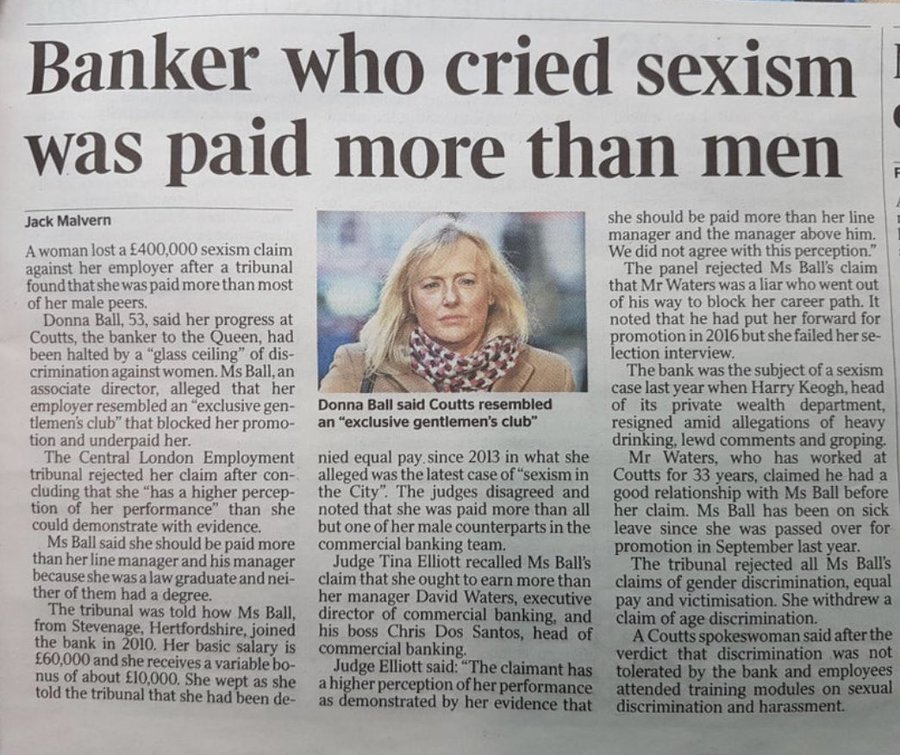
Huge reaction as Toyota shifts away from DEI and pro-LGBTQ events (8 October 2024) Ooh, and a company grows out of the woke thing

Jetstar boss Steph Tully’s plan to change entire Aussie industry (18 September 2024) And now airline management feel the need to bang the feminist drum.

Women and wealth, by Bettina Arndt (19 August 2024)

Does virtue signaling in advertising impress you or depress you? It’s time to take a look at ESG (6 September 2023)

‘Significant concerns’ in Downing Street as NatWest boss quits over Farage leak (26 July 2023)

Weaponising banks against men, by Bettina Arndt (6 July 2023)

NAB takes on financial abuse (26 June 2023)

NAB cracking down on financial abuse (26 June 2023)

Redesign banking products to protect women from financial abuse: Report (22 November 2022)

Bankwest Curtin Research Centre – take a look at their publications and media releases. See if you can find any gender-related topic that isn’t covered in a manner consistent with feminist ideology.

Inconvenient truths about impoverished women and privileged men, by Bettina Arndt (11 April 2021)

Commonwealth Bank launches anti-domestic violence and financial abuse initiative (20 July 2020) Such initiatives can be positive – should be positive – if not for what seems to be a compulsion to ‘white-out’ all trace of abusive women and male victims of abuse.

Young women drain their super accounts (18 June 2020) Australia

Raise women’s super to 15%: Victorian Labor (12 February 2020) The gynocracy warmly welcomes the assistance of fem-compliant governments. Yet another case of #GenderEqualityWhenItSuits

NAB promotes #EndToViolence (November 2017) with further details in their web site

Did Westpac just mansplain gender diversity to its competitors? (26 October 2017) Westpac learns, as have countless male feminists, that no matter how much you pander to feminist nonsense, you will still be subjected to harsh criticism.

Westpac under fire over same sex marriage email (5 October 2017)

“Westpac has been forced to defend an email from a staff networking group telling fellow employees to vote Yes in the same-sex marriage survey, erroneously claiming that doing so would prevent 3000 suicides a year”

What? No, Women Shouldn’t Be Paid More Super Than Men, by Corrine Barraclough (26 May 2017)

Why we’re backing women, by Lorraine Murphy, National Australia Bank (6 March 2017)

Young women can budget in the short term but struggle with long-term investments: survey (14 February 2017) A very gynocentric article, but which does support the value of addressing financial literacy/skill to enhance post-retirement financial status.

Banks preaching about gender wage gap myth, by Rita Panahi (28 October 2016)

Female tech leadership to get $1m boost (4 October 2016)

Shareholders slam CBA’s ‘diversity’ bonus (27 September 2016) Australia

It would seem that National Australia Bank has now jumped on the bandwagon (August/September 2016) See below and here. Perhaps trying to regain their feminist cachet after an earlier #fail

nab

I see that both ANZ and NAB have directors on the board of Diversity Council Australia. DCA are, amongst other things, the organisers of this feminist talk-fest planned for November 2016.

CEOs say women will be promoted and men should get used to it or leave (24 August 2016)

Radical proposal to force bosses to fork out extra super for women (3 June 2016)

Angus Aitken out at Bell Potter after ANZ Michelle Jablko email (26 May 2016) with further background to this episode in this interview with Kate Jenkins

Tweet from Paul Edwards, Group GM Corporate Communications at ANZ. So now it’s forbidden to criticise women in the finance sector (misogyny!). In the words of Miranda Devine: “Where is the sexism? You know what damages women? Cheap virtue signalling PC BS like this”

The Superannuation Gender Gap (21 April 2016) Australia. Related reddit discussion thread here

Australian bank buys into the gender pay gap rubbish (9 April 2016) with related Reddit discussion thread here. Note the observation about the Bank disabling comments on their Facebook page and cleansing earlier comments – as feminists are wont to do.

Australian bank ANZs new ad. Pushing the wage gap myth on children (March 2016) Reddit mensrights discussion thread

‘Blatant sexism’: ANZ’s #equalfuture campaign cleared of discriminating against men (4 September 2015)

ANZ pays women extra super (31 August 2015) A very long-running discussion in the Whirlpool online forum

ANZ bank giving female employees an extra $500 to correct gender pay gap (August 2015) Reddit mensrights discussion thread

ANZ Bank launches a super deal for female employees (29 July 2015)

ANZ pushes its new gender diversity measures in national campaign (29 July 2015)

This article suggests that women might be better off considering the impact of financial literacy on their retirement savings, rather than complaining about the wage gap.

Postscript (19 September 2018) Today Bill Shorten, Australian federal leader of the Opposition, announced a $400 million scheme to support women in relation to their retirement Super balances

Image

My submission to the 2016 Federal Government Inquiry into Domestic Violence and Gender Inequality

Introduction

Thank you for permitting me the opportunity to contribute my thoughts in relation to the work of the Inquiry, and concerning the pressing issue of domestic violence generally.

I believe the Inquiry’s Terms of Reference to be ill-considered, inappropriate, and strongly indicative of ideological bias. In what appears to be akin to a ‘dorothy-dixer’[1] on the floor of parliament, the Terms of Reference appear to have been formulated with the intention of producing a report that simply justifies a continuation of the existing failed gender-biased approach to combatting domestic violence. In so doing it seems that remaining in lockstep with the feminist movement has been accorded a higher priority than actually addressing the problem via constructive debate about the full range of potential causes and solutions of/for DV.

I fully anticipate that the only new development to arise from the Inquiry will be leveraging the Committee’s ‘findings’ in order to be institute progressively higher levels of government funding for the Domestic Violence Industry[2]. Funding for which there will likely continue to be few, if any, controls or oversight in relation to performance monitoring and accountability.

The Committee has opted to pursue a biased, parochial and blinkered approach to a complex social issue about which there are many views but few certainties. It is an approach which, based on nothing more than the cherished belief of one particular lobby group, pre-empts consideration of other, quite likely more relevant, factors.

A strong consensus exists – beyond the confines of the feminist encampment – that several factors jointly bring about patterns of domestic violence. Gender inequality is but one of these. Parental abuse and neglect of children who subsequently grow up to become perpetrators being another. I would join others in suggesting that gender inequality is, in itself, generally a relatively minor factor. Indeed, I believe that in many cases it bears little or no influence at all.

In what has become an established tactic, however, anyone proposing that gender equality is not a pivotal factor underpinning domestic violence is shamed and threatened.[3] [4] [5] [6] The Terms of Reference of this Committee will clearly only strengthen the resolve of those who encourage and pursue such totalitarian and counter-productive behaviour.

Committee members, this is not the type of approach to adopt if you genuinely wish to identify and then win support for truly effective strategies to remedy complex social problems.

Might I suggest that the reference to ‘education’ (in the Terms of Reference) was intended to generate expressions of profuse support from the feminist faithful for further ‘public awareness campaigns’[7] and school programs[8]. This despite the fact that I am yet to learn of any conclusive proof with regard to the value of either of these strategies. Excepting of course their value to those pro-feminist advocacy groups and consultancies who will find themselves in receipt of generous allocations of public funds[9]. Additionally, in both cases I would suggest that a case could be made that such programs also have the potential to bring about certain negative outcomes.

As to diverting the discussion to examine the likely impact of toys and entertainment on the incidence of domestic violence? I feel that would likely constitute a poor investment of time and resources … these being inconsequential yet over-stated minutia in the overall scheme of things.

I reject the following positions in relation to gender equality and domestic violence:

That gender inequality is the primary contributing factor with respect to the incidence of domestic violence in Australia

That the overall picture of gender inequality in Australia is one that strongly favours men/boys

That in the overwhelming majority of cases, domestic violence manifests itself in the form of men abusing women

In contrast, individuals and organisations who ascribe to feminist ideology would count amongst the core supporters of those statements noted above. Bearing that in mind I would suggest that the Committee be mindful of the following:

  • The term ‘feminist’ is not inter-changeable with ‘woman’ or ‘women’ given that only a small minority of women identify as feminists [10]
  • Feminists do not hold any form of mandate to speak on behalf of Australian women
  • Feminists have a strongly vested interest in painting domestic violence as a gendered issue involving male violence towards women, including a substantial and growing pecuniary interest [11]
  • Feminists have a well-established ‘track record’ of engaging in biased and academically flawed research, and in misrepresenting research undertaken by others in order to support their position and/or to undermine the position of those holding alternate views.[12] [13]

These last two dot points imply a need to subject the statements and conduct of feminists and feminist organisations to some reasonable standard of scrutiny, rather than simply accepting them at face value.

Gender inequality as the primary contributing factor with respect to the incidence of domestic violence in Australia

The theoretical cornerstone of the feminist approach is the ‘Duluth Model’ which is discussed in this rather illuminating email exchange[14]this academic paper[15], and in various posts in my blog[16]. In a nutshell, applying this framework to most (let alone all) incidents of DV is highly misleading and inappropriate.

Further, if gender inequality is the single greatest determinant of domestic violence then:

Why is the incidence of domestic violence greater in lesbian couple than in heterosexual couples?[17]

How might one explain the already high and growing levels of female-perpetrated violence generally?[18]

How might one explain the significant geographical variations in the incidence of domestic violence? (refer chart which follows)

Why does there exist a very considerable number of male victims of domestic violence? [19] [20]

How might one explain the relatively high levels of child abuse and neglect involving single mothers? [21]

Why is the level of domestic violence so high in countries like Sweden that, even feminists would agree, have a higher than average level of gender equality?

These categories or situations of domestic violence are not the inconsequential anomalies that many propose them to be. On the contrary, they constitute very large and substantial pieces of the domestic violence jigsaw.

highrateDVareas

In an intimate partnership between two people of different genders, an unequal balance of power can be a factor contributing to DV. But what feminists refuse to concede is that the partner asserting most power need not be male, and often isn’t.

The Inquiry’s Terms of Reference are based on the premise that it is an established and undeniable fact that gender inequality is the predominant factor behind domestic violence. This is absolutely not the case. On the other hand, there are many others in the community who hold differing views – views similar to my own. In this submission I will introduce you to sources of information that very much counter the feminist position of domestic violence.

On the suggestion that the overall picture of gender inequality in Australia is one that strongly favours men/boys

Let’s assume for a moment that gender inequality is in fact the predominant trigger for the initiation of domestic violence. So just how much gender equality is present in Australian society? The feminist position is that there is a great deal of gender equality, and that it is strongly biased in favour of men/boys. I do not believe this to be the case. Feminists have a pronounced tendency to overstate or imagine disadvantages faced by women, whilst conveniently overlooking the many disadvantages faced by men/boys.

The indicator most commonly advanced by feminists to ‘prove’ the existence of gender equality is the gender wage gap. This use of the wage gap statistics for this purpose is misleading has been thoroughly debunked.[22] [23]

The next most commonly cited statistics are those concerning the number of male vs female politicians and CEO’s. Yes there is obviously an imbalance but again this need not be indicative of gender discrimination nor inequality.[24] Indeed if this were the case then surely there would be a Minister for Men’s Affairs, or at least men’s/boys divisions within government agencies – of which there are none.  Not only is there no advocacy for men/boys whatsoever, there exists active discrimination against them in many agencies including for example the Australian Human Rights Commission.[25] [26]

In terms of various other indicators of equality I would draw the Committee’s attention to the material contained in these two overseas sources:

http://philosophyofmensissues.blogspot.ca/2014/10/evidence-re-gender-equality-and-feminism.html

http://www.avoiceformen.com/the-facts-about-men-and-boys/

On the suggestion that, in the overwhelming majority of cases, domestic violence manifests itself in the form of men abusing women

IF gender inequality was the primary cause of domestic violence, and IF there was rampant gender inequality in Australian, and IF that inequality favoured men/boys, then one would expect that almost all cases of domestic violence involved men abusing women. But is this the case? No, it is certainly not the case.

I would draw the Committee’s attention to the sources listed below, with many further sources available online[27]. These all demonstrate that at least one third of the victims of domestic violence are males.

References examining assaults by women on their spouses or male partners: An Annotated Bibliography by Martin S. Fiebert.[28] This bibliography examines 286 scholarly investigations: 221 empirical studies and 65 reviews and/or analyses, which demonstrate that women are as physically aggressive, or more aggressive, than men in their relationships with their spouses or male partners. Here is a link to an updated June 2013 version of Fiebert’s bibliography.[29]

Partner Abuse, Volume 1, No. 1, 2010 The new journal was created to showcase academic research into domestic violence without gender bias[30]

Partner Abuse State of Knowledge Project – Facts and Statistics on Domestic Violence at-a-Glance.[31] Sponsored by the Journal Partner Abuse, November, 2012. This study is also discussed in this article:

Male Victims of Intimate Partner Violence in the United States: An Examination of the Review of Literature through the Critical Theoretical Perspective, by Caroletta A. Shuler (2010)[32] and related reddit discussion thread[33]

Boys Victims of Dating Violence, Too[34] (29 January 2016) USA

Extensive listing of mainly North American research findings related to domestic violence[35] (29 April 2015)

Family violence in Canada: A statistical profile[36] (27 January 2011) This study found an almost equal numbers of male and female victims of DV

Partner Violence as Female-specific in Aetiology[37]

Intimate partner violence: Facts and statistics[38] (1 September 2014) This paper includes some discussion of ‘Patriarchal Dominance’ theory

Domestic violence rates are higher for homosexual couples than for heterosexual couples[39] (18 November 2013)

Differences in Frequency of Violence and Reported Injury between Relationships with Reciprocal and Nonreciprocal Intimate Partner Violence[40] (2006), which includes this statement:

“Almost 24% of all relationships had some violence, and half (49.7%) of those were reciprocally violent. In non-reciprocally violent relationships, women were the perpetrators in more than 70% of the cases.”

The graphic that follows, for example, was sourced from a Canadian organisation (www.saveservices.org). Interestingly, broadly similar patterns of perpetration have been observed in the UK, USA, Australia and Canada (although Australian lags somewhat in terms of the information available on male victimisation/female perpetration).

women_as_abusers


In closing I would invite members of the Committee to take a few moments to also read my submission to the recently-released Victorian Royal Commission on Family Violence[41], given that that document provides further relevant background information concerning certain matters that will also likely be addressed in this current Inquiry.

I wish the members of the Committee well in their endeavours, and I sincerely hope that the concerns I have expressed in this submission prove to be unfounded.

[1] https://en.wikipedia.org/wiki/Dorothy_Dixer

[2] http://www.fighting4fair.com/uncategorized/so-what-exactly-is-the-domestic-violence-industry/

[3] http://www.fighting4fair.com/uncategorized/a-message-to-supporters-of-the-white-ribbon-campaign-feminist-version/

[4] http://www.fighting4fair.com/uncategorized/sallee-mclaren-must-write-on-the-blackboard-i-must-not-challenge-the-feminist-narrative-domestic-violence/

[5] http://www.mamamia.com.au/miranda-devine-unsuitable-women-article/

[6] http://www.fighting4fair.com/uncategorized/beware-the-ire-of-an-angry-feminist/

[7] http://www.fighting4fair.com/uncategorized/two-awareness-campaigns-only-one-can-be-criticised-cowed-by-feminism/

[8] http://www.fighting4fair.com/uncategorized/no-place-for-feminist-propaganda-in-our-schools/

[9] http://www.fighting4fair.com/uncategorized/so-what-exactly-is-the-domestic-violence-industry/

[10] http://www.fighting4fair.com/uncategorized/some-indicators-that-feminism-is-no-longer-worthy-of-trust-or-support/

[11] http://www.fighting4fair.com/uncategorized/so-what-exactly-is-the-domestic-violence-industry/

[12] http://www.fighting4fair.com/uncategorized/fudging-the-figures-to-support-the-feminist-narrative-domestic-violence/

[13] http://www.fighting4fair.com/uncategorized/on-blocking-out-non-feminist-perspectives-and-opinions/

[14] http://www.naasca.org/2015-Articles/032915-TheDuluthModel-JasonDale.htm

[15] http://ncfm.org/libraryfiles/Children/DV/Gender%20Paradigm%20In%20Domestic%20Violence.pdf

[16] http://www.fighting4fair.com/#Domestic Violence

[17] http://www.breitbart.com/london/2015/05/07/attack-of-the-killer-dykes/

[18] http://www.fighting4fair.com/uncategorized/on-the-recent-increase-in-violent-crime-carried-out-by-women-and-girls/

[19] http://www.fighting4fair.com/uncategorized/domestic-violence-one-sided-media-coverage-and-bogus-statistics/

[20] http://www.fighting4fair.com/uncategorized/on-the-experience-of-male-victims-of-domestic-violence/

[21] http://www.fighting4fair.com/uncategorized/mostly-female-perpetrators-so-child-abuse-is-a-gendered-crime-then/

[22] http://www.fighting4fair.com/uncategorized/the-myth-of-wage-disparity/

[23] http://www.fighting4fair.com/uncategorized/that-tired-old-feminist-chestnut-that-is-the-gender-wage-gap-resurrected-in-australia/

[24] http://www.fighting4fair.com/uncategorized/less-than-5050-representation-does-not-automatically-imply-gender-bias/

[25] http://www.fighting4fair.com/uncategorized/gender-bias-at-the-australian-human-rights-commission/

[26] http://www.fighting4fair.com/uncategorized/australian-taxpayer-funded-organisations-that-do-littlenothing-for-men/

[27] http://www.fighting4fair.com/uncategorized/domestic-violence-one-sided-media-coverage-and-bogus-statistics/

[28] http://www.csulb.edu/~mfiebert/assault.htm

[29] https://j4mb.files.wordpress.com/2014/03/140901-martin-s-fiebert-bibliography.pdf

[30] http://www.responsiblerecovery.org/PDF/PartnerAbuse.pdf

[31] http://www.domesticviolenceresearch.org/pages/12_page_findings.htm

[32] http://fathersunionaustralia.com/wp/partner-abuse-state-of-knowledge-project-the-gold-standard-of-domestic-violence-information/

[33] http://np.reddit.com/r/todayilearned/comments/37t7cp/til_that_47_of_male_victims_of_domestic_abuse_are/

[34] http://www.medicinenet.com/script/main/art.asp?articlekey=193363

[35] http://www.mrarchivist.com/frm_display/explore/?item=&topic=Intimate%20Partner%20Violence&nation=United%20States

[36] http://www.statcan.gc.ca/daily-quotidien/110127/dq110127a-eng.htm

[37] http://www.newmalestudies.com/OJS/index.php/nms/article/view/149

[38] http://www.sciencevsfeminism.com/resources/intimate-partner-violence-facts-and-statistics/

[39] https://winteryknight.wordpress.com/2013/11/18/domestic-violence-rates-are-higher-for-homosexual-couples-than-for-heterosexual-couples/

[40] http://ajph.aphapublications.org/doi/abs/10.2105/AJPH.2005.079020

[41] http://www.fighting4fair.com/uncategorized/submission-to-the-victorian-royal-commission-on-family-violence-may-2015/

Regarding the report of the Victorian Royal Commission on Family Violence

My initial blog post on this issue, which includes a copy of my submission, can be accessed here. The final report of the Royal Commission can be accessed here. (Oh, and here’s the latest Victorian DV ‘initiative’ as of February 2024)

Men constitute a demographic group the same size as do women. The Commissioners admitted that one in four victims of DV are male (although that’s understating the correct figure). And yet here we see the discussion of male victims tucked away in a section of the report dealing with the needs of various minority groups. I recently observed the same approach being taken in the recent Queensland DV Inquiry.

Still it could have been worse, for male victims didn’t even rate a mention as constituting even a minority group in the Issues Paper produced by the Commission in March 2015 (refer clause 35).

And so in the final Royal Commission report a sub-section entitled ‘Male Victims’ can be found in Volume 5, which includes discussion of each of the following affected groups in the community:

Aboriginal and Torres Strait Islander peoples (60 pages)
Older people (32 pages)
Culturally and linguistically diverse communities (32 pages)
Faith communities (10 pages)
Lesbian, gay, bisexual, transgender and intersex communities (26 pages)
People with disabilities (38 pages)
Male victims (10 pages)
Rural, regional and remote communities (22 pages)
Women in prison (14 pages)
Women working in the sex industry (8 pages)

(Men in prison and men working in the sex industry are apparently exempted from involvement in family violence).

At ten pages in length the ‘Male Victims’ sub-section constitutes 0.48% of the bulk of this mammoth 2,082 page report, and features only two of the report’s 227 recommendations. The Commission’s report, by the way, cost $13.5 million.

Recommendation 180. The Victorian Government publicise and promote the Victims Support Agency in any information campaign relating to family violence as the primary source of assistance for male victims. The agency should also provide appropriate online resources for male victims [within 12 months].

Recommendation 181. The Victims Support Agency continue to receive all police referrals (L17 forms) relating to male victims, including after the establishment of the Support and Safety Hubs. The agency and all other relevant support services should develop joint arrangements to ensure that male victims of family violence are supported in obtaining the help they need [within two years].

Forgive me, but after reading these, the earth isn’t exactly moving for me. You’d think that if the Commissioners were only going to allocate two recommendations specifically in relation to the needs of male victims, then they might have come up with something a little more incisive and substantial than these.

One only has to read as far as the second paragraph of the ‘Male Victims’ section to see male victimisation being minimised. Do you recognise the following gem of many earlier pro-feminist reports/papers on domestic violence?

“Violence by women towards male partners is generally less severe than that of men towards their female partners.” (No citation provided)

On p209 I note the statement “A lack of data makes it difficult to determine the extent of the service gap for male victims of family violence.” And yet no subsequent recommendation that suitable research be undertaken.

Then on p210 “A number of men expressed a particular sense of injustice in connection with family violence intervention orders. In particular, some said the justice system was unable to differentiate between ‘true perpetrators’ of family violence and those men who were ‘set up’ by a female partner.

Conversely, the Commission heard that it was common for male perpetrators of family violence to blame their situation on unfair legal processes, rather than accepting responsibility for their own behaviour.” (The latter attributed to community legal service with no evidence provided of statistical validity)

My initial impression of the report prior to undertaking a more thorough reading?

I’m disgusted. By no means surprised. But most definitely disgusted.

With regards to its treatment of male victims, the Commission’s report represents nothing more than a token effort at providing a semblance of the level of support and compassion provided for female victims of domestic violence.

We really do still have a very long way to go to achieve gender equality and justice in this regard.

The most positive aspects of the report I can see thus far are that:

    • Some attention was given to the need for greater oversight, review and performance measures in the provision of domestic violence services. This is an issue that I addressed in both my submission, and in my blog post in relation to the Domestic Violence Industry.
  • Some attention was given to the significance of the impact of domestic violence (and presumably child abuse and neglect) on children with regards to its effect in creating a generational cycle of abuse. This is, I believe, a causal factor which is far more significant that gender inequality. (Postscript: Unfortunately however it seems that the rapporteurs have even managed to apply gender bias to this issue – see comments below from Greg Andresen of the One in Three organisation)

Update as of 24 Sept 2023: Family violence roles axed in public service purge

Update as of 6 March 2022: Anti-male gender bigotry is now VIC Gov’t policy

Update as of 29 May 2024: Victorian Premier Jacinta Allan creates social media backlash by creating new new role of Parliamentary Secretary for Men’s Behaviour Change

See also:

Victorian budget 2017: record spending to break family violence (2 May 2017)

Video and discussion thread concerning a gender-biased advertising campaign (17 January 2017)

Victoria Is Spending More Money On Domestic Violence Than The Federal Government (15 July 2016)

Urgent Family Violence Investment Will Help Keep Women And Children Safe (13 April 2016) Only one mention of the word “men” here, and that is in relation to behaviour change programs fos abusive men. Male victims and/or female perpetrators? Erased

‘Silent victims’: royal commission recommends better protections for child victims of family violence (1 April 2016)

Minister for Prevention of Family Violence needs to think about her own family history (1 April 2016)

Family Violence royal commission proposes policing, social services, courts overhaul (31 March 2016)

neave

Royal Commission into Family Violence: fixing the culture starts now (31 March 2016)

Royal commission calls for complete overhaul of Victoria’s family violence services and responses (30 March 2016)

Family violence: Portrait of an abuser (30 March 2016)

Royal Commission into Family Violence: what you need to know (30 March 2016)

Examples of where the feminist lobby pushed to have gender inequality addressed in situations where the status quo favored women

<< Sound of crickets >>

Oh come on, someone throw me a bone … I’m serious … after several years and more than 2,000 hits on this page, not one person has come up with an example. For pity’s sake, there must be at least one example of feminists speaking up against gender equality favouring women that I can showcase here.

Please … otherwise people are going to think that feminists are more interested in female privilege than gender equality

Well until such time as an example is provided, how about we broaden things out? Let’s consider some issues that are/were claimed to promote gender inequality, but where feminists said/did nothing until such time that significant numbers of women were affected. Hmm, for example: alimony or spousal support, expulsion from university due to an allegation of sexual misconduct (example),  the nature of enforcement for those not paying court-ordered child-support, retirement age, and pre-nuptial agreements.

Plight of the Waspi women: Labour calls for women’s retirement age to be lowered to 64 (24 September 2017)

Pension entitlement age: ‘Women march in Scotland because they’re being treated like men’ (17 September 2016) Reddit discussion thread with linked article

I think part of the answer to this is that, to a feminist, an area where women are advantaged relative to men is not seem as inequitable (let alone, a privilege) but rather as reasonable compensation for all the other areas where they believe women are still disadvantaged.

See also:

For every 100 girls (2023 Update) by Prof. Mark J. Perry

Women lose state pension age appeal against government (15 September 2020) UK

Sturgeon mocks Tory MSP for raising ‘male pay gap’ (30 June 2017) UK

Jennifer Lawrence and Chris Pratt’s pay gap (16 June 2016)

Would anyone like to suggest other issues to consider here?

Elsewhere in this blog you might also be interested in reading:

If the central tenet of feminism is equality then what men’s/boys causes have feminists championed recently?

Gendered, gendered, gendered: The word that fuels the feminist machine

Few of those reading this would be unfamiliar with the feminist proclivity for labelling a plethora of issues as ‘gendered’. Like many terms it doesn’t mean much without considerable qualification. And even then it may not mean much. But if something can’t be portrayed as being gendered then feminists and their beloved narrative lose traction.

The Merriam-Webster dictionary defines ‘gendered’ as “reflecting the experience, prejudices, or orientations of one sex more than the other.” The problem though is that in real life there are relatively few things that only (or even predominantly) affect one gender. In most situations both genders wield a significant influence and/or are significantly affected. We’re all in it together. One topical example would be online harassment.

Let’s now look at an even more contentious issue, child abuse. Most non-sexual child abuse and neglect is perpetrated by women. Most sexual abuse of children is perpetrated by men (although there are still plenty of sexual abusers of children who are female). So is child abuse gendered? And in terms of framing remedial action, is it more or less productive to attack child abuse as a gendered issue?

The straw that broke this camel’s back today was an article entitled Australia’s most shocking statistic: Sexual abuse and domestic violence against women with disabilities by Ginger Gorman. The tagline was the shocking announcement that 90% of disabled women have been sexually assaulted during their lifetime.

Ginger’s article tells us that most abuse takes place in institutions, yet makes no mention of the abuse of disabled men/boys. She then provides some examples of incidents of abuse involving male perpetrators in non-institutional settings. The actual gender mix of perpetrators of abuse, in either institutional or non-institutional settings, is left unstated.

In the absence of further details it’s highly likely that readers would have assumed that most victims of abuse were female, and their abusers male. Such is the inevitable outcome of persistent gender bias in the media on top of decades of gynocentric conditioning.

This is despite that fact that there are certainly instances where research has found most perpetrators of abuse to be women. One such example can be found in the Adele Mercier incident, whereupon a feminist academic wrongly denied female perpetration of institutional abuse.

This selective presentation of statistics – only showing the extent to which women are affected, and in the absence of comparative statistics for men and boys – is extremely common in feminist literature. This problem is discussed further in a separate blog post about feminist research and their misleading use of statistics.

The source document for the 90% abuse claim was a submission by the Australian Cross Disability Alliance. I found the relevant reference in the section entitled ‘Incidence & prevalence data on gendered disability violence‘ (page 37). Despite asserting that the abuse was gendered, this section provided no comparative statistics whatsoever in relation to the abuse of men/boys.

How is that appropriate in terms of either compassion or academic rigour? I mean, is this a case of just ‘trust me, I’m a feminist’?

I then took the matter up with the author of the article in a series of exchanges on Twitter including the following:

gorman3

Look, don’t get me wrong, the most important thing here is to effectively reduce the incidence of child abuse. The rest is second-order stuff. But I honestly don’t see that goal being significantly advanced via the blinkered and self-serving approach taken by feminists. As with domestic violence, framing a solution to half a problem translates into no solution at all.

Oh, and colour me surprised – see below for how this episode ended.

How could anyone take feminism seriously when one is constantly reminded how infantilised its followers have become?

oldwhitemen

gorman


See also:

UK charity for the homeless, ‘Shelter’, doesn’t specify gender of the homeless – 90% of whom are male (9 November 2017) Hardly a coincidence

How to make anything a gendered issue, by Blaise Wilson (30 April 2017) Video

The following are some of the other posts in my blog that are also relevant to this issue:

Persistent pro-feminist and anti-male bias in the mainstream media
More assaults at aged care homes
The unbearable lameness of being
How tragic that feminists ignore their role in demonising men

whitemaleold


Advocating for men/boys online: Is there benefit to be had in one-on-one interaction with feminists online?

TLDR: I provide the following post for the interest of those sympathetic and/or active in promoting MRA, rather than to provide some kind of a ‘slap in the face’ to those opposed to it. So, based on my experiences to date, do I think that there is a net benefit in interacting with feminists and/or White Knights on social media? My answer to that is an unequivocal ‘no’.

I have noticed some MRA’s spend a great deal of time providing information and/or trading barbs with feminists online. My own online interactions with feminists and their allies have been singularly unproductive. They very rarely provide interesting alternative perspectives or leads to useful sources of information. Instead they offer a narrow and predictable range of ad hominem barbs and child-like taunts, often immediately followed by blocking you.

After these exchanges I get the feeling that I have achieved nothing more than diverting time and energy away from those other things that might have been tackled in the limited time available – for example, targeted lobbying, preparing submissions, etc. Occasionally I’ve also had to expend further time afterwards dealing with subsequent unfounded/exaggerated complaints to moderators, Facebook, etc.

It’s for this reason I prefer to contribute in public forums (e.g. online discussions of articles in MSM) where I try to raise awareness amongst the general public of specific men’s issues, and of related sources of information. Here you find many ‘fence sitters’, who are somewhat curious about gender issues and open to new ideas.

But perhaps if we look at a couple of case-studies:

In this first example what began with a little banter in relation to one of my blog posts, ended with a door slam. mangina3

Followed soon thereafter by:

mangina

This second example demonstrated pretty much the same pattern as you can see in these few screen grabs:


Anyway I thought I’d take this opportunity to put the question to far more seasoned campaigners than I … once you add up all the time and energy spent dealing with individual feminists, is there a net benefit to be had? Were they interested in your facts? Have you won over any hearts and minds?

blocking

Or have you just found yourself, time and time again, switching off your laptop late for dinner … tired and frustrated and thinking that there must be a better way?

If only feminists could play a banjo like this


Re-instatement of the Women’s Budget Statement in Australia? Bring it on, but consider men too

In an earlier blog post I briefly examined a number of pro-feminist organisations in Australia, noting (in part) the extent of public funding received by each. My post on the Domestic Violence Industry also identified another substantial sump for both government funding and private donations.

Despite the fact that I only scratched the surface in relation to identifying such organisations, the extent of state and federal funding involved already amounted to hundreds of millions of dollars each year.

Wouldn’t it be interesting if someone could tally up all the public funds that are directed towards the welfare of women/girls? And then go through a similar exercise in relation to funding for men/boys. To what extent do you think the two amounts would be comparable?

Well, until 2013 the Australian federal government did something a little similar. It was called the Women’s Budget Statement. I’m not sure why it was terminated, but perhaps it was found that the data it provided was unreliable and/or otherwise unhelpful in comparison to the annual cost of compiling the Statement. Another possibility was that it identified so much expenditure directed towards women that it’s value as a sop to the feminist lobby was eclipsed by the potential it posed for an angry voter backlash.

(Newsflash: It’s back … Women’s Budget Statement 2021-22), Budget Statement 2022-23 and 2023-24)

In Wales (U.K) someone did the maths and found that women’s groups/causes were handed 77 times as much funding as were men’s groups/causes.

By way of background here are some links to historical information concerning the previous version/s of the Women’s Budget Statement:

http://apo.org.au/files/Resource/grb_sharpbroomhill_australia_updf_final_copy_copy.pdf

http://www.gender-budgets.org/index.php?option=com_content&view=article&id=46&Itemid=112

http://apo.org.au/research/budget-2014-15-gender-lens

https://www.dss.gov.au/sites/default/files/documents/05_2013/dfh035_13_budget_tagged.pdf (Women’s Budget Highlights as mentioned in this article)

What prompted me to write this post today was the publication of ‘Gender neutral policies are a myth: why we need a women’s budget‘, by academic Miranda Stewart. I would recommend taking a moment now to read that article and the readers comments that follow it (or at least those that were not removed by the moderator).

Miranda thinks that the community would benefit from the re-instatement of the Women’s Budget Statement. The author justifies this gynocentric bias, at least in part, on the existence of the much-discredited gender pay gap. I believe it would be far more equitable and effective (as a policy development tool) if there was one combined document that considered the impact of federal expenditure on both men and women.

Another point of difference between what Miranda has in mind, and what I envisage, relates to the nature of the information provided. Miranda wants to see an assessment of the economic impact, on women, of a wide range of government policies. I am not convinced how accurately such impacts could be assessed, nor to the extent it could be kept free of the gender bias and ideological tweaking that is now rampant across the Australia public service.

I would be satisfied with something simpler, merely a listing of specific programs or allocations that were directed towards (or could be determined to benefit) alternately either boys/men or girls/women. This in itself would be a difficult task, as many such allocations are hidden, for example, deep within departmental budgets.

In other cases, allocations which would appear to be gender-neutral could be determined on closer analysis to strongly favor one gender in relation to the other. An example of this would be funding for the Australian Human Rights Commission.

This suggestion is noted in another article (refer point 5), although I think Claire Moore, Shadow Minister for Women, probably has different priorities in mind.

So where would one make a start on creating such a spreadsheet? Well I’ve already mentioned the various organisations listed in my blog post about misandric agencies. We could expand that initial list by considering each of the members of the Equality Rights Alliance, Australia’s largest network of organisations with an interest in advancing women’s equality. From then on it would be a matter of relentless burrowing through budget papers seeking relevant allocations.

The intention would be to combine the total funding received by each organisation and compare that figure with total annual funding for boys/men’s groups and issues. Although larger in magnitude I imagine that the women’s budget would be somewhat easier to compile given that there are specific ministries and sections with agencies that deal with women’s issues.

I would wager that there is absolutely no chance that the expenditure ratio would match the ratio of males/females in the Australian population, with an overwhelming bias towards the welfare of girls/women.

As an aside bear in mind that men, both individually and through the corporate entities they own, contribute far more than 50% of the government’s income. Click across to this blog post and scroll down to ‘taxation’ to see some relevant sources. Would it not be more equitable if the default setting was that half of government expenditure was subsequently utilised to support the interests/welfare of men and boys?

I believe that such a process of financial analysis would not only identify a massive and inequitable gendered imbalance in government funding, but it would also identify enormous waste and duplication. I wonder just how many indulgences like this are out there waiting to be uncovered?

If I am correct and there is a substantial favouring of females over males, how can this be justified? Barring the absence of incontrovertible evidence of overwhelmingly greater need, across the board, this would be indicative of neither gender equality nor prudent governance.

Certainly priority should be given to the area/s of greatest genuine need. And of course there will be areas where women’s needs are greater than mens (and vice versa). Thus note that I am not suggesting for a moment that one would seek to religiously apply a 50% split to every government program in Australia.

But humor me and suppose that a detailed and objective analysis did find that vastly more support was accorded to women/girls across all of government? And that meanwhile funding was urgently required to meet the demonstrated needs of men/boys?

Let’s find out. Otherwise, sorry, not good enough. Not by a long shot.

See also:

Australia’s Federal Budget Forgets Men, by James L. Nuzzo (3 April 2025)

The launch of ‘Gender Budget Watch‘ (30 April 2024) within the website of ‘Gender Lens Australia’ 

Gender responsive budgeting‘. Latest material from the Australian Department of Prime Minister and Cabinet (November 2023)

The Australian Government’s Women’s Budget Statement 2023-24 intentionally erased the one third of victims of intimate partner violence who are male (May 2023) Tweet issued by the One in Three group.

$2.1 Billion Budget Package for Women and Girls (30 March 2022)

Federal budget: Katy Gallagher announces abolition of ‘pretty punitive’ ParentsNext program (5 May 2023) “What Katy Gallagher has declared as the best federal budget for women in more than 40 years“. And for men/boys? The sound of crickets.

Is it time Australia had a Men’s Budget? (28 October 2022)

The women’s budget is headed in the right direction. But the policies still need work and The women’s budget statement signals a massive shift in how federal budgets are formulated and framed (26 October 2022)

Budget details released on 25 October 2022, with a plethora of programs for women. The word ‘men’ does not appear once in this statement, but #GenderEquality! … blow whistle and wave streamers, blah blah.

Women’s Budget Statement 2022/23 (29 March 2022) and Creating opportunities for women to fulfill their potential

Grants and Funding – Department of the Prime Minister and Cabinet – An example of one of almost countless sources of public funding for feminists and other women (November 2021)

2021-labor-womens-budget-statement.pdf (alp.org.au)

Dear Josh, here’s what women really want from the budget (3 May 2021) “Last year’s budget was widely criticised for leaving women behind“. Really? Not by anyone I know, that’s for darn sure.

Now even the budget is a tool of the Coalition’s evil oppression of women. Apparently … (23 April 2021)

‘Gender ignorant’ treasurers leave Australia lagging behind in women’s equality, equity advocate says | Gender | The Guardian (29 January 2021) Read about the feminist version of reality

Backing Aussie startups owned and led by women (7 December 2020) 

ICMI20: Eccentrik Hat – “Why Men Need Help And Why Feminism Won’t Help Them” – YouTube (18 November 2020) Hello!

Payne defends budget measures as gender neutral (19 October 2020)

Some information posted on Twitter about provision for women in the 2020 budget

Treasurer, a tiny $240 million for ‘women’s economic security’ is insulting (6 October 2020) Another typical feminist article that makes no effort to provide context for the claims made based on a comparative analysis of benefits solely for men & boys.

Each budget used to have a gender impact statement. We need it back, especially now (30 September 2020)

Who’ll most benefit from tax cuts? Rich men. We need gender-responsive budgeting, now (16 September 2020) And once again, ‘applying the gender lens’ means exclusively focusing on real & imagined budgetary impacts on women

Women, older Australians were most likely to receive the Morrison government’s $750 stimulus payments (16 September 2020)

Calls for female-focused budget as women face financial ‘gender disaster’ (16 August 2020)

How the Australian Budget process is failing women (2 April 2019). Apparently we need “Gender responsive budgeting” and “women’s economic needs demand more frequent and intense intervention”. Yes, and for men/boys … well, oh, let’s not go there, right?

Women’s Economic Security Statement (19 November 2018)

“A priority for the Australian Government is to create the right economic settings for women to help them participate in work, increase their economic security and give them meaningful choices about their lives.”
 

The Queensland government produced a Women’s Budget Statement (6 July 2017)

Women’s group call for gender aware budget (22 May 2017) Australia. They are not calling for a “gender aware budget”, they are calling for a female-aware budget … no mention whatsoever is made of looking at the impact of the budget on men. More of the same here and here.

Gender Lens on the Budget 2017/18 (undated) Australia. We need something like this to look at the impact of the budget on men (shame this one didn’t address both genders)

Interview with Australian Minister for Foreign Affairs, Julie Bishop (24 January 2017) The financial analysis I spoke of earlier would need to encompass foreign aid, which is increasingly gender-focused towards women/girls.

Only men pay taxes (8 October 2016) Video. On the issue of the gendered impact of the current taxation regime see also this blog post

Research finds that as a group, only men pay tax (8 September 2016) Wouldn’t it be interesting to run a rigorous financial analysis here in Australia to see if the same pattern was evident?

Despite the rhetoric, this election fails the feminist test (28 June 2016), by Eva Cox

Women left behind by a budget that does little to redress inequality, by Eva Cox (5 May 2016) Well if women were left behind in the Budget Eva, what say you about men and their issues?

The Distribution of Income and Fiscal Incidence by Age and Gender: Some Evidence from New Zealand (2013)

womensagenda.com.au/…/each-budget-used-to-have-a-gender-impact-statement-we-need-it-back-especially-now

A feminist laments: “Why do so few men turn up to hear women speak?”

An article by Ruby Hamad has leapt to the front of the field in my ‘Foolish Feminist Articles of 2016’ competition. It’s entitled ‘Why do so few men turn up to hear women speak?’. That’s the question, but we don’t have to read too much before we realise that Ruby already knows the answer … men don’t attend because they are disinterested or even contemptuous of women’s issues.

I beg to differ as I think that many men are keenly interested in women’s issues, if only because in most cases these are actually shared issues. It might surprise Ruby to learn that many advocate s for men’s rights were originally very supportive of feminist principles … prior to realising the chasm between dictionary feminism and feminist strategy/priorities IRL. In terms of showing contempt for the opinions of people of other genders, well with feminists I’d say that’s very clearly a case of ‘pot-kettle-black’.

The focus of Ruby’s article was a particular event, the All About Women Festival. “It’s a full day of talks and discussions about ideas that matter to women and provides an important platform for women’s voices … So, invite your friends, your colleagues, your best friend or your sisters.”

Ruby notes “It is astounding to me that men think they have little gain from an event such as this. Men need to hear first-hand what the world is like for women. Men need to listen while women speak.”

Anyhow let’s move on to consider the real reasons why men might have avoided this event, and other similar events in general. I’d also heartily recommend that readers consider the opinions of others as expressed in two related Reddit discussion threads here and here.

The first and most obvious answer is that men/men’s groups weren’t specifically invited to attend the event, a feminist event which is clearly presented as being about women and women’s voices. It’s hardly surprising that men might be disinclined to attend for fear of causing upset by intruding on a womens safe space. In other words some men may not have attended the event out of respect for women.

Secondly, feminist’s have a history of telling men who attend their events to keep their mouth’s shut, even in the case of men who identify as feminists. Why then would men wish to attend an event where they would be denied the opportunity of full and active participation, or perhaps even singled out for abuse?

Here’s one of countless examples of that occurring:

“Professor Tompkins praises Jill Johnston (author of the 1973 classic Lesbian Nation: The Feminist Solution) for being “what was then called a ‘ball-buster’: a take-no-prisoners, man-hating dyke”:

There’s even a key scene in the film when she gets really mad at a man in the audience and gives him an intense ball-busting dyke response to what simply seems to be his presence. She says: “Like, I feel a hostile male element in here and it’s bothering me…I don’t mind guys being here but I feel a hostile male element and, um, that’s making me, that’s making me agitated.”

When the young man attempts to engage her she explodes at him: “You better get the f–k out of here or I’m going to kick you right in the balls and get you out of here so fast man…. I don’t like your generalizations, man…. So sit down, shut up, or get out. I feel a hostile male vibe in here, and I don’t like it….You don’t feel it and I feel it. You feel something different than I feel!” (Source)

Thirdly, feminist’s themselves rarely attend events discussing mens issues unless to deliberately disrupt the proceedings, and usually after their earlier attempts to have the event cancelled failed (using lobbying and misinformation campaigns). Go ahead and google on ‘feminists disrupt mens event’ to rustle up some examples (here’s something to get you started). Clearly the notion that ‘women need to listen while men speak’ doesn’t fly. Can’t feminists just be grateful that men don’t stoop to reciprocating feminist’s own actions?

Fourthly, feminists, both individually and collectively, routinely use many and varied forms of censorship to block and silence men who endeavour to reach out to women to tell them what the world is like for men. Details in this blog post.

Does anyone else think the underlying message of this article is that feminists have ‘all rights and no responsibility’ when it comes to presenting their case?

And in case anyone thought that only Australian feminists would be sufficiently detached from reality to complain about men not wishing to attend feminist events, here is an example from the northern hemisphere:

SXSW’s Online Harassment Summit was just one more place for men to ignore women – Good solutions found a small audience (13 March 2016)

“Soraya Chemaly of Women’s Media Center remarked toward the end of a panel about women in the media: “It’s mainly women in this room. Probably we don’t need this information.”

Yes, I’m sure women know it all already. Gee, I bet that event would have been loads of fun if the other attendees were all as arrogant as Soraya.

In closing Ruby, maybe this article provides all the answers you need.

See also:

Football star calls out men for silence on abortion rights (25 June 2022) “American football star Megan Rapinoe has called out men’s silence following the US Supreme Court’s decision on abortion rights”. And thus suddenly men are criticised for *not* expressing their views on women’s issues.

From Sex War to Family Union: an interview with Neil Lyndon (6 January 2022)

AGAR: A man disagreeing with a woman isn’t always mansplaining | Toronto Sun (9 August 2021)

We should have the right not to like men (10 September 2020) and The Woman who hates men so much – she wrote a bestseller about it (11 September 2020)

Men, please stop hijacking women’s issues (18 October 2017)

The Feminist Far Left Is Making More Enemies Than Allies, by Claire Connelly (16 March 2017)

Sydney Girls High School prefects hit back after Sydney Boys’ viral video‘ (13 March 2017)

Dear men: Here is your engraved invitation to join the Women’s March on Washington‘ (14 January 2017) See related Reddit discussion thread here

Munk Debates: The End of Men, by Leslie Loftus (21 November 2013)

How a feminist debate was derailed by asking all men to leave (4 December 2012)

Image

On suicide

One of the defining features of the present-day feminist is their lack of compassion for the welfare of men/boys. This was again driven home to me this morning when I read an article ‘Suicide isn’t just an older man’s problem‘ (sub-titled ‘Suicide is increasing among young people, especially women‘).

The topic of men is dispensed with in a single paragraph (para 8):

“Historically, suicide in Australia has been largely seen as a male problem, with men, particularly middle-aged men, frequently identified as a high risk in our national strategies. Projects have focused on workplaces such as the construction industry, and men’s information resource centres. In men over the age of 25, rates are higher than those among younger women; however, with the exception of men aged between 55 and 64, these rates appear to be relatively stable.”

The bulk of the article is about women and young women, and how serious the problem of suicide is for them.

In this article today the authors only acknowledge the issue obliquely, by way of saying that ‘yes it’s a thing, but it’s not just about men’ … before proceeding to make it all about women. Seriously?

And so we have a serious social problem that disproportionately affects men, but which is largely ignored in feminist literature. On the odd occasion the male suicide issue is mentioned, the problem is essentially blamed on men, for e.g. masculinity, and the pressure imposed by gender roles.

A common theme is that the key to better means mental health is men opening up and talking to people. Oftentimes this is expressed in a simplistic and sometimes condescending way, viz. if only men would act more like women … problem solved.

Yes many, but not all, men might benefit from verbalising their concerns, but much more than that is needed. Systemic and cultural changes that acknowledge the value of men, and initiatives to address the myriad issues raised elsewhere in this blog. Measures that would act as a counterweight to the prevailing gynocentric bias. That’s the scale of action required to make substantial progress towards a remedy.

Oh, and take a look at this article in The Guardian … “Figures show more than one in 10 prison suicides are by women”. The other nine? Nothing to worry about.

ImageSee also:

Journal article regarding suicide by physicians – displaying female bias (26 February 2025)

DEI is killing people, by Bettina Arndt (14 February 2025)

The epidemic of male suicide in Australia, by Augusto Zimmermann (15 August 2024)

Rising number of domestic abuse victims taking their own lives, figures suggest (14 March 2024) Zero mention of the gender ratio of victims

Narrow escape for Lisa Wilkinson (25 November 2023) Scroll down to the section dealing with an ABS suicide chart

Lynching of men is our national sport, by Bettina Arndt (11 November 2023)

Australia is in the grips of a health epidemic we’re ignoring, despite the potentially fatal consequences (15 October 2023) No mention of gender differences in this article, which is now typical for the MSM. Unless the picture that would be portrayed supported feminist principles, then gender is rendered invisible.

Child abuse involving a female perpetrator is more likely to lead to suicide (30 May 2023) Twitter thread

A Researcher Studied The Most Common Last Words Of Suicidal Men (2 April 2023)

Man who jumped to death at Disneyland was principal accused of child endangerment (5 December 2022)

The true cause of male suicide (20 September 2022)

Only 16% of Washington’s Social Workers are Male – and It’s a Real Problem (15 July 2022)

Girlfriend told man to ‘kill himself’ before he committed suicide (8 April 2022)

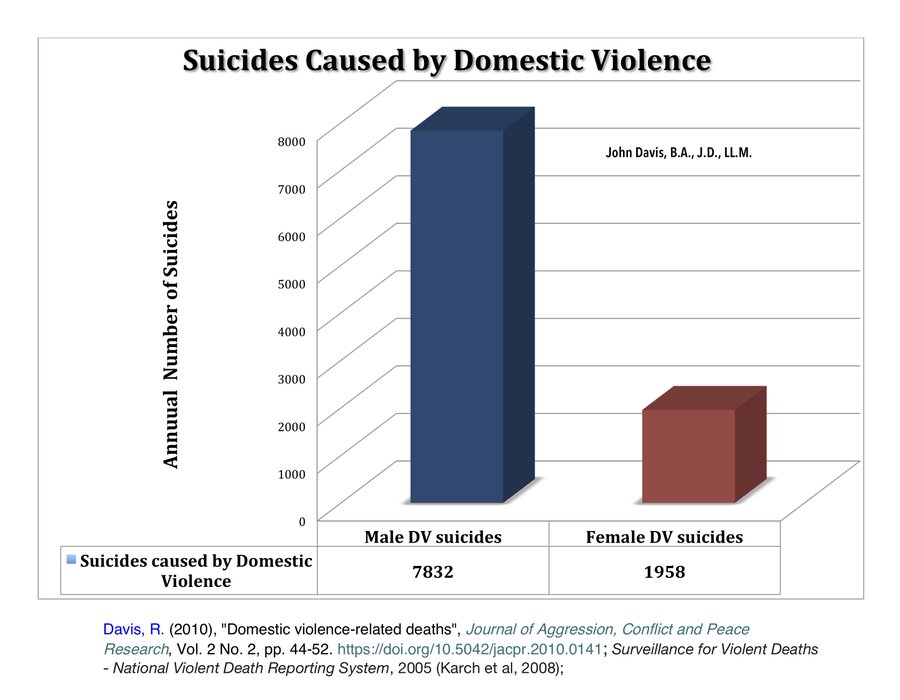
Suicide by domestic violence: call to count the hidden toll of women’s lives (27 February 2022) Little mention of the fact that many men also die by suicide as a result of their victimisation. Indeed it’s claimed that 90% of suicides as a result of DV are female.

Why would you stand up for men and boys? Milgram’s message of hope to male psychology (2 December 2021)

If More Men Are Seeking Help for Mental Health, Why Are So Many Dropping Out of Therapy? — The Latch (15 June 2021)

Men’s Dropout From Mental Health Services: Results From a Survey of Australian Men Across the Life Span – Zac E. Seidler, Michael J. Wilson, David Kealy, John L. Oliffe, John S. Ogrodniczuk, Simon M. Rice, 2021 (sagepub.com) (27 May 2021)

Man cleared of rape killed himself fearing ‘rapist’ label would ‘never go away’ (17 February 2021) UK

If we’re serious about reducing male suicide, we need to stop blaming men for their own despair (10 September 2020) UK

Where is the honesty in the discussion around male suicide? (10 September 2020)

Suicide rate for men reaches its highest level in two decades (1 September 2020)

The difference between male and female suicide resulting from an accusation being made (17 February 2020) Re: Caroline Flack’s death

Middle-aged men make up the largest age-specific increase in suicides, but we can learn from history (13 February 2020) Australia

New suicide plan based on lived experience (29 January 2020) Australia. But more than half of this $64 million is to be spent on at-risk women … see comment from Australian Men’s Health Forum.

Suicides in the UK: 2018 registrations (3 September 2019)

White-washing the truth about why men kill themselves, by Bettina Arndt (10 July 2019) Recommended reading

Research confirms 5 uncomfortable facts about young male suicide (March 2019) Australia

Feminist, Chidera Eggerue, doesn’t have time to worry about male suicide (Tweet dated 14 March 2019) See also this tweet dated 13 March.

What makes a man suicide? Rambling on traditional expectations and suicide (9 March 2019)

Intimate partner problems and suicide: are we missing the violence? (January 2019)

University accused of hiding suicide data is UWE Bristol – the same Uni that last month blocked a men’s officer who wanted to campaign on male suicide. Draw your own conclusions (28 November 2018)

Regarding the suicide of Anthony Bourdain – most probably linked to his relationship with Asia Argento (13 September 2018)

Julia Gillard achieves the impossible (22 June 2018)

QLD Election FactCheck: are ‘up to 21 fathers’ dying by suicide every week? (15 November 2017) “Suicide is a complex phenomenon that has multiple causes and should never be attributed to one factor alone” and so is Domestic Violence, and yet feminists are content to blame that on gender inequality alone.

Note the readers comments incl. this one:

“It does not surprise me that suicide among men is increasing. Forty a week is a national disgrace and the Family Court of Australia is a big part of this problem.My divorce took all my capital and reduced my ability to pay maintenance. It took my super, used to pay off the mortgage, after saying I could keep my super if my wife could keep hers. I put her through university, typed all her assignments and even writing some so that she could become a lawyer and use the system to screw me. When my wife failed to allow access to my daughter for weekends and holidays, I was told by the Family Court of Australia that it did not enforce court orders, “and especially not for men”.

I have not even spoken on the telephone with my daughter for more than fifteen years because her mother hangs up when I ring. I have a court order specifying alternate weekends and weekly phone calls. My daughter is now in her twenties and until two months ago I was still paying maintenance. I was down south a few weeks ago and was roundly abused as an MCP by one virago because I stepped back and allowed her to enter the lift first. In a modern society where few people seem to have any knowledge of good manners, life is sometimes confusing and disadvantaged.”

Dozens of construction workers dying or facing serious injury each year because of suicide attempts (9 July 2017)

“Griffith University-based clinical psychologist Jacinta Hawgood said the macho culture of mining and construction was playing a key role in the stark statistics. “While women will talk to each other about difficulties, men often will not ask each other ‘are you OK?,’’ she said.”

Male suicide has nothing to do with politics. Apparently, by Corrine Barraclough (6 July 2017)

7 Truths Feminists Must Accept About Male Suicide, by Corrine Barraclough (26 June 2017)

Michelle Carter found guilty by judge in text message suicide case (16 June 2017) USA

Corrine Barraclough: Piecing together the pain of loss for men after abortion (3 June 2017)

Australian men aged over 85 have the highest rate of suicide, ABS data shows (30 May 2017)

The Truth About Custody Disputes, Suicide And Compassion, by Corrine Barraclough (22 May 2017)

The rise of the ‘sad dad’ is not a divorce trend, but a gendered one (21 May 2017) Feminists say men should be more like women and express their emotions, but when they do they are mocked and accused of playing to the audience.

Men, Prisons, Separation and Suicide (12 May 2017)

Deaths of despair stalk millennials in an unforgiving job market (19 April 2017)

Maine Democrats at ‘Values and Vision’ gathering erupt in laughter at white male suicide (14 April 2017) USA

Suicide, Ms Gillard? You can’t handle the truth, by Corrine Barraclough  (4 April 2017)

Women’s Day Off, by Karen Mac Fly (March 2017)

“I do not think the high rates of suicide and depression in men can solely be attributed to unjust laws that put men into situations where they see no reason to go on living, or the general misandry spread in the media. These are but the tangible results of modern women’s callous attitudes towards men.”

We must not allow suicide to become normalised (16 February 2017) See readers comments, particularly in relation to author’s decision to focus on young women.

Time to Talk Day: the mental health statistics you need to know (2 February 2017)

Stop telling men to show their emotions (3 December 2016) Excellent Reddit discussion thread with more than 200 posts

In 2015, there were 3,027 people who died by suicide — 2,292 were men and 735 were women. Guess which of those two numbers the ABC finds more worrying (28 September 2016) Australia

Women’s mental health needs ‘not considered adequately’ (25 September 2016) UK

1mhvywj

In Men, Depression is Different: Symptoms—and help—are unlike what women experience (19 September 2016)

The rules men live by are killing them: Here’s how we can help, by Shae Elise Allen (19 September 2016)

Let’s talk about male suicide, by Corrine Barraclough (10 September 2016) Australia

Why Our Suicide Prevention Strategies Are Failing To Stop Male Suicide (9 September 2016)

Making sense of male suicide in Australia (27 July 2016)

Does the NUS have a man problem? (31 May 2016) UK

Seven ways to understand male suicide in Australia (26 May 2016)

Facts and stats about suicide in Australia (March 2016)

What do we do now that suicide rates among young women are on the rise? (14 March 2016) It must have burned Jenna Price (‘Destroy the Joint’) to mention the word men (once) in a role other than as perpetrator of evil. Jenna thinks there needs to be more kindness shown, but presumably not the variety of kindness that radfem’s of her ilk shower on CIS-Het white men who constitute the bulk of suicides.

NewAccess can help Aussie men in pain (11 March 2016) Australia

Hard times: the suicide scourge among Australia’s tradies (5 March 2015)

No. of suicides in Japan drops below 25,000 for first time in 18 years (18 January 2016) Of those who killed themselves in 2015, 16,641 were men and 7,330 women.

International Men’s Day Debate in UK Parliament 2015 (23 November 2015)

Robert Whitley: Why men commit suicide (19 November 2015)

Male University of York Student Commits Suicide on Day His University Ditches International Men’s Day After Pressure From Feminists (18 November 2015)

Tactical burying of men’s issues (16 November 2015) Reddit mensrights discussion thread and here is a deleted comment from that thread

Male suicide now a national public health emergency, MPs warned (5 November 2015) UK

Gender, gender everywhere…but not in this study (3 November 2015) Reddit post pointing out yet another example of a MRM article where gender is not specified as men are the most detrimentally affected

Middle-aged male suicide rate rises by 40 per cent since 2008 (30 October 2015)

A record 564 people committed suicide in New Zealand in the past year (6 October 2015) Male suicides trending up, women down

TIL in the UK the most common cause of death for men under 50 is suicide, and related reddit mensrights discussion thread

True gender equality is when both women and men have a voice, by Deepika Bharadwaj at TEDxGatewayWomen (9 September 2015) Video presentation

Man shaming and victim blaming: The A-Z of male suicide in the UK (14 April 2015)

‘A silent issue’: Researchers say 1 in 3 teen boys attempt suicide after being sexually assaulted (13 April 2015)

Fatal silence: Why do so many fortysomething men kill themselves? (13 April 2015)

It’s society, not biology, that is making men more suicidal (24 February 2015)

Men and Suicide: The Silent Epidemic (21 February 2015)

Robin Williams one of many: More middle-aged men committing suicide, and experts don’t know why (15 August 2014)

If as many women killed themselves as men, we’d never hear the end of it (30 January 2015) Article and related Reddit mensrights discussion thread

Suicide surpassed war as the military’s leading cause of death (31 October 2014)

Suicide among men four times higher than women (2 December 2014)

Extreme family violence: trying to understand murder-suicide (7 November 2013)

“Murder-suicide is most often perpetrated by men – but this is hardly surprising. Men are generally the perpetrators of murder, and men make up the majority of suicides in Australia, too.” Only a feminist would hold up the fact that many men kill themselves as proof that men are inherently violent.

Male suicide rates and causes (19 April 2011)

Divorce and suicide risk (2003) (with details concerning an actual case of a divorce-related suicide here)

Eye of Woden – Addendum on male suicide

ImageImage


Elsewhere in this blog you might be interested in reading:

On men’s health: The statistics and the underlying factors

Is it my imagination or does media coverage of mens health initiatives usually focus on male shaming?

If the central tenet of feminism is equality then what mens/boys causes have feminists championed recently?

I thought women were meant to be more empathetic?

Image