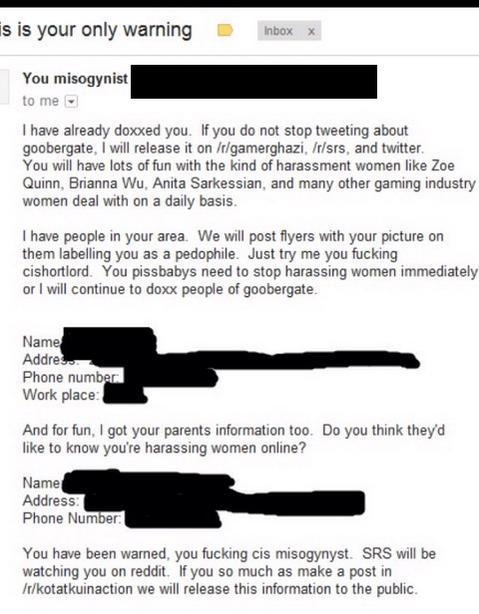
Whilst most of them labour on in denial, the fact is that feminists can be particularly spiteful and relentless in the manner in which they attack those who question or criticise their jaundiced view of the world. Although not according to this feminist:
Feminists are also not averse to turning on allies, particularly the men who openly support them (for examples see 1/ 2/ 3/ 4/ 5/ 6/ 7/ 8/ 9). Wow, don’t they just love dishing it out?
Now as I mentioned in the “About this blog” post, women who publicly defend men and men’s rights issues are especially loathed by feminists. Click on this hyperlink and read an example of some conservative women who wound up with targets on their backs in this manner.
And two more examples of women targeted by feminists are Erin Pizzey and Catherine Hakim:
Erin Patria Margaret Pizzey is an English family care activist and a novelist. She became internationally famous for having started one of the first women’s refuges (called women’s shelters in the U.S.) in the modern world, Chiswick Women’s Aid, in 1971, the organisation known today as Refuge. Pizzey has been the subject of death threats and boycotts because of her stance that most domestic violence is reciprocal, and that women are equally as capable of violence as men. Further details about Erin here and here
Catherine Hakim is a British sociologist who specializes in women’s employment and women’s issues. She has worked in British central government, and as a Senior Research Fellow in the London School of Economics. She is currently a Senior Research Fellow at the Centre for Policy Studies. She has published extensively on labour market topics, women’s employment, sex discrimination, social and family policy, as well as social statistics and research design. She has published over 100 articles in academic journals and edited collections, and over a dozen textbooks and research monographs. She is best known for developing preference theory and her criticism of many feminist assumptions about women’s employment.
Apparently even worse still are women who not only criticize feminism, but do so on the basis of its overt misogyny towards women. This is discussed in a post by a well-known female MRA, Alison Tieman.
And yet at the same time, feminists have a deeply unenviable propensity to quickly play the ‘frightened and oppressed victim’ card should the tables be turned (aka ‘cry bully’).
Perhaps the most common way in which feminists lash out is through employing what is known as shaming tactics. At other times, though their response can include tactics such as online bullying, stalking and threats, and/or the lodgement of false or exaggerated claims to Twitter/ISP’s/etc in order to have the accounts of their targets closed.
In another post I talk about a recent Australian example involving the ‘Sunrise’ TV show. In one of the media articles that ensued, Michael Lallo suggested that only feminist women posting online attracted threats of violence/death … with of course the threats being made by men.
Well Michael, time to open your eyes and wake up … and you can start by checking out these sources:
To Milo or not to Milo? (21 February 2017) How the left neutralised a very annoying thorn in their side. A story rich in hypocrisy given what various feminists/SJW have previously said & done & walked away from without penalty.
Samantha Allen is a feminist writer – here is a recent example of her work. Another article in which she proudly states that she hates men is discussed here (source article available here)
Domestic violence (DV), also referred to as Intimate Partner Violence (IPV) or Family & Domestic Violence (FDV), is a shocking blight on the community. This is a scourge that inflicts substantial negative impacts on the lives of countless men, women and children. Whilst definitions have evolved and broadened, DV is loosely defined as “physical, sexual, or psychological harm by a current or former partner or spouse“.
It is important to acknowledge that DV encompasses man on man, women on women, man on woman, and woman on man violence (both cis- and transgender). Further, in many instances violence is perpetrated by both partners as shown in the accompanying diagram. There is also a strong nexus between the incidence of child abuse/neglect and subsequent perpetration of domestic violence by affected individuals upon reaching adulthood.
The Wikipedia entry for ‘Epidemiology of domestic violence‘ provides readers with useful background information on this topic. For those willing to read something a little meatier, I would recommend this paper by esteemed DV researcher Malcolm George. Malcolm walks the reader through the historical context to the current debate about gender differences in violent behaviour and the way that society responds to the issue.
Many of those working within the DV sector, particularly here in Australia, only choose to acknowledge one element of the problem – that part involving male perpetrators and female victims. It is no coincidence that most staff within these government agencies, universities and NGO’s are strongly influenced by, and biased towards, feminist ideology. The feminist position is unequivocal, and it is that domestic violence = men’s violence towards women. Here is an example of that mindset, and here are many others.
This routine failure by feminists to recognise and discuss male victims, female perpetrators and bi-directional violence is no accident or coincidence. It is a deliberate strategy to build their brand, and in so doing demonise the overwhelming majority of men who have never, and would never, hurt or abuse their partner.
As a result, and in order to support the feminist narrative, a great deal of ‘cherry-picking’ and misrepresentation occurs in relation to the statistics provided in DV literature. In addition, the design and implementation of survey instruments is too often tainted with bias. This issue, that of feminist efforts to hide or discredit legitimate research and/or generate false or misleading statistics, is explored in this further blog post.
You will note, as you scroll down this page, that there are a multitude of sources of DV statistics, particularly the United Kingdom and the United States. Here in Australia, much less research has been undertaken – particularly in relation to male victimisation. One of the more significant sources is the Australian Bureau of Statistics Personal Safety Survey 2012, which found that one in three victims of domestic abuse were male. The results of overseas studies generally found levels of male and female victimisation that were closer to parity, and in some instances even higher rates of victimisation for men that women.
Unfortunately many journalists display remarkable tunnel-vision when addressing the topic of IPV. Indeed some have suggested that the media is complicit in the same sort of systemic gender bias against males noted earlier amongst those working in the field of DV.
Turning to my first example, an article called ‘Til death do us part’ which appeared in The Australian newspaper. It consisted of five pages of heart-wrenching coverage of men’s violence towards female partners, but made no mention of any other form of domestic violence, i.e. m-m, f-f, or women on men. Similarly this February 2014 article from The Mail newspaper also neglected to mention that men can be victims too.
Fiona McCormack also ignores male victims and female abusers this item on Australian ABC TV … except in an aside where she implies that anyone who raises the issue of women abusers is only seeking to “excuse” the behaviour of male abusers. This is very much akin to the feminist predilection of labelling anyone who questions various aspects of sexual assault (e.g. false rape allegations) as being “rape apologists” “victim blamers” etc.
Now let’s turn to this article by Charlie Pickering (more about Charlie here). Charlie is concerned that more attention is paid to the issue of random one-punch attacks on men, than on the violence visited nightly on women people in their homes. He goes on to state:
“For a long time, the termdomestic violence has softened and normalised what is really going on. A more accurate term is ‘men’s violence against women’. Not ‘violence against women’, because that takes the responsibility for it away from those who need to be made responsible.”
This belief, that by acknowledging male victims and female perpetrators, we are somehow ignoring the validity and the pain of female victims is absurd, yet unfortunately commonplace in public discourse. The fact that there may be somewhat fewer male victims does not, nor should not, make domestic violence a gendered issue.
A precious few writers, like this one, suggest a more practical and unbiased approach to the issue:
“When it comes to the statistics about domestic abuse, it doesn’t matter to me how many men to how many women experience domestic violence. Domestic violence is a power issue more than a gender issue. Intimate Partner Violence affects men and women, and I really do not care in what proportion …
Within anti-domestic violence advocacy, there seems to be a trend to pit female victims against male victims and vice-versa. I do not know who is behind it, nor do I know if there is a “who” to blame. I do know that blame has no place in this fight against domestic abuse, especially when victim blames victim for any reason …
In a perfect society, men and women are equally protected under the law not because more laws were made to protect one sex but because in each mind and heart of all people, women and men are respected equally, and the individual contributions or crimes are our only measures of judgment. However, this ideal is as far away from our current reality as the idea that no person would seek power over another.”
Many others within the wider community have, however, embraced a biased and incomplete representation of DV, liberally salted with misinformation, at face value. Who could blame them, given that so many sources are bellowing out the same relentless message about male perpetrators and female victims, whilst studiously ignoring other elements of the issue.
Here in Australia, let’s look at this page within the web site of the Department of Social Services entitled ‘Women’s safety’, and the linked 28 page literature review prepared by ‘Urbis’ consultants at a cost of $220,000. One would have assumed, especially given the enormous cost, that the review would have encompassed all forms of abuse and perpetration. But, unfortunately, it did not.
In fact the review states that “Male perpetrators of domestic violence or sexual assault against men and female perpetrators of either offence against men have not been considered in this literature review. It is acknowledged that in practice the great majority of programs will be targeted towards men who commit domestic violence or sexual assault against women.”
Yes, that makes perfect sense … there are no programs for female offenders so let’s pretend they don’t exist. Such circular logic is (almost) unbelievable. And no, there is no corresponding ‘Mens Safety’ page within the DSS web site.
To be fair, the authors of some studies do admit that there are many female perpetrators and male victims, and that little research has been directed towards these groups. They also admit that there are probably many similarities between male and female perpetrators of IPV. They then invariably proceed, however, to offer a variety of justifications to continue their focus on the ‘domestic violence = Mens violence towards women’ model (example).
When misleading statistics are repeatedly exposed the feminist reaction is to move the goalposts by expanding the reach of the definition of domestic violence to encompass sexual violence, and less tangible forms of non-physical ‘violence’. This serves to both maximise the perceived magnitude of the problem, as well as support the anti-male narrative.
Naturally those areas where female perpetration is substantial, such as child abuse and elder abuse, are totally ‘out of bounds’. This theme is explored in this separate blog post. The same approach has been taken by feminists to prop up the notion of the existence of a ‘rape culture‘ in western societies.
Those of us concerned about men’s rights seek to have all aspects of domestic violence considered, as well as seeking remedies to specific issues such as:
the lack of resources to assist abused men and their children
laws and legal procedures that are based on the assumption that the male in the relationship is the abuser
negative and biased behaviour towards men who seek assistance, for example the screening of (only) male callers to abuse help-lines to determine if they are in fact perpetrators (example)
A selection of statistical sources that haven’t been doctored to support the feminist narrative
References examining assaults by women on their spouses or male partners: An Annotated Bibliography by Martin S. Fiebert. This bibliography examines 286 scholarly investigations: 221 empirical studies and 65 reviews and/or analyses, which demonstrate that women are as physically aggressive, or more aggressive, than men in their relationships with their spouses or male partners. Here is a link to an updated June 2013 version of Fiebert’s bibliography.
Partner Abuse, Volume 1, No. 1, 2010 The first edition of a new journal created to showcase academic research into domestic violence without gender bias
“Almost 24% of all relationships had some violence, and half (49.7%) of those were reciprocally violent. In non-reciprocally violent relationships, women were the perpetrators in more than 70% of the cases.”
More than 125,000 women homeless because of domestic violence (15 February 2016). The only figures for male victimisation that were mentioned – because they appeared to support the feminist perspective – were drawn from this media release from a government agency. What’s not mentioned though is that the relatively low numbers of men seeking assistance are indicative of factors other than simply lower rates of male victimisation, incl.:
the rampant genderbias of ‘help-lines’, advocacy groups and even government agencies
the (widely-known) lack of resources available to help male victims (with or without children, and
the much greater incidence of non-reporting of DV by men (compared to women)
This article and related reddit discussion concern a move in Victoria, Australia, to alter the law in relation of using self-defence where death of a partner occurs (article) (discussion)
General sources regarding Intimate Partner Violence
Prevalence of recorded family and domestic violence offending: A birth cohort study (17 September 2024) The Australian Institute of Criminology has a known pro-feminist bias, but one statistic was interesting “nearly 1 in 10 men (9.6%) born in NSW were found to have been processed against by police for a family or domestic violence offence by the age of 37.” Now we just need to account for the influence of distorting factors such as false allegations.
Domestic abuse: The latest lie (19 July 2019) UK. This article addresses, amongst other things, the feminist myth that most men who suffer domestic violence are the victims of other men.
“The proportion of male victims who told police about their domestic abuse increased from 10.4% in 2014-15 to 14.7% this year as charities said more men were shaking off the stigma of talking about their suffering.“
How Victoria’s family violence system fails some victims – by assuming they’re perpetrators (14 November 2017) I thought this paper was going to talk about men being misidentified as DV aggressors, but oh no, apparently it happens to women all the time <facepalm> and men exploit this to obtain intervention orders to protect themselves (& their children) from women who aren’t really hitting/abusing them.
Shocking domestic abuse statistics don’t show the real picture: it’s even worse (14 December 2016) UK. This is one of several articles written by feminists in response to the recent release of stats showing the large (and increasing) number of male victims. Essentially they say ‘it doesn’t matter how many men are victims, women have it worse and we should focus entirely on them’.
Stopping Fathers Committing Family Violence (13 December 2016) The Victorian Government (Australia) ignores female perpetrators of domestic violence – it’s something only dads do! Disgusting bias
This is one of countless examples of how feminist DV advocacy groups seek to minimise both women’s role in perpetrating abusive behaviours, and its degree of impact on male victims.
“The findings of an in-depth domestic violence study, which showed violent conduct almost evenly split between the genders, are potentially cause for concern, a senior police officer says.”
The gender of domestic violence (8 June 2016) NZ video concerning the difficulty experienced by researchers whose findings showed that women were equally likely to abuse.
For Nelson Women’s Refuge manager Katie O’Donnell, the solution to New Zealand’s domestic violence problem is more straightforward. “People say it’s a really complex issue. Well, it is a complex issue but also it isn’t – guys just have to stop doing it”
The surprisingly common reason John hits his partner (14 October 2015) Of course a male batterer is profiled, but watch the fur fly when someone suggests a contributing factor that doesn’t fit the feminist Duluth Model.
Tara Moss: ‘We can’t let trolls hijack the domestic violence conversation’ (5 March 2015) Australia. This is the feminist concept of a “conversation” – we talk & you shut-up. If you try to join our conversation then you are a troll. And, as is becoming increasingly common of late, no reader’s comments were permitted on this article.
Can domestic abusers be rehabilitated? (1 February 2015) Gynocentric/pro-feminist bias but worth reading in conjunction with the comments contributed by readers
Telstra introduces domestic violence leave (13 January 2015) Australia. Article implies only women are victims of domestic violence and leaves us guessing as to whether the company policy is sexist/discriminatory – or just the journalism
Why don’t we speak up when we see signs of domestic violence? (1 October 2014) This article in a pro-feminist web site provides a stereotypical feminist perspective on the subject. What was notable was that almost all the readers comments attacked the author’s obvious anti-male bias. This article forms the focus of this blog post.
In this article a feminist writer, Amanda Hess, attempts to rationalise why domestic violence by a female sports star should be addressed differently than in the case of a male sports star (22 September 2014) Most of the 600+ readers comments that followed disagreed and told her so in no uncertain terms.
‘Lollies at a childrens party and other myths: Violence, protection orders and fathers rights groups’ by Miranda Kaye and Julia Tomie (1998). Another detailed but flawed paper in support of the feminist position on DV. Its main line of attack is that available statistics don’t support claims made by men’s rights advocates. It conveniently ignores the fact that most Australian DV research is undertaken by feminists and biased towards finding ‘evidence’ to support a pre-determined conclusion. Thus the accuracy and impartiality of the research is the real issue, rather than the credibility of the whistle-blowers.
The paper also misinterprets and/or takes out of context, many of the comments it attributes to fathers groups in an attempt to portray them as irrational or unreasonable. Finally the authors attack specific statements put forward by fathers groups despite the same arguments having been used (at other times) by feminists in support of their own (feminist) perspective. The authors of this paper, for example, want to jump from one camp to the other (and back again) in relation to the issue of whether behaviour other than physical violence should be included in the definition of domestic violence.
We need to show it’s just not manly to hit out (9 July 2014) Nonsense article dripping with white knight bias … “The idea that the woman may be equally to blame, even if she is also violent and even the initiator of the violence, is simply not acceptable”
A reddit discussion thread about the anti-male bias evident in the web site of an American domestic violence centre’s web site. Unfortunately such bias (i.e. stating or implying that all men accessing the site are abusers and that all women are victims) is also common in domestic violence centres in Australia.
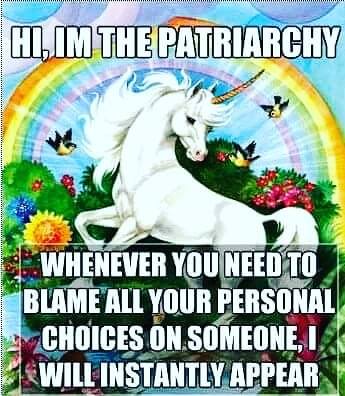
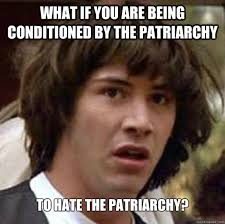
Well the term ‘patriarchy’ gets thrown around a lot by feminists. Apparently it’s like hell for women. Sort of a catch-all for all the bad things that happen to women that can’t be (in their minds) blamed either on themselves or one particular guy.
“Patriarchy is a social system in which males are the primary authority figures central to social organization, occupying roles of political leadership, moral authority, and control of property, and where fathers hold authority over women and children. It implies the institutions of male rule and privilege, and entails female subordination.”
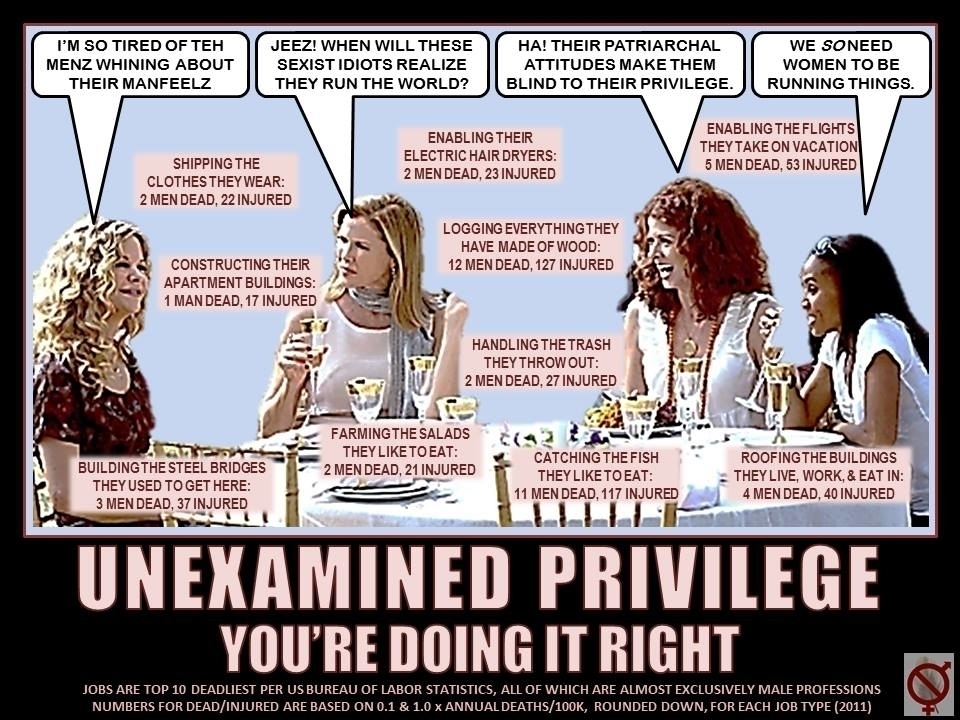
Basically feminists claim that men have constructed, and continue to maintain, a social paradigm expressly designed for our own benefit. If that were the case then it’s hard to explain statistics like these and these, showing men at a disadvantage is so many areas. I figure that us guys could build a better paradigm than that.
Yes, there are ruling elites present within our society. And yes, well over 50% of their members are probably men. But a social system created by men for men? A fairy tale. And don’t anyone dare suggest that the ruling coven of contemporary feminists are in fact a ruling elite in their own right (and one that continues to grow in influence).
The following articles explore the concept of patriarchy in some detail:
A while ago I came across a US state program that was designed to encourage males to have respect for women. The organisation ‘A Voice for Men’ responded with a provocative and graphic statement along the lines of “we’ll have respect for those people who are deserving of respect”. Read the comments that follow the pictures to capture the essence of the ensuing discussion.
David was one amongst the many feminists and camp followers to bite back. David’s article concluded with the statement:
“The logic here is airtight: because some women get drunk and urinate in public, women don’t deserve respect.
I guess men never get drunk and urinate in public, or ever do anything vaguely embarrassing that gets caught on camera?
Is it really asking too much to respect people as people, foibles and all?”
Well David, yes it is too much to ask of feminists apparently. Can you name even one single male “foible” that feminists are willing to accept?
Men do some gross things, and its usually no-one’s fault but our own. The difference is that we admit it instead of denying it to maintain a moral high ground above the opposite sex … or alternatively blaming our behaviour on someone else or some mythical matriarchy. Hell when some guys really go too far we even express pointed criticism of their behaviour, and urge them to lift their game. Another significant point of difference, yes?
If feminists were truly into equality then surely they would support a reciprocal program that urged girls and women to ‘Respect men’. No? What’s that I hear? Guffaws of laughter instead? Telling, isn’t it?
In fact on that point, a post that I recently contributed to an online discussion was zapped by a moderator because I concluded with the suggestion that women should respect men (in the same sentence I also said men should respect women). It wasn’t even a feminist site either. This is what things have come to … simply suggesting that women should respect men is just cause to be labelled a ‘redneck’ or similar.
I guess one gender must be more equal than the other, or something.
YouTuber promises to release sex tape (23 January 2017) Feminists can find the time to criticize men on the basis of just about anything, but criticise a woman for eroding respect for women? No way, well not unless they are conservative and/or anti-feminist.
Stripper: There are many girls like Stacey (8 January 2017) Australia. Not seeing any thing here along the lines of an admission of greed, amorality and reckless stupidity. Yeah, girl power
“What happened to the modern man? I think he got left behind and died of starvation because I don’t see any around these days. I went on a date the other night, shocking right? But when the dinner came to an end and we were laughing away into the sunrise and the check came out- he slid it towards me. If you need to re-read that last sentence then please do so now.
Ahh yes, he slid the check to me and asked to split. The worst word in the English dictionary. Right next to debt and vegetarian. I mean, nobody wants to split their pants, their hair line, alcohol, or especially, a check. Don’t get me wrong, I’m not some mega bitch, but guys will always make more money than girls.” (Source)
Why feminists hate debating anti-feminists (26 August 2016) Feminists feel entitled to not have their opinions challenged because only they can know their experience as a woman. Although they see no such contraint to understanding/explaining/judging men’s experiences.
White House meets with activists calling for gender equity in My Brother’s Keeper (15 July 2014) The current US administration shamelessly panders to the feminist hierarchy. They finally introduce one (1!) program aimed at helping males, and even then they had to exclude white males because of the anticipated backlash. Were feminists willing to make this one small concession? Oh no. Let’s not worry about the scores of pre-existing programs from which males are excluded. It’s pathetic, it really is. When are people going to wake up to what is going on?
Ok, well while someone thinks of a concrete example of how feminists have lent tangible support to an area where men/boys are disadvantaged, please read the comments contributed in this discussion entitled ‘Do you think feminism is becoming a sexist anti-men movement?’
And then peruse the following sources:
Feminist Lara Witt advises that “on a weekly basis, cisgender men ask me how they can be (better) allies. I don’t usually respond because I’m forever tired of teaching for free. So because I’m super generous I decided to put together this primer on … How men can be slightly less trash” (4 March 2019)
Women’s Network tries to hijack International Men’s Day! (22 September 2017) Video. You couldn’t make this stuff up … An IMD2017 event organised by women’s group behind cover of bogus men’s group, with proceeds to pro-feminist group that ignores male victims of domestic violence.
Ryerson’s independent student newspaper the Eyeopener reports the Ryerson Students’ Union (RSU) has “rejected the last appeal” to have the school sanction the Men’s Issues Awareness Society (MIAS).
According to the group’s president, Kevin Arriola, the point of the group is to raise “issues that have never been [talked] about or usually disregarded.”
MIAS has received its major opposition from the school’s Feminist Collective.
In November, Ryerson Feminist Collective organizer Arezoo Najibzadeh called the idea of the group “horrifying.” Najibzadeh said, “I think it’s just horrifying. I don’t see the benefit of having them on campus.”
““We have a women’s ministry which is to escalate and ensure women’s issues issues are brought to the forefront and to the centre of government policy because at this time there’s clearly serious gender inequality in society…It is almost like nullifying the efforts of the women’s ministry, having a Men’s Affairs Department,” Women’s Aid Organisation (WAO) executive director Sumitra Visvanathan said in a phone interview with Malay Mail Online”
See the articles in this other post, regarding actions taken by York University (UK) in November 2015 to stop discussion of male issues on International Men’s Day
“I’m just going to say it: Sometimes I feel sorry for men” (July 2015) This is a fairly typical NAFALT ‘look, feminists understand’ piece – the closest thing to genuine sympathy that any feminist will put her name to. But nowhere will you see any form of acknowledgement that women are partially responsible for the pressure that men face. Instead it is always “people” or “society” that force men to adopt/maintain assigned gender roles. And of course no examples are provided as to where women have actively assisted with any problematic issues affecting men/boys.
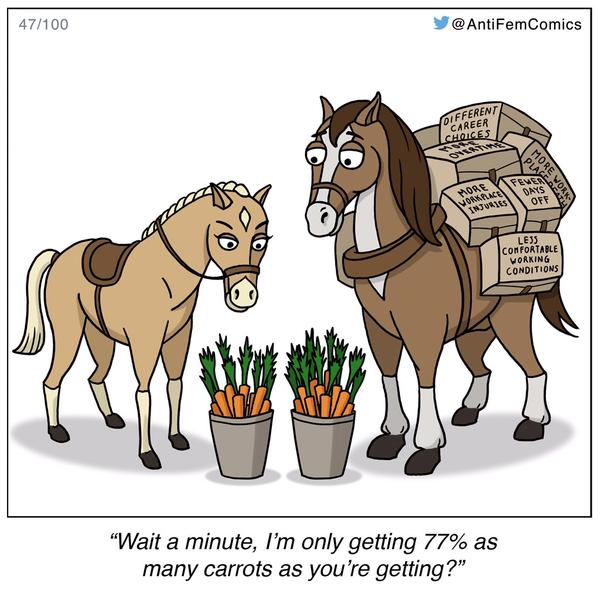
Some people call the notion of a gender pay gap a ‘myth’, but it does in fact exist. A certain mythical element arises however in the way that feminists blatantly misrepresent the pay gap to support and advance their peculiarly jaundiced view of the world. You see, feminists would have us believe that women earn substantially less than men for doing the same work, and that this is primarily the result of sexist bias by employers. Such a position is equal parts over-simplification and outright falsehood, yet it forms a key prop in the gender feminists’ claim of perennial victimhood at the hands of a cruel and unyielding patriarchy.
Indeed, all manner of people – even ex-President Obama – keep spouting this bunkum, and the mainstream media laps it up and repeats it ad nauseam. (Oh, and by the way, Politi-Fact rated the President’s statement as ‘mostly false’, with further comments here).
Feminists conveniently neglect to tell everyone that:
as you drill down into the data looking at particular segments of the workforce, one is increasingly likely to find that the wage gap favours women – not men
pay disparity is the outcome of many different variables, of which sexist discrimination by employers is just one – and a relatively minor one at that
Indeed the most significant variables affecting pay rates relate to personal choices made by individual employees, choices such as type of job, amount of overtime worked, etc.
“In Britain, lesbians are paid an average of eight per cent more than straight women, with the trend even more extreme in other western countries. In the US, the difference is 20 per cent …
Dr Nick Drydakis, senior lecturer in economics at Anglia Ruskin University in the UK who authored the World Bank report, said pay differentials were explained by the career and lifestyle choices that gay women were more likely make.
“Lesbians may realise early in life that they will not marry into a traditional household,” he said.”
So, does this mean that employers actively discriminate against straight women?
“Love the way it’s so obviously special pleading. Gay men earn less? Must be discrimination! Lesbians earn more? Must be lifestyle choices. Women earn less? Must be sexism. Men earn less? Must be lifestyle choices.”
Please take a moment to review some or all of the following sources:
The Factual Feminist‘ (Christina Hoff Sommers) looks at the wage gap issue Part 1, Part 2 and Part 3
Penalizing ourselves (22 September 2022) Hooray, another article that delves deeper than the usual feminist offering on the subject. It happens sometimes
The Gender Pay Gap is real. Here’s proof (29 August 2017) Discusses a recent NZ study which failed to convince most (all?) of those who contributed reader’s comments.
“The easiest way to solve the ‘gender pay gap’ would be to make it a criminal offence for a man to financially subsidize ANY woman, even his wife. Then women would have an incentive to work to the best of their earning potential regardless of the wealth of their male spouse.”
Earnings inequality among men soars (13 January 2017) UK. There are many significant pay gaps other than all men v all women, but any gaps that don’t support the feminist narrative tend to be ignored. This study is just one of many examples.
“blah, blah, blah Where men and women are doing the same job, they are usually paid almost the same – although men still have a slight advantage, earning an average of 1.6% more blah blah blah”
Daniel Radcliffe: How can this still be happening? (25 April 2016) Harry Potter actor talks about how much more male Hollywood actors are paid. Neglects to mention factors inconsistent with feminist narrative – like the pay differential for fashion models for e.g.
Daily Reminder That the Wage Gap Isn’t Real (5 March 2016) A list of links to articles and videos debunking the gender pay gap, some of which will already be included in my post, others not.
“Here is a list of the ten most remunerative majors compiled by the Georgetown University Center on Education and the Workforce. Men overwhelmingly outnumber women in all but one of them:
1. Petroleum Engineering: 87% male
2. Pharmacy Pharmaceutical Sciences and Administration: 48% male
3. Mathematics and Computer Science: 67% male
4. Aerospace Engineering: 88% male
5. Chemical Engineering: 72% male
6. Electrical Engineering: 89% male
7. Naval Architecture and Marine Engineering: 97% male
8. Mechanical Engineering: 90% male
9. Metallurgical Engineering: 83% male
10. Mining and Mineral Engineering: 90% male
And here are the 10 least remunerative majors—where women prevail in nine out of ten:
1. Counseling Psychology: 74% female
2. Early Childhood Education: 97% female
3. Theology and Religious Vocations: 34% female
4. Human Services and Community Organization: 81% female
5. Social Work: 88% female
6. Drama and Theater Arts: 60% female
7. Studio Arts: 66% female
8. Communication Disorders Sciences and Services: 94% female
9. Visual and Performing Arts: 77% female
10. Health and Medical Preparatory Programs: 55% female”
This 2011 article in the New York Times, ‘They call it the reverse gender gap‘, discusses the woes of women earning more than many men (yes, even back in 2011!)
Re: “But they make less money no matter what the job”
Wrong. “In 2011, 22% of male physicians and 44% of female physicians worked less than full time, up from 7% of men and 29% of women from Cejka’s 2005 survey.” (See ama-assn.org/amednews/2012/03/26/bil10326.htm)
That’s just one of countless examples showing that some of the most sophisticated women in the country choose to earn less while getting paid at the same rate as their male counterparts.
A thousand laws won’t close that gap.
In fact, no law yet has closed the gender wage gap — not the 1963 Equal Pay for Equal Work Act, not Title VII of the 1964 Civil Rights Act, not the 1978 Pregnancy Discrimination Act, not affirmative action (which has benefited mostly white women, the group most vocal about the wage gap – tinyurl.com/74cooen), not the 1991 amendments to Title VII, not the 1991 Glass Ceiling Commission created by the Civil Rights Act, not the 1993 Family and Medical Leave Act, not diversity, not the countless state and local laws and regulations, not the thousands of company mentors for women, not the horde of overseers at the Equal Employment Opportunity Commission, and not the Ledbetter Fair Pay Act, which is another feel-good bill that turned into another do-nothing law (good intentions do not necessarily make things better; sometimes, the path to a worse condition is paved with good intentions)…. Nor will a “paycheck fairness” law work.
That’s because women’s pay-equity advocates, who always insist one more law is needed, continue to overlook the effects of female AND male behavior:
Despite the 40-year-old demand for women’s equal pay, millions of wives still choose to have no pay at all. In fact, according to Dr. Scott Haltzman, author of “The Secrets of Happily Married Women,” stay-at-home wives, including the childless who represent an estimated 10 percent, constitute a growing niche. “In the past few years,” he says in a CNN report at tinyurl.com/6reowj, “many women who are well educated and trained for career tracks have decided instead to stay at home.” (“Census Bureau data show that 5.6 million mothers stayed home with their children in 2005, about 1.2 million more than did so a decade earlier….” at tinyurl.com/qqkaka. If indeed a higher percentage of women is staying at home, perhaps it’s because feminists and the media have told women for years that female workers are paid less than men in the same jobs — so why bother working if they’re going to be penalized and humiliated for being a woman.)
As full-time mothers or homemakers, stay-at-home wives earn zero. How can they afford to do this while in many cases living in luxury? Answer: Because they’re supported by their husband, an “employer” who pays them to stay at home. (Far more wives are supported by a spouse than are husbands.)
The implication of this is probably obvious to most 12-year-olds but seems incomprehensible to, or is wrongly dismissed as irrelevant by, feminists and the liberal media: If millions of wives are able to accept NO wages, millions of other wives, whose husbands’ incomes vary, are more often able than husbands to:
-accept low wages -refuse overtime and promotions -choose jobs based on interest first, wages second — the reverse of what men tend to do (The most popular job for American women as of 2010 is still secretary/administrative assistant, which has been a top ten job for women for the last 50 years. http://www.huffingtonpost.com/2013/06/11/gender-wage-gap_n_3424084.html) -take more unpaid days off -avoid uncomfortable wage-bargaining (tinyurl.com/3a5nlay) -work fewer hours than their male counterparts, or work less than full-time instead of full-time (as in the above example regarding physicians)
Any one of these job choices lowers women’s median pay relative to men’s. And when a wife makes one of the choices, her husband often must take up the slack, thereby increasing HIS pay.
Women who make these choices are generally able to do so because they are supported — or, if unmarried, anticipate being supported — by a husband who feels pressured to earn more than if he’d chosen never to marry. (Married men earn more than single men, but even many men who shun marriage, unlike their female counterparts, feel their self worth is tied to their net worth.) This is how MEN help create the wage gap: as a group they tend more than women to pass up jobs that interest them for ones that pay well.
This last reference is also quite dated, and is not about feminist misrepresentation per se, but just shows how easily incorrect statistics can be created (in this case by Australian politician Joe Hockey) and then go into circulation:
Both feminist literature and articles in the mainstream media (which is heavily biased towards the feminist perspective) make common use of various ‘facts’ to support their arguments. Some of these include:
That 1 in 4 women will be raped.
Women are paid 77% of what men are paid for equal work
1 in 3 women suffer from domestic violence
90% of the world’s poorest people are women
The conviction rate for rape is 6%
These are not facts. They are examples of what is a sustained effort to mislead the public, with the aim of building public (read: political) support for the feminist cause.
Some of the common ‘red flags’ in relation to pro-feminist statistics include:
lack of citation of the original source, with countless instances of incorrect and debunked statistics being used again and again
no context being provided for statistics used, and in particular the comparable figure for males is very rarely provided
“While most men don’t perpetrate violence, approximately 90% of all violence committed against children is perpetrated by men.” So states the ‘Polished Man‘ web site. A complete lie that they subsequently amended after adverse feedback. Here is the related reddit discussion thread.
Fear: The terrible feeling every woman experiences by Melissa Hoyer (6 November 2014) and Pray for Clementine (4 December 2014) Two similar articles by Australian feminist journalists concerning their sickening level of paranoia regarding men. In the second article Clementine Ford is freaking out because a stranger in the street, a man, tried to talk to her.
Firstly, let’s begin with details regarding all the men’s studies centres in Australia: <sound of crickets>
Now, picture this if you will … the University of South Australia considers establishing a number of new courses related to men’s health and well-being. Feminist writer gets wind of this and writes an article dumping on the idea (see articles listed below, and be sure to look at the readers comments). The University gets scared and back-pedals at 100 mph. Bye, bye, men’s studies course – which would have been an Australian first.
Conclusion? Clearly every university should have women’s studies courses because they are a wonderful and necessary initiative. Mens studies courses should, however, be opposed on the basis that they are redundant and wicked and can only serve to foment misogyny and advance the cause of the patriarchy. (Oh, and the same goes for student clubs/associations that focus on men’s issues.)
The solution? For feminists? Obstruct the creation of men’s studies courses, whilst (to avoid accusations of one-upmanship) rename women’s studies centres as gender studies centres. But there was no sudden move to jointly address male issues. No, they simply carried on exactly as before with an overwhelming gynocentric focus interspersed with the occasional message from some male feminist ally such as Michael Flood. Note the example here as to how well this new approach works out.
But back to what happened at the University of South Australia, a story which is told in the articles linked below and in accompanying readers comments:
And as for overseas examples of Men’s Studies Centres? Well these tend to feature the examination of men and masculinity through the feminist lens. This article talks about one such place, the Stony Brook University ‘Center for the Study of Men and Masculinities’.
Regarding women’s studies
Let’s now have a look at a listing of women’s studies centres in Australia that were in existence when I first uploaded this post*:
(Essential reading: everything by Camille Paglia; Daphne Patai and Noretta Koertge–Professing Feminism: Cautionary Tales from the Strange World of Women’s Studies; and Christina Hoff Sommers–Who Stole Feminism? How Women have Betrayed Women)
News.com.au is a major online source of mainstream news in Australia, the CEO of which is David Penberthy who was mentioned in a reader’s post here. Some time ago a reader sent me a copy of an email that he had sent to the team at news.com.au after he had got fed-up with their ongoing sexist bias:
“As a frequent visitor to your site I am dismayed by the evident bias I see with regards to:
1. The types of articles that you choose to publish 2. The decision as to which articles you allow comments on and which you don’t 3. The decision of moderators as to whether comments are posted or excluded
In particular the type of bias that I find most annoying and which is particularly prevalent in your site is a stridently anti-male and pro-feminist bias.
I have read your FAQ page entries in relation to some of these points but I find that in practice your team makes decisions that are not necessarily in line with your guidelines. For example I myself on many occasions have sought to post comments that were in no way profane, etc etc but were not accepted.
Further some of the articles you publish, and also some of the comments, I (and I am sure many others) find to be in poor taste or offensive … it just seems that some positions are consistently deemed more acceptable than others … and lo and behold these seem to feature misandric themes that belittle and promote negative stereotypes concerning men. It’s tiresome and it’s wrong and you should improve your performance in this regard. If uncertain simply apply the test …. if this article or this comment was about women, would I publish it? If yes then go ahead. If not then don’t …”
News.com.au replied addressing a side-issue – but said nothing about the central issue of gender bias. This other blog post provides some examples of their biased journalism.
So how is sexist bias reflected in newspapers and web sites like news.com.au? It is done through a combination of the following measures:
Through the choice of which subjects are addressed in articles and which ones are ignored, and then whether the coverage of each subject is balanced or only provides a partial picture of the issue at hand
Through whether or not online public comments are enabled, and if so, for how long comments are accepted
Through the nature and degree of moderation of online public comments
Through the choice of loaded words within articles to reflect whether each particular view expressed, or person quoted is either good/valid or bad/invalid, as seen through the ideological filter imposed by the journalist or editor
Through the use of misleading or bogus statistics within articles to support a pro-feminist perspective
With regards to point 2 above, I have noted a recent trend towards not permitting readers comments in relation to topics for which there will likely be a reader backlash against the pro-feminist position being advanced by the author and/or editor. A ‘good’ example of this is an article entitled ‘Proof that men are bigger idiots than women‘. In this case not only were readers comments not permitted, but the article was also excluded from news.com.au’s Facebook page and Twitter feed. Thus those who objected to the obvious misandry of the article were effectively silenced, conveying an impression of reader acceptance.
With regards to point 4 above, this reddit discussion thread looks at the choice of words used by the media in reporting instances of sexual assault of underage boys by women (versus the words used when reporting underage girls assaulted by men). The headline of this article in news.com.au ‘Teachers accused of having threesome with student, 16, in Louisiana‘ would no doubt have been ‘Teachers gang-rape student’ were the student female instead of male. Anti-male bias was also evident in this 2009 academic report by Roland Landor.
This article is another example of how journalists change language depending on the gender of the victim. When a woman assaults a man (who doesn’t even try to defend himself) it is a “fight“, but if it was the other way around it would be reported as an “unprovoked attack“.
Ah, but news.com.au by no means has a monopoly on applying feminist bias and blocking material that portrays men and mens rights in a fair and balanced manner. No, Australia’s ABC is yet another citadel of femdom. This was amply demonstrated in the 2014 article entitled ‘A lesson for men’s rights activists on real oppression‘ by misandrist journalist Clementine Ford.
Despite the usual feminist moderator habit of binning the majority of posts contributed by those not supportive of feminism, there were still some interesting exchanges amongst the readers comments.
Still on the topic of Clementine Ford, perhaps have a look at this other paper. If you scroll through the readers comments, amongst the offerings of simpering sycophants you will note a contribution from another who stated:
“You lost any right to speak about equality when you attacked and demonise those who are attempting to act as a counterbalance to the feminist movement. The only thing this article resembles is propaganda. For every issue females suffer, and they were good points, you proceeded to ignore about a dozen which society is now suffering under because of feminism.
Like how masculinity is seen as a “problem to be removed” at the age of school children.
About how it is encouraged for females to become teachers now with no effort to do the same for males to balance the number of people from each gender tutoring students.
How abuse and sexual assault against males is often either ignored or used as a source of humour, especially in forms of media. To the point where the castration of a male is only laughed at and mocked by a female audience.
About how some laws in the US have changed for the worse. One in particular allowing females the right to charge a man with rape if they have consumed any amount of alcohol, even if it was consensual sex and she was the one who talked him into it.
About how university and college applications emphases upon getting more female students even long after they make up a considerable percentage of those entering each established teaching institute.
About how unemployment rates are far higher for males than they are for females; with “stay at home dads” being encouraged as a good thing while the very thought of a “housewife” staying at home and cleaning is regarded as offensive.
About how homeless the number of homeless men is staggeringly higher for males than it is for females, yet in many countries with this problem there are far more women’s shelters than there are those devoted to men.
About how divorce courts favour women over men, allowing them to leave with far more of their former husband’s possessions than the other way around. Similarly how unemployment is grounds for the divorce with a man while it is not for a woman.
About how any research which feminists deem “offensive” causes those who research it to be blacklisted. Such as one scientist who showed produced a paper showing findings and statistics which showed that for women, the hormone transfer from semen provides a number of health benefits, including anti-depressants.
Or how about how any attempts by masculinists to counterbalance and correct where feminism has gone too far and men’s rights are suffering is scorned as being “chauvinistic” or childish?
All that and far more you simply ignore and choose to portray MRA’s as acting irrationally and out of fear of equality? I’m not sure whether to laugh or weep.
Equality has not been achieved, that is something you got right, but it is not simply the female populations suffering. Some points you made were good, as I stated, but you seem blind to the idea that females might be dominating aspects to society and equality might come from them losing power as much as males.
Next time attempt to think about what you are talking about. Or better yet, why don’t you show some of that supposed interest in equality you kept mentioning and try to discuss the problems each gender is facing.”
And how did Ms. Ford respond to this thoughtful observation? By typing “TL;DR” (i.e. too long/didn’t read). Definitely not the sharpest knife in the drawer, and clearly not the least bit interested in considering alternative perspectives.
“I think many feminists have unfortunately become as inflexible and unlistening as they say men are largely because of the media’s selective reporting.
When reporting on gender issues and the male-female dynamic, as on all other issues, the media are supposed to objectively reflect all views. But over the past four decades they have reflected ideological feminists’ views almost exclusively.
The effect of this long-running lack of objectivity is, I think, to create in our collective mind an entrenched and immutable perception that no other view is possible and that gender issues and the male-female dynamic as portrayed by these feminists are not foolhardy concepts but widely accepted fact that is completely beyond dispute.
Thus, the ordinary woman — even the woman who may disdain feminists — can hardly be blamed for believing she is taken advantage of by men and must endure such oppressions as poorer treatment by male doctors and lower pay than the men at her company doing the exact same work.
Many if not most women are subjected to these oppression stories virtually very day of the year in the still-unobjective (liberal) media. The stories are convincingly told by intelligent, sophisticated members of such groups as the National Women’s Law Center (NWLC), which says in the very first sentence of its position statement on equal pay:
“American women who work full-time, year-round are paid only 77 cents for every dollar paid to their male counterparts.”
If such educated, sophisticated groups as the NWLC — and the Institute for Women’s Policy Research, the subject of the following commentary — believe women are unfairly paid less, it must be true. Why would they lie?
This article informs us of an “alarming” (11.7%) increase in the number of women over 55 facing homelessness. It was based on a study by the University of Queensland’s Institute of Social Science Research. There is no mention that this demographic is a small percentage of homeless people generally, who are predominantly male. In fact there is no mention of men at all. Funny thing that.
“It is fairly annoying to constantly hear men make up the majority of x, therefore we need to help the female minority, but when the roles are reversed, the answer is still to aid women. Men are the problem when they comprise a majority that women want to be a part of, and men are ignored when they’re the minority or the majority of something women want no part of”
See this article for an example of how feminists don’t acknowledge gender when the story doesn’t fit their victim narrative (i.e. in this case six boys rather than six “students”). In this October 2014 BBC story note how no mention was made of the gender of the murdered students, guess they must have all been male (they were). This article addresses the same issue.
See the diagram in this Guardian article entitled ‘Drowning Lower and Middle Income Countries‘. It says “Worldwide 33% were female”. Hmm, I guess that means two-thirds of those who drowned were men.
“Read the tone and language in this article about a man who threatens his female partner with a knife, then read the tone of these two articles one about a female stabbing her male partner the other of a female murdering her partner by stabbing him. Great examples of the sexism and bias in the media”:
It’s hard to believe that once decent papers like The Age and the Courier-Mail now deem this hateful and misleading rubbish as being somehow worthy of publication.
Domestic violence: Why does The Spectator relentlessly peddle feminist propaganda and lies about domestic violence, but not the truth? (30 March 2021) UK
Sometimes anti-male bias takes the form of simply omitting any reference to men (often in relation to male victimisation). This article, concerning homelessness, is one such example.
Everyday sexism at the Australian State Broadcaster: When airmen die in training and combat they are labelled “crew” and “people”. When two thirds of the workforce making the aeroplanes are men, the article notes that “one third were women” (19 September 2015) Reddit mensrights discussion thread
How many men are paedophiles? (29 July 2014) Coz everyone knows there’s no female paedophiles right? Now they couldn’t have written an article called “How many people are paedophiles?” could they? ah, because … misandry
Blogged down in polarities (7 July 2014) This article isn’t about pro-feminist bias, it is about a broader issue of media behaviour that see views deliberately (and irresponsibly) polarised to attract reader interest and involvement. This is sometimes known as “click-bait journalism”.
In another post I question the extent to which feminists are concerned about equality for men and boys (they’re not). In this post I wanted to focus instead on women and girls.
Every day we hear another feminist scorning those who query some or all aspects of feminist ideology because, you know, feminism is just about achieving equality … BUT
How about equality for American women of colour? Poor women in western countries? Transgender women? Sex-workers? Other women who hold views or choose lifestyles at odds with feminist ideology – for example ‘pro-life’ women or conservatives?
How about equality for women in developing countries?
How much do the feminist hierarchy care about fighting for recognition, freedom and equality for these women?
In some cases privileged white western feminists don’t even care about the rights of other white western women. This occurs, for example, in the case of conservative and/or anti-feminist women (internalised misogyny=they deserve it), or where defending women’s rights would undermine the feminist narrative.
For example, you could almost hear the rapid intake of feminists breath when Olympic volleyball star Kerri Walsh Jennings stated that “I was born to have babies“.
To take another example, consider the silence of feminists in relation to the scandal at Rotherham in the U.K or the sexual assault of women in Europe by Muslim economic refugees as discussed in this blog post.
The current dominant variant of feminism is increasingly being recognised as being largely controlled by, and acting in the interests of, well-educated white women. This ruling feminist clique demonstrates little more than a token appreciation of (or interest in) the challenges faced by poorer women and/or women outside the western bloc. They are by no means shy, however, to speak on their behalf.
See Alain Soral, French writer and subversive activist, on feminism (video)
And interestingly, the privileged uber-feminists are just as catty and defensive when called out by their less-advantaged sisters as they are when men try to join the feminist conversation soliloquy.
In this feminist blog post the author states “I saw the same kinds of things happening – white feminists reacting defensively to criticism, women of color being silenced or ignored or attacked.”
She and others like her are basically saying that women of color have unique life experiences, and can offer a different and valuable perspective. Theirs is a perspective which is foreign to white feminists, who should listen to them and understand their issues rather than putting words in their mouth and/or telling them what they need. No doubt very laudable advice. Why, it might even be applied to how white feminists interact with men. But oh no, silly me! For not only are our genes different, but so too are our chromosomes.
Thus when it comes to men (and presumably also men of colour) the author shares this insight:
If the issues concerned a bunch of women and men in arguing over whether something were sexist or not, there would be no question of who was right. When you have a group of men ganging up and claiming that the women in the room are being oversensitive and irrational and seeing sexism where there is none (we have all been in this room before, I think), we all know the men are full of bullshit. It is an egregious show of male privilege.
Well I’m seeing sexism too now, so does this mean I’m NOT full of bullshit?
When I read the author’s “About” page, I couldn’t help thinking that we could substitute men for women of colour. Let’s try it now:
“I believe in the struggle for equality of all people regardless of gender, race, sexual orientation, ethnicity, etc. This struggle means recognizing and fighting discrimination wherever it exists.”
This is especially true when it is within our own ranks. So let’s stop burying our heads in denial. Let’s recognize the hypocrisy of claiming to fight oppression while simultaneously acting as oppressors ourselves. Listen to the words of your sisters brothers who do not have your white privilege ‘Y’ chromosome. Do not get angry and blame them for your faults. Instead, listen.
Because it’s okay to make mistakes. It’s okay to be wrong sometimes — everyone is. But it’s not okay to deny those mistakes, to refuse to change or learn from them, to insist we are perfect the way we are. In doing so, we keep the same old systems of hierarchy and oppression in place.
And isn’t that just what we criticize patriarchy for doing?”
And here is the story about the life of an Australian Aboriginal woman, Bess Price. See what she thinks about the efforts of left-leaning white feminist women to help achieve equality for her people.
What about the Rotherham child abuse scandal in the UK? Did the global feminist movement swing into action to address this shocking example of ‘rape culture’? Hmm. not exactly, no. Perhaps if the abusers were white lacrosse players with plummy accents there might have been a bit more to get excited about.
And how about the negative & patronising feminist view of women who elect not to join (or remain in) the paid workforce … much has been written on that subject. Here’s a recent example:
Finally, and I’m not sure that this is the most appropriate place to post this link, but in this Youtube video a woman of colour compares the use of the term ‘misogynist’ nowadays with the historical use of the term ‘nigger’.